Liron Libman on the ATT
Posted: April 25, 2013 Filed under: Nuclear 2 CommentsFriend of ACL Liron Libman has written a truly excellent review and discussion of the new ATT over at his blog. I highly recommend it as the best review and explanation I’ve seen of the ATT so far.
I had the pleasure of meeting Liron when I was recently in Jerusalem. He was previously the head of the International Law Department of the Israeli Defense Force. So he’s someone eminently qualified to write on the ATT. He’s also a really nice guy.
Why Nuclear Supplier States are in Collective Breach of the NPT
Posted: April 24, 2013 Filed under: Nuclear 4 CommentsI have argued before, and particularly in my 2011 book, that the NWS parties to the NPT, along with the other supplier state NPT parties, are collectively in breach of the NPT’s terms due to their overly restrictive policies regarding export of peaceful nuclear energy technologies to developing countries, as harmonized through the Nuclear Suppliers Group.
Here’s what NPT Article IV(2) says (emphasis mine):
All the Parties to the Treaty undertake to facilitate, and have the right to participate in, the fullest possible exchange of equipment, materials and scientific and technological information for the peaceful uses of nuclear energy. Parties to the Treaty in a position to do so shall also co-operate in contributing alone or together with other States or international organizations to the further development of the applications of nuclear energy for peaceful purposes, especially in the territories of non-nuclear-weapon States Party to the Treaty, with due consideration for the needs of the developing areas of the world.
So, supplier states parties to the NPT (“parties in a position to do so”) are under an international legal obligation to contribute to the further development of applications of peaceful nuclear energy technologies by NNWS, and in particular developing NNWS. This obligation provides the backdrop for considering the lawfulness of the restrictions that supplier states have agreed upon through the NSG on the export of nuclear technologies, and in particular dual use nuclear technologies.
In light of this obligation, let’s think about the current dispute between the US and South Korea, in which South Korea is trying to negotiate a nuclear technology sharing agreement with the US which allows for the export to South Korea of nuclear technologies, including enrichment and reprocessing technologies, from US vendors. The US is so far unwilling to allow transfers of these technologies due to proliferation concerns. See reports here and here.
Enrichment and reprocessing technologies are of course dual use – meaning that they play an integral part in a state’s development of a full peaceful nuclear fuel cycle, but they can also be used in a nuclear weapons development program – like most of the other parts of the nuclear fuel cycle. The US, and the other members of the NSG, consider enrichment and reprocessing (ENR) technologies to be especially proliferation sensitive because of the particular roles they play in the nuclear fuel cycle, and their susceptibility for use in producing fissile materials for a nuclear explosive device. For this reason, the NSG guidelines were recently revised to place even higher restrictions on these technologies than on other technologies in the fuel cycle. (See my post on this revision from Arms Control Wonk here)
But what about the obligation of the US under NPT Article IV(2) quoted above? Can the US get out of this obligation simply by declaring that some dual use technologies that are part of the fuel cycle are in its opinion too proliferation sensitive, and therefore can be restricted from trade with NPT NNWS? This is the basis assumption on which the entire NSG Part II guidelines and trigger lists are maintained. But I think this assumption is fundamentally erroneous.
BOSTON BOMBING & WMD
Posted: April 24, 2013 Filed under: Miscellaneous 4 CommentsDzhokhar Tsarnaev, one of the suspects in the Boston bombing tragedy, has been formally charged with using a weapon of mass destruction and malicious destruction of property resulting in death (under the Violent Crime Control and Law Enforcement Act of 1994)
The fact that I am from Spain makes it easy for me to understand the fears and feelings that terrorism can generate. Unfortunately I am familiar with such events: just to give one example, in 1987 the terrorist group ETA placed a powerful explosive in a supermarket in Barcelona that killed 21 people and wounded 45.
Nonetheless, what is surprising to me in the Boston case is the charge of ‘using a weapon of mass destruction’.
Certainly, the concept of “weapons of mass destruction” (WMD), although widespread, raises questions of definition. The term WMD first appears in 1948, in a document of the Commission for Conventional Armaments, referring to issues that did not belong to its jurisdiction but to the Atomic Energy Commission (another committee established by the United Nations General Assembly). Specifically, the mandate of the Atomic Energy Commission was, inter alia, the preparation of proposals to eliminate atomic weapons and “all other major weapons adaptable to mass destruction” (Res AG 1(I), 24 January 1946). The demarcation criterion was, therefore, the ‘capacity’ of certain weapons to cause a destructive effect comparable to that produced by the use of atomic weapons.
Indeed, destructive potential and indiscriminate effect are the two criteria commonly used to identify WMD. For example, the Paris Agreements of 23 October 1954 on the Accession of the FRG to the North Atlantic Treaty use the criteria of potentiality. Specifically in Annex II of Protocol III of these agreements, which gives a combined treatment to nuclear, chemical and biological weapons (prohibiting their manufacture to the FRG), only nuclear weapons are expressly defined as capable of “mass destruction, widespread damage or mass poisoning”. Regarding their indiscriminate effects, this is the approach followed by the International Committee of the Red Cross, which includes in the category of WMD all weapons that, by their nature and manner of use, cause indiscriminate effects and, consequently, do not have the ability to distinguish between military targets and civilians (XXI International Conference of the Red Cross, Istambul, 1969, Resolution XIV).
Both approaches have obvious shortcomings. Technological and weaponry development demonstrate the existence of conventional weapons that are highly destructive and, certainly, the destructive capacity of chemical and biological weapons depends on the characteristics of their delivery systems as well as on the amount and type of products used. Indiscriminate effects are also currently in question especially because of the so called “miniaturized” nuclear weapons, whose effects are supposed to be similar to some conventional weapons.
Even with these shortcomings, it seems to me to be useful to keep the name of weapon of mass destruction to encompass only nuclear, biological and chemical weapons. First, because only these weapons have mass destructive capacity and non discriminatory effects by nature. This is one of the reasons that justifies the special characteristics of the WMD international treaties. Second, because this is the usual meaning assigned to that notion: many international treaties, like Sea-Bed Treaty, BWC, CWC, Treaty of Tlatelolco, Outer Space, Treaty of Rarotonga, and Celestial Bodies use the term WMD with this understanding and definition. Indeed, and more recently, this is also the understanding of the Security Council expressed in Resolution 1540 (2004) among others. The U.S. is a party to most of these treaties, and lead Security Council action against the proliferation of WMD.
Given this international consensus, the association of the criminal behavior perpetrated in the Boston marathon with the concept of WMD, introduces a confusion that in my opinion does not contribute to the strengthening of the WMD legal regime, and I don’t see how it can help to deal with these kind of criminal actions or to prevent them in the future.
Relative Evidentiary Standards?
Posted: April 24, 2013 Filed under: Nuclear 12 CommentsAm I the only one who sees in the US official position on allegations by Israel and others of chemical weapons use in Syria, quite a different approach than the one the US has taken regarding allegations by Israel and others of a nuclear weapons program in Iran? There was a very good story on NPR about the allegations concerning CW use in Syria this morning (see here) and of course it’s in other news outlets as well (see here).
The US seems to be requiring “conclusive evidence” of the use of CW in Syria before it will consider that its “red line” (where did this recently ubiquitous phrase come from anyway?) regarding Syrian use of WMD has been crossed, requiring the US to intervene in a significant way in the country’s bloody civil war. The standard being required by the US appears to be much higher than that required by Israel and also by France and the UK, who all appear convinced that CW have been used by the government in Syria against opposition forces. In this Reuters piece, there is speculation that the US is trying to learn from its mistakes in the lead up to the Iraq war in 2003 regarding intelligence and the presence of WMD. Some of that may be going on. But I can’t help thinking that what’s really going on here primarily is that, unlike the Iraq case in 2003, and unlike the Iran nuclear case, the US really does not want to get involved seriously in Syria, and so is moving the goalposts of evidentiary standard regarding WMD in this case so that they are unlikely ever to be met – intentionally.
I mean, think about all the US has done to Iran on the basis of nothing near “conclusive evidence” of an Iranian nuclear weapons program – in fact on the basis of no real evidence at all, and in the face of the US intelligence community saying Iran DOESN’T have a NW program. And yet the US has imposed crippling sanctions on Iran and has exerted every ounce of compulsory pressure it can muster on the basis of this lack of evidence.
What I’m saying is that the standard of evidence for the presence of WMD in the Iran case, the Syria case, and the Iraq case in US policy, seem very relative and circumstantial, and have much more to do with whether the US wants, for political, ideological, and self-interested reasons, to get involved in a specific situation, than it does with a consistent, law-based approach to dealing with suspected proliferation cases.
This shouldn’t necessarily come as a surprise – its really just mirroring US policy in other areas, for example in humanitarian intervention. It’s common knowledge that the standard for serious US involvement in cases of humanitarian suffering has much more to do with the region where it is occurring, exactly who it is happening to, and what US economic and security interests will be served through getting involved, than it has to do with a consistent and genuine concern with humanitarian suffering. See the Kosovo case versus the Rwanda and Sudan cases.
First modern chemical warfare: 98th anniversary today
Posted: April 22, 2013 Filed under: Chemical, History, War | Tags: Battle of Ypres, Chemical warfare, Chlorine, History, World War 1 4 CommentsOn this day, 22 April at 5 p.m. CET the first major chemical attack in modern warfare began 98 years ago, when German Imperial Forces released between 150–168 tonnes of chlorine gas from almost 6000 cylinders along a 700-metre front near the Belgian town of Ieper.
In a study for SIPRI published in 1997, I summarised the opening of the 2nd Battle of Ypres as follows:
Modern chemical warfare is regarded as having begun on 22 April 1915. On that date German troops opened approximately 6000 cylinders along a 7-km line opposite the French position and released 150–168 tonnes (t) of chlorine gas. Tear-gas (T) shells were also fired into the cloud and at the northern flank, the boundary between French and Belgian troops. Between 24 April and 24 May Germany launched eight more chlorine attacks. However, chemical warfare had not been assimilated into military doctrine, and German troops failed to exploit their strategic surprise. Chemical weapon (CW) attacks in following weeks were fundamentally different as they supported local offensives and thus served tactical purposes. In each case the amount of gas released was much smaller than that employed on 22 April, and crude individual protection against gas enabled Allied soldiers to hold the lines.
Prior to the April 1915 use of a chlorine cloud, gas shells filled with T-stoff (xylyl bromide or benzyl bromide) or a mixture of T-stoff and B-stoff (bromoacetone) had been employed. In addition, as early as 14 February 1915 (i.e., approximately the same period as CW trials on the Eastern front) two soldiers of the Belgian 6th Division had reported ill after a T-shell attack. In March 1915 French troops at Nieuwpoort were shelled with a mixture of T- and B-stoff (T-stoff alone had proved unsatisfactory). In response to the British capture of Hill 60 (approximately 5 km south-east of Ypres), German artillery counter-attacked with T-shells on 18 April and the following days. In the hours before the chlorine attack on 22 April the 45th Algerian Division experienced heavy shelling with high explosive (HE) and T-stoff.
Such attacks continued throughout the Second Battle of Ypres. Although Germany overestimated the impact of T-shells, on 24 April their persistent nature appears to have been exploited for the first time for tactical purposes. Near Lizerne (approximately 10 km north of Ypres) German troops fired 1200 rounds in a wall of gas (gaswand) behind Belgian lines to prevent reinforcements from reaching the front. The park of Boezinge Castle, where Allied troops were concentrated, was attacked in a similar manner.
Just a small thought that almost a century later we are still worrying about the possibility of the use of gas in war.
So let’s get right into this North Korea thing . . .
Posted: April 15, 2013 Filed under: Nuclear 26 CommentsWell, we all know that the rhetoric coming from North Korea has reached seemingly new heights of crazy aggressiveness over the past few weeks. This has included overt threats to preemptively attack the United States with nuclear weapons. Most analysts seem to see this as the new young leader Kim Jong-un trying to show his domestic audience, as well as to perhaps a lesser extent the international audience, that he’s a big strong man; which is kind of ironic since he bears a rather striking physical resemblance to the Stay Puft Marshmallow Man in Ghostbusters – a more apt comparison than it might first appear, given the movie plot.
Anyway, I know that a lot of analysts are saying that we’ve seen this kind of thing before, and it’s probably just bluster without any serious intention or desire to start a real physical fight with the US. I personally think, though, that the big difference between this time and previous times is that this time NK is considerably further down the technological line toward actually having a deliverable nuclear weapon with which to realistically threaten at least Japan and South Korea, if not the US itself.
I know that estimates of NK’s technological capability differ, and I can’t credibly comment on them. Though I did see this story about a rather embarrassing reveal of a DIA analysis. If it’s true that North Korea has achieved the capability to put a nuclear warhead on a missile, this is a game changer in my view. And even if they haven’t yet, the amount of time left before they acquire this capability seems to be shrinking quickly.
Julian Ku over at Opinio Juris asks the sort of obvious next question in this post: Should the US bomb North Korea before it launches its missile?
I’ve written about North Korea and how much it concerns me – much more than Iran – a number of times on this blog. I think the current situation is extremely worrisome and dangerous. It’s the kind of situation in which misjudgments could be made on either side that could lead to open military conflict. I think this is especially true with the callow Kim Jong Un in charge in NK.
I often criticize US officials when they say that Iran’s possession of a nuclear weapon is unacceptable. Of course, in the case of NK we are way beyond that point now. NK has nuclear weapons, we know that. And we know they have long range missiles capable, or nearly capable, of reaching the US. It is only a matter of time before they progress development of both, and put the two together to have a weapon capable of striking both Japan and the US. Also unlike the Iranian case, I have no confidence – zero – in the rationality and prudence of decisionmaking by NK officials. I think they are incredibly unpredictable, and are just genuinely nuts. This regime possessing nuclear weapons capable of striking Japan or the US is, in my opinion, absolutely unacceptable.
What do I mean by that? I’m still trying to think it through. I know what an ugly mess it would be to actually engage in military force against North Korea to forcibly disarm it of its nuclear weapons stockpile, and stop its development programs. I know the proximity of Seoul, and the presence of thousands of US troops around the DMZ. My uncle and his family live in Seoul. So it’s not something that I would want done unless absolutely necessary. I’m not a military planner, so I don’t know exactly how it would all work out. But I’m sure there are no good options for such a campaign.
But on the other hand, I do not want to live in a world in which North Korea has nuclear weapons deliverable at its psychotic whim against the US. Again, this isn’t Iraq 2003. This isn’t Iran 2013. This is a country that we know has nuclear weapons, and that we know is closing in on the capacity to deliver them against the US. And the rhetoric, whether to be believed 100% or not, is just not something I think we can ignore.
Where, then, is the “red line” here? Where is the point at which it will be necessary for the US and South Korea to take the extreme step of preemptively attacking North Korea? I don’t know, but I think it’s coming soon. And if/when it does, I think it will be both legal under international law, and morally justifiable. I agree with Julian Ku’s legal analysis generally, and while of course the principles of the jus in bello would have to additionally be met (most importantly proportionality and discrimination), I think North Korea presents the strongest case we have ever seen for the satisfaction of the Caroline criteria for anticipatory self-defense in the jus ad bellum. In this case I unfortunately see few other realistic options.
Back from Abroad . . . .
Posted: April 15, 2013 Filed under: Nuclear 1 Comment

Sorry I’ve been so quiet lately. I was travelling abroad for the past two weeks or so. I first went to Jerusalem, where I was invited to give an International Law Forum presentation by colleagues at Hebrew University Faculty of Law. My sincere thanks to Dean Yuval Shany, Moshe Hirsch, Shai Dothan, Eitan Barak, and Robbie Sabel for this invitation and for the exceptional hospitality I was shown by these colleagues and friends. I gave my presentation on Iran’s nuclear program and international law. Readers of this blog will know that my legal conclusion is that Iran has been essentially correct in its legal arguments concerning interpretation of the NPT and IAEA legal sources, and the role and mandate of the IAEA, in the context of Iran’s case. You can imagine that I was a bit nervous about presenting this conclusion and supporting analysis in Israel, but I also thought it would be invaluable to receive the critique of those who care most in the world about this issue. However, I had no cause for anxiety. The participants in the forum were of the highest professional quality and character, and were open minded as well as rigorously though reasonably critical. The discussion was one of the most productive I have ever had with a group of colleagues on this topic. So again, I am grateful for the hospitality and welcome I received from colleagues at Hebrew University, and for their extremely useful feedback on my presentation.
I was also shown great kindness and hospitality by Aharon and Elika Barak. Aharon Barak was of course the former President of the Supreme Court of Israel. He and his wife Elika, who was previously the Vice President of the National Labor Court of Israel, have visited the University of Alabama Law School several times over the past few years. This has been an enormous privilege for us here. They are both wonderful people, and monumental legal figures in Israel. I simply cannot say enough in praise of Aharon Barak in particular, and his role as a member, and ultimately President, of the Israeli Supreme Court. I encourage everyone to read his seminal cases on torture, targeted killings, and the security wall in the West Bank, as well as his books, including his recent work on proportionality. I don’t always agree 100% with his analysis, but it is always profound, and he has overall been a tremendous force in support of international law in Israel. He is a personal legal hero of mine for all that he has accomplished, and for his exemplary humanitarian character.
While in Jerusalem, I also had an amazing experience touring around the city. Those who have been to Jerusalem know what I mean. Like nowhere else in the world.
From Jerusalem, I travelled to Stockholm, for a conference organized jointly by the University of Amsterdam Faculty of Law, and the National Defense College of Sweden, with Andre Nollkemper of Amsterdam as the principal. This was a really fascinating conference on the topic of shared responsibility in international law. My assigned topic was the potential use of a theory of shared, or collective, responsibility of states in the area of arms control. I think this theory is potentially very useful and parsimonious in the arms control area. My paper will appear as a chapter in a book to be edited by Andre Nollkaemper. The participants in this meeting were first rate.
Anyway, I’m back now and will try to catch up some with the arms control law news and events. Obviously the biggest occurrence over the past two weeks was the adoption of the Arms Trade Treaty by the U.N. General Assembly. Unfortunately, we haven’t been able to feature any posts on this topic here at ACL. But there has been some excellent analysis and commentary elsewhere. Here are a few posts on topic that I’ve seen around the web:
http://armstradetreaty.blogspot.com/
http://opiniojuris.org/2013/04/02/here-comes-the-arms-trade-treaty-fight/
Jack Straw on the Possibility of a Military Strike Against Iran: “War is not an option.”
Posted: March 31, 2013 Filed under: Nuclear 36 CommentsThis is a very interesting piece by Jack Staw, the former UK Foreign Minister. Before I get to his real substantive points, I have to say that when I first read this, and saw Straw quoting from the UN Charter and giving an analysis of international law in the first few paragraphs, I was shocked at the hypocrisy of the man. This is the same Jack Straw, after all, who infamously rejected the legal advice of his own excellent legal adviser, Sir Michael Wood, when Straw was Foreign Minister and Sir Michael clearly advised him that the 2003 invasion of Iraq was in violation of the same sources of international law Straw now quotes. Read this story on that little bit of history. So I don’t know if Straw is now trying to re-create his image, after having been fully a party to Britain’s involvement in that imprudent and disasterous war. Maybe he sees this as the only way he’ll ever be part of another Labour government in the future. In any event, it smelled funny to me.
On a more minor legal point, I don’t agree with his legal assessment that Iran’s failure to declare Natanz and Arak before 2003 constituted a violation of the NPT. As I’ve explained previously, if anything this was an instance of non-compliance with Iran’s IAEA CSA and no more.
But here are the real substantive analyses and conclusions of this particular piece, with which I do very much agree:
I have never been complacent about a nuclear-armed Iran, which is why I devoted so much time to negotiations with the country. My own best judgment is that Iran’s Supreme Leader, Ayatollah Khamenei, who controls the nuclear dossier, probably wants to create the intellectual capacity for a nuclear weapons system, but will stop short of making that system a reality. If I am wrong, further isolation of Iran would follow; but would it trigger nuclear proliferation across the Middle East? Not in my view. Turkey, Egypt and Saudi Arabia “have little to gain and much to lose by embarking down such a route” is the accurate conclusion of researchers from the War Studies Department of King’s College London.
In any event, a nuclear-armed Iran would certainly not be worth a war.
There has been no more belligerent cheerleader for the war party against Iran than Benjamin Netanyahu, Israel’s prime minister. Netanyahu was widely expected to strengthen his position in the January elections for the Israeli parliament, but lost close to a third of his seats. The electorate seemed to take more heed of real experts such as Meir Dagan, a former head of Mossad, Israel’s external intelligence agency, and Yuval Diskin, a former chief of Shin Bet, its internal security agency.
In 2011, Dagan described an Israeli attack on Iran as a “stupid idea”. More significantly, both Dagan and Diskin have questioned the utility of any strike on Iran. Diskin says there’s no truth in Netanyahu’s assertion that “if Israel does act, the Iranians won’t get the Bomb”. And Dagan is correct in challenging the view that if there were an Israeli attack, the Iranian regime might fall. “In case of an attack [on Iran], political pressure on the regime will disappear. If Israel will attack, there is no doubt in my mind that this will also provide them with the opportunity to go ahead and move quickly to nuclear weapons.” He added that if there were military action, the sanctions regime itself might collapse, making it easier for Iran to obtain the materiel needed to cross the nuclear threshold.
As with the reality of a nuclear-armed North Korea, the international community would have to embark on containment of the threat if, militarily, Iran did go nuclear. But these hard-boiled former heads of the Israeli intelligence agencies are right. War is not an option.
New Report on the Effectiveness of Iran Sanctions
Posted: March 31, 2013 Filed under: Nuclear 3 CommentsThis new report from the National Iranian American Council on the impact of Western sanctions on Iran’s nuclear calculations looks excellent and very insightful. I recommend it highly.
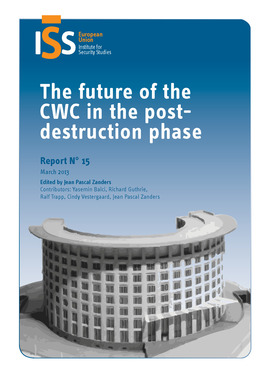
Future of the CWC in the post-destruction phase
Posted: March 27, 2013 Filed under: Chemical | Tags: Chemical warfare, chemical weapons, CWC, Disarmament, European Union, OPCW, Review conference, Science, Verification 3 CommentsThe future of the CWC in the post-destruction phase
Report – No15 – 27 March 2013
Yasemin Balci, Richard Guthrie, Ralf Trapp, Cindy Vestergaard, Jean Pascal Zanders
edited by Jean Pascal Zanders
From the Foreword by Ambassador Jacek Bylica, Principal Adviser and Special Envoy for Non-proliferation and Disarmament, European External Action Service:
The international community can be justifiably proud of the Chemical Weapons Convention. It has banned an entire category of weapons of mass destruction and provided for their verifiable elimination under international supervision. A small but effective intergovernmental organisation, the Organisation for the Prohibition of Chemical Weapons (OPCW), has been created for this purpose.
[…]
In the present international situation it is important to note that the Convention has created a de facto legal norm against the production, possession and usage of chemical weapons for military purposes. This prohibition goes beyond the letter of the Convention and stems from the reactions to the tragic experience of World War I and more recent cases of CW usage, including against non-combatants.
[…]
This volume features contributions derived from some of the presentations made by world-class experts at the workshop organised by the EU Institute for Security Studies in cooperation with the European External Action Service on 10 September 2012. The workshop offered an opportunity to reflect on some of the challenges facing the CWC over the next decade in preparation of the Third Review Conference at The Hague in April 2013. I am confident that this report presents an invaluable contribution to the debate on the future direction of our joint efforts which aim at the total and irreversible elimination of chemical weapons from the face of the Earth.
 Arms Control Law