
“Going to Tehran: Why the United States Must Come to Terms with the Islamic Republic of Iran”
Posted: February 15, 2013 Filed under: Nuclear 37 Comments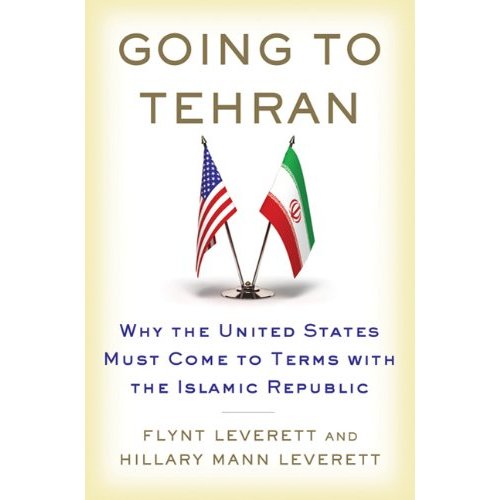
We’ve just finished the day-long symposium here at Penn State. The event was well organized, and the hosts have been extremely kind and gracious. I thought my panel went well, and I was very impressed with Ambassador Butler. He has a true wealth of diplomatic experience, and possesses what I think to be a very fundamentally correct understanding of the NPT. Penn State is very fortunate to have him here teaching in the School of International Affairs.
But the best thing about today, for me, was learning more about Flynt and Hillary Leverett’s new book “Going to Tehran: Why the United States Must Come to Terms with the Islamic Republic of Iran.” Reading their book and hearing both of their truly excellent presentations of their research and arguments in it, was a singular and profound thinking and learning experience for me. They are both first class scholars and intellectuals, and present their arguments in an extremely well organized, thought through, well researched and supported, and persuasive manner. Having read some of their book before I got to the conference, while I agreed on the essential thrust of the book already, there were a few points on which I was not at all sure that I agreed with them. But their discussions of their research and arguments today were persuasive, and I walk away from the conference with my mind changed on some things. That is a good day in academia. Being intellectually challenged, hearing rigorous and persuasive reasons supporting the challenge, and ultimately being persuaded to change your mind because you’ve learned something new.
I think it goes without saying, but I’ll say it anyway, that I HIGHLY recommend to readers Flynt and Hillary’s book. It seeks to correct so many incorrect assumptions that even professor-types have about Iran, and proposes a particular approach for diplomatic rapprochement with Iran that I think is absolutely the best way forward for the US and the world.
Symposium at Penn State University
Posted: February 14, 2013 Filed under: Nuclear 9 CommentsWe wrote our new book, Going to Tehran: Why the United States Must Come to Terms with the Islamic Republic of Iran, out of a conviction that how Washington deals with Iran over the next few years will largely determine America’s standing as a great power-in the Middle East and globally-for at least the next quarter century. More specifically, if the United States continues its counterproductive quest to dominate the Middle East by intensifying economic warfare, cyber warfare, and covert attacks against Iran and perhaps even launching another war to “disarm” yet another Middle Eastern state of weapons of mass destruction it does not have, the “blowback” against the U.S. position and U.S. interests will be disastrous. If, on the other hand, Washington abandons its delusionally self-damaging quest to dominate the Middle East-and accepting the Islamic Republic as a legitimate entity representing legitimate national interests and “coming to terms” with it is essential in that regard-the United States will be much better able to protect its real and legitimate interests, in the region and globally.
We also believe that the course of U.S.-Iranian relations over the next few years will have enormous implications for the rules-based legal frameworks and governance mechanisms that shape international order in the 21st century. So we are pleased that, using our book as a “launch point,” the Penn State Journal of Law and International Affairs will sponsor a day-long symposium, “The U.S.-Iranian Relationship and the Future of International Order,” on Friday, February 15 see here <http://law.psu.edu/news/us_iranian_relationship> , at Penn State’s main University Park campus in State College, PA.
Both of us will give keynotes-Flynt will open the proceedings by discussing “The Iranian Nuclear Issue, the End of the American Century, and the Future of International Order,” and Hillary will conclude by addressing “How Precipitous a Decline? U.S.-Iranian Relations and the Transition from American Primacy.” There will also be panels on “Iran and the Future of Nuclear Nonproliferation” and “The Iranian Case and Use of Force Doctrine as a Constraint on State Behavior” with outstanding participants, including David Andelman, Editor of the World Policy Journal; Ambassador Richard Butler, A.C.; Vice Admiral James Houck; and Professors Daniel Joyner, Tiyanjana Maluwa, and Mary Ellen O’Connell.
For anyone in or near Pennsylvania who would like to come in person, you would be most welcome. For everyone else, a live webcast <http://law.psu.edu/events/us_iranian_relationship/webcast_2_15> of the symposium will be available.
-Flynt Leverett and Hillary Mann Leverett,www.GoingToTehran.com
Stop! – Or We’ll Say Stop Again!
Posted: February 12, 2013 Filed under: Nuclear 16 CommentsSo by now we’ve all heard the news that North Korea has conducted a third underground nuclear explosive test, and according to early indications, this one is a significant improvement in terms of yield over the first two. I won’t get into all the speculation about the type of warhead (uranium or plutonium) or its size (whether improved in miniaturization or other features). I’m sure that will be the topic of discussion over at Arms Control Wonk.
To me, what comes to mind is how this is yet another illustration of how misplaced Western governments’ trust has been and continues to be in the power of economic sanctions, whether multilateral or unilateral, to address nuclear weapons proliferation concerns. It also brings home yet again how misguided the UN Security Council’s strategy has been in dealing with both North Korea and Iran.
The empirical facts about economic sanctions, and the unlikelihood of their success in changing target state behavior in the manner desired by those applying the sanctions, is fairly well documented in existing academic literature and studies. See here, here, and in a piece I wrote about Iran a while ago.
Make no mistake, international sanctions can certainly affect the target state and its economy, and make its citizens’ life a misery. This is certainly happening in both North Korea and Iran. But that’s not the same thing as actually affecting the target state’s behavior in the manner desired, particularly in the context of high politics and security issues like nonproliferation. This is just primal, schoolyard psychology people. If a bully on the school playground orders you not to do something – or else – and if you have any backbone at all, your immediate, natural reaction is to say screw you and do it anyway. Who are you to tell me not to do it? I’ll do it just to show you I can and that you can’t stop me. And its all wrapped up in pride and saving face, and all that just primal psychological stuff that we all know well from our days on the playground and that, at the end of the day, explains so much about international relations – much moreso in my opinion than grand-looking quantitative modeling done by our friends in political science departments (I did a PoliSci MA and was never convinced of the validity of most of the quantitative explanatory work done in the field of international relations theory. Maybe more on that another time).
Rouzbeh Parsi put it well at a conference I recently attended, when he said that international economic sanctions have far more to do with the sanctioners than with the sanctionee. They serve a cathartic purpose for the sanctioning states, so that they can say themselves and to their friends and constituents, that they are doing something about the commonly perceived problem. I honestly think that most high level foreign policy makers know deep down that the sanctions programs they keep outwardly relying on in cases like North Korea and Iran aren’t going to work. They just don’t have any other politically realistic options for expressing to their various intended audiences – mostly consisting of each other and of their domestic political constituencies – that they are trying to do something, and are not allowing the target to “get away” with its bad behavior.
The problem is, of course, that the target keeps getting away with its behavior, and actually seems to do more of the behavior the sanctioners don’t like, in order to show the sanctioners that the sanctions aren’t working. Remember the kid in the schoolyard? So what do the sanctioners do? The only thing they can do – you guessed it – apply more sanctions. And the cycle repeats itself.
I’ve always thought of the UN Security Council’s handling of these two cases – Iran and North Korea – using somewhat interwoven mental analogies to the games of chess and poker. In my opinion, the UNSC’s actions in these cases have shown a really unfortunate inability to look several moves ahead, as one must do in chess, in order to think through how their moves are likely to be countered by the opposing side, and then to what exactly they will do in response at each stage in order to bring their strategy to a successful conclusion (this assumes of course that they have a strategy to begin with). The decisions by the UNSC to command Iran to cease uranium enrichment, and to command North Korea not to conduct further nuclear tests, are prime illustrations of the UNSC overplaying the hand that it originally had (there’s the poker) – i.e. the power and influence that it could predictably exert over the target of their commands – and didn’t fully think through the sequence of moves by both sides that would likely flow from this play of their hand.
The result has been, essentially, that both Iran and North Korea have called the UNSC’s bluff, and now the UNSC is just standing there saying to each one of them “Stop! – or we’ll say stop again!” Unable to withdraw their commands or roll back their sanctions without losing face, the UNSC just looks more and more foolish, and more and more impotent, and their program of action more and more miscalculated, as both targets of their solemnly declared commands and sanctions continue to do exactly what they want to do, rubbing the UNSC’s nose in its inability to stop them. It didn’t have to be this way. If only the members of the UNSC had played more chess and poker.
Welcoming Dr. Jean-Pascal Zanders to Arms Control Law!
Posted: February 11, 2013 Filed under: Nuclear 1 CommentI’m extremely pleased to welcome Dr. Jean-Pascal Zanders as the newest permanent contributor to ACL! Jean-Pascal is a Senior Research Fellow at the European Union Institute for Security Studies, and is a well established expert on chemical and biological nonproliferation/disarmament regimes and related diplomacy. In addition to email communication, Jean-Pascal and I had a very stimulating conversation over dinner in Paris recently, and I know that he will bring a wealth of insight and expert analysis to the blog. So welcome, Jean-Pascal!
Here’s a couple of paragraphs from his bio at the EUISS webpage:
Jean Pascal, Senior Research Fellow, has been at the EUISS since June 2008. His research areas cover armament, disarmament and non-proliferation of chemical, biological, radiological and nuclear weapons, as well as space policy. He was Project Leader of the Chemical and Biological Warfare Project at the Stockholm International Peace Research Institute (SIPRI) from October 1996 until August 2003 and Director of the Geneva-based BioWeapons Prevention Project (BWPP) from April 2003 until May 2006. He holds Masters Degrees in Germanic Philology-Linguistics (1980) and Political Sciences (1992) and a PhD in Political Sciences (1996) from the Free University of Brussels.
He has published extensively on chemical and biological weapon issues in English, Dutch and French since 1986. His most recent publications with the EUISS are: (with Kathryn Nixdorff) Enforcing non-proliferation: the European Union and the 2006 BTWC Review Conference, Chaillot Paper no. 93 (November 2006), (editor) Nuclear weapons after the 2010 NPT Review Conference, Chaillot Paper no. 120 (April 2010), and A new farewell to arms: viewing disarmament in a new security environment, Policy Brief no. 6 (December 2010). He is currently researching the internal dynamics of a terrorist or criminal entity seeking to acquire a chemical or biological weapons capability, the meaning of disarmament in the current security context, and running a project on the longer-term future of the Chemical and Biological and Toxin Weapons Conventions. He also coordinates the pillar of ‘Core Issues’ (which includes, inter alia, CBRN disarmament and non-proliferation) in the European Strategy and Policy Analysis System, Pilot Study 2011, a 2010–2030 foresight exercise by the European Union.
ISIS Encourages the IAEA to Use Unauthenticated Evidence in its Reports on Iran
Posted: February 11, 2013 Filed under: Nuclear 5 CommentsFriend of ACL Professor Yousaf Butt, and Dr. Ferenc Dalnoki-Veress, both highly qualified physicists, have just published an insightful new analysis of information which appears to have formed part of the evidence on which the IAEA has relied in its continuing determination of Iran’s noncompliance with its safeguards agreement.
This is important stuff, as it goes directly to the heart of evidentiary provenance and reliability, the IAEA’s practices of evidence gathering and assessment, and thus to the reliability and credibility of IAEA reports and legal determinations regarding Iran and potentially other countries.
I highly recommend that you read this. It makes the issues clear even for non-technical types like me.
Israeli Strike in Syria
Posted: January 31, 2013 Filed under: Nuclear 34 CommentsI’m sitting at a cafe in the Marais district of Paris, waiting for my entrecôte to arrive, and just read about the Israeli airstrike in Syria, apparently targeting a shipment of missile parts which the Israelis expect were heading to Hezbollah for use against Israel.
Robert Kelley – Next Steps Forward for the IAEA and Iran
Posted: January 31, 2013 Filed under: Nuclear 8 CommentsI am honored, and feel truly privileged to welcome Robert Kelley as a guest contributor to ACL. Bob is a nuclear engineer and a veteran of over 35 years in the US DOE’s nuclear weapons complex, most recently at Los Alamos. He managed the centrifuge and plutonium metallurgy programs at Lawrence Livermore National Laboratory, and was seconded by the US DOE to the IAEA where he served twice as a Director in the nuclear inspections in Iraq, in 1992-1993 and 2002-2003. He is currently an Associate Senior Research Fellow at the Stockholm International Peace Research Institute.
___________________________________________________________________
Next Steps Forward for the IAEA and Iran
Robert Kelley
The IAEA and Iran’s government have developed a tense working relationship for which both bear blame. On several occasions, Iran has failed to declare nuclear fuel cycle-related activities in a timely way, as it is obliged to do under its agreement with the agency. At best this can be seen as bad faith in the relationship; at worst, deliberate withholding by Iran.
Beyond that, however, the IAEA is trying to expand its inspection program in Iran by demanding access to undeclared facilities. These requests are on shaky ground, partly because since Iran has not ratified the Additional Protocol they go well beyond the IAEA’s clear rights and authorities, and partly because they are based upon information that is flimsy and suspect.
By openly providing a questionable technical basis for inspections the IAEA is leaving itself open to a serious loss of credibility as a technical organization. While the IAEA seems to do a good job of accounting for nuclear materials around the world, its traditional area of expertise, there is no external oversight of this process. If there are problems with IAEA’s methods and performance they would likely only be revealed by complaints from a member state itself. Only the IAEA Board of Governors can adjudicate this.
Outside the area of materials accountancy, in the inspection of facilities deemed to be part of a suspect nuclear program, the IAEA has drifted far from its core competencies. In Syria, for example, the IAEA was successful in collecting uranium particles at a site that had been “sanitized.” But then the IAEA cavalierly dismissed Syrian explanations that the natural uranium particles found at a bombed suspect site came from Israeli missiles. The agency’s claims that the particles are not of the correct isotopic and chemical composition for missiles, displays an appalling lack of technical knowledge about military munitions based on information from questionable sources. If the IAEA is to be respected it must get proper technical advice. For example deep earth penetrating bombs, not missiles were used in Syria.
In the case of Parchin, the IAEA is relying upon secret information provided by unspecified states or parties. A great deal of the information has been selectively leaked to create an impression that the agency has significant reason to want to visit a particular building, among hundreds at the site. The IAEA bases its request upon a suspicion that that the building was used for experiments involving explosives and uranium to understand the hydrodynamic behavior of a neutron initiator for a nuclear explosive. Such experiments, if they occurred, would use a few grams of uranium in a huge chamber. They would probably be a violation of Iran’s nuclear safeguards undertakings. However the IAEA has failed to make a convincing case that these experiments took place. And it has added confusion by saying the most important experiments involving test explosions took place at an Iranian town called Marivan, 500 kilometers away.
Some of the experiments described by the IAEA do not and cannot use uranium. The results would be inconclusive if they did. So the basis for the IAEA’s requests continues to be opaque. The timeline for the alleged experiments is also highly suspect, with claims that massive experimental facilities had been fabricated even before they had been designed, according to the available information. The IAEA work to date, including the mischaracterization of satellite images of Parchin, is more consistent with an IAEA agenda to target Iran than of technical analysis.
Further clouding the picture is Iran’s massive redevelopment of the area around the buildings at Parchin the IAEA wants to visit, which were largely inactive for many years. This activity began with a sudden flurry after the IAEA first asked for a visit in 2012. Bulldozers and other vehicles appeared at the suspect site delivering or removing equipment, moving roads, bulldozing an area immediately east of the suspect building, and water was observed coming from one building. The sudden activity heightened suspicion that Iran was trying to hide something but it really doesn’t prove anything.
For one thing, water has been observed coming from this building and an adjacent one in past years. Moreover, sensitive environmental samples are not collected in buckets of dirt as the bulldozing suspicions might have made people think. The IAEA will not be taking soil samples around the Parchin buildings because it would be counterproductive — ordinary soil contains considerable particles of uranium which interferes with the very sensitive process of detecting nanoparticles of man-modified material. Inspectors will, instead, take very clean wipes from carefully chosen spots inside the buildings of interest. If Iran has done a massive amount of cleaning and painting inside the building to hide uranium, the IAEA will have to work harder to collect useful samples. But it can be done and traces of uranium are hard to conceal.
However, the IAEA’s continuing requests to visit a military site for tenuous reasons are an irritant to Iran and delaying a resumption of talks between the P5+1 and Iran. The IAEA should do some serious rethinking about the technical validity of its request. Based upon the evidence provided so far and the extensive leaks, there is little to suggest that Parchin is the place for IAEA to take a stand.
(A version of this article first appeared in the Nuclear Intelligence Weekly, Vol. VII, No. 3, January 18, 2013)
Thank You, Senator Lugar. And Welcome, Professor Lugar
Posted: January 28, 2013 Filed under: Biological, Chemical, Missile, Nuclear 1 CommentWhen I was an undergraduate student years ago, I had the opportunity to have lunch with a U.S. senator from Indiana named Richard Lugar–someone about whom, I now cringe to admit, I did not know much at the time. The Cold War was still frigid, but the world was not far from momentous changes few saw coming. I remember clearly my reaction to Senator Lugar–here is someone who thinks deeply about U.S. interests and cares about American responsibilities beyond our shores.
In his long career in public service, Senator Lugar exhibited those traits in many contexts, but perhaps most famously in his work to prevent the proliferation of weapons of mass destruction (WMD). In the very early 1990s, with his colleague Sam Nunn, Senator Lugar created the Cooperative Threat Reduction Program (CTRP), widely known as the Nunn-Lugar program, which is hailed as one of the most significant U.S. national security policies of the post-Cold War period. The program was effective in not only achieving its initial objective of helping states emerging from the Soviet Union’s collapse keep nuclear weapons and related materials and capabilities from falling into dangerous hands but also expanding into chemical and biological weapons and beyond the former Soviet states. In December 2012, the U.S. government and the non-proliferation community celebrated the 20th anniversary of the CTRP.
This milestone asks us not only to reflect on the past but also to probe the future. Senators Nunn and Lugar know better than anyone that the CTRP has not made WMD proliferation a relic of another time and place. Indeed, the CTRP’s expansion beyond nuclear issues illustrates both the dangerous legacy of chemical weapon arsenals and the difficult task of managing “dual use” knowledge and capabilities in the biological realm. Further, the CTRP approach is predicated on mutual political commitment to cooperation, a prerequisite not present in important contexts of proliferation concern, such as Pakistan, Syria, North Korea, and Iran. Worries have arisen with Russia too given its declaration in the fall of 2012 that it would not renew its CTRP agreement with the United States in 2013 without changes to the arrangement–a disconcerting development given the scale and seriousness of the remaining WMD threat reduction agenda in Russia.
Problems with Russia and the inhospitable political conditions for cooperative threat reduction in other contexts of proliferation concern do not spell the “end of Nunn-Lugar.” However, we are entering a potentially challenging phase for this strategy that requires thinking hard about U.S. interests and caring about American responsibilities. Cooperative WMD threat reduction might become increasingly complicated for external and domestic reasons.
Externally, maintaining progress with CTRP efforts faces shifting national interests, characterized foremost by Russia’s re-evaluation of its arrangement with the United States. The risk of such shifts is not the sudden embrace of WMD proliferation; rather it is the danger of slackening focus on the urgency of threat reduction. In addition, cooperative threat reduction strategies might well find future crises that involve proliferation concerns extremely hard to affect. Just think of the proliferation fears that experts have about the collapse of the Assad regime in Syria, the implosion of the North Korean regime, or the potential cascade effect of Iranian development of nuclear weapons.
Domestically, commemorating two-decades of CTRP success should not underestimate looming political problems. Richard Lugar is no longer in the Senate, which raises questions about who will assume the burden of leadership he bore effectively on this issue for so many years. And leadership will be needed because the United States is facing wrenching choices at home and abroad as the moment of reckoning with its worsening fiscal crisis is upon the nation’s political institutions. Senator Lugar’s defeat in a primary election demonstrates the lack of traction his statesmanship on WMD proliferation had with voters–a cautionary tale for any politician operating in an extremely polarized country fixated on domestic issues and living well beyond its fiscal means.
In January 2013, my employer, Indiana University, named Richard Lugar a Distinguished Scholar and Professor of Practice in its new School of Global and International Studies. Professor Lugar (how strange that sounds) is donating his senatorial papers to Indiana University, a gift that will provide a treasure trove of resources for research on many issues, but especially his dedication to reducing the dangers of WMD proliferation. We still have much to learn . . .
Why Can We Only Break International Law in order to Torture and Kill People and not in order to Help Them?
Posted: January 28, 2013 Filed under: Nuclear 11 CommentsI was just coming home from driving my daughter to school, when I heard a story on NPR about how the US has been encouraging the opposition coalition in Syria politically, and in particular encouraging moderates to become involved, but that now the US is failing to make good on promises it has made to provide actual material support to the opposition, and through it to the suffering Syrian people, and in so doing is undermining those very moderate elements. The reason for this failure to follow through on promises? Well, John Bellinger came on the radio to say that international law forbids the US from becoming involved in the internal affairs of another country, and that because the US still recognizes the Assad regime as the legal government of Syria, international law forbids giving material aid – even simply humanitarian aid – to the Syrian people through the opposition.
I’m less interested in whether Bellinger’s assessment of law is correct as I am with what seems to me to be quite a sickly ironic fact of US foreign policy. We only break international law when we think we have to kill people or torture them for national security purposes. Then the cause is important enough that international law doesn’t matter. Iraq, Guantanamo, Bagram, assassinations in Iran, drones in Pakistan – the list could go on. But when we are faced with humanitarian crises when our support could help thousands to live and NOT die – Rwanda, Darfur, Syria, etc. – we stay our hand, because of conservative interpretations of the niceties of international law. Now how sickly ironic is that, particularly in light of the human rights and humanitarian principles central to so much of modern international law?
If we accept that sometimes we will have to break international law in the course of practical international relations, I would be much happier about doing so in a case like supporting the Syrian opposition and Syrian people, than I am about doing so in order to disproportionately kill civilians in our ridiculously ill-conceived wars in Iraq and Afghanistan.
The Wrong Country in the Crosshairs
Posted: January 24, 2013 Filed under: Nuclear 12 CommentsForget about Iran, here’s who we should really be worried about. A country that openly possesses nuclear weapons, has sold nuclear technologies and information to pretty much anyone willing to buy, and is the world’s worst proliferator of missiles. And they are certifiably crazy – paranoid delusional, with yet another generation of the worst kind of corrupt and absolute dictator with his boot on the throat of his people. North Korea is a clear, avowed threat to its neighbors, South Korea and Japan. And it seems that North Korea is, even if slowly, steadily progressing its missile and nuclear weapons programs to eventually reach the capability to put a miniaturized nuclear warhead on the nose of a ballistic missile and shoot it wherever their nutty heads think it should go. Including at their avowed arch enemy, the US.
North Korea scares me a whole lot more than Iran does, in terms of the actual threat they pose both to their neighbors and to me. I have pretty much zero faith in the rationality of their decisionmaking, and I genuinely don’t know what they’re likely to do if/when they eventually achieve this ultimate capability.
I know well the military/security challenges posed by the proximity of Seoul to the border. And of course as a legal matter, since North Korea withdrew from the NPT and its IAEA CSA, there is effectively no substantive international law restraining it from any of these actions (short of actually using a nuclear weapon). Only a raft of U.N. Security Council resolutions. I would say, though, that all of the energy the US is expending on addressing Iran’s nuclear program, and Israel’s concerns about it, should be immediately switched over to deal with an actual threat to international peace and security – North Korea.
 Arms Control Law