Gradually making sense of Syria’s CW declarations
Posted: August 11, 2014 Filed under: Chemical | Tags: chemical weapons, CWC, Disarmament, Mustard agent, OPCW, Ricin, Sarin, Syria, Verification 1 CommentSince my last update on the elimination of Syria’s chemical weapon (CW) capacities in May, all precursor chemicals have finally left the country. Some have been shipped to facilities in Finland and the USA, where they are in the process of being destroyed. The United Kingdom meanwhile completed the destruction of 190 tonnes of chemicals at an incinerator in Ellesmere Port.
As of 7 August, 74.2% of Syria’s entire stockpile of chemical warfare agent precursors have been destroyed. Other chemicals are meanwhile being neutralised on board of the US vessel Cape Ray in the Mediterranean, and the resulting reaction mass will eventually be commercially incinerated too.
The Organisation for the Prohibition of Chemical Weapons (OPCW) is gradually slipping off the radar screen of international media. The huge pressure of safely evacuating the precursor chemicals from the war-torn country now removed, the organisation can slowly return to its more familiar role in the background of international politics: monitoring compliance with the Chemical Weapons Convention (CWC) and resolving any outstanding issues. Syria will increasingly become more integrated as a ‘normal’ member of the OPCW. This, however, does not mean that the OPCW will relax its efforts to achieve full accounting of its chemical warfare programmes, clarification of allegations of CW use, or complete destruction of all relevant declared facilities. Syria’s recurring amendments to its initial declaration of 23 October 2013 demonstrate the grinding, but nonetheless steady progress the OPCW is making.
Two new elements (at least to outsiders) have surfaced over the past couple of weeks: Syria’s presentation of a destruction plan for abandoned chemical weapons (ACW) and the declaration of a CW production facility dedicated to ricin manufacture.
Re-hexamination of Syria’s sarin
The UN Secretary-General’s latest monthly progress report on the elimination of Syria’s chemical warfare capabilities refers to Syria’s submission on 14 July of a destruction plan for two sarin-filled munitions. Syria denies ownership of these CW and has therefore declared them as ACW.
The two munitions were recovered after the CW attack at Jobar, an eastern suburb of Damascus, on 24 August 2013 (i.e., three days after the Ghouta chemical attacks). Four days later, Syria notified the UN Secretary General of the use of an improvised explosive device (IED) releasing a foul and strange odour. The UN team investigating alleged CW use visited the site on 29 September. It was unable to examine the place of impact or recover munition fragments, because mine clearing operations had completely corrupted the surroundings. Syrian officials handed over IED fragments and contaminated soil samples, which they claimed came from the incident site. For obvious reasons, the UN team could not certify their chain of custody.
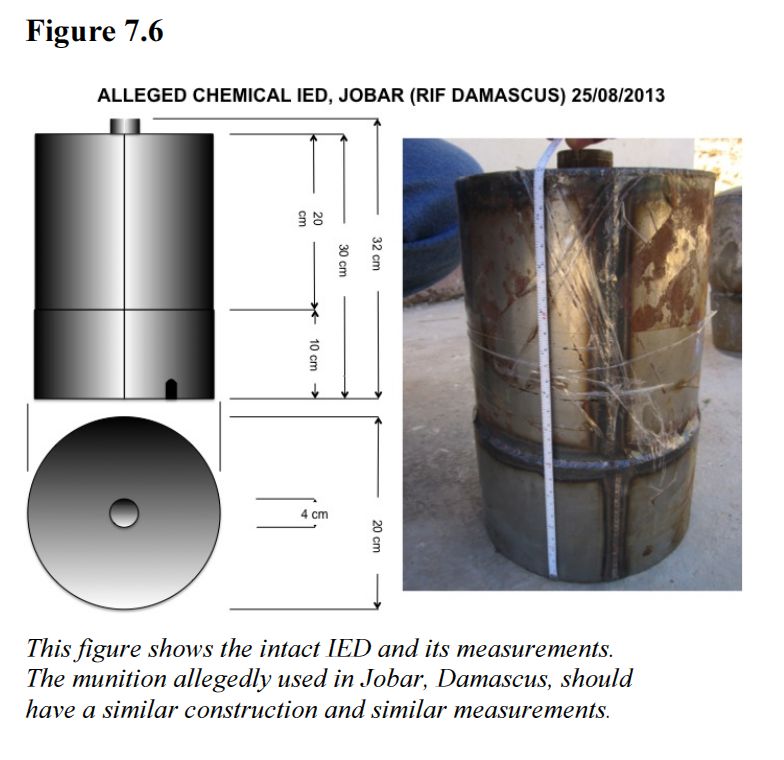
According to the Final Report by the UN Mission (p. 65), the investigative team ‘was also presented with two metal canisters discovered by Government soldiers during the offensive operations in Jobar on 25 August 2013 in the immediate aftermath of the incident and in close vicinity of the site of the alleged incident’. These were said to be identical to ones used in the chemical incident the day before. Made of steel sheeting of 1mm thickness, the plates were bent and welded together manually at a sub-industrial standard. The canisters nevertheless revealed a high degree of expertise with the electric welding process. The UN investigators were also able to establish that ‘a detonator and a coiling of the detonating cord, acting as a booster, composed the fire train, electrically initiated’. They had an internal fill capacity of up to approximately 4 litres (see figure below). The two metal canisters are the ACW Syria declared to the OPCW. (This description corrects the suggestion in my posting of 26 May that the two ACW were Volcano rockets. The claim that Syria did not declare any Volcano rockets as CW still stands, however.)
Analysis of their contents by the OPCW confirmed sarin as their payload. Moreover, the filling displayed all the characteristics of sarin as produced by the Syrian government, the principal telltale sign being the presence of hexamine (hexamethylenetetramine). Since its presence in samples was first reported by the UN investigative team last September in relation to the Ghouta attack and the OPCW later released that Syria had declared 80 metric tonnes of the chemical in connection with sarin production, there has been furious speculation as to its exact role. In a recent analysis focussing explicitly on the role of hexamine, UK-based CW expert Daniel Kaszeta argued that the Syrians used the compound as an acid scavenger in the final reaction of their rather unique sarin production process. Reacting DF (methylphosphonyl difluoride) with isopropanol yields sarin and hydrofluoric acid, the latter being a toxic and extremely corrosive gas that would have quickly damaged the production and agent filling installations. Hexamine binds this acid, and does so more efficiently than other amino compounds.
However, recent discussions with officials from some Western states indicate two other roles of hexamine, namely as catalyst and stabiliser. The catalyst function is probably closely tied to the acid scrubber role. In an e-mail exchange today, Ralf Trapp, a chemist and consultant to the OPCW, confirmed that hexamine increases the yield of the chemical reaction by pulling the equilibrium between the precursors and reaction product (sarin) in favour of the latter. As a result, the sarin concentration receives a significant boost, possibly up to 60%. This degree of purity is considerably higher than the yields achieved by Iraq in the 1980s.
As a stabiliser, hexamine probably allowed the Syrians to store freshly produced sarin for days, if not several weeks. This understanding is more compatible with views before the civil war that Syria’s CW served strategic deterrence. Munitions declared to the OPCW last autumn also seem to validate those views. Initiating the final reaction shortly before use, as was the case in Iraq, would have undermined this doctrinal role. The insight also raises fresh questions about the curious White House claim last August that the United States had observed Syrian preparations for three days prior to the Ghouta attacks.
Strictly speaking, the chemical analysis of the sarin in the two ACW confirms beyond any doubt that the nerve agent was produced by means of the same process as the one used by the Syrian government. The distinctive signature, however, cannot exclude the possibility that insurgents might have captured some CW. Western officials tend not to give much credence to this hypothesis.
Castor beans: cancer research, castor oil, or ricin?
The latest monthly progress report also reveals that on 14 July Syria submitted yet another amendment to its initial declaration. The document lists a dedicated ricin production plant. As a weapon the toxin is banned under both the Biological and Toxin Weapons Convention (BTWC) and the CWC. The CWC requires the verified destruction of CW production facilities, but the amendment claims that it is located in an area not under government control. It also states that the entire quantity of ricin produced was eliminated prior to the entry into force of the CWC for Syria. If correct, then Syria need not declare its past toxin weapon holding. CW disarmament in Syria, however, is hardly a normal operation. As with its claimed destruction of 200 tonnes of mustard agent early in 2013, the OPCW must investigate those statements to ascertain that the country is not hiding any residual CW.
This progress report was the first to publicly mention ricin production. Last April concerns about the toxin had already filtered out of the United Nations, but they have thus far remained a relatively low-level matter at the OPCW. This was in part a consequence of the high-priority preoccupation with getting the precursor chemicals out of Syria, and in part because nothing seems to indicate that the country presently has ricin weapons. Questions remain nonetheless.
Syria apparently cultivated castor oil plants (Ricinus communis) on several tracts the size of football fields. In itself, this is no so unusual as the oil makes for an excellent lubricant for heavy engines, such as those in military lorries. However, Syria’s initial explanation referred to cancer research and treatment, which was wholly implausible in view of the minute quantities of ricin required for research. Castor oil also lacks any medicinal value to cure cancer. It was used to deliver some chemotherapy drugs to tumours, but occasional side effects, such as allergic reactions, have led to the adoption of alternatives. Starting in the 1980s, Texas Tech University and Texas Tech University Health Sciences Center conducted long-term research on the oncological application of genetically modified ricin to kill diseased cells. According to a press release of October 1998, ‘just two acres of land, given the right castor seed, could produce enough ricin to meet the world’s pharmaceutical supply need for cancer treatment’. Ricin is also being investigated in relation to neurological degenerative disorders and in the treatment of intractable painful neuropathies. It is rather hard to think of Syria as a global supplier of medicinal ricin many times over.
This leaves the question of ricin as a weapon. Ricin is an instrument of choice for assassinations, as befell Bulgarian dissident writer Georgi Markov in London in 1978. More recently clumsy attempts to send ricin-filled letters to hated persons, including President Barack Obama, have also put the spotlight on the agent. Since the First World War many states considered ricin as a possible tool of warfare, but they have never incorporated it as a standard agent into their chemical and biological warfare arsenals. Despite the military attractiveness of its toxicity, the toxin poses several serious problems in relation to large-scale production, longer-term storage (unless turned into a solid), and dissemination techniques. While none of these problems are insurmountable, the net effect is that the agent is more cumbersome to weaponise or less effective on the battlefield than alternatives.
Right now the reason behind Syria’s declaration of a CW production facility exclusively dedicated to ricin manufacture remains murky. On the one hand, in view of the many publicly available accounts describing the many difficulties of producing and especially storing the toxin in free state for longer periods of time, it almost seems implausible that Syria would have embarked on a major ricin weapon programme. Interestingly, several Western officials I recently spoke to tend to discount public Israeli reports on Syria’s ricin programme. The annual US State Department report on arms control treaty compliance for 2014 dropped the reference to ricin-based biological weapons in the BTWC section and does not mention the toxin in the separate CWC compliance report. The 2013 treaty compliance document still stated: ‘In 2004, Israel’s Intelligence and Terrorism Information Center said in a report on Syria that the Scientific Studies and Research Center had been developing ricin-based biological weapons’.
On the other hand, if the Syrian factory was indeed dedicated to the production of oil or lubricants, the possibility exists that it used a cold hydraulic pressing technique, in which case 1–5% by weight of ricin might remain in the resulting mash. A fact sheet on ricin by the OPCW Science Advisory Board (SAB) released in February 2014 notes that castor oil production plants are not subject to Schedule 1 inspections under Article VI of the CWC. The SAB therefore recommended that the Director-General encourage National Authorities in producing countries to promote hot pressing and other techniques that ensure inactivation of residual ricin in the waste mash. In other words, the Syrian amendment might reflect a compromise with the OPCW to remove any ambiguity about the purpose of the ricin resulting from a particular production process in view of the need for absolute certainty that all aspects of the country’s CW programme have been eliminated. A future oil-extraction plant using a process that inactivates residual ricin could then be constructed without the need for long-term verification modalities for that installation.
A possible explanation for the ricin factory declaration for sure, but more details are required to confirm the scenario. To be continued.
And the destruction of mustard agent?
As I reported in May, OPCW inspectors were looking into Syria’s claim earlier this year that it had destroyed some 200 tonnes of mustard agent in the spring of 2013. They are still trying to obtain further documentation substantiating these destruction operations. Onsite inspections of the disposal sites are still pending before this particular file can be closed.
[Cross-posted from The Trench.]
NPT Article VI and BTWC Article IX
Posted: May 28, 2014 Filed under: Biological, Chemical, Nuclear | Tags: BTWC, CWC, Disarmament, NPT 1 CommentThis discussion between Marco and Dan on Article VI of the NPT and customary law is instructive.
In this particular case, Marco’s application of the notion to a single article rather than the totality of the treaty puzzles me. I would tend to agree with Dan’s counterpoint. However, Dan then refers to the CWC in its entirety to draw an analogy. In my mind a bit problematic for two reasons:
1. The CWC is a disarmament, rather than a non-proliferation treaty. It means that the weapon category in its entirety is banned and no exeception exists for any state, whether big or small; whether powerful or weak. However, more to the present discussion, as a consequence of the CWC being a disarmament treaty (i.e., going to zero and remaining at zero in the future), the convention is final. It does not have aspirational articles with regard to ambitions not covered by its own text.
2. Article VI of the NPT resembles more of Article IX of the BTWC:
Each State Party to this Convention affirms the recognized objective of effective prohibition of chemical weapons and, to this end, undertakes to continue negotiations in good faith with a view to reaching early agreement on effective measures for the prohibition of their development, production and stockpiling and for their destruction, and on appropriate measures concerning equipment and means of delivery specifically designed for the production or use of chemical agents for weapons purposes.
I find it difficult to see how this article could have turned the BTWC into a CW disarmament treaty (as proponents of nuclear disarmament often tend to do with regard to Article VI of the NPT) or how it could reflect on customary law regarding CW, even if considering that most people view the 1925 Geneva Protocol banning the use of chemical and biological weapons as having entered into customary law.
Just like the CWC, the BTWC is also a disarmament treaty and has similiar finality with regard to biological and toxin weapons. Nevertheless, I would argue that the BTWC today, despite having fewer parties than the CWC, fits more firmly into customary law: no state actually claims having BW or maintaining an offensive BW programme. (For example, in an interview in Der Spiegel on 19 January 2009, Bashar al-Assad more than implicitly admitted to CW, but flatly denied BW.) This has important implications from an armament/disarmament perspective: there is no space whatsoever for testing weapons in the field, training troops or developing military doctrines for their use on both the strategic and tactical levels. Even for states not party to the BTWC. Such types of preparations can be and would be detected.
But back to BTWC, Article IX: between 1975 (EIF for the BTWC) and 1993 (Opening for signature of the CWC) we witnessed an accelerated CW armament competition between the US and the USSR (including the startup of the US binary production programme), the start of Iraq’s CW programme culminating in gas being used in the 1980-88 Gulf War; Libya’s CW programme, Syria’s, …
So, as far as the analogy with Dan’s argument goes (I am discussing 2 different weapon categories mentioned in a single treaty): each party to the BTWC, whether a possessor or non-possessor of CW was bound to negotiate the CWC, but it did not prevent several among them to develop, produce, or even use CW during the intervening period.
Syria: Disarmament in animated suspense
Posted: May 26, 2014 Filed under: Chemical | Tags: chemical weapons, CWC, Disarmament, OPCW, Syria, Verification 2 CommentsSyria has now missed about every single deadline since it was unable to move the Priority 1 chemicals out of the country by the end of last year. These even include renegotiated time frames and the self-imposed final date of 27 April. One more fixed date is pending: 30 June, by which time all precursor chemicals should have been neutralised.
It would now seem that the world will sigh with relief if everything is aboard the Danish and Norwegian freighters by the end of next month. US officials envisage 60 working days to neutralise the volume of precursor chemicals and hydrolyse the mustard agent on board the US ship Cape Ray. The end of this mission could be pushed back even further if factors such as bad weather or sea states exceeding safety standards interrupt activities. In addition, the original schedule foresaw incineration of the reaction mass by the end of 2014. However, one of the companies selected by the Organisation for the Prohibition of Chemical Weapons (OPCW), Finland’s Ekokem, requires at least nine months. This potentially pushes completion of the disarmament tasks agreed in the US-Russian framework agreement of September last year into the second quarter of 2015. Consequently, the disarmament mandate established by UN Security Council resolution 2118 (2013) can be expected to remain in place at least as long.
Similar delays affect the final destruction of former CW production facilities (CWPF). Different interpretations about the perimeter of several CWPFs block consensus decision-making on the formal destruction plan in the Executive Council of the OPCW, and hence progress in the field.
Finally, concerns have emerged whether Syria has declared its entire CW stockpile. In particular, the country has claimed destruction of 200 metric tonnes of mustard gas in March 2013, but initially failed to declare this to the OPCW.
Remaining precursor chemicals
Syrian authorities have consistently claimed that heavy fighting at key sites and high security risks along the transportation routes make it all but impossible to transfer the precursor chemicals to the port of Latakia within the set deadlines. The Joint OPCW-UN Mission has tended to confirm these security assessments. It has also reported shelling into Latakia in March and intensive combat operations around the final storage site.
According to the 7th monthly report submitted to the UN Security Council on 25 April, 96.45% of declared Priority 1 chemicals and 81.09% of declared Priority 2 chemicals had been moved onto the Danish vessel Ark Futura and the Norwegian freighter Taico respectively. Combined they amounted to 92.03%. The remaining 8%—about 100 metric tonnes of precursors—consisted of
- Priority 1 chemicals:
- B salt (N (2-chloroethyl)-N-ethyl propan 2 amine salt)
- DF (methylphosphonyl difluoride)
- Isopropanol
- Priority 2 chemicals
- Butan-1-ol (alcohol)
- HCl (hydrogen chloride)
- HF (hydrogen fluoride)
- Hexamine
On 20 May, the OPCW–UN Joint Mission confirmed the destruction of all isopropanol. (It should be noted that ‘B salt’ did not figure in the initial list of precursors and was included in one of the revised declarations by Syria. It is possible that a declaration error was made concerning ‘BB salt’.)
The 7.2% of chemicals that must still be shipped out remain trapped at Al Sin. Very little is known about the military site, except for its identification as a CW production facility in the 3rd monthly report of last December (Annex, paragraph 15). ‘Al Sin’ features in a few combat reports by insurgent factions published to the internet on 20 March, and are described as depots or an airport. Some press accounts suggest that the chemicals are at an airbase.
Battalion 559 of the Syrian armed forces holds a storage base that fits the descriptions. It is located about 63km to the northeast of Damascus along a major road travelling from the Adra suburban area in the general direction of Palmyra (Tadmur). About 14km to the south of Al Sin lies the Sayqal Military Airbase, which also houses several ammunition storage installations.
Al Sin has two major access routes (presumable the aforementioned main road going either northeast or southwest) and a secondary road travelling through the mountains. At present, the main access routes are unusable because they are controlled by insurgents or within easy targeting range of their heavier weaponry. The secondary road is impractical, considering that the DF has been transferred into large 2000-litre reinforced containers and the highly dangerous and volatile HF is contained under pressure in industry-standard cylinders. Transport in a large, escorted convoy along a mountainous track not only runs a high risk of accidents, the surroundings also offer many opportunities for ambushes. The Syrian army is currently mounting major military operations to clear (one of) the two principal routes out of Al Sin. Once achieved, the evacuation of the final precursors to Latakia is expected to be completed shortly afterwards.
Destruction of CW production facilities at an impasse
Political blockage over the destruction of Syria’s twelve CWPFs prevents progress on an important dimension of the elimination of the country’s chemical warfare capacity. The Chemical Weapons Convention (CWC) refers to CWPFs in many articles and sections of the Verification Annex. Article II, 8 defines it in terms of equipment for producing or filling certain types of chemicals and buildings that house such equipment. They must be irreversibly destroyed under a detailed destruction plan, although some buildings can be converted under strict conditions to purposes not prohibited by the convention. Despite Syria’s request, the Executive Council of the OPCW has refused to authorise conversion of some facilities.
In contrast, CW storage facilities (CWSF) are discussed only in the Verification Annex, Part IV(A) in relation to the presence of CW, their verification and destruction. A party to the CWC must declare a CWSP’s name, exact coordinates and a detailed site diagram, including a boundary map and the location of bunkers/storage areas within the facility. It must also provide a detailed inventory of the CW they contain. No treaty provision, however, demands the destruction of CWSFs.
Syria has apparently five underground structures, tunnels shaped in the form of a staple. They comprise three major sections. Each of the two extremities offers entrance to the complex. However, only one of the arms is the actual CWPF; the two other sections Syria has declared as storage sites. Following extensive discussions with OPCW technical staff and onsite visits at the end of March, a CWPF destruction plan was proposed to the Executive Council, which it rejected. The United States and other members of the Western Europe and Other States Group represented on the Executive Council argued that the storage areas form an integral part of the production site, and that therefore Syria’s circumscription of the CWPFs is incomplete. In addition, the argument has been put forward that via a network of tunnels they link up to other parts of a larger military complex.
It is difficult to see how the impasse can be overcome soon. The Executive Council habitually decides by consensus. If the United States and its partners press for a vote, they are by no means certain of gaining a majority. Even if they do, there may be ramifications in other areas of treaty implementation further down the road. Syria, for its part, has adopted a very assertive posture since becoming an OPCW member last October and is unlikely to budge on anything that does not represent a formal, unambiguous obligation under the CWC or without pressure from Russia. The current frosty relations between Moscow and Washington are not helpful either.
Did Syria declare all?
Over the past month or two several questions have arisen as to whether Syria declared its full chemical warfare capacity. They are in part due to the recent attacks with barrel bombs allegedly containing chlorine canisters, and in part to the amendments to its formal declarations to the OPCW. The latter are the result of normal verification routines by OPCW staff, which it undertakes for all parties to the OPCW. Analysis of declarations and onsite inspections often lead to the discovery of inconsistencies, contradictions or even missing information, which yield lists of questions and issues that the state party must resolve. Syria is no exception, and a significant new amendment to earlier declarations is expected in the near future. Although it will not contain new types of chemicals, there will be variations in the volumes of declared precursors without much changing the overall total of 1,300 metric tonnes. In contrast, it will include a thus far undeclared CW research centre near Damascus. (Readers of this blog will recall that the Executive Council and UN Security Council decisions of 27 September compel Syria to declare research facilities, even though this is not required by the CWC.)
A initial team of 8 OPCW inspectors left for Syria on 2 May and they were joined by an additional 5 personnel on 12 May to investigate the chlorine attack allegations. They can have access to the one site where the government has claimed that the rebels used a chlorine weapon, but until now have been refused entry into the rebel areas. Negotiations with insurgents to enable the safe transit of the precursor chemicals to the port of Latakia or for OPCW-UN Joint Mission staff to have access to sites in rebel-controlled territory are conducted through the office of Lakhdar Brahimi, the Joint Special Envoy of the United Nations and League of Arab States for Syria. While the office continues to function, Brahimi’s resignation on 13 May, effective at the end of the month, implies the loss of a lot of political clout with the insurgents. It’s impact on the disarmament process is unclear for the time being, but the convoys transporting the precursor chemicals and the OPCW–UN Joint Mission may face growing security and safety challenges if the current lack of progress continues for any significant length of time. Future investigations of alleged used of CW may also be compromised.
Another element that tends to contribute to the unease about Syria’s truthfulness is the fact that until today the government has not declared owning any of the Volcano rockets believed to have delivered sarin nerve agent against the Ghouta district last August. It did report two such missiles, but stated that it had found them and that it was not their possessor. Many countries and observers blame the Syrian military for the Ghouta attacks and other chemical strikes.
Finally, the questions if Syria has declared all its ‘weaponised’ warfare agents revolve around whether it has irreversibly disposed of about 200 metric tonnes of mustard gas. Syrian officials claim that the stock was destroyed at three sites in March 2013, around the time of the chemical attacks in Khan al-Assal near Aleppo and several months before the Ghouta sarin strikes. (No allegation of a mustard attack has so far been recorded.) Interestingly enough, Syria apparently mentioned these destruction activities before or during the US-Russian bilateral negotiations in Geneva last September, but the issue has only been picked up more recently. The Syrian government has now supplied the OPCW with details of these operations, which still require confirmation. OPCW inspectors plan to verify the claim and the veracity of its particulars by means of interviews, record analysis and on-site sampling. UNSCOM inspectors in Iraq during the 1990s occasionally had to resort to similar methodologies to determine whether the claimed volume of agent destroyed without international supervision corresponded to reality. Syria formally declared 20.25 metric tonnes of mustard agent (an amount relatively small compared to the overall volume of declared nerve agent precursors), which will be hydrolysed on board the Cape Ray. Inevitably, the episode has raised concerns among some OPCW members about possible undeclared ‘weaponised’ nerve agents.
More to follow over the next weeks, I am sure.
Postscript: Two hours after posting this contribution, the OPCW published an updated report on the status of CW disarmament in Syria.
[Cross-posted from The Trench.]
After 99 years, back to chlorine
Posted: April 22, 2014 Filed under: Chemical, War | Tags: Chemical warfare, Chlorine, CWC, OPCW, Syria, World War 1 Leave a commentToday is the 99th anniversary of the first massive chemical warfare attack. The agent of choice was chlorine. About 150 tonnes of the chemical was released simultaneously from around 6,000 cylinders over a length of 7 kilometres just north of Ypres. Lutz Haber—son of the German chemical warfare pioneer, Fritz Haber—described the opening scenes in his book The Poisonous Cloud (Clarendon Press, 1986):
The cloud advanced slowly, moving at about 0.5 m/sec (just over 1 mph). It was white at first, owing to the condensation of the moisture in the surrounding air and, as the volume increased, it turned yellow-green. The chlorine rose quickly to a height of 10–30 m because of the ground temperature, and while diffusion weakened the effectiveness by thinning out the gas it enhanced the physical and psychological shock. Within minutes the Franco-Algerian soldiers in the front and support lines were engulfed and choking. Those who were not suffocating from spasms broke and ran, but the gas followed. The front collapsed.
The impact of this gas attack surprised the German Imperial troops too. Their cautious advance behind the chlorine cloud, their hesitation in the confusion about what was happening despite having secured their initial objectives within an hour, and their halt after darkness fell meant that they almost immediately lost the strategic surprise. They would never regain it.
A first generation warfare agent in worldwide industrial application
How ironic it is that today, almost a century later, the latest chemical warfare allegations in the Syrian civil war concern chlorine once again. Everybody knows about the dangers of the chemical element, but nobody really considers it any longer as a militarily useful agent. At least not in standard warfare scenarios.
Chlorine and derived products are in massive industrial production. According to the World Chlorine Council, there are more than 500 chlor-alkali producers at over 650 sites around the globe, with a total annual production capacity of over 55 million tonnes of chlorine. Based on the low threat assessment and its wide relevancy to the chemical industry and trade, the Chemical Weapons Convention (CWC) does not even list it in Schedule 3 of toxic chemicals (Phosgene, another widely used chemical and World War 1 agent, is).
An oversight by the CWC negotiators? Hardly. Books on the toxicology and treatment of chemical warfare agents published between 1992—year of successful conclusion of the negotiations—and 1997—year of entry into force of the CWC—hardly mention chlorine. Chemical Warfare Agents, edited by Satu Somani (Academic Press, 1992), presents a few scattered references, mostly in relation to other agents or public health. Another book featuring the same title, written by Timothy Marrs, Robert Maynard and Frederick Sidell (Wiley, 1996), gives it a four-line acknowledgment in the opening historical section. And the monumental Medical Aspects of Chemical and Biological Warfare, edited by Frederick Sidell, Ernest Takafuji and David Franz (Office of the Surgeon General, US Army, 1997), accords it about two pages out of 721 in a subsection entitled ‘Historical War Gases’.
Today, chlorine is mostly viewed as a public health or environmental hazard resulting from occupational exposures, industrial accidents or the malfunctioning of pool chlorination systems.
Back to World War 1
It goes without saying that during and after World War 1 perceptions of chlorine as a combat agent were quite different. Despite having been replaced by much more potent toxic chemicals, belligerents released chlorine gas until the final month of the war. Considering that the first contingents of the American Expeditionary Forces arrived in Europe in June 1917, but saw their first major military engagements in May/June 1918, the US War Department registered and examined 838 ex-service men who had been gassed with chorine (and survived their experience). A closer medical examination of 98 victims to assess the long-term effects of exposure suggests that all US chlorine casualties were affected between July and October 1918. It is interesting to note that Maj. Gen. Harry Gilchrist, Chief of the Chemical Warfare Service, and Philip Matz, Chief of the Medical Research Subdivision of the Veterans’ Administration, devoted half of their medical study, The Residual Effects of Warfare Gases (War Department and US Government Printing Office, 1933), to chlorine, mustard being the other agent of their investigation.
Their description of chlorine remains interesting, because it departs from its utility as a warfare agent, rather than as a public health hazard. The element is almost 2.5 times heavier than air, which means that it will cling to the surface and sink into depressions. At 15° C liquefaction requires 4-5 atmospheres pressure. Upon release at 25° C, one litre of liquid chlorine will yield 434 litres of chlorine gas. Moisture stimulates the element’s chemical action, so the liquid gas must be thoroughly dehydrated for storage in steel cylinders.
Concentration and length of exposure both play a role in the physiological action of chlorine and their effects on humans and animals. The authors noted that ‘a concentration of 1–100,000 of chlorine gas is noticeable, 1–50,000 may cause inconvenience, while a concentration of 1–1,000 may produce death after exposure for five minutes’. (The numbers correspond to 0.01 mg/ml; 0.5 mg/ml and 1mg/ml respectively.) Experimental studies on dogs (carried out to determine the types of lesions various concentrations of chlorine will produce) showed that the animals died within 72 hours from acute effects at concentrations of 2.53 mg/l and higher. These concentrations were labelled as lethal. A small percentage of the animals recovered within a week. A concentration of 1.9–2.53 mg/l increased the recovery rate markedly, whereas dosages below the 1.9 mg/l were rarely fatal. Recovery rates were markedly faster at lower concentrations.
Concentrations required for injury and death are relatively high. For comparison, in the section on mustard (dichlordiethyl sulphide) Gilchrist and Matz deemed this oily compound to be 50 times more toxic than chlorine. It can be deadly in concentrations from 0.006 to 0.2 mg/l, but they considered 0.07 mg/l at an exposure of 30 minutes to be the lethal concentration.
Rewind to March 2013
Syria, just like any other country with a relatively advanced chemical industry, produced chorine in large quantities before the civil war. Readers will recall that early reports of chemical attacks at Khan al-Assal, west of Aleppo, in the middle of March of last year mentioned a strong smell of chlorine. To the east of Aleppo, there was a chlorine production facility (which the Jubhat Al Nusra, a jihadist rebel group ideologically similar to Al Qaeda, reportedly took over in December 2012). However, accounts also mentioned scores of fatalities, which would be inconsistent with a chlorine-filled rocket warhead. I have always been sceptical about those claims, precisely because of the agent’s chemical properties and physiological action. At the time, descriptions did not fit the claimed agents, whichever these might have been.
The need to compress the agent into a liquid has ramifications for delivery: the container must be sufficiently strong to withstand several atmospheres of pressure, and if dropped from an aircraft, sufficiently thin for the skin to break open. It must also be large enough so that a lethal concentration can be built up for a sufficiently long time. Given that humans smell chlorine at very low concentrations, the chances that they will remain at the site of impact are remote. The element is also not colourless; in fact, its name derives from the ancient Greek ‘khloros’, meaning pale green.
The same goes for rocket delivery of the warfare agent. Shells were attempted during World War 1, but this method for chlorine discharge was quickly abandoned in favour of much more potent munition fillings, such as phosgene.
So, it would be good to get more details on the recent incidents and review them in the light of possible chlorine delivery. Please note that I do not deny the possibility of toxic incidents over the past few weeks, but I would just like to see the various facts reconciled with the claimed chain of events. Given that Russian Foreign Minister Sergey Lavrov and French President François Hollande have once again waded into the controversy, politicisation of the ‘truth’ cannot be far away, alas.
Back to where it all started
So, as we reflect on that fateful 22 April in 1915, the sad thought is that chlorine is back, or at least, that people feel that chlorine is back as a possible lethal combat agent.
Allegations fly, but if confirmed, the incidents would be the first acts of chemical warfare committed involving a state party to the CWC. If Syria’s accusation of insurgent use is correct, then the government has every opportunity to demand an investigation from the OPCW and request assistance. If the insurgents’s claim of government use is correct, as non-state actors they cannot request the OPCW anything. However, any state party to the convention can demand an investigation of alleged use by the OPCW, and the Syrian government has no right of refusal (Verification Annex, Part XI). The opposite would be a serious material breach of its treaty obligations and tantamount to an admission of guilt. Or, the states parties can determine that the claims are insufficiently substantiated to warrant an investigation. In which case, it would be nice if they all were to sing the same tune.
So, which way shall the international community have it? The principal long-term casualty of those political games might be the CWC, even though, admittedly, we are still far away from the death knell that 22 April 1915 sounded for the 1899 Hague Declaration (IV, 2) concerning asphyxiating gases.
Postscript
Several recent reports have suggested that because chlorine or other toxicants, such as riot control agents or incapacitants, are not listed in one of the schedules, they are not covered by the CWC. This is a major error. Any chemical which through its chemical action on life processes can cause death, temporary incapacitation or permanent harm to humans or animals is a chemical weapon, according to Article II of the CWC. This is the default position. There are only four categories of purposes (Art. II, 9), under which a toxic chemical would not be considered a weapon.
Talking disarmament for the Middle East
Posted: April 20, 2014 Filed under: Biological, Chemical, Nuclear | Tags: Arab League, biological weapons, BTWC, chemical weapons, CWC, Disarmament, Iran, Israel, Middle East, NPT, nuclear weapons, NWFZ, Verification, WMDFZ 1 CommentLast month Noha Tarek from Egypt commented on my reflection that neither members of the Non-Aligned Movement (NAM), with the exception of India, nor Arab League members have contributed financially or in kind to the elimination of Syria’s chemical weapons (CW). Syria participates in both groupings. She linked disarmament elements to a host of intra-regional and external politics and considered the relationship between Syria’s (read: Arab) CW and Israel’s nuclear arsenal.
It has taken me a while to reply. I could have easily registered my disagreement with several elements, but that does not open new perspectives for disarmament in the Middle East. Moreover, any ‘correctness’ of a viewpoint would depend entirely on whether Noha and I share a common taxonomy of issue interrelatedness, which we do not. On the contrary, I am absolutely convinced that the public discourse on disarmament in the region must change if any progress is to be made. By governments, to make negotiated solutions acceptable to their respective citizens. By the public to allow politicians and diplomats the space to back out of entrenched positions held for so many decades. Security, of course, remains paramount. However, it can be organised differently. Disarmament is after all the continuation of security policies by alternative means.
Can we move beyond the endless, anaemic exercises to describe every conceivable obstacle in their minutest detail? Is it possible for issue experts from international civil society to design from a purely technical viewpoint some first practical steps to offer substance to the disarmament debate ? This blog posting sketches a few possibilities. I am far from certain that I have the right answers (or even the right analysis for that matter), but the thoughts can hopefully foster a problem-solving discourse.
Getting by with a little help from my friends
Posted: February 27, 2014 Filed under: Chemical | Tags: Arab League, chemical weapons, CWC, Disarmament, Iran, Middle East, Non-Aligned Movement, OPCW, Syria 3 CommentsRidding Syria of its chemical weapons (CW) is a costly undertaking. It is projected to cost many tens of millions of Euros. To this end both the United Nations and the Organisation for the Prohibition of Chemical Weapons (OPCW) have set up trust funds in support of the Syrian CW disarmament project. The OPCW has already managed to collect close to €60 million. International financial and in-kind support were required as Syria had notified the organisation upon its accession to the CWC that it was not in a position to pay for the CW destruction operations. Despite the international community’s assumption of responsibility for the disarmament project via the decisions taken by the OPCW Executive Council and the UN Security Council on 27 September, analysis of the list of donors reveals that neither Non-Aligned Movement (NAM) members (barring a single exception) nor Arab League states have come to the assistance of its fellow member state. Yet both bodies do repeatedly declare their full commitment to General and Complete Disarmament or a region free of non-conventional weapons for the Middle East.
Sponsoring CW Disarmament
In line with Security Council Resolution 2118 (2013) the money in the UN trust fund pays for the purchase and transport of non-military logistical equipment, water transportation, power generators, port shipping fees, drivers, food, fuel expenses, and other related services. According to a fact sheet released by the Joint Mission earlier this month, $7.014 million (€5.1 million) has been received from Denmark, Luxembourg, The Netherlands, Russia and the United States. Japan has pledged an additional $9 million (€6.55 million).
The OPCW operates two trust funds, one to cover operations in Syria and one to pay for the destruction of Syria’s CW. The fact sheet reports that they total €8.66 million ($9.049 million) and €42.4 million ($58.5 million) respectively in actual contributions and pledges. Last Tuesday the OPCW announced that Japan has donated €13.25 million ($18,2 million)—almost doubling the €7.1 million ($9.7 million) the country had initially pledged to both OPCW trust funds—to support operations related to the destruction of Syria’s CW programme. The grand total of funds available to the OPCW now stands at around €57.3 million ($78.74 million). As important are the in-kind contributions offered by several states and the European Union to both the UN and the OPCW. These include a variety of services and logistical support or the making available of special equipment.
The combined totals of funds entrusted to the OPCW represent the equivalent of over two-thirds of the organisation’s annual regular budget, a clear indicator of the magnitude of the undertaking. Adding the in-kind donations, the total value of contributions may actually exceed the OPCW’s annual regular budget. In addition, the OPCW is to recoup the verification costs from Syria. To this end the Council of the European Union decided to unfreeze funds from the assets blocked under EU sanctions against the Assad regime.
Those figures undeniably testify to the sizeable international support for eliminating Syria’s chemical warfare capacity. Closer examination, however, shows that the burden is carried mainly by the Europe, North America, Australia and New Zealand, and Turkey. Russia, Byelorussia, China and three other Asian states—India, Japan and South Korea—make up the remainder. In other words, not a single country from Africa and Central and South America, and a majority of CWC parties from the Asia–Pacific region do not contribute in any way to the project. Even tiny Andorra has managed to transfer €15,000.
The friend of my friend is my . . . frenemy?
Of the 120 members of the Non-Aligned Movement (NAM), which always calls for general and complete disarmament, the elimination of weapons of mass destruction, and international cooperation and development, only India has pledged €736,000 in support of the destruction of CW from fellow NAM member Syria. Iran, a close ally of the Syrian government, currently chairs the group.
Even more striking is the total lack of any form of contribution from the Middle East. (Turkey belongs to the Western Europe and Other States Group of parties to the CWC.) Iran, for instance, actively promotes chemical disarmament. Each year during the Conference of the States Parties it organises an event commemorating the chemical warfare victims of the 1980–88 war with Iraq. Since November 2012 a memorial sponsored by Iran adorns the garden of the OPCW headquarter building. The statue represents a victim gradually losing his/her life from the effects of chemical weapons whose body is simultaneously converted into peace doves. Without concrete action today to safeguard the Syrian people from the consequences of the chemical attacks (irrespective of who might be the perpetrator), Ypres, Sardasht and Halabja are reduced to mere incidents in the history of warfare and denied meaningful commemoration. Being close, Iran may want to press the Syrian government to speed up the removal of the precursor chemicals and intervene to offer its expert medical assistance in the field. Chairing the NAM, it may wish to press members to actively contribute to the international CW removal effort in Syria. For a government trying to reconnect with all constituencies of the global community, active and demonstrable participation might send many positive signals about its political commitment to disarmament in all its national and international dimensions.
None of Syria’s Arab League partners (all of whom except Egypt are parties to the CWC) have even made a token contribution. Some members may have deep-rooted issues with President Bashar al-Assad, but the money does not actually go to him. It contributes to eliminating the possibility that civilians do not have to face another Ghouta amid all the ongoing carnage. Yet, the regional organisation will undoubtedly profess its absolute commitment to a Middle East free from non-conventional weapons at the Preparatory Committee of the NPT Review Conference starting in New York next April. Particularly, it will express its profound frustration with the fact that no meeting to rid the region from biological, chemical and nuclear weapons, and missiles has yet been convened as requested by the final document of the 2010 Review Conference. And for sure it will blame precisely those countries that contribute the most to the elimination of Syria’s CW.
Will somebody point out that by supporting the elimination of Syria’s chemical weapons, Middle Eastern states may actually change the security calculations in their region (including those by Israel), and that therefore they, rather than outsiders, could contribute greatly to their desired goal of regional disarmament?
[Cross-posted from The Trench blog]
Neither Humanitarian Intervention Nor Self-Defense in Syria: A New Justification for the Use of Force in International Law?
Posted: August 28, 2013 Filed under: Chemical | Tags: Chemical warfare, chemical weapons, CWC, international law, Syria 62 CommentsAs matters hurtle toward a military strike against Syria, the debate about the prudence and legality of such a strike is in full frenzy–and Arms Control Law has participated in this debate earlier and over the past few days.
Here, I follow-up on a thought I raised in a reply to a comment on my August 23rd post on international and national legal issues associated with possible military action against Syria in response to the chemical weapons attack, namely that the international legal justification for using force against Syria is not really humanitarian intervention.
So, to continue this thought experiment, what might be emerging here is, in essence, a claim that use of chemical weapons on a large-scale provides an independent basis in international law for countries to use force against the government perpetrating such an illegal action.
As we have seen in the debate, including my August 23rd post, commentators have tried to slot a military response to the Syrian chemical weapons incident into existing exceptions to the prohibition on the use of force in international law, including arguments that such a military response:
- Can only be legal if authorized by the Security Council;
- Could, perhaps, fall under a broad concept of self-defense; and
- Can be justified as humanitarian intervention not requiring Security Council authorization.
However, Security Council authorization is unlikely, and arguments from self-defense (even broadly interpreted) and humanitarian intervention encounter serious problems as justifications for the use of military force against Syria as a response to the chemical weapons incident. As between a self-defense argument and the humanitarian intervention argument, the humanitarian intervention argument appears to have more support, with the humanitarian intervention in Kosovo undertaken without Security Council authorization often considered the best precedent. The resolution the U.K. has introduced at the Security Council apparently seeks authorization for “all necessary means to protect civilians,” which links to the humanitarian intervention framing of the problem.
Although I understand the framing of the issue in this manner, especially given existing international law on the use of force, the humanitarian intervention argument does not fit this crisis well. The humanitarian intervention exception to the prohibition on the use of force is very controversial even when used to prevent or stop humanitarian atrocities. Even many supportive of the humanitarian intervention in Kosovo acknowledged it did not, or should not, constitute a strong precedent for a humanitarian intervention exception to the prohibition on the use of force in international law.
The path to the use of force against Syria is hard, however, to pave with humanitarian intentions. From the “red line” laid down by President Obama through the present crisis, the focus has been on the use of chemical weapons by Syria in its civil war. Although we do not know what the anticipated military strike will involve, public statements of the U.S. and other governments indicate that the military response will be limited in scale and duration, designed to deter any further use of chemical weapons, and is not intended to change the course of the Syrian civil war or effect regime change. Put another way, based on what we are being told, this military intervention appears surgically focused on shoring up the international legal prohibition against the use of chemical weapons.
Preventing any more use of chemical weapons would have positive humanitarian consequences in removing one type of weapon from the battlefields of Syria, but, as many have already argued, the currently stated purposes and objectives of the military response will not alleviate the humanitarian disaster the Syrian civil war has become. As has already been asked, is death and suffering from chemical weapons worse, as a humanitarian matter, than death and suffering from conventional weapons?
The anticipated military strikes will not, apparently, degrade the Syrian military’s ability to use heavy conventional weapons against civilians and civilian areas, which have been the source of much human death and suffering in this conflict to date. Nor apparently are the strikes designed to change the Syrian government’s and military’s strategies, tactics, and choice of weapons, except with regard to chemical weapons. Humanitarian protection, as an objective or outcome, is deliberately limited to use of a specific type of weapon. Put differently, but for the use of chemical weapons, we would not be debating humanitarian intervention any differently than we have since the Syria civil war started. More simply, it’s fundamentally about the weapon not the human suffering.
Following this thought, justifying military action against Syria flows most directly, then, from the importance of protecting the “chemical weapons taboo” in international law–the complete prohibition in armed conflict of the use of any chemical weapons. This prohibition contains within it not only the purpose of limiting the suffering war causes but also the core interests of states in eliminating chemical weapons from armed conflict. These core interests have coalesced multilaterally in a manner that makes this prohibition one of the most important rules in international law, an importance developed on the journey from the trenches of World War I, to the Geneva Protocol of 1925, and to the CWC of 1993–as enhanced by actions to prevent chemical terrorism (e.g., Security Council Resolution 1540).
Looking at the way the move to military action against has developed, the anticipated military response appears most deeply rooted in this prohibition and its fundamental importance in international relations. This prohibition is, then, the basis for justifying the legitimacy and legality of a use of force against Syria in the absence of a Security Council resolution.
But. wait, I hear people saying (or perhaps shouting), international law has not recognized such an exception to the prohibition on the use of force–there’s no state practice or opinio juris supporting this notion, nor does any treaty, including the Geneva Protocol or CWC, create any such exception. All correct arguments, but my point is that we are perhaps seeing unfold a rapidly emerging acceptance of a new exception to the prohibition on the use of force grounded in a critical rule of international law, the importance of which depends on its protection or, if you will, its enforcement, including through military means against violators. Otherwise, we are left with the contorting legal gymnastics necessary to make what is about to happen “humanitarian intervention” or “self-defense.”
This thought experiment has not addressed every issue, problem, pitfall, or potential “you can’t be serious” response raised by what it has suggested, but, being a speculative enterprise, pushing this idea farther at the moment might aggravate more than illuminate.
SCOTUS and the CWC: A Challenge to the U.S. CWC Implementation Act
Posted: August 28, 2013 Filed under: Chemical | Tags: Bond v. United States, chemical weapons, Constitution, CWC, CWC Implementation Act, Federalism, U.S. Supreme Court 2 CommentsAnd now for something completely non-Syrian that still involves chemical weapons. In its October 2013 Term, the US Supreme Court will hear Bond v. United States, a case that involves treaty interpretation and constitutional challenges to the CWC Implementation Act. Briefly, the federal government successfully prosecuted Carol Ann Bond under the criminal provisions of this Act for using toxic chemicals against a woman who had an affair with Bond’s husband. Bond challenged the federal government’s interpretation of the CWC (as implemented in the Act) and asserted that the treaty did not apply to her case. She also argued that the CWC Implementation Act was unconstitutional because it exceeded Congress’ authority to pass legislation to implement a valid treaty, encroached on state authority for local criminal matters, and, thus, violated principles of federalism.
For those interested in learning more about the case, see the Bond v. United States page on SCOTUSblog. This page includes links to the briefs filed by the parties and amicus briefs submitted by various experts. One such amicus brief filed by experts on international arms control agreements (including me) supports the U.S. government’s position in this case and seeks “to explain the CWC’s requirements in light of its text, structure and history and the shared understanding of the 189 states parties to the CWC, to explain the treaty’s importance for the United States and the rest of the world, and to explain the reasons why the terms of the treaty were intentionally made expansive.”
Syria: Should UN Investigators Pass Judgement?
Posted: August 23, 2013 Filed under: Chemical | Tags: Chemical warfare, CWC, Middle East, Syria, Verification 2 CommentsI have started my own blog related to my new independent professional initiative called The Trench, which focusses primarily the future of disarmament and on questions of chemical and biological weapons.
My latest writing is on why the UN investigative team cannot speak out on who might be responsible for the CW attacks in Syria now two days ago.
Dan and I will look into how ACL and The Trench can link up without unnessarily duplicating each item.
All the best,
Jean Pascal
UN Human Rights Council: Claims of CW Use in Syria, But No Proof
Posted: June 4, 2013 Filed under: Chemical, War | Tags: 1925 Geneva Protocol, Chemical warfare, chemical weapons, CWC, Human Rights Council, International Humanitarian Law, Rome Statute, Syria 2 CommentsThis morning the UN Human Rights Council published the report of the Independent International Commission of Inquiry on the Syrian Arab Republic (ICI).
While detailing the horrors of the escalating civil war and the atrocities committed by both sides, the document was eagerly awaited after Commissioner Carla del Ponte had claimed on Swiss-Italian television four weeks ago that the ICI has evidence of rebel use of chemical weapons (CW). She added that it still had to see direct evidence of government chemical warfare. The next day the ICI clarified that ‘it has not reached conclusive findings as to the use of chemical weapons in Syria by any parties to the conflict. As a result, the Commission is not in a position to further comment on the allegations at this time’. Despite its terseness, it did not exactly refute del Ponte’s asseveration.
The 29-page ICI report, however, supports none of the details in her television interview. The introductory summary notes that ‘there are reasonable grounds to believe that chemical agents have been used as weapons’, but ‘the precise agents, delivery systems or perpetrators could not be identified’. CW are addressed in more detail in Part IV(D) on Illegal Weapons:
136. As the conflict escalates, the potential for use of chemical weapons is of deepening concern. Chemical weapons include toxic chemicals, munitions, devices and related equipment as defined in the 1997 Convention on the Prohibition of the Development, Production, Stockpiling and Use of Chemical Weapons and Their Destruction. Also applicable is the 1925 Geneva Protocol which Syria has ratified. The use of chemical weapons is prohibited in all circumstances under customary international humanitarian law and is a war crime under the Rome Statute.
137. The Government has in its possession a number of chemical weapons. The dangers extend beyond the use of the weapons by the Government itself to the control of such weapons in the event of either fractured command or of any of the affiliated forces gaining access.
138. It is possible that anti-Government armed groups may access and use chemical weapons. This includes nerve agents, though there is no compelling evidence that these groups possess such weapons or their requisite delivery systems.
139. Allegations have been received concerning the use of chemical weapons by both parties. The majority concern their use by Government forces. In four attacks – on Khan Al-Asal, Aleppo, 19 March; Uteibah, Damascus, 19 March; Sheikh Maqsood neighbourhood, Aleppo, 13 April; and Saraqib, Idlib, 29 April – there are reasonable grounds to believe that limited quantities of toxic chemicals were used. It has not been possible, on the evidence available, to determine the precise chemical agents used, their delivery systems or the perpetrator. Other incidents also remain under investigation.
140. Conclusive findings – particularly in the absence of a large-scale attack – may be reached only after testing samples taken directly from victims or the site of the alleged attack. It is, therefore, of utmost importance that the Panel of Experts, led by Professor Sellström and assembled under the Secretary General’s Mechanism for Investigation of Alleged Use of Chemical and Biological Weapons, is granted full access to Syria.
Is there anything new?
The strongest refutation of del Ponte comes in §138: insurgents ‘may access and use’ CW refers to a future possibility, not events in a recent past. The 430 interviews and other evidence collected between 15 January and 15 May 2013 yielded ‘no compelling evidence that these groups possess such weapons or their requisite delivery systems’.
Although the next paragraph states that ‘allegations have been received concerning the use of chemical weapons by both parties’, it does not specify from whom the ICI obtained this information. Listing the main allegations between March and mid-May, the sources may just as well have been the UN Secretary General, the formal requests to Ban Ki-moon by Syria, UK and France to launch a formal investigation of alleged use, or the many media reports. It does not assert, as del Ponte did, that ‘Our investigators have been in neighbouring countries interviewing victims, doctors and field hospitals and, according to their report of last week which I have seen, there are strong, concrete suspicions but not yet incontrovertible proof of the use of sarin gas, from the way the victims were treated.’ As a matter of fact, the ICI document does not mention sarin a single time. The mere assumption that no UN member would submit to the Secretary general a frivolous request for an onsite investigation allows the Commissioners to write in the introductory summary that there are reasonable grounds to believe that CW have been used, possibly by both sides. In §140 the ICI nonetheless comes to the obvious conclusion that confirmation or refutation of the allegations will be possible only after samples retrieved directly from victims or the site of the alleged attack by an independent international expert team have been tested.
Much ado about nothing?
It is a plain shame that Carla del Ponte has felt the need to join the global chorus of blabberati. Commentaries will invariably focus on her statements, or on whether the ICI document buttresses the Obama Administration’s position that its self-proclaimed red line has not yet been crossed.
Yet, despite the brevity of the section on CW allegations, the report adopts some remarkably thinking in §136:
- It accepts the Chemical Weapons Convention (CWC) as a foundation of international criminal law. In particular, it embraces the wide-ranging definition of a CW, which means that for criminal prosecution no discrimination between warfare agents based on an ill-defined lethality criterion is acceptable. The CWC applies to incapacitants and irritants (such as riot control agents, for instance, tear gas), as well as to industrial chemicals such as chlorine (a warfare agent of World War I vintage). Whatever toxicant any belligerent may choose to use, it will fall under the remit of an international criminal court for Syria. This statement may well be a first! (See, for example, Yasemin Balci’s discussion of criminal law in Future of the CWC in the Post-Destruction Phase.)
- It also refers to the applicability of 1925 Geneva Protocol prohibiting the use of chemical and biological weapons in armed conflict and emphasises Syria’s ratification. The phrasing is interesting, because it juxtaposes rather than cascades both international agreements, thus implying that the scope of the CWC definition of a CW also applies to the Geneva Protocol.
- It declares CW use as prohibited in all circumstances under customary international humanitarian law and determines that it is a war crime under the Rome Statute. Most significantly, it does so in a separate sentence and without specific referral to the Geneva Protocol. Usually, scholars, lawyers and officials will assert that the Geneva Protocol has entered customary international law. According to their phrasing, the ICI Commissioners strongly suggest that the CWC equally informs the customary norm, which is not without consequence given their emphasis on the CWC definition of a CW. It definitely sharpens the boundaries of a war crime as defined under the Rome Statute.
These points will be and have to be the subject of legal debate to bolster the CW prohibition under any and all circumstances.
 Arms Control Law