When did you last hear ‘gas’ and ‘humane’ in the same sentence?
Posted: April 5, 2014 Filed under: Chemical, History | Tags: Chemical warfare 6 CommentsThis morning, I came across an item on the BBC website entitled: Princess Anne: Gassing badgers is most humane way to cull.
According to the piece, Princess Royal’s comments came after the British government said it would not expand badger culling from two pilot culls aimed at reducing TB in cattle.
Interest groups of course welcomed her remarks. As a representative of the National Farmers’ Union said in a BBC radio interview ‘The Princess Royal is noted for outspoken views and her forthright honesty. I think it’s an option that needs looking at. And provided we can tick all the boxes as far as humaneness goes then it would certainly be an option to consider.’
When was it the last time you saw ‘gassing’ and ‘humane’ juxtaposed? The humanitarian argument was definitely advanced after the end of the First World War to justify the continuation of the chemical warfare programmes in Allied countries. (Germany lost its sovereign right to armament with the 1919 Versailles Treaty.)
Just check this little item in the The Lewiston Daily Sun of 4 June 1932:
Gas is championed as a humane weapon of war by Maj. Gen. Amos A. Fries, who was chief of chemical warfare for the United States during the world War. […]
General Fries said the humaneness of gas lies in the fact that, while it disables an enemy temporarily, it makes possible a high percentage of recoveries.
The irony shall not escape the badgers.
[Cross-posted from The Trench]
UK Government Releases Intelligence Assessment on Chemical Weapons Use in Syria and Legal Position on Use of Military Force against Syria
Posted: August 29, 2013 Filed under: Chemical | Tags: Chemical warfare, chemical weapons, International Humanitarian Law, international law, Syria 4 CommentsThe UK government has released its intelligence assessment of chemical weapons use in Syria, and its legal position on using military force against Syria in the absence of a Security Council authorization.
Neither Humanitarian Intervention Nor Self-Defense in Syria: A New Justification for the Use of Force in International Law?
Posted: August 28, 2013 Filed under: Chemical | Tags: Chemical warfare, chemical weapons, CWC, international law, Syria 62 CommentsAs matters hurtle toward a military strike against Syria, the debate about the prudence and legality of such a strike is in full frenzy–and Arms Control Law has participated in this debate earlier and over the past few days.
Here, I follow-up on a thought I raised in a reply to a comment on my August 23rd post on international and national legal issues associated with possible military action against Syria in response to the chemical weapons attack, namely that the international legal justification for using force against Syria is not really humanitarian intervention.
So, to continue this thought experiment, what might be emerging here is, in essence, a claim that use of chemical weapons on a large-scale provides an independent basis in international law for countries to use force against the government perpetrating such an illegal action.
As we have seen in the debate, including my August 23rd post, commentators have tried to slot a military response to the Syrian chemical weapons incident into existing exceptions to the prohibition on the use of force in international law, including arguments that such a military response:
- Can only be legal if authorized by the Security Council;
- Could, perhaps, fall under a broad concept of self-defense; and
- Can be justified as humanitarian intervention not requiring Security Council authorization.
However, Security Council authorization is unlikely, and arguments from self-defense (even broadly interpreted) and humanitarian intervention encounter serious problems as justifications for the use of military force against Syria as a response to the chemical weapons incident. As between a self-defense argument and the humanitarian intervention argument, the humanitarian intervention argument appears to have more support, with the humanitarian intervention in Kosovo undertaken without Security Council authorization often considered the best precedent. The resolution the U.K. has introduced at the Security Council apparently seeks authorization for “all necessary means to protect civilians,” which links to the humanitarian intervention framing of the problem.
Although I understand the framing of the issue in this manner, especially given existing international law on the use of force, the humanitarian intervention argument does not fit this crisis well. The humanitarian intervention exception to the prohibition on the use of force is very controversial even when used to prevent or stop humanitarian atrocities. Even many supportive of the humanitarian intervention in Kosovo acknowledged it did not, or should not, constitute a strong precedent for a humanitarian intervention exception to the prohibition on the use of force in international law.
The path to the use of force against Syria is hard, however, to pave with humanitarian intentions. From the “red line” laid down by President Obama through the present crisis, the focus has been on the use of chemical weapons by Syria in its civil war. Although we do not know what the anticipated military strike will involve, public statements of the U.S. and other governments indicate that the military response will be limited in scale and duration, designed to deter any further use of chemical weapons, and is not intended to change the course of the Syrian civil war or effect regime change. Put another way, based on what we are being told, this military intervention appears surgically focused on shoring up the international legal prohibition against the use of chemical weapons.
Preventing any more use of chemical weapons would have positive humanitarian consequences in removing one type of weapon from the battlefields of Syria, but, as many have already argued, the currently stated purposes and objectives of the military response will not alleviate the humanitarian disaster the Syrian civil war has become. As has already been asked, is death and suffering from chemical weapons worse, as a humanitarian matter, than death and suffering from conventional weapons?
The anticipated military strikes will not, apparently, degrade the Syrian military’s ability to use heavy conventional weapons against civilians and civilian areas, which have been the source of much human death and suffering in this conflict to date. Nor apparently are the strikes designed to change the Syrian government’s and military’s strategies, tactics, and choice of weapons, except with regard to chemical weapons. Humanitarian protection, as an objective or outcome, is deliberately limited to use of a specific type of weapon. Put differently, but for the use of chemical weapons, we would not be debating humanitarian intervention any differently than we have since the Syria civil war started. More simply, it’s fundamentally about the weapon not the human suffering.
Following this thought, justifying military action against Syria flows most directly, then, from the importance of protecting the “chemical weapons taboo” in international law–the complete prohibition in armed conflict of the use of any chemical weapons. This prohibition contains within it not only the purpose of limiting the suffering war causes but also the core interests of states in eliminating chemical weapons from armed conflict. These core interests have coalesced multilaterally in a manner that makes this prohibition one of the most important rules in international law, an importance developed on the journey from the trenches of World War I, to the Geneva Protocol of 1925, and to the CWC of 1993–as enhanced by actions to prevent chemical terrorism (e.g., Security Council Resolution 1540).
Looking at the way the move to military action against has developed, the anticipated military response appears most deeply rooted in this prohibition and its fundamental importance in international relations. This prohibition is, then, the basis for justifying the legitimacy and legality of a use of force against Syria in the absence of a Security Council resolution.
But. wait, I hear people saying (or perhaps shouting), international law has not recognized such an exception to the prohibition on the use of force–there’s no state practice or opinio juris supporting this notion, nor does any treaty, including the Geneva Protocol or CWC, create any such exception. All correct arguments, but my point is that we are perhaps seeing unfold a rapidly emerging acceptance of a new exception to the prohibition on the use of force grounded in a critical rule of international law, the importance of which depends on its protection or, if you will, its enforcement, including through military means against violators. Otherwise, we are left with the contorting legal gymnastics necessary to make what is about to happen “humanitarian intervention” or “self-defense.”
This thought experiment has not addressed every issue, problem, pitfall, or potential “you can’t be serious” response raised by what it has suggested, but, being a speculative enterprise, pushing this idea farther at the moment might aggravate more than illuminate.
Now What? Responding to Alleged Chemical Weapons Attack in Syria
Posted: August 23, 2013 Filed under: Chemical, War | Tags: Chemical warfare, chemical weapons, humanitarian intervention, international law, Libya, R2P, Security Council, Syria, United States, War Powers Resolution 55 CommentsAs media are reporting, high-level discussions in Washington, D.C. and elsewhere are focusing on how governments should respond to the incident in Syria involving an alleged chemical weapons attack by the Syrian regime. These discussions include consideration of military strikes against Syria. Earlier, in light of conclusions that the Assad government had used chemical weapons on a small scale, deliberations about arming Syrian rebels raised questions of international law and other sources of law (EU law, US law). See, for example, Pierre-Emmanuel Dupont’s Arms Control Law post on this issue.
At present, the debate about direct military strikes is dominated by non-legal questions, such as (1) clarifying what happened and who is responsible (on which see Jean Pascal Zanders’ posts on Arms Control Law and The Trench), (2) further danger to US credibility given existing controversies about President Obama’s “red line” statements, and (3) whether military intervention would be prudent or effective. However, as suggested by gathering momentum for military action, legal issues are on the agenda internationally and within governments contemplating the use of force. So, here are some preliminary, general thoughts on these legal questions.
International Law
In terms of international law, two critical, linked issues are (1) the principles on state responsibility (did a chemical weapons attack occur, and was the Syrian government responsible?), and (2) the rules on the use of force (does a chemical weapons attack attributable to the Syrian government provide a justification for other states to use force against Syria?).
The cleanest scenario would be for the evidence to show that the Syrian government used chemical weapons, and, then, for the Security Council to authorize UN member states to respond with military force to this threat to international peace and security.
For many reasons, this scenario is unlikely to be the one that plays out. At the moment, it appears as if definitive attribution of this attack to the Syrian government will prove time-consuming, difficult, and politically contentious, leaving enough room and time for differences among members of the Security Council to produce opposition to a resolution authorizing the use of force against Syria.
The next strongest basis for using force, the right to use force in self-defense, is not an option because the attack in question was not perpetrated against another state. Nor, at the moment, would an argument of anticipatory or pre-emptive self-defense be persuasive as a justification for using force.
That leaves the more controversial option of justifying a use of force under the “responsibility to protect” (R2P) principle, or (to the extent it is considered distinct from R2P) under the older idea of humanitarian intervention. This option is controversial because, among other things, whether a state can rely on these grounds to use force without Security Council authorization remains hotly debated, indicating that no consensus exists in international law on this question. The Syrian conflict, and the humanitarian debacle associated with it, has revealed the depth of disagreement about, and the difficulties associated with, the R2P principle in international law.
However, even given this controversy, the large-scale use of chemical weapons by a government against civilians in a civil war constitutes an atrocity of sufficient gravity that states can, with some force, argue that international law permits military action against that government without authorization of the Security Council. This argument will agitate the long-standing legal controversy in this area, but the controversy cuts both ways in that its existence means neither position is beyond the legal pale. Potentially effective ways to manage the controversy in order to tip opinion in the direction of using force without Security Council authorization include (1) producing clear and convincing evidence of Syrian government responsibility for a chemical weapons attack, (2) making good faith efforts to try to obtain Security Council authorization for a use of force, and (3) ensuring serious multilateral support for, and participation in, military action against Syria.
US Law
In terms of US law, military strikes by US armed forces would bring questions of constitutional war powers into play, as well as the War Powers Resolution (WPR). Most recently, controversies about the application of constitutional war powers and the WPR erupted in connection with the US air campaign against Libya. To much debate, the Obama administration argued that US military activities against Libya did not constitute “war” under the Constitution or “hostilities” under the WPR. Whether the administration would use the same reasoning with respect to military action against Syria depends on many factors, including the scope and seriousness of US military efforts.
However, we know enough to understand that Libya and Syria are not comparable. To date, US reluctance to get involved militarily in Syria flows, in part, from a realization Syria presents a harder target, and a more difficult operational context, than Libya. These differences would probably require more extensive, much riskier military activities than the US was able to undertake against Libya. Legally, it would be harder to sustain the position that such activities do not constitute “war” under the Constitution or “hostilities” under the WPR. Further, very limited military actions designed to permit re-use of the legal positions taken in the Libya incident could undermine the international legal case that military force is justified in responding to a large-scale atrocity committed with chemical weapons.
To avoid constitutional and statutory problems, the President could seek congressional authorization to use force, but the wisdom of US military intervention into the Syrian conflict has been, and currently is, at issue in Washington, D.C., even in light of the alleged chemical weapons atrocity. Given this, and the nasty political climate between the White House and Congress, it is difficult to believe that Congress would declare war on Syria absent some development that would dramatically change the political calculations inside the Beltway.
Syria: Should UN Investigators Pass Judgement?
Posted: August 23, 2013 Filed under: Chemical | Tags: Chemical warfare, CWC, Middle East, Syria, Verification 2 CommentsI have started my own blog related to my new independent professional initiative called The Trench, which focusses primarily the future of disarmament and on questions of chemical and biological weapons.
My latest writing is on why the UN investigative team cannot speak out on who might be responsible for the CW attacks in Syria now two days ago.
Dan and I will look into how ACL and The Trench can link up without unnessarily duplicating each item.
All the best,
Jean Pascal
Major CW attack reported in outskirts of Damascus
Posted: August 21, 2013 Filed under: Chemical, War | Tags: Chemical warfare, Middle East, Syria 6 CommentsReports are coming in of a major chemical attack on the outskirts of Damascus.
Syria conflict: ‘Chemical attacks’ near Damascus
21 August 2013 Last updated at 07:08 GMT
http://www.bbc.co.uk/news/world-middle-east-23777201
Video footage very disturbing:
More footage and pictures at
Poisoning/suffocation looks certain; not sure if nerve agent.
More to come over next hours, I am sure.
See my early comment at The Trench.
Jean Pascal
UN Human Rights Council: Claims of CW Use in Syria, But No Proof
Posted: June 4, 2013 Filed under: Chemical, War | Tags: 1925 Geneva Protocol, Chemical warfare, chemical weapons, CWC, Human Rights Council, International Humanitarian Law, Rome Statute, Syria 2 CommentsThis morning the UN Human Rights Council published the report of the Independent International Commission of Inquiry on the Syrian Arab Republic (ICI).
While detailing the horrors of the escalating civil war and the atrocities committed by both sides, the document was eagerly awaited after Commissioner Carla del Ponte had claimed on Swiss-Italian television four weeks ago that the ICI has evidence of rebel use of chemical weapons (CW). She added that it still had to see direct evidence of government chemical warfare. The next day the ICI clarified that ‘it has not reached conclusive findings as to the use of chemical weapons in Syria by any parties to the conflict. As a result, the Commission is not in a position to further comment on the allegations at this time’. Despite its terseness, it did not exactly refute del Ponte’s asseveration.
The 29-page ICI report, however, supports none of the details in her television interview. The introductory summary notes that ‘there are reasonable grounds to believe that chemical agents have been used as weapons’, but ‘the precise agents, delivery systems or perpetrators could not be identified’. CW are addressed in more detail in Part IV(D) on Illegal Weapons:
136. As the conflict escalates, the potential for use of chemical weapons is of deepening concern. Chemical weapons include toxic chemicals, munitions, devices and related equipment as defined in the 1997 Convention on the Prohibition of the Development, Production, Stockpiling and Use of Chemical Weapons and Their Destruction. Also applicable is the 1925 Geneva Protocol which Syria has ratified. The use of chemical weapons is prohibited in all circumstances under customary international humanitarian law and is a war crime under the Rome Statute.
137. The Government has in its possession a number of chemical weapons. The dangers extend beyond the use of the weapons by the Government itself to the control of such weapons in the event of either fractured command or of any of the affiliated forces gaining access.
138. It is possible that anti-Government armed groups may access and use chemical weapons. This includes nerve agents, though there is no compelling evidence that these groups possess such weapons or their requisite delivery systems.
139. Allegations have been received concerning the use of chemical weapons by both parties. The majority concern their use by Government forces. In four attacks – on Khan Al-Asal, Aleppo, 19 March; Uteibah, Damascus, 19 March; Sheikh Maqsood neighbourhood, Aleppo, 13 April; and Saraqib, Idlib, 29 April – there are reasonable grounds to believe that limited quantities of toxic chemicals were used. It has not been possible, on the evidence available, to determine the precise chemical agents used, their delivery systems or the perpetrator. Other incidents also remain under investigation.
140. Conclusive findings – particularly in the absence of a large-scale attack – may be reached only after testing samples taken directly from victims or the site of the alleged attack. It is, therefore, of utmost importance that the Panel of Experts, led by Professor Sellström and assembled under the Secretary General’s Mechanism for Investigation of Alleged Use of Chemical and Biological Weapons, is granted full access to Syria.
Is there anything new?
The strongest refutation of del Ponte comes in §138: insurgents ‘may access and use’ CW refers to a future possibility, not events in a recent past. The 430 interviews and other evidence collected between 15 January and 15 May 2013 yielded ‘no compelling evidence that these groups possess such weapons or their requisite delivery systems’.
Although the next paragraph states that ‘allegations have been received concerning the use of chemical weapons by both parties’, it does not specify from whom the ICI obtained this information. Listing the main allegations between March and mid-May, the sources may just as well have been the UN Secretary General, the formal requests to Ban Ki-moon by Syria, UK and France to launch a formal investigation of alleged use, or the many media reports. It does not assert, as del Ponte did, that ‘Our investigators have been in neighbouring countries interviewing victims, doctors and field hospitals and, according to their report of last week which I have seen, there are strong, concrete suspicions but not yet incontrovertible proof of the use of sarin gas, from the way the victims were treated.’ As a matter of fact, the ICI document does not mention sarin a single time. The mere assumption that no UN member would submit to the Secretary general a frivolous request for an onsite investigation allows the Commissioners to write in the introductory summary that there are reasonable grounds to believe that CW have been used, possibly by both sides. In §140 the ICI nonetheless comes to the obvious conclusion that confirmation or refutation of the allegations will be possible only after samples retrieved directly from victims or the site of the alleged attack by an independent international expert team have been tested.
Much ado about nothing?
It is a plain shame that Carla del Ponte has felt the need to join the global chorus of blabberati. Commentaries will invariably focus on her statements, or on whether the ICI document buttresses the Obama Administration’s position that its self-proclaimed red line has not yet been crossed.
Yet, despite the brevity of the section on CW allegations, the report adopts some remarkably thinking in §136:
- It accepts the Chemical Weapons Convention (CWC) as a foundation of international criminal law. In particular, it embraces the wide-ranging definition of a CW, which means that for criminal prosecution no discrimination between warfare agents based on an ill-defined lethality criterion is acceptable. The CWC applies to incapacitants and irritants (such as riot control agents, for instance, tear gas), as well as to industrial chemicals such as chlorine (a warfare agent of World War I vintage). Whatever toxicant any belligerent may choose to use, it will fall under the remit of an international criminal court for Syria. This statement may well be a first! (See, for example, Yasemin Balci’s discussion of criminal law in Future of the CWC in the Post-Destruction Phase.)
- It also refers to the applicability of 1925 Geneva Protocol prohibiting the use of chemical and biological weapons in armed conflict and emphasises Syria’s ratification. The phrasing is interesting, because it juxtaposes rather than cascades both international agreements, thus implying that the scope of the CWC definition of a CW also applies to the Geneva Protocol.
- It declares CW use as prohibited in all circumstances under customary international humanitarian law and determines that it is a war crime under the Rome Statute. Most significantly, it does so in a separate sentence and without specific referral to the Geneva Protocol. Usually, scholars, lawyers and officials will assert that the Geneva Protocol has entered customary international law. According to their phrasing, the ICI Commissioners strongly suggest that the CWC equally informs the customary norm, which is not without consequence given their emphasis on the CWC definition of a CW. It definitely sharpens the boundaries of a war crime as defined under the Rome Statute.
These points will be and have to be the subject of legal debate to bolster the CW prohibition under any and all circumstances.
Let’s Get Syri-ous About Chemical Weapons
Posted: May 25, 2013 Filed under: Chemical, War | Tags: Chemical warfare, Chlorine, Middle East, Sarin, Syria 10 CommentsA few days ago Robert Serry, the UN Middle East peace envoy, informed the Security Council of increasing reports on chemical weapon (CW) use in the Syrian civil war. He was right of course: in the first four months of 2013 the total number of alleged incidents had already risen by 500% compared to the whole of 2012. Last year there was one claim of CW use with a specific place and time: an attack with an incapacitating agent—sometimes referred to as BZ, other times as (the non-existent) Agent 15 (part of the Iraq invasion lore) near Homs.
Up to 30 April 2013 five such site- and time-specific reports emerged:
- 19 March: The Syrian government accused the insurgents of a chemical attack in Khan al-Assal, Aleppo province. The chlorine (which incredibly turned into sarin over time, and ultimately became bleach) in the rocket killed 16 people according to early reports, a figure that eventually rose to 31. Rebel forces quickly put the blame on the Syrian armed forces. As written in an earlier Arms Control Law contribution, pictures and film footage did not support the allegation.
- 19 March: Rebel allegation of CW attack at Al-Otaybeh, east of Damascus, involving organophosphates. This incident yielded the image of man with foam around the mouth. Foaming is typical of drowning, so the accusation might have had some foundation if the rebels had alleged phosgene use. (Phosgene causes the lungs to be filled with fluid, producing a condition known as ‘dry land drowning’.) However, it is not characteristic of exposure to a nerve agent. A morgue allegedly held six CW fatalities, but not all victims came from Al-Otaybeh.
- 24 March: Rebels allege the use of ‘chemical phosphorus’ bombs at Adra, near Douma. As they did not report burns, the term could have been a misuse for organophosphates. The reports also referred to poisonous gas of some variety producing convulsions, excess saliva, narrow pupils and vomiting.
- 13 April: Two women and two children reportedly died from a chemical agent in a bomb dropped by the Syrian air force in Sheikh Maqsoud, Aleppo District. The death toll, however, varied. Twelve people were also reported to have been injured after contact with the initial victims and responded well to atropine treatment.
- 29 April: Eight people reportedly suffered from vomiting and breathing problems after helicopters had dropped canisters over Saraqeb. One woman later died. One observer presented pictures of canisters similar to one found in Sheikh Maqsoud. While apparently correct, nothing indicates what their contents might have been (some pictures appear to show a bullet exit hole in a canister).
I cannot judge from afar whether these allegations are correct or not. However, I do remain surprised by the lack of visual evidence. In these days of the Internet and when every participant in the Arab uprisings seems to own a camera-equipped smart phone, I cannot find any images or film of victims displaying outward symptoms that correspond with the claimed agent. No images of fatalities; and no images of the areas where the actual attacks took place. Yes, one [1] picture showed a purported site, but did the scattered animals really die from a CW attack?
More strikingly, the allegations lack density. One would/should expect a multitude of reports with a variety of witnesses recounting a more or less similar incident. One would/should expect them evoke different imageries to express their respective emotions and experiences. These help to reconstruct a testable reality, even from afar. For instance, based on the many television reports in the immediate aftermath of the chemical attacks against Halabja in March 1988—internet and mobile phone prehistory!—I was able to sketch a map of the affected area. The layout later proved to be remarkably similar to the drawing in the report by experts from the Belgian-Dutch Médecins sans frontières who were the first foreigners to reach the town. (As I had no sense of distance, dimensions did differ.) If I read that the US State Department is working behind the scenes to identify medical professionals with proof of CW use and planning to move them out of Syria to meet with UN investigators in Turkey, then I really begin to wonder how scant all other evidence now available to governments must be.
Let’s get serious about chemical weapons in Syria
Based on materials available so far, I continue to find it difficult to give any credence to the CW allegations. The claims do not match reported symptoms. There is no evidence-based back-up of specific allegations from different (including government) sources. Nobody has offered serious refutation of plausible alternative explanations for the described phenomena.
With the passage of time even the narrative has changed: a Midas touch has turned chlorine to sarin, the golden accusation of evil (think Saddam; think Aum Shinrikyo). Indeed, the allegations have mouldered into amorphous compost fertilising calls for humanitarian or military intervention, arming the insurgents and regime change. Particularly, US President Barack Obama’s drawing of a red line with regard to chemical warfare in August 2012 and the questioning of his willingness to follow up on his threat in the light of more recent allegations have distorted discussion of what is actually happening on the ground. More to the point: all these issues have little bearing on whether CW were used or not. If humanitarian law judges 80,000 dead in the civil war as insufficient to justify foreign military intervention, then why would a few scores of fatalities from (supposed) chemical attacks sway the international community, represented by the UN and other regional security and humanitarian institutions? Is it perhaps that ‘eighty thousand’ already represents a ‘statistic’, while politicians today are desperately looking for a ‘tragedy’?
There are serious indications—no proof—that something is amiss in Syria. That something is poisoning the air, literally and metaphorically. For this reason alone, credible and independent investigation of incidents is overdue by long. We surely do not want another Curveball knocking democracy unconscious. Or do we?
First modern chemical warfare: 98th anniversary today
Posted: April 22, 2013 Filed under: Chemical, History, War | Tags: Battle of Ypres, Chemical warfare, Chlorine, History, World War 1 4 CommentsOn this day, 22 April at 5 p.m. CET the first major chemical attack in modern warfare began 98 years ago, when German Imperial Forces released between 150–168 tonnes of chlorine gas from almost 6000 cylinders along a 700-metre front near the Belgian town of Ieper.
In a study for SIPRI published in 1997, I summarised the opening of the 2nd Battle of Ypres as follows:
Modern chemical warfare is regarded as having begun on 22 April 1915. On that date German troops opened approximately 6000 cylinders along a 7-km line opposite the French position and released 150–168 tonnes (t) of chlorine gas. Tear-gas (T) shells were also fired into the cloud and at the northern flank, the boundary between French and Belgian troops. Between 24 April and 24 May Germany launched eight more chlorine attacks. However, chemical warfare had not been assimilated into military doctrine, and German troops failed to exploit their strategic surprise. Chemical weapon (CW) attacks in following weeks were fundamentally different as they supported local offensives and thus served tactical purposes. In each case the amount of gas released was much smaller than that employed on 22 April, and crude individual protection against gas enabled Allied soldiers to hold the lines.
Prior to the April 1915 use of a chlorine cloud, gas shells filled with T-stoff (xylyl bromide or benzyl bromide) or a mixture of T-stoff and B-stoff (bromoacetone) had been employed. In addition, as early as 14 February 1915 (i.e., approximately the same period as CW trials on the Eastern front) two soldiers of the Belgian 6th Division had reported ill after a T-shell attack. In March 1915 French troops at Nieuwpoort were shelled with a mixture of T- and B-stoff (T-stoff alone had proved unsatisfactory). In response to the British capture of Hill 60 (approximately 5 km south-east of Ypres), German artillery counter-attacked with T-shells on 18 April and the following days. In the hours before the chlorine attack on 22 April the 45th Algerian Division experienced heavy shelling with high explosive (HE) and T-stoff.
Such attacks continued throughout the Second Battle of Ypres. Although Germany overestimated the impact of T-shells, on 24 April their persistent nature appears to have been exploited for the first time for tactical purposes. Near Lizerne (approximately 10 km north of Ypres) German troops fired 1200 rounds in a wall of gas (gaswand) behind Belgian lines to prevent reinforcements from reaching the front. The park of Boezinge Castle, where Allied troops were concentrated, was attacked in a similar manner.
Just a small thought that almost a century later we are still worrying about the possibility of the use of gas in war.
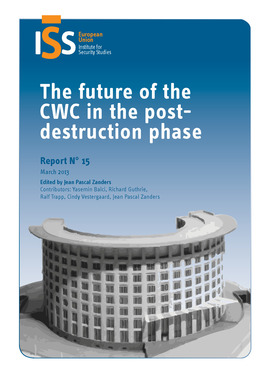
Future of the CWC in the post-destruction phase
Posted: March 27, 2013 Filed under: Chemical | Tags: Chemical warfare, chemical weapons, CWC, Disarmament, European Union, OPCW, Review conference, Science, Verification 3 CommentsThe future of the CWC in the post-destruction phase
Report – No15 – 27 March 2013
Yasemin Balci, Richard Guthrie, Ralf Trapp, Cindy Vestergaard, Jean Pascal Zanders
edited by Jean Pascal Zanders
From the Foreword by Ambassador Jacek Bylica, Principal Adviser and Special Envoy for Non-proliferation and Disarmament, European External Action Service:
The international community can be justifiably proud of the Chemical Weapons Convention. It has banned an entire category of weapons of mass destruction and provided for their verifiable elimination under international supervision. A small but effective intergovernmental organisation, the Organisation for the Prohibition of Chemical Weapons (OPCW), has been created for this purpose.
[…]
In the present international situation it is important to note that the Convention has created a de facto legal norm against the production, possession and usage of chemical weapons for military purposes. This prohibition goes beyond the letter of the Convention and stems from the reactions to the tragic experience of World War I and more recent cases of CW usage, including against non-combatants.
[…]
This volume features contributions derived from some of the presentations made by world-class experts at the workshop organised by the EU Institute for Security Studies in cooperation with the European External Action Service on 10 September 2012. The workshop offered an opportunity to reflect on some of the challenges facing the CWC over the next decade in preparation of the Third Review Conference at The Hague in April 2013. I am confident that this report presents an invaluable contribution to the debate on the future direction of our joint efforts which aim at the total and irreversible elimination of chemical weapons from the face of the Earth.
 Arms Control Law
