I’m very pleased to host a guest post by Theodore Richard, an attorney with the United States Strategic Command (USSTRATCOM). The piece is on the fascinating topic of “nuclear demonstration shots” during armed conflict. I confess that I had never heard of this concept. In the piece, the author argues that such demonstration shots are, in theory, not in violation of international law. I’ll jump in in the comments section with some thoughts and questions, and of course I encourage others to do the same, in a collegial and engaging manner.
The author wishes to make it clear that the views expressed in this article are solely those of the author and do not reflect the official policy or position of the DoD or the U.S. Government.
——————————————————-
Legality of Nuclear Demonstration Shots in Wartime
By Theodore Richard
Dr. Justin Anderson posted an article and follow up about the application of the laws of war to the potential use of nuclear weapons. One point he made was that not every potential use of nuclear weapons would have catastrophic humanitarian consequences. He provided examples, specifically identifying a high altitude demonstration shot as having limited humanitarian consequences.
This example, however, generates a question about the legality of potential nuclear demonstration shots. Could it be possible to interpret the 1963 Limited Test Ban Treaty (LTBT) as prohibiting wartime use of nuclear weapons, including demonstration shots? Neither the United States nor the Soviet Union held such a view during the Cold War. In the early 1980s, the Washington Post reported that in the event of a Soviet invasion, NATO contemplated whether its “first use” of a nuclear weapon in response should be a demonstration shot detonated over empty water to show resolve.
At a glance, the first paragraph of the LTBT might appear to support the prohibition of this or any demonstration shot. It says, “Each of the Parties to this Treaty undertakes to prohibit, to prevent, and not to carry out any nuclear weapon test explosion, or any other nuclear explosion, at any place under its jurisdiction or control: … in the atmosphere; beyond its limits, including outer space; or under water, including territorial waters or high seas… .”
The treaty, however, does not support that interpretation when looking at the entire document, including its historical background. The complete reading, rather than an assessment of isolated text, is necessary to understand the treaty’s meaning. Article 31 of the Vienna Convention on the Law of Treaties holds that a treaty is to be interpreted in accordance with the plain meaning of terms, in their context, and in light of the treaty’s object and purpose. The United States and Soviet position in 1963 was that the treaty prohibited testing, not wartime use. The treaty’s scope is limited in the title, which establishes that the treaty’s object and purpose is limited to testing. The treaty’s text then further defines the prohibition as to testing within the atmosphere, outer space, or the oceans.
President Kennedy made this point clear in 1963, when he explained the LTBT to the nation. He clarified that the LTBT only restricted nuclear testing. The treaty would not “mean an end to the threat of nuclear war. It will not reduce nuclear stockpiles; it will not halt the production of nuclear weapons; it will not restrict their use in time of war.”
Although Secretary of State Dean Rusk and the White House Special Counsel Ted Sorensen thought that applying the LTBT to wartime use was “far-fetched,” others were concerned that the LTBT might be read in a way to prohibit wartime use. Ultimately, the United States asked for the Soviet position on the question. Soviet Foreign Minister Gromyko was presented with the “possibility that Article One might be read to outlaw use of nuclear weapons in war. Gromyko looked baffled. He said ‘this treaty deals with the prohibition of nuclear tests in three environments. Of course it is not a prohibition of nuclear weapons or weapons in general, although the USSR is in favor of general and complete disarmament. The scope of the treaty is self-explanatory.’”
Similarly, Secretary Rusk told the Joint Chiefs of Staff in August 1963, “Article I of the treaty in no way inhibited our ability to use nuclear weapons in either general or limited hostilities and pointed out that this had been made categorically clear in the President’s speech, the Secretary’s speech at the time of signing the treaty, the President’s message transmitting the treaty to the Senate, and the Secretary’s testimony before the Foreign Relations Committee. It was not a ‘ban the bomb’ treaty. Mr Harriman stated that, when he had raised the subject with Gromyko, the latter had appeared to be baffled as to our reason for raising the question.”
Could other treaties limit nuclear demonstration shots during wartime? They were not prohibited by the 1899 or 1907 Hague Conventions, nor by the 1949 Geneva Conventions. The other potential source would be the 1977 Additional Protocol I to the Geneva Conventions, but it was negotiated with the understanding that it applied only to conventional weapons. Even if it did apply, it would not necessarily prohibit a demonstration or warning shot where neither the adversary nor a civilian population was actually affected because such a shot would not rise to the level of an attack under Article 49.
If the concern relates to an electromagnetic pulse (EMP) generated from the blast adversely impacting civilians, then Article 52(2) of Additional Protocol I would require the EMP effects to be directed against a legitimate military objective; Article 57 would require an attacker to take feasible precautions to avoid civilian loss of life and property damage; and Article 51(5)(b) would require the effects be proportional (meaning that the expected loss of civilian life, injury to civilians, and damage to civilian objects cannot be excessive in relation to the concrete and direct military advantage anticipated from the EMP).
While the United States has rejected Additional Protocol I for ratification and rejects the applicability of its new rules, it applies fundamental principles of the law of war to nuclear weapon use. Thus, the United States would still evaluate demonstration shots for compliance with longstanding, fundamental rules of warfare. Wartime demonstration shots would not be prohibited by any currently existing treaty unless they otherwise violate the law of war.
One often reads complaints by Iranian officials, and by the Iranian public, that the U.S. is not complying with the commitments it undertook in the JCPOA to ease economic sanctions on Iran in exchange for Iran’s compliance with its JCPOA commitments to limit its nuclear program. This got me wondering whether this is in fact the case.
As far as I can tell, the U.S. has in fact complied with all of its specifically delineated sanctions-lifting commitments that are due for compliance at the present stage of the JCPOA’s schedule. This explanatory document released by the U.S. Treasury provides a detailed review of the specific sanctions-lifting actions the U.S. has taken, and their relationship to the JCPOA. I haven’t seen any commentator seriously call into question this recitation of what the U.S. government has done, nor have I seen any persuasive allegations that the U.S. has not complied with the letter of its commitments under the JCPOA to this point.
Rather, what seems to be at the root of the complaints by Iranian officials and the Iranian public is disappointment caused by an earlier excess of expectations about the economic benefits that would flow from the JCPOA’s commitments of sanctions relief, and about how quickly those benefits would be realized.
As others have explained, the reasons why the economic benefits of the JCPOA’s sanctions relief commitments have to this point been disappointingly slim are manifold and complex. First, the JCPOA sanctions commitments only required the U.S. to remove sanctions that were specifically related to Iran’s nuclear program, leaving in place a complex legal architecture of primary and secondary economic and financial sanctions targeting Iran based on U.S. concerns about human rights in Iran, and Iran’s connection to terrorist groups. These remaining sanctions have, by many accounts, significantly deterred foreign investment and commerce with Iran, due to fears particularly by non-U.S. banks that they will inadvertently run afoul of this byzantine web of continuing sanctions, and face stiff financial penalties. Second, Iran’s economy is notoriously opaque and riddled with corruption. This creates an environment of business risk that is simply unattractive to many foreign companies.
These and other factors have combined to produce only modest economic benefits for Iran over the past six months since the lifting of sanctions, which has in turn made the initial excitement and optimism about the JCPOA in Iran fade significantly.
Tyler Cullis has written extensively on the issue of U.S. sanctions on Iran post-JCPOA, including detailed analysis of the most recent developments, and possibilities for narrowing the gap between commitments and expectations. I recommend his work to readers.
So what are we to make of the gap between Iranian expectation and commitment reality with regard to sanctions relief in the JCPOA? Were Iranian negotiators bamboozled by their U.S. counterparts into thinking that the sanctions relief commitments the U.S. was undertaking would lead to an economic windfall for Iran? I doubt it. I’m confident that the Iranian negotiators were sophisticated enough to know exactly what they had bargained for, and understood the limited nature of the economic benefits that would flow to Iran, particularly during the early months following the lifting of sanctions. I suspect that, just like the negotiators from the P5+1, the Iranian negotiators knew they were not going to get everything they wanted out of the JCPOA. That’s the nature of compromise.
But I also suspect that the Iranian negotiators understood that with the lifting of U.N. Security Council sanctions and European Union sanctions, also provided for under the JCPOA, doors would be opened that were not previously open to foreign investment and commerce with Iran, and that even under the pall of continuing U.S. sanctions, eventually businesses in Europe and Asia would become confident enough to take their first furtive steps back into the potentially hugely lucrative Iranian economy. And that as ever when there is sufficient economic incentive, creative minds would devise financial means to facilitate these transactions.
For those of us who want the JCPOA to be successful and to remain adhered to by all of its parties, the hope now must be that the understandable disappointment felt by Iranians can be tempered by a more realistic, cautiously optimistic patience, and that it does not translate into political loss for President Rouhani and his moderate allies in the 2017 Iranian Presidential election.
And please God don’t let Donald Trump be elected President here.
The online academic journal Questions of International Law has just published a symposium on my book Cyber Operations and the Use of Force in International Law(which is now available also in paperback). Two excellent scholars, Prof. Christian Henderson (Sussex University) and Dr. Emanuele Sommario (Scuola Superiore Sant’Anna – Pisa) discuss my analysis of the jus ad bellumand jus in belloissues arising from the use of cyber technologies. Their reviews are themselves very interesting contributions to the debate on cyber security and well worth reading.
Another excellent (and very positive!) review of my book has been written by Vincent Roobaert and has been published in the latest issue of the NATO Legal Gazette.
I’m very pleased to announce a new initiative here at Arms Control Law. I’ve been planning this for some time and have finally gotten things going. The idea is a podcast series – yes, I know everyone is doing podcasts. But this one is devoted to discussions/interviews with scholars and practitioners in the arms control law area.
Most of the discussions will feature scholars working on new projects – articles or books, and the podcast will be a way for the author to briefly introduce the subject of the work to the ACL audience through a 30 minute or so discussion with me and with my co-host Professor Jack Beard from the University of Nebraska College of Law. Jack was a long-time practitioner of arms control law in the U.S. government, and is now a prolific arms control law scholar. He is also the chair of the International Law Association American Branch’s Use of Force Law Committee, which is co-sponsoring this podcast series.
I’m hoping that this podcast series will provide a new vehicle for disseminating quality arms control law scholarship, as well as discussions on current topics in the field, in a medium that can be listened to anywhere – in the car, at the gym, etc.
We’re going to kick off the series with a discussion of one of Jack’s own recent papers, entitled “Soft Law’s Failure on the Horizon: The International Code of Conduct for Outer Space Activities.” This article has been accepted for publication in the University of Pennsylvania Journal of International Law. You can find the paper here on SSRN. It’s an extremely timely critique of the E.U’s Code of Conduct in this area, and includes some really interesting questions about international legal sources, i.e. the role of soft law in the arms control area. Listeners should feel free to post comments and questions about the podcast.
Readers will likely have read media reports today summarizing the IAEA’s latest official report on Iran’s compliance with the JCPOA and Security Council Resolution 2231, which was presented to the IAEA Board of Governors today. A full copy of the IAEA report has, fortunately, been provided to ACL in the interests of transparency by a source in Vienna. You can find it at the link below.
The five page report finds that Iran is upholding its commitments under the JCPOA, and has been cooperating with IAEA inspectors. It concludes:
The Agency continues to verify the non-diversion of declared nuclear material at the nuclear facilities and locations outside facilities where nuclear material is customarily used (LOFs) declared by Iran under its Safeguards Agreement. Evaluations regarding the absence of undeclared nuclear material and activities for Iran remained ongoing.
Noticeably absent, of course, is any consideration of whether the other parties to the JCPOA, including particularly the U.S., are abiding by their JCPOA commitments. I think this would actually make for more interesting reading.
I’m actually genuinely asking this. I don’t know the answer. I know Russia has made this accusation repeatedly over the years, and again just in the past few days. Here’s a nice explanation of the issues involved.
But honestly I don’t know a lot about the INF treaty, other than what I could gather through looking at the text itself and a few online articles. The question seems to be one involving some technical determinations about the kinds of missiles and launching systems that the US either has or plans to have at its bases in Eastern Europe. For me to get up to speed and give an answer I would have confidence in would take me a while. So I thought I would just throw the question out to readers who may have actual expertise in this area that they could share. Please either leave a comment, or if you would like to do a guest post, just let me know by email.
Every few months we hear a new claim – and the inevitable follow-up discussions about the believability of that claim – regarding how far North Korea has come in developing a nuclear warhead that can be miniaturized and fitted onto one of their increasingly long-range missiles, and thus used to threaten its regional neighbors, or even the continental United States. The particulars of just where they are right now are less concerning to me than what appears to be a fairly linear progression of advancement in their capabilities, which again appears to make it only a matter of time – and here it seems realistic to talk of months or at the most a handful of years – before they achieve the ability to strike the U.S. with a nuclear tipped missile. And what’s really concerning is that TO THIS DAY I still haven’t heard anyone with a particularly good plan to stop this from happening.
There’s lots of talk of more sanctions, and of returning to negotiations. A good bit of talk about offering greater incentives. Of course all of these things have been tried before with North Korea and don’t seem to have made much of a difference in the trajectory of their progress toward a missile-deliverable nuclear weapon.
Then there’s the idea that at some point China will get tired of tolerating and protecting the increasingly defiant NK leadership and will do . . . something . . . about it. I wish that would happen, but there seems to be an awful lot of guessing and assumptions that go into that reliance, which don’t pat down the concern very much.
I come back to this subject at intervals here at ACL. Some previous posts are here, here, here, and here. I try to stay up to date on at least some of the leading writing on what to do about the North Korean threat. And it just baffles me that there isn’t a concrete plan for stopping the emergence of this capability by North Korea.
In my previous posts I’ve tried to head off any comparison between the North Korean case and the Iran case, on which I’m well known to have taken a different tack entirely. I don’t want to go back through the distinctions again here. If you’re serious, you know what they are.
And again, as I’ve also said before, I’ll put my general non-interventionist bona fides up against anyone’s and expect to come out favorably in the comparison. I am absolutely not some hawk that looks automatically to military force to solve WMD proliferation problems. Quite the opposite.
But sometimes there literally is no other practical option, and the threat is real and credible. And in those circumstances I’ve always been willing to afford states facing the imminent threat of use of nuclear weapons against them, the right to strike in an anticipatory fashion to defeat the threat. This is in my view within the right of self defense accorded to states under international law. Debates about what imminence means in this context are rich, sophisticated and nuanced. But at some point, I think states do have a right to preemptively use military force to degrade threats of use of nuclear weapons against them.
Like so much in international use of force law, practical legality will essentially depend on whether states generally are satisfied that a use of force was reasonable, necessary and proportionate to an intolerable threat, and that all reasonable peaceful means to avoid using military force had been exhausted. For example, Israeli threats to use military force against Iran’s nuclear facilities never met these tests of satisfaction. But I think that at some point, a preemptive military strike by the U.S. Against North Korea would.
Is the U.S. at that point yet with North Korea? I don’t think so. But when will we be? I’d give it months or at the most a handful of years.
I don’t know anyone in the right agencies of the U.S. government to check (not that they’d tell me even if I did) but I’m sure that plans for just such a military contingency are well maintained, they just aren’t spoken about publicly.
I suspect this is, in the end, the concrete plan for stopping North Korea’s nuclear threat to it’s neighbors and to the U.S. It’s just not part of what U.S. officials are ready to talk about yet. I sincerely hope it doesn’t come to this, and that something will change to make it unnecessary.
But if not, I’d rather see this than live with a North Korea capable of launching a nuclear first strike against the United States.
UPDATE: Here’s a link to an article I wrote in 2008 on use of force law in the context of WMD proliferation. I’ve referenced it a couple of times in the comments to this post, and I wanted to make it available to those interested:
I just read this piece over at The National Interest by Tom Sauer, entitled “It’s Time to Outlaw Nuclear Weapons.” It’s probably the best presentation of a coherent and practical scheme for moving forward with the program of nuclear disarmament that I’ve seen.
Sauer argues for the conclusion of a treaty outlawing the possession of nuclear weapons, by those states willing to sign onto such a statement. He estimates that between 120-150 states might be willing to sign onto such a treaty, and accepts that none of the nuclear weapons possessing states would sign onto it.
Sauer is a little bit low on detail about what the Nuclear-Weapons Ban Treaty would actually say, but since he seems to be alluding to the parallel process on the CBW side, I suspect what he means is that the NWBT would simply be a declaration by all states parties that both the use and possession of nuclear weapons are unlawful, and that the parties obligate themselves never to possess or to use them.
This would be the first procedural step, and would create a broadly supported international norm that could then be referenced by civil society activists within nuclear weapons states to try to persuade their governments to embark seriously on efforts to disarm.
The next step would then be to actually get the nuclear weapons states on board to signing a separate treaty, a Nuclear Weapons Convention (NWC) that would do the much more detailed and difficult work of setting an actual schedule and targets for disarmament, much like the Chemical Weapons Convention did.
I like this general presentation of the process going forward because I do think Sauer and others in the humanitarian initiative are right that a NWBT, as described here, could indeed likely be agreed now, and would in fact attract a majority of states to sign on to it. I suspect the nuclear weapons would put a lot of pressure on their allies and client states not to sign it, so I don’t know what the final tally would be. But I think it would be a significant majority of states. And I do think that such a treaty that simply recites the understanding of a majority of states that the possession and use of nuclear weapons is illegal, would be useful not only for the norm internalization purposes that Sauer mentions, but also as an important evidence of both state practice and opinio juris supporting the establishment of a rule of customary international law.
Readers will recall that Marco and I had a good exchange a while ago on the subject of customary international law related to NPT Article VI. See here, here, here, and here. The effectiveness of a NWBT in contributing to the establishment of parallel customary law would involve some of the same issues that we discussed in those exchanges, e.g. Marco’s concern about specially affected states. But in the end, in my opinion, if a supermajority of states manifested state practice and opinio juris supporting this ban, on a subject that I truly think can be argued persuasively to specially affect all states as potentially no other, a rule of customary international law should and would be recognized to come into existence. This rule would then create obligations for all states, including the nuclear weapons possessing states.
Regarding the subsequent NWC, I have to say I’m not very optimistic at all that such a treaty will ever be concluded, at least not in a form comparable to the CWC. I think that nuclear weapon states’ national interests will always prevent them from agreeing to completely disarm. But that doesn’t mean that the preliminary step of concluding a NWBT is without usefulness. Quite the contrary, for all the reasons discussed. And the setting of such an international legal norm, in both treaty and customary law forms, could over time put pressure on nuclear weapons states to at least reduce their stockpiles of nuclear weapons to low numbers, which would make the world a safer place.
(Cross posted from Arms Control Wonk. I was kindly invited to write this piece and post it there by Michael Krepon)
I’m grateful to Michael Krepon for this invitation to contribute to Arms Control Wonk. I have long respected Michael’s work here.
In this piece, I’d like to offer a response of sorts to Justin Anderson’s fine recent piece here at ACW, though I don’t mean it to target his piece alone, but rather the implications of some of the arguments that he and others have made concerning the legality of the use of nuclear weapons.
Gro Nystuen and Kjølv Egeland recently published an excellent piece in Arms Control Today providing a concise yet thorough review of jus ad bellum and jus in bello principles of international law relevant to the possession and use of nuclear weapons. These are principles of law related to the international use of force by states, and to the conduct of forces during armed conflict.
I recommend Nystuen and Egeland’s piece to readers, and I agree with their legal assessment that there does indeed remain a “legal gap,” and not just a compliance gap, identifiable as the absence in general customary law of a complete prohibition on the use and possession of nuclear weapons, as distinguishable from general customary rules that completely prohibit the use and possession of chemical and biological weapons. It is to this legal gap that the currently trending “Humanitarian Pledge,” and the related “Humanitarian Impact of Nuclear Weapons” multinational movement are addressed.
In his piece, Justin Anderson takes issue with one statement in a UN General Assembly resolution that is related to this movement. Essentially, his argument is in agreement with Nystuen and Egeland’s conclusion that there are at least conceivable uses of nuclear weapons that would not manifestly violate the principles of jus ad bellum or jus in bello. This indeed was the realization that prevented the International Court of Justice from being able to decide, in its 1996 advisory opinion, that the use or threat of nuclear weapons was in all cases unlawful. Anderson provides a hypothetical case in which, he contends, the use of nuclear weapons would be lawful:
Should the United States or an ally, for example, face an imminent nuclear attack, the U.S. military might advise the president that preventing the attack would require a rapid strike, launched at a distance, using munitions that would completely disable or destroy – rather than merely degrade – the belligerent forces preparing the attack. These requirements might rule out available conventional options; in this scenario, a U.S. nuclear strike would be a legitimate response due to the military necessity of completely neutralizing the target in order to prevent a catastrophic, mass-casualty attack against the United States or an ally.
Neither I nor, I think, Nystuen and Egeland would disagree with Anderson’s assessment of this hypothetical, so long as the principles of necessity and proportionality in jus ad bellum, and the principles of discrimination and proportionality in jus in bello, were in fact observed in the resulting nuclear strike.
However, while not disagreeing with the idea that there exist theoretical possibilities for the lawful use of nuclear weapons, I do think one has to bear in mind the extremely narrow sets of circumstances where such lawful uses could take place. Take Anderson’s hypothetical above. Yes, this could happen. The chances of its happening are quite remote, however. And what of the other often mentioned hypothetical cases for the lawful use of nuclear weapons, in which all of the principles of jus ad bellum and jus in bello would be satisfied, and in which conventional weapons might under the prevailing circumstances be ineffective – e.g., the enemy submarine out at sea, or the hard and deeply buried enemy bunker in the middle of the desert? Again, while similarly theoretically possible, these scenarios are also similarly unlikely to present themselves in the course of reasonably foreseeable armed conflicts.
The concern that arises is in trying to harmonize the theoretical usefulness of nuclear weapons in these very circumscribed and unlikely cases, with the existing stockpiles of nuclear weapons maintained by nuclear weapon states, and argued by them to be justified on the basis of these potential uses. The disparity is of course most acutely discernible in the cases of the United States and Russia, which each possess over 7,000 nuclear weapons, by far most of which are equipped to deliver strikes of a destructive power that could only conceivably be legally justifiable in the extremely unlikely case that Justin Anderson has described.
Is it reasonable, therefore, to argue that the United States needs 7,000 nuclear weapons, by far most of which could only legally be used in one highly unlikely situation – that of an imminent nuclear weapons launch by another state? This is to say nothing of justifying the cost of maintaining and upgrading these weapons, as Joe Cirincione often usefully reminds us.
One can’t shake the suspicion that when military and other national-security types talk about these narrow hypotheticals in order to defeat arguments that the use of nuclear weapons is always unlawful – and thereby also provide at least political justification for the possession of nuclear weapons – they aren’t really thinking that these are the only occasions when nuclear weapons use might be desirable. Rather, these are just the only uses they want to talk about. And that when push comes to shove, if allowed to maintain and upgrade such excessive nuclear arsenals, and create new platforms for their delivery – including cruise missiles, for example – considerably more situations than these might start to look like nails to a man holding a hammer – a shit-ton of hammers, in fact.
If nuclear weapon states were genuine in their representations that they need their nuclear weapons only for cases where international law would be satisfied by their use, and bearing in mind the cost of maintaining nuclear weapons stockpiles of the size maintained by the U.S. and Russia, surely we would be looking at an empirical reality of nuclear weapons possession much more in line with the “low numbers” that James Acton has compellingly written about.
The fact that we are not faced with a low-numbers reality appears, therefore, to belie arguments by nuclear weapon states that they intend to abide by existing international law in their planned, or at least conceived-of, uses of nuclear weapons.
So while it’s true that current international law does not provide for a general prohibition on the possession and use of nuclear weapons, it does contain obligations for states that significantly limit their options. I’ve written about the disarmament obligation in the NPT, and current nuclear weapon state noncompliance with it, at length elsewhere. These disarmament obligations are currently being pressed, if incompetently, by the Marshall Islands against nuclear weapon states at the International Court of Justice.
With regard to the use of nuclear weapons, we fortunately have not witnessed their use in armed conflict since 1945. So no state could be said to currently be in violation of the rules of jus ad bellum or jus in bello because of such use. However, while legal gaps remain in international law that could conceivably allow for the lawful use of nuclear weapons, the limited scope and likelihood of occurrence of circumstances in which such use would be lawful, when compared to the size and cost of efforts to maintain nuclear weapon state nuclear arsenals, makes nuclear weapon state arguments concerning their intention to abide by those obligations in the future ring a bit hollow.
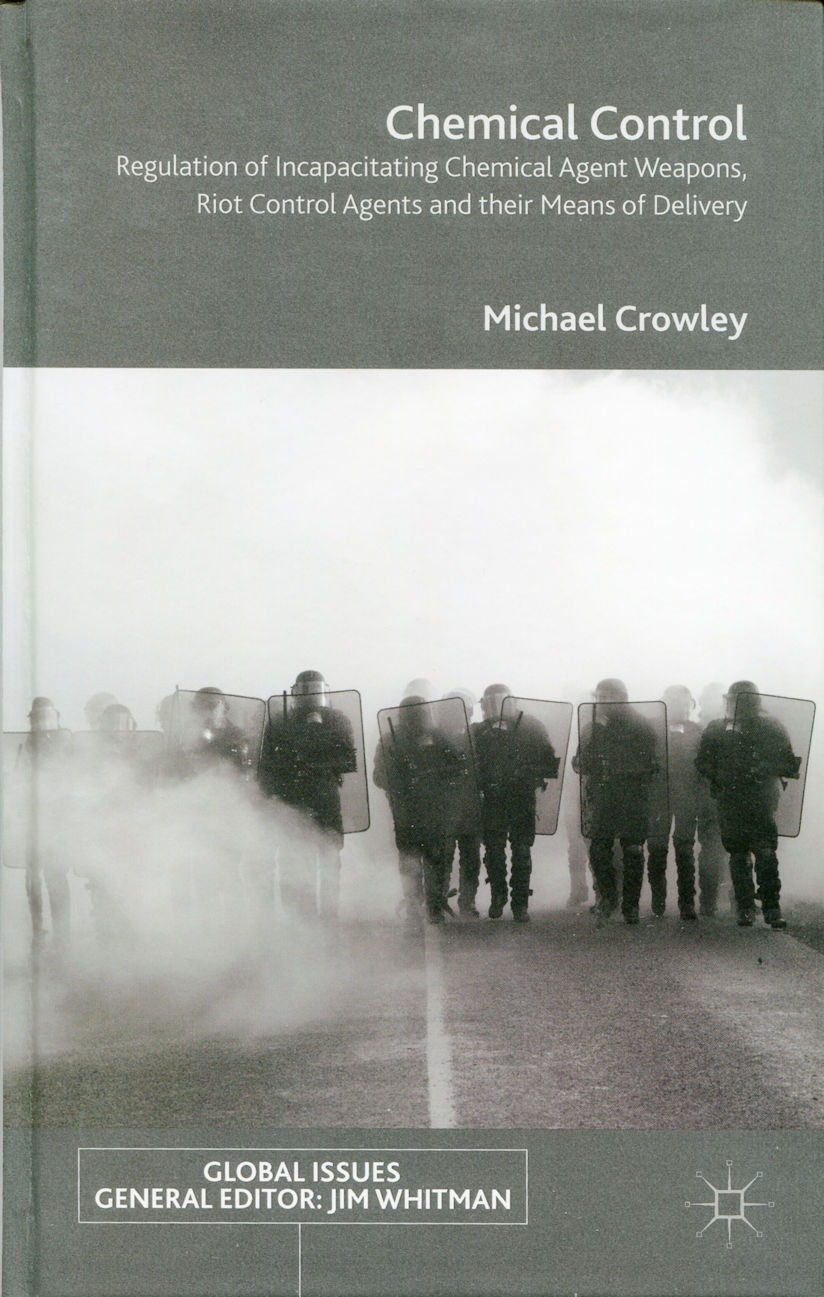
Anybody who has attended one of Michael Crowley’s annual presentations at the Organisation for the Prohibition of Chemical Weapons (OPCW) on the challenges posed by riot control and incapacitating agents for the future of the Chemical Weapons Convention (CWC) knows his passion for the subject matter. And his overwhelming knowledge about the latest developments in science, technology, industry and government policies. These characteristics also typify his book on the topic, Chemical Control, published late last year.
The book can be read on three levels:
as an almost encyclopaedic presentation of facts,
as an in-depth analysis of the regulatory regimes pertaining to chemical crowd control agents, which leads to concrete policy recommendations, and
as a treatise on the analytical framework that has guided the research and the book structure.
Each level has merit in its own right. The third one, however, lifts this book above many other monographs on weaponry. Not just because of the ways in which it has informed Crowley’s research and analysis, but because it opens windows to fundamental debates on the purpose of disarmament and arms control today and tomorrow. He was right to resist calling his analytical framework a theory, but it nevertheless contains elements of theory. He formulates certain assumptions, but the book’s primary goals unfortunately do not give him the space to discuss them in depth. Because Crowley fundamentally questions some traditional understandings of the purpose of disarmament and arms control, he lays down an intellectual challenge that disarmament theorists or international lawyers cannot ignore.
A rich data source
The first level is that of the researcher’s data paradise. The monograph offers highly technical and detailed information on the nature of riot control and incapacitating agents and their delivery systems, the research and development behind them, where they are being manufactured and how they are traded, and most importantly for the other levels on which the book can be read, where and how they are being used.
Chemical warfare has its fair share of horror stories. About the impact of toxic chemicals on the body—from the painful and slow-healing blistering of the skin by mustard agents to the uncontrollable convulsions caused by exposure to sarin or other nerve agents. About the human experiments conducted not just in the Japanese prisoner of war camps in China in the Second World War or the dungeons of the darkest totalitarian regimes, but also in the bastions of Western democracy. Until today veterans in the UK and the USA, for example, are fighting to have their contribution to the national defence effort officially recognised and receive adequate compensation and health care—if they are still alive.
However, it is quite a different present-day horror story to read that quite a few states use incapacitants and riot control agents (such as tear gas)—toxic chemicals that some try to sell to public opinion as so-called non-lethal or humane weapons—to torture prisoners or regime opponents. Page after page, table after table Crowley details national practices of certain countries. They beggar belief were it not for the fact that source references make up two-thirds of the pages with tables.
Crowley methodically presents the different types of agent together with their characteristics and consequences after exposure, the country armament programmes and practices, and incidents. He never meant those pages to be read in a systematic way; they are detailed reference materials for researchers worldwide. In that sense he comes as close as possible to an encyclopaedic treatment of the subject matter. Future reports by him and other researchers will have to update the data sets.
If assimilation of this wealth of data might appear daunting, then section introductions and conclusions pull the main strands of his empirical analysis neatly together.
Considerations for policy shapers and makers
The second level is that of policy advice. I must admit that when I first saw the table of contents and noticed that the final chapter addressed conclusions and recommendations I had concerns about the substance of the book. It is one thing to undertake solid empirical research; it is quite a different thing to lay out arguments (and thereby present data selectively) in support of policy recommendations. Too often such treatises display superior argumentative logic, all the while lacking foundation in factual reality. Or they may sink to the level of wholly speculative ‘may and might’ analyses spinning hypothetical, often worst-case scenarios whose projected consequences then inform policy recommendations.
To my relief Crowley avoids this trap because a solid analytical framework structures his analysis (see the third level below). Thus after having laid out the technical aspects and national programmes of crowd control agents, he moves to the regulatory regimes. Again he proceeds systematically. In what amounts to over half of the book, he devotes a chapter each to arms control and disarmament law, international humanitarian law, human rights law, international criminal law, technology transfer control regimes, and UN drug control conventions. For each of the treaties, regulations, policy declarations, or informal arrangements (such as the Australia Group or Wassenaar Arrangement) Crowley presents the reader with a summary of the objectives and tools, an analysis of their implementation, and options for amelioration.
In the penultimate chapter he examines how civil society can contribute to the strengthening and implementation of the respective regimes. It comprises a comprehensive overview of ideas that have been explored in the fields of chemical and biological weapon control over the past decade and a half, as well as various initiatives whose primary concern have been the humanitarian and human rights consequences of the application of crowd control agents. In the process the author comments on such activities and suggests further options and improvements.
Crowley’s recommendations are rooted in this detailed analysis. He identifies areas of action where governments (and by extension, intergovernmental organisations) have to assume their responsibilities with regard to the strengthening and implementation of the international rules. He also considers how civil society constituencies can contribute to the strengthening of existing tools (e.g., through the development of ethical and professional codes of conduct, educational initiatives, etc.) or develop independent initiatives to track developments (e.g., open source monitoring of the use of crowd control agents or the political and technological imperatives for their further development and international commercialisation) with a view of holding policy makers accountable.
The final chapter thus comprises succinct summaries of the issues treated in the preceding chapters and related policy recommendations.
Analytical framework
As already indicated in the introduction, to me the best aspect of the book is the analytical framework. Crowley calls it ‘holistic arms control’ (HAC). It concentrates on existing arms control and disarmament measures, but seeks to expand on the numbers and types of regulatory measures and broaden the range of possible stakeholders.
The ambition is not small: he must weave a net whose meshes are sufficiently wide to catch all relevant data, while small enough to filter out irrelevant elements. Moreover, his construct is multidimensional, capturing the technologies together with national and human security concerns of inappropriate use, all relevant international legal regimes and other types of regulation together with the relative strengths and weaknesses, and possible strategies to reinforce all barriers against misuse of crowd control chemicals.
He deconstructs this ambition in the opening chapter and in the process outlines a step by step methodology that will form the backbone for the whole book. Cowley’s rigid adherence to the model contributes significantly to the readability of his analysis: throughout the reader remains aware of the stage of analysis and when particular questions are likely to be addressed. At the same time, he leaves the reader with a strong sense of comprehensiveness by bringing in many elements that one might not immediately consider when touching upon the subject of incapacitating and riot control agents. His discussion of the 1971 UN Convention on Psychotropic Substances is but one example.
A theoretical knot
However, the HAC framework is not merely analytical, it is also aspirational. It carries elements of theory formation that offer the perspective of substantive debates on the purpose of disarmament in fast changing times. As the author states (p.4):
Recognizing that reliance upon a single disarmament or arms control agreement alone would not guarantee success, scholars have explored a number of concepts, seeking to broaden the range of possible regulatory mechanisms.
His analysis is therefore also aspirational:
Although the proposed HAC analytical framework concentrates upon existing arms control and disarmament measures, it attempts to widen the range of applicable mechanisms for regulation, and also the nature of the actors involved in such regulatory measures.
Consequently, HAC can be thought of as a framework for analysis to aid the development of a comprehensive, layered and flexible approach to arms control […]
Left unsaid is the central question: what is the core purpose of disarmament (as embedded in the Biological and Toxin Weapons Convention (BTWC) and the CWC, two key pillars of the regime against the misuse of incapacitating or riot control agents)? Furthermore, how do treaty regimes evolve in the light of technological, political and social changes over the years since their adoption and entry into force?
Humanitarian considerations have over the past two decades taken up a prominent place in the disarmament and arms control discourses. This means that today a different reference framework for judging effectiveness of a convention exists than the one originally intended: the focus of the public debate has shifted from the weapon technology (which must be eliminated) to the consequences of their use under a variety of circumstances on individuals and communities, which in turn has amplified calls to hold those responsible for violations accountable under national and international criminal law. That conflict of purpose is on clear display in the Syrian civil war: many people do not understand why the international community can invest resources in eliminating Syria’s chemical warfare capacity, but does not want to intervene to stop the slaughter of civilians.
The issue really becomes interesting when two humanitarian considerations intersect at a given decision-making moment in a disarmament setting, and a choice has to be made. Crowley points to such a moment during the 3rd CWC Review Conference in April 2013 (pp. 130–31), however without realising the underlying conflict (of conscience) that led to the item of incapacitating agents being dropped form the final document. The debate occurred when the number of reported chemical weapon (CW) incidents in the Syrian civil war was rising fast, and only a few weeks after the UN Secretary-General established a mission to investigate allegations of CW use. Including a condemnation of the escalating chemical warfare crisis proved highly controversial. Compromise was possible on severely weakened language only, which was totally unacceptable to the Western Group and Other States (WEOG). The final document was in the balance. Given that Poland was chairing the review conference, failure was not an option for the European Union members.
One WEOG ambassador was unable to get updated guidance on compromise language on the questions of incapacitants and Syria from his capital, and therefore had to decide under his personal responsibility (all the while bearing in mind that the successful outcome of the review conference hung in the balance). He opted to go with the compromise language on Syria and (in consultation with the original sponsor, Switzerland) drop references to incapacitants, a key consideration being that the issue could be taken up at a later date. Does such a decision make the CWC less effective? The consensus language in the final document would ultimately form a not insignificant foundation for subsequent action by the OPCW following the sarin attacks in the district of Ghouta less than four months later, and Syria’s accession to the CWC and subsequent disarmament. Outcomes at meetings can result from complex decision processes when different interests conflict with each other and priorities (often in function of developments at the time) need to be established.
So, I raise the question whether the global community is best served by finding ways to ameliorate core instruments or by broadening the range of tools in order to capture a particular issue of interest? I have no immediate answer because, as the book describes, science and technology and their application in various circumstances may evolve much faster than the international community can regulate them or update existing treaty regimes. Nevertheless, I do have the concern that multiplication of treaties and other regulatory instruments lead to different lists of states participating in each one of them and different levels of compliance and enforceability. That could lead to a cacophony of expectations based on different requirements and interpretations of obligations.
This final reflection is not a criticism of Chemical Control. The question touches upon theories of regime formation and international law and goes beyond the purpose of Michael Crowley’s book. However, it is a matter I definitely wish to engage him on. I can only commend him for offering a solid framework for structuring that particular debate on the future of disarmament and arms control and identifying the fundamental assumptions underlying both concepts.

 Arms Control Law