Arrests of Foreigners in Iran Not Helping
Posted: November 6, 2015 Filed under: Nuclear 8 CommentsThe subject of dual nationality Iranian citizens, such as Jason Rezaian, being arrested in Iran on what look like trumped-up political charges, has long been a concern. But I have to say the most recent spate of arrests in Iran of foreigners, in the wake of the agreement on the JCPOA, has been particularly off-putting to me. Take the arrest, reported here and here, of Nizar Zakka. As I understand it, Zakka is Lebanese and also holds permanent residence status in the US. So he is not an Iranian citizen. He has apparently recently been arrested on espionage charges because, according to Iranian state media, he “has deep ties to the U.S. intelligence and military establishment.”
I’m not sure what it means to have “deep ties to the U.S. intelligence and military establishment,” but if that on its own is enough for a foreigner to be arrested in Iran, then this sends a very discomfiting message to people like me who have for some time wanted to visit Iran, but who have both visceral and intellectual concerns about making it back out of the country. I mean, like most people who write about nuclear nonproliferation issues, I know people in U.S. intelligence and military agencies. Does that mean I have “deep ties” to those agencies? I don’t think I do, but I’m not willing to gamble on what the IRGC is going to make of those connections.
I think this recent series of arrests is a real shame, because it is going to make people like me think more than twice about visiting Iran. And particularly because, in the case of Nizar Zakka, he was actually in Iran by invitation of the government to attend a conference. That’s basically why I would visit Iran if I were to go. I’ve talked to several Iranian friends about this possibility in the past, and I was basically just waiting for the right opportunity to accept such an invitation. But honestly I’m not going to do so at this point.
I think I understand at least partially the politics involved. After the JCPOA was agreed, the conservative elements of the Iranian government have wanted to reassert themselves, and apparently they think that arresting foreigners with ties to foreign governments they don’t like will send a message of strength and continued antipathy towards those governments. Well, it may be doing that, but I don’t see that as in any way a constructive move for the country and its interests. I don’t see how Iran’s interests are served by dissuading academics and businessmen who are generally in favor of increased engagement between Iran and the world, from visiting the country. But maybe that’s also on the agenda of the authors of this new policy – to generally discourage engagement between Iran and the rest of the world.
If it is, then congratulations. I think it will work.
Innocence Slaughtered: Introduction
Posted: October 16, 2015 Filed under: Chemical | Tags: Chlorine, Civil society, Disarmament, International Humanitarian Law, OPCW, War, World War 1 Leave a commentInnocence Slaughtered will be published in December 2015
In November 2005 In Flanders Fields Museum organised and hosted an international conference in Ypres, entitled 1915: Innocence Slaughtered. The first major attack with chemical weapons, launched by Imperial German forces from their positions near Langemarck on the northern flank of the Ypres Salient on 22 April 1915, featured prominently among the presentations. I was also one of the speakers, but my address focussed on how to prevent a similar event with biological weapons. Indeed, it was one of the strengths of the conference not to remain stuck in a past of—at that time—nine decades earlier, but also to invite reflection on future challenges in other areas of disarmament and arms control. Notwithstanding, the academic gathering had a secondary goal from the outset, namely to collect the papers with historical focus for academic publication.
The eminent Dutch professor and historian Koen Koch chaired the conference. He was also to edit the book with the historical analyses. Born just after the end of the 2nd World War in Europe, he sadly passed away in January 2012. He had earned the greatest respect from his colleagues, so much so that the In Flanders Fields Museum set up the Koen Koch Foundation to support students and trainees who wish to investigate the dramatic events in the Ypres Salient during the four years of the 1st World War. The homage was very apt: Professor Koch had built for himself a considerable reputation as an author of studies on the 1st World War. Most remarkable: The Netherlands had remained neutral during the conflagration, which adds to the value of his insights.
Death, unfortunately, also ends projects. In the summer of 2014, while doing some preliminary research on the history of chemical warfare, I came across the manuscripts of the chapters that make up the bulk of this book. They were in different editorial stages, the clearest indication of how abruptly the publication project had screeched to an end. Reading them I was struck by the quality of the contents, rough as the texts still were. Together, the contributions also displayed a high degree of coherence.
One group of papers reflected on the minutiae of the unfolding catastrophe that the unleashing of chlorine against the Allied positions meant for individual soldiers and civilians. They also vividly described German doubts about the effectiveness of the new weapon, and hence its potential impact on combat operations. These contributions also reflected on the lack of Allied response to the many intelligence pointers that something significant was afoot. In hindsight, we may ponder how the Allied military leaders could have missed so many indicators. Yet, matter-of-fact assessments of gas use by Allied combatants recur in several chapters, suggesting either widespread anticipation of the introduction of toxic chemicals as a method of warfare or some degree of specific forewarning of the German assault. Gaps in the historical record, however, do not allow a more precise determination of Allied anticipation of chemical warfare. Still, a general foreboding may differ significantly from its concrete manifestation. From the perspective of a contemporary, the question was more likely one of how to imagine the unimaginable. Throughout the 2nd Battle of Ypres senior Allied commanders proved particularly unimaginative. In the end, the fact that German military leaders had only defined tactical goals for the combat operations following up on the release of chlorine, meant that they had forfeited any strategic ambition—such as restoring movement to a stalemated front, seizing the Channel ports, or capturing the vital communications node that Ypres was—during the 2nd Battle of Ypres, or ever after. The surprise element was never to be repeated again. Not during the 1st World War, not in any more recent armed conflict.
The second group of papers captured the massive transformation societies were undergoing as a consequence of industrialisation, science and technology, and the impact these trends were to have on the emergence of what we know today as ‘total war’. Chemical warfare pitted the brightest minds from the various belligerents against each other. The competition became possible because the interrelationship between scientists, industry, politicians and the military establishment was already changing fast. But chemical warfare also helped to effectuate and institutionalise those changes. In many respects, it presaged the Manhattan Project in which the various constituencies were brought together with the sole purpose of developing a new type of weapon. In other ways the competition revealed early thinking about racial superiority that was to define the decades after the Armistice. The ability to survive in a chemically contaminated environment was proof of a higher level of achievement. In other words, chemical defence equalled survival of the fittest. Or how Darwin’s evolutionary theory was deliberately misused in the efforts to justify violation of then existing norms against the used of poison weapons or asphyxiating gases.
During and in the immediate aftermath of the war, opposition to chemical warfare was slow to emerge. In part, this was the consequence of the appreciation by soldiers in the trenches and non-combatants living and working near the frontlines that gas was one among many nuisances and dangers they daily faced as its use became more regular. Defences, advanced training and strict gas discipline gave soldiers more than a fair chance of surviving a gas attack. The violence of total war swept away the humanitarian sentiments that had given rise to the first international treaties banning the use of poison and asphyxiating gases in the final year of the 19th century. Those documents became obsolete because people viewed modern gas warfare as quite distinct from primitive use of poison and poisoned weapons or the scope of the prohibition had been too narrowly defined. By February 1918 chemical warfare had become so regular that a most unusual public appeal on humanitarian grounds by the International Committee of the Red Cross (ICRC) badly backfired on the organisation. Throughout the 1920s the choice between an outright ban on chemical weapons and preparing populations for the consequences of future chemical warfare would prove divisive for the ICRC. In contrast, peace and anti-war movements in Europe campaigned against war in all its aspects and consequently refused to resist one particular mode of warfare before the Armistice. It is instructive to learn that opposition to chemical warfare specifically first arose far away from the battlefields—northern America and neutral Netherlands—and among a group of citizens not directly involved in combat operations: women. And perhaps more precisely, women of science who protested the misapplication of their research and endeavours to destroy humans. Just like the chlorine cloud of 22 April 1915 foreshadowed the Manhattan project, the Women’s International League for Peace and Freedom presaged the Pugwash Conferences on Science and World Affairs, who would bring together scientists, academics and political leaders to counter the growing menace of nuclear war and find solutions to other threats to peace and security.
It was clear to me that I should not remain a privileged reader of the manuscripts. They contained too much material and insights that the broader public should have access to. Piet Chielens, curator of the In Flanders Fields Museum, and Dominiek Dendooven, researcher at the Museum, could not agree more, and so a new publication project was born. However, since the centenary of the chlorine attack was only a few months away, reviving the academic product Koen Koch had been working on was initially not an option. So, the decision was to exploit modern communication technologies and produce the volume as a PDF file in first instance. However, by the time the electronic edition was ready for online publication, In Flanders Fields Museum had found a publisher willing and able to produce a formal edited volume before the end of the centenary year of the first modern gas attack. My gratitude goes to Ryan Gearing of Uniform Press for his guidance and concrete assistance in making this book a reality.
Time for preparing this publication was very short. To my pleasant surprise, every author in this volume responded favourably and collaboration over several intense weeks—both in the preparation of the original PDF version and the subsequent book project—proved remarkably gratifying and productive. Some contributors even took the time to introduce me to certain concepts widely accepted among historians, which I, with my background in linguistics and political science, had interpreted rather differently. For the experience in preparing this volume, I indeed wish to thank every single contributor.
22 April 1915 was not just the day when the chlorine cloud rolled over the battlefield in Flanders. It also symbolises the confluence of often decade-old trends in science, technology, industry, military art and the way of war, and social organisation. That day augured our modern societies with their many social, scientific and technological achievements. However, it was also a starting point for new trends that eventually led nations down the path of the atomic bomb and industrialised genocide in concentration camps. It also highlighted the perennial struggle of international law and institutions to match rapid scientific and technological advances that could lead to new weapons or modes of warfare. This volume captures the three dimensions: the immediate impact of poison warfare on the battlefield, the ways in which the events in the spring of 1915 and afterwards shaped social attitudes to the scientification and industrialisation of warfare, and the difficulties of capturing chemical and industrial advances in internationally binding legal instruments. Indeed, there can be no more poignant reminder that our insights into the trends that brought the chlorine release 100 years ago are crucial to our understanding of trends shaping our societies today and tomorrow.
Yes, the world has moved on since the 1st World War, even if the use of chlorine in the Syrian civil war one century later may seem to challenge the thought. Yet, one institution may unwittingly have come to symbolise the progression. Fritz Haber, the scientific and organisational genius who led Imperial Germany’s chemical warfare effort in 1915, was awarded the Nobel Prize for Chemistry in 1918. Typical for the day, the Nobel Committee detached scientific achievement from moral considerations. His contribution to the development of a synthetic fertiliser for agricultural use, for which he got the prize, equally enabled Germany to continue munition production in the face of an Allied blockade denying it access to foreign raw materials. Haber’s part in chemical warfare too fell entirely outside the Nobel Committee’s considerations. Ninety-five years later, in 2013, the Organisation for the Prohibition of Chemical Weapons received the Nobel Peace Prize for its progress in eliminating the scourge of chemical warfare. The decision represented a strong moral statement, for it reflected the (Norwegian) Nobel Committee’s views that today chemistry, and science in general, should serve peaceful purposes. Therefore it is indeed painfully paradoxical that the successful elimination of the most toxic substances developed and produced for warfare has resulted in the return of chlorine, today a common industrial chemical, as a weapon of choice in the Syrian civil war that started in 2011.
We indeed still experience the consequences of 22 April 1915: this dichotomy between the application of science and technology for life and their mobilisation for war continue to characterise our societal development today. This realisation explains why I thought that the papers, initially prepared under the guidance of Professor Koen Koch, should see the light of day. Particularly now.
Jean Pascal Zanders
Ferney-Voltaire, October 2015
How is Israel a Non-Nuclear Weapon State?
Posted: October 8, 2015 Filed under: Nuclear 4 CommentsI just ran across this recent report by David Albright and ISIS. Before proceeding, I just have to take this opportunity to share a chuckle of incredulity with others who have similarly noted Albright’s decision to change ISIS’ Twitter handle to . . . wait for it . . . @TheGoodISIS. Talk about self delusion. I’ve enjoyed some schadenfreude-filled moments lately seeing even the arms control wonk establishment bashing Albright on Twitter.
But back to the report. On the whole it’s innocuous enough – an accounting of civil HEU stocks around the world. But what caught my eye is that on Page 5, Israel is listed in the portion of a table titled “Non-Nuclear Weapon States (NNWS) that received US-origin HEU.” It made me wonder what possible criteria ISIS was using to categorize Israel as a Non-Nuclear Weapon State? Israel is of course not a party to the NPT, which is the legal source for the term Non-Nuclear Weapon State. So Israel clearly can’t be called an NNWS based on its membership in that category of states parties the NPT.
I don’t know if Albright is trying to play some game of semantics here by reference to NPT Article IX(3), which defines a nuclear weapon state as “one which has manufactured and exploded a nuclear weapon or other nuclear explosive device prior to 1 January 1967,” and therefore by exclusion determining that Israel can’t be categorized as one of those, and so must be a non-nuclear weapon state. But if that’s the game, Albright should note that this sentence in Article IX(3), read in full, makes it clear that this definition is only applicable “For the purposes of this Treaty . . .” So this definition, and any negative extrapolation, does not apply to Israel.
So what about just a colloquial use of the term non-nuclear weapon state? If that’s what Albright means here, then he’s being pretty disingenuous in referring to Israel by this term. It’s well documented that Israel possesses nuclear weapons, and willfully turning a blind eye to this evidence – if that is what he’s doing – just makes Albright look like he’s whitewashing over it.
Not very “scientific,” ISIS.
Elephant Not in the Room: Whither the Mythological Parchin Explosion Chamber?
Posted: October 2, 2015 Filed under: Nuclear 11 CommentsAnother great guest post by friend of ACL, Dr. Yousaf Butt, on the technical implications of the findings of the IAEA when Agency inspectors finally visited the site at Parchin that they’ve been angling to visit for years.
—————————————————————
Elephant Not in the Room: Whither the Mythological Parchin Explosion Chamber?
By: Yousaf Butt
Dr. Yousaf Butt, a nuclear physicist, is senior scientific advisor to the British American Security Information Council (BASIC) in London. The views expressed here are his own.
Many reporters and non-proliferation experts have been busy lately arguing over the protocols used for taking samples at the Parchin military site in Iran. They may have missed the elephant in the room. This might be excusable since there is no elephant in the room: the enormous explosion chamber that was supposed to be there was not seen by the IAEA in their latest visit to their latest building of interest at Parchin.
As all hardcore Parchin fans know, the IAEA had visited the site twice before and also found nothing suspicious in – or even around – the other buildings they had previously been interested in. Three strikes and you’re out? Well, not quite: one ought to wait for the results of the sampling before passing final judgment on whether nuclear materials were used at Parchin and whether possible safeguards violations may have occurred.
However, it seems fairly clear by now that the intel supplied to the IAEA regarding the chamber was flawed. Regardless of whether the sampling results end up being positive or not, there is no chamber at Parchin at any of the multiple locations deduced from the intel fed to the Agency by some unknown third-party.
Could the huge chamber have been cut-up and sneaked out as some people at a DC-based NGO have insisted? As Robert Kelley – a former head of the DoE Remote Sensing Laboratory at Nellis Air Force Base and a former IAEA inspections director – explains in a recent SIPRI release, the answer is a firm “No” — because of continuous satellite monitoring:
“A removal operation would be obvious to an observer using panchromatic satellite imaging, supplemented by Synthetic Aperture Radar (SAR) and many forms of multi-spectral imaging.”
To those of us who have been examining the scientific quality of some of the allegations against Iran the non-existence of the mythological chamber has not come as a big surprise: it may well be that the same country that fed the bogus and amateurishly-flawed Associated Press graphs to the IAEA, also fed the now-debunked Parchin chamber story.
As Robert Kelley recaps, there were multiple failures of competence in the 2011 IAEA Annex report that made the Parchin allegations in the first place. Most glaringly, there is no need for an explosion chamber if the aim of the chamber was nuclear-weapons related in the first place: “Claims about the purpose of the alleged experiments at Parchin are not consistent with the logic of nuclear weapons design and testing.”
Apart from the latest Parchin report, non-proliferation experts and reporters would be well-advised to do their due-diligence and read the compendium of expert SIPRI reports written by Robert Kelley and his colleague Tariq Rauf – the former Head of Verification and Security Policy Coordination at the IAEA.
A puzzling question persists, however: If the chamber never existed and there’s no big nefarious deal at Parchin why then were the Iranians so insistent to lead the latest swipe-sampling inspections themselves? It’s uncertain of course, but it may be related to the reports that the IAEA mishandled the Syria investigation and so Iran perhaps wanted to ensure that that is not repeated at Parchin.
The upshot of all this is that the IAEA should stick to doing nuclear materials accountancy and not delve into nuclear weaponization investigations, until its mandate and expertise is broadened to include such activities.
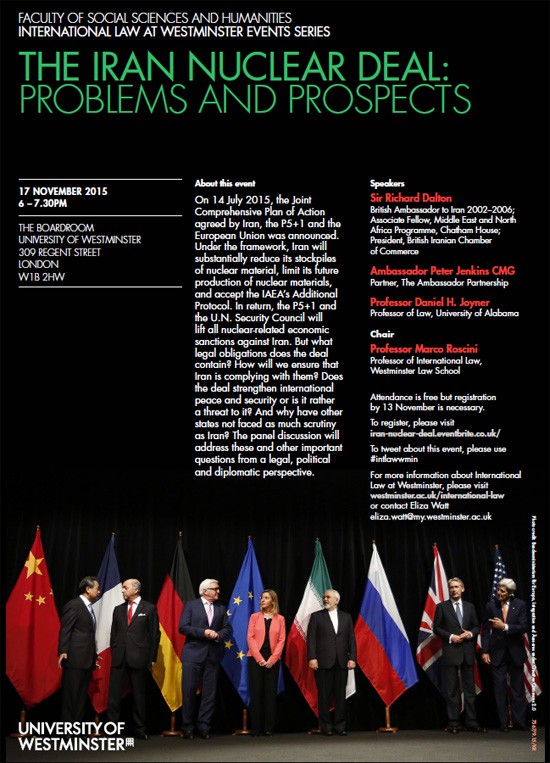
Panel on the Iran nuclear deal
Posted: October 1, 2015 Filed under: Nuclear | Tags: IAEA, Iran, NPT, nuclear security, nuclear weapon states, nuclear weapons Leave a commentOur followers in London and the UK will be interested in this panel on the Iran nuclear deal that will take place at the University of Westminster in London on 17 November. As you know, on 14 July 2015 the Joint Comprehensive Plan of Action agreed by Iran, the P5+1 and the European Union was announced. Under the framework, Iran will substantially reduce its stockpiles of nuclear material, limit its future production of nuclear materials, and accept the IAEA’s Additional Protocol. In return, the P5+1 and the UN Security Council will lift all nuclear-related economic sanctions against Iran. But what legal obligations does the deal contain? How will we ensure that Iran is complying with them? Does the deal strengthen international peace and security or is it rather a threat to it? And why have other nations not faced as much scrutiny as Iran? The panel discussion will address these and other important questions from a legal, political and diplomatic perspective.
Speakers include, in addition to our own Dan Joyner, Sir Richard Dalton (British Ambassador to Iran 2002-2006; Associate Fellow, Middle East and North Africa Programme, Chatham House; President, British Iranian Chamber of Commerce) and Ambassador Peter Jenkins, CMG (Partner, the Ambassador Partnership).
To register, please click here.
Innocence Slaughtered – Forthcoming book
Posted: September 25, 2015 Filed under: Chemical | Tags: 1899 Hague Declaration, 1925 Geneva Protocol, Chemical warfare, international law, World War 1 1 CommentThe introduction of chemical warfare to the battlefield on 22 April 1915 changed the face of total warfare. Not only did it bring science to combat, it was both the product of societal transformation and a shaper of the 20th century societies.
This collaborative work investigates the unfolding catastrophe that the unleashing of chlorine against the Allied positions meant for individual soldiers and civilians. It describes the hesitation on the German side about the effectiveness, and hence impact on combat operations of the weapon whilst reflecting on the lack of Allied response to the many intelligence pointers that something significant was afoot.
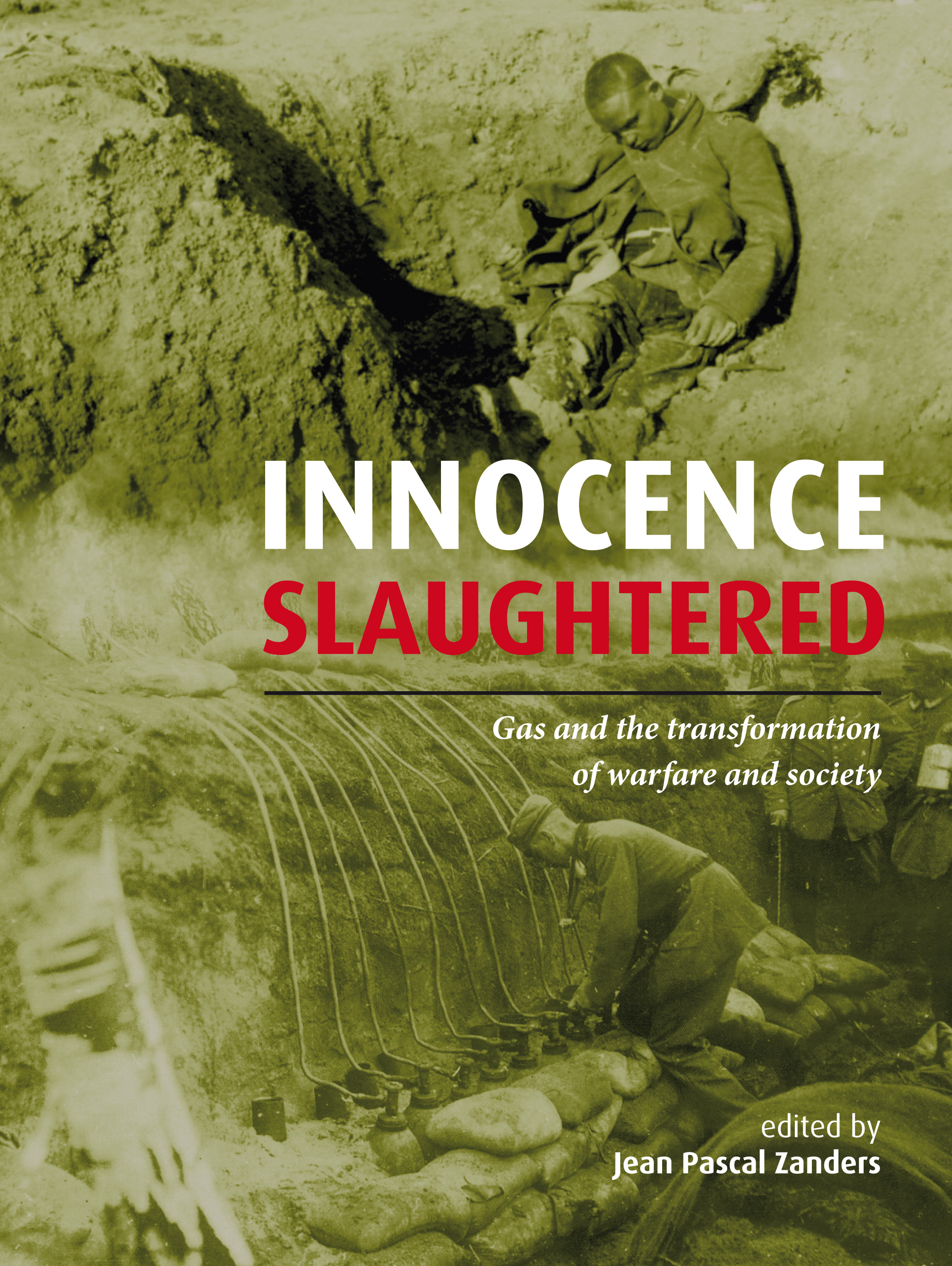
It goes on to describe the massive transformation that societies were undergoing as a consequence of industrialisation, science and technology, and the impact these trends were to have on the emergence of what we know today as ‘total war’. Chemical warfare pitted the brightest minds from the various belligerents against each other and in some ways this competition revealed early thinking about intellectual superiority that was to define the decades after the Armistice. The ability to survive in a chemically contaminated environment was proof of a higher level of achievement. In simple terms, chemical defence equalled survival of the fittest.
- Edited by Dr Jean Pascal Zanders
- Introduction by Ahmet Üzümcü, Director-General of the Organization for the Prohibition of Chemical Weapons (OPCW)
- To be published in December 2015
Table of Contents
- Ahmet Üzümcü (Director-General Organisation for the Prohibition of Chemical Weapons): Preface
- Jean Pascal Zanders: Introduction
- Jean Pascal Zanders: The Road to The Hague
- Olivier Lepick: Towards total war: Langemarck, 22 April 1915
- Luc Vandeweyer: The Belgian Army and the gas attack on 22 April 1915
- Dominiek Dendooven: 22 April 1915 – Eyewitness accounts of the first gas attack
- Julian Putkowski: Toxic Shock: The British Army’s reaction to German poison gas during the Second Battle of Ypres
- David Omissi: The Indian Army at the Second Battle of Ypres
- Bert Heyvaert: Phosgene in the Ypres Salient: 19 December 1915
- Gerard Oram: A War on Terror: Gas, British morale, and reporting the war in Wales
- Wolfgang Wietzker: Gas Warfare in 1915 and the German press
- Peter van den Dungen: Civil Resistance to chemical warfare in the 1st World War
- Leo van Bergen and Maartje Abbenhuis: Man-monkey, monkey-man: Neutrality and the discussions about the ‘inhumanity’ of poison gas in the Netherlands and International Committee of the Red Cross
- Jean Pascal Zanders: The road to Geneva
Becoming the largest weapon-control treaty
Posted: September 22, 2015 Filed under: Chemical | Tags: Angola, CWC, Egypt, Israel, Middle East, OPCW, Palestine, Universalisation 3 Comments[Cross-posted from The Trench]
The Organisation for the Prohibition of Chemical Weapons (OPCW) has just announced the accession of Angola to the Chemical Weapons Convention (CWC). The country deposited its instrument of accession with the UN Secretary-General on 16 September, which means that it will become a party to the CWC 30 days later, that is, 16 October.
Angola will thus be the 192nd state to join the OPCW. No other treaty limiting possession or use of a particular type of weaponry can boast that many parties. The Non-Proliferation Treaty (NPT) has 191; the Biological and Toxin Weapons Convention (BTWC) 173.
Middle East – The hard nut
According to the OPCW statement, only four states now remain outside the treaty: Egypt, Israel, North Korea and South Sudan.
North Korea presents the simplest problem. There is no diplomatic interaction at all, so expectations that Pyongyang will join the CWC any time soon are as good as zero.
Some optimism exists about South Sudan. Efforts are underway to secure succession (Sudan has been a party since June 1999) as part of a broader package that includes offers of assistance to rebuild the war-torn state. Having said that, the date of OPCW membership keeps getting pushed back into a less definite future in parallel with the floundering efforts to bring peace to the country.
Egypt remains of course obsessed by Israel’s nuclear weapons, while Israel continues to fail to see any benefits in collective security in its pursuit of a peace-first policy in a region that seems to be descending ever further into violence and instability. The fact of the matter is that neither country would lose an iota of national security by joining the CWC; quite on the contrary. Symbolism can be a powerful demotivator …
And what about Palestine?
Among the NPT’s membership is the State of Palestine, which acceded to the treaty as the 191st party in February 2015. It deposited its instrument of accession in London and Moscow (but not Washington). On 10 September the UN General Assembly voted to fly the Palestinian flag outside the UN building—together with that of another non-member observer state maintaining a permanent observer mission at the UN Headquarters, the Holy See.
OPCW statements do not list this Palestine in its statements on universality. It should be noted that UN membership is not a precondition for becoming a party to the CWC. Article XX speaks about accession of ‘any state’; Article XXIII designates the UN Secretary-General as depository and provides no grounds for rejecting any state. The Vatican joined the CWC in June 1999.
As far as I know, Palestinian authorities have not made any statements about acceding to the CWC. It may be that some low-level contacts are taking place between the OPCW and the Palestinian Mission to the EU in Brussels, but if this is the case, it is definitely not yet causing any ripples.
Is there an abundance of caution as a consequence of US laws that defund UN agencies that accept Palestine as a full member, thereby seemingly legitimising its quest for full statehood? While it is true the the USA is the single biggest contributor to the OPCW budget, reality is that (1) the OPCW is not a UN agency, and (2) as noted above, the CWC is not an invitation-only club. Unlike, for example, the UN Educational, Scientific and Cultural Organization (UNESCO), OPCW members do not get to vote on the accession of another state.
So, for the OPCW, four or five more countries before full universality, that’s the question!
Amano Visits Parchin
Posted: September 21, 2015 Filed under: Nuclear 29 CommentsJust a quick post to note that IAEA DG Amano announced on Sunday that he has personally visited the Parchin facility, including the building that has been the subject of so much speculation regarding it’s alleged use as a testing space for nuclear explosive initiators. In a statement about his visit, he said that he and his team were allowed into the building, and that environmental tests were performed in collaboration with Iranian technicians. This was the first time that the IAEA had visited this particular building, though it had visited the Parchin facility twice previously.
The political significance of the DG’s visit to this part of the Parchin facility is huge. It is almost certainly supposed to represent the capstone being placed upon the IAEA’s investigation of the site and it’s role in the agency’s PMD inquiry. And as the Parchin facility has been the most visible and specific part of the agency’s PMD allegations against Iran since the DG’s November 2011 report, this visit appears highly politically symbolic in also marking the beginning of the end of the IAEA’s PMD inquiry as a whole. The JCPOA, of course, provides that the DG must submit a report on the PMD issue to the IAEA BOG by December 15, 2015, upon receipt of which the BOG is supposed to act “with a view to closing the issue.” So the DG’s visit to Parchin would seem to be a communication that everything is moving forward toward this outcome, as planned.
I and others have written a lot about the PMD issue, and the Parchin facility specifically, on this blog over the past few years. I’ve argued all along that the PMD issue was both inappropriate as a subject for the IAEA to be investigating, and overblown in the significance attached to it by many observers (e.g. David Albright, Mark Hibbs). It has been very gratifying to me over the past year or so to see that my view of the PMD issue – i.e. that it should be pragmatically dealt with and the IAEA investigation expeditiously ended – has been the view adopted by the P5+1 negotiators, and eventually by the IAEA itself. This outcome will certainly not satisfy those who pushed so hard for Iran to be required to completely capitulate and confess every detail of its nuclear research programs. But it is the right outcome of an issue that should never have been made into an issue by the IAEA in the first place, and which has demonstrated serious problems regarding the IAEA’s own understanding of its legal mandate, and its utilization of third-party intelligence information.
I will be very pleased to see the PMD issue put to rest, so that the more meaningful and productive issues of forward-looking safeguards on Iran’s nuclear program can be focused on.
Reviewing Parchin
Posted: August 16, 2015 Filed under: Nuclear 37 Comments
Reviewing Parchin
By: Dr. Yousaf Butt
Yousaf Butt, a nuclear physicist, is senior scientific advisor to the British American Security Information Council (BASIC) in London. The views expressed here are his own.
Given some of the exchanges taking place last week, the UN might be concerned about the possibility of the Parchin military complex in Iran triggering an all-out rhetorical war in the non-proliferation community.
Parchin is, of course, the military site in Iran where conventional explosives testing possibly relevant to nuclear weapons research is alleged to have taken place, more than a decade ago.
According to information reportedly leaked by some elements within the US intelligence community, Iran may be attempting to “clean up the site ahead of planned inspections by the IAEA.”
But can Iran really do that by carrying out paving or construction at the site as some commentators have alleged for years? If future IAEA inspections reveal nothing of concern at the site – as past IAEA inspections there did – does this mean Iran succeeded in its alleged sanitization? Or could it be that the IAEA is targeting the wrong building again – like it appears to have done two times in 2005? Or would it simply mean there is no evidence to support the allegations?
Recently, a lot has been made about the location of parked vehicles at Parchin. Should one care where on the site Iran parks cars and bulldozers?
To help answer such questions, here are some simple technical guidelines and some background information:
1. In a case like Parchin – where the IAEA says there is a known building of interest – sampling is best done indoors within that building using swipe samples. External (outdoors) sampling can complement this but is of less intrinsic interest.
2. Tehran cannot sanitize the inside of buildings using paving or bulldozers outside the building. Public satellite imagery released to-date does not tell us whether Tehran has attempted sanitization within the building(s) of interest.
3. In any case, complete sanitization within buildings where work with nuclear materials has taken place is almost impossible to accomplish. The Agency itself states:
Any nuclear process … will also produce particulate materials with particle dimensions in the 0.1 [to] 10 micrometer range. Such small particles are believed to be quite mobile and will travel several meters from their point of origin due to air currents or human activity. This mobility also makes it extremely difficult to clean up an area to such an extent that no particles remain available for swipe sampling. [emphasis added]
4. The location where vehicles are parked, absent other information, is not indicative of very much.
5. The IAEA has visited Parchin twice before and found nothing of concern, possibly because they were targeting the wrong building(s) before, or because there is no actual evidence of nuclear-materials related research at Parchin. The IAEA then stated:
The Agency was given free access to those buildings and their surroundings and was allowed to take environmental samples, the results of which did not indicate the presence of nuclear material, nor did the Agency see any relevant dual use equipment or materials in the locations visited.
If the IAEA happened to be targeting the wrong buildings before, it could also be targeting the wrong building(s) now. The intel the Agency was/is relying on for its allegations appears to be not very solid. Hopefully, the protocol worked out between Iran and the IAEA at the conclusion of the JCPOA provides a framework to reach a quick final conclusion.
6. The IAEA had the possibility to access the current building of interest in 2005 but did not go there then, by choice. Olli Heinonen was head of IAEA safeguards at the time and led the inspections – he described the methodology of choosing which buildings to inspect:
At the time, it[Parchin] was divided into four geographical sectors by the Iranians. Using satellite and other data, inspectors were allowed by the Iranians to choose any sector, and then to visit any building inside that sector. Those 2005 inspections included more than five buildings each, and soil and environmental sampling. They yielded nothing suspicious, but did not include the building now of interest to the IAEA. The selection [of target buildings] did not take place in advance, it took place just when we arrived, so all of Parchin was available….When we drove there and arrived, we told them which building. [emphasis added]
7. Dr. El Baradei who was head of the IAEA when the Parchin and the “Alleged Studies” (now known as PMD) file first surfaced had reservations about the quality of the intel involved, stating: “The IAEA is not making any judgment at all whether Iran even had weaponisation studies before [2003] because there is a major question of authenticity of the documents.” [emphasis added]
To sum up: the most important place to take swipe samples would be on the inside of the building(s) of interest. Construction and paving work outside or the locations of parked vehicles is not of great intrinsic importance, absent other information.
One hopes that the IAEA is indeed targeting the correct building(s) now so that a positive or negative swipe result from inside the building(s) will settle the case quickly and definitively. Incidentally, a negative result would not mean that Iran managed to sanitize the site because the most important sampling would be done indoors where it is almost impossible to get rid of evidence of nuclear materials use.
ABA Journal Seeking Nominations for this Year’s Blawg 100
Posted: August 14, 2015 Filed under: Nuclear 2 CommentsI’m getting around to this a little bit late this year. My apologies for that. The ABA Journal’s request for nominations can be found here.
If a few of you readers wouldn’t mind to nominate ACL, I’d be grateful. I know it’s not a big deal in the broad scheme of things, but it’s been a really nice validation of our work on the blog the past two years to be included on the list.
NOMINATIONS ARE DUE BY AUGUST 16! SO PLEASE NOMINATE TODAY.
Thanks in advance to everyone who takes the time.
 Arms Control Law