Rauf and Kelley on the PMD Report and the IAEA Intel Problem
Posted: December 16, 2015 Filed under: Nuclear 2 CommentsTariq Rauf and Bob Kelley’s new SIPRI report providing an analysis of the IAEA PMD report is a must read. The two former IAEA insiders give a rigorous and critical review of the technical findings of the IAEA in both the original 2011 PMD report, and now in the final 2015 PMD report. You won’t find this kind of serious and independent review from the normal DC think tank crowd.
Rauf and Kelley further give some overall critical observations about culture and and administrative paradigm clashes in the IAEA, and then particularly focus on a problem that I and others have pointed to as well over the years – the increased recent reliance by the IAEA secretariat on intelligence information provided to it by third party member states. Here’s their conclusion and recommendations:
A structural weakness of the IAEA is that there is no transparent process for the supply of intelligence information and confirmation of its authenticity. The usual process is for the Member State(s) to provide the intelligence information either in documentation or electronic form to a special assistant in the Director General’s office and/or to the Deputy Director General for Safeguards, alternatively to give a closed briefing in its embassy/mission. The IAEA then deals with the information as described in an earlier section above. There is no established process to share such information with the accused State or with the BoG. In 1993, however, the IAEA Secretariat was allowed by the US to show classified satellite imagery provided by the US to the Board in a technical briefing. To the authors’ knowledge this modality has not been repeated.
The supply and use of intelligence information is a sensitive yet complex issue as noted in the excerpt from an IAEA BoG Governor cited in an earlier section above. The IAEA cannot serve as a feedback loop to intelligence agencies on the veracity of information provided by them through safeguards inspections and assessments. Nor can or should the IAEA rely on such information without confirming its authenticity. This obviously leaves the IAEA in a difficult position as is clearly evidenced by the Iran PMD file where the Agency seems to have been caught short.
RecommendationsThe authors recommend that the BoG put in place a methodology for the acceptance and use of intelligence information drawing from the practices of the Organization for the Prohibition of Chemical Weapons (OPCW) and the Comprehensive Nuclear-Test-Ban Treaty Organization (CTBTO). In these two organizations, allegations of non-compliance can be raised by any State Party which provides its information to the Director General, who in turn shares it with the Executive Council. The Executive Council is convened; the Accuser State puts forward its case on allegations of non-compliance or suspicious activities in another State along with supporting information/evidence. The Accused State has the opportunity to present its defence. Following deliberations, the Executive Council can stop a challenge inspection in the case of the OPCW or authorize an on-site inspection in the case of the CTBTO. Such a practice could serve the IAEA well – the Accuser State to provide information to the IAEA Director General, who then shares it with the BoG, the Board convenes to examine the in formation presented by both the Accuser and Accused States and then to decide on the way forward preferably on the basis of consensus but by a vote if necessary. In fact, the JCPOA contains a somewhat similar provision for the Joint Commission in paragraph 36 on dispute resolution, and as noted previously in 1993, the IAEA Secretariat presented satellite imagery on DPRK from the U.S. to the Board of Governors.
It is essential that the IAEA BoG expeditiously comes up with a mechanism governing the provision and handling of intelligence information to the IAEA Secretariat. There is great potential for misuse of such information and of suborning the independence of the Agency in the absence of such a mechanism, as abundantly demonstrated by the cases of Iraq, Iran and Syria in recent time.
Technical and Diplomatic Analysis of the IAEA PMD Report
Posted: December 11, 2015 Filed under: Nuclear 34 CommentsI wanted to follow up about the new IAEA PMD report by pointing to a couple of very good analytical pieces that have been written about it from, respectively, technical and diplomatic perspectives. Both are at Lobelog:
Robert Kelley’s technical piece here,
and Peter Jenkins’ diplomatic/political piece here.
I highly recommend both. They are a breath of fresh air compared to most of the think tank commentary going on right now.
I really try to stay away from personally commenting on technical questions that come up in the nuclear nonproliferation area. I try to be very careful in recognizing that I am simply not qualified to provide my own original analysis on such technical questions. This is precisely the kind of self-awareness that I don’t see in far too many members of the arms control think tank community who, with either no or thin legal education qualifications, have zero qualms about confidently asserting their own original analysis of legal questions.
In that vein of prudential personal reserve, I will not comment at length about Jeffrey Lewis’ new piece over at Foreign Policy, in which he interprets the IAEA PMD report as having made
a straightforward assertion that Iran attempted to build a nuclear weapon prior to 2003.
But let’s do remember what the report actually concluded:
The Agency assesses that a range of activities relevant to the development of a nuclear explosive device were conducted in Iran prior to the end of 2003 as a coordinated effort, and some activities took place after 2003. The Agency also assesses that these activities did not advance beyond feasibility and scientific studies, and the acquisition of certain relevant technical competences and capabilities. The Agency has no credible indications of activities in Iran relevant to the development of a nuclear explosive device after 2009.
The Agency has found no credible indications of the diversion of nuclear material in connection with the possible military dimensions to Iran’s nuclear programme.
Again, from a non-technical-specialist point of view, it seems to me that Lewis is overstating the case. I don’t see that the PMD report findings substantiate an assertion that, prior to 2003, Iran was in fact attempting to build a nuclear weapon – as if there was a full blown Iranian Manhattan Project going on.
It seems to me that a more reasonable and responsible interpretation of the technical findings of the PMD report would be that Iran was, prior to that date, engaging in a coordinated effort to gain the technical capability necessary to build a nuclear bomb, should the political decision at some point be made to do so. Again, the report says that the agency found “no credible indications of the diversion of nuclear material” to this capacity building R&D program. So they apparently weren’t actually experimenting with nuclear material at any point. And the report further says that “these activities did not advance beyond feasibility and scientific studies.” Again, this doesn’t seem to support the identification of an intent to in fact manufacture, or at least attempt to manufacture, a nuclear weapon. It seems to me that this identification is an unwarranted assumption, in a case where other intentions are just as persuasively indicated.
That’s all I’ll say. Perhaps technical specialist types can chime in in the comments section. I do think, though, that it is important to be as clear as we can be about what the PMD report actually says, and what we should understand about Iran’s past weaponization program. I’ll mostly leave it to the likes of Bob Kelley and other actually qualified people to provide that interpretation. But Lewis’ assertion struck me as particularly excessive and unsupported by what the report actually says.
The Ethiopian Yearbook of International Law (EtYIL)
Posted: December 11, 2015 Filed under: Miscellaneous Leave a commentWe are pleased to share the birth of our new Yearbook.
The Ethiopian Yearbook of International Law (EtYIL) is a peer-reviewed academic journal that publishes scholarly works of the highest standard in the field of international law broadly defined, but with a focus on Ethiopia and the Horn of Africa region. For more information please see http://www.springer.com/series/15093 . The first edition of the EtYIL is due for publication in 2016. It is a pleasure to invite you to submit ideas, abstracts and manuscripts for the 2017 edition of the Yearbook. To do so please contact the Editorial Team at ethiopianyearbook@gmail.com“
The JCPOA and the Broader Conclusion
Posted: December 8, 2015 Filed under: Nuclear 4 CommentsI wanted to note a new piece up at Arms Control Wonk by Andreas Persbo. Andreas is an old colleague and we have collegially crossed swords many times over the years.
I wanted in that same spirit to make a few observations about his most recent piece, in which he also cites a piece by Mark Hibbs on the same subject.
What I wanted to make sure is clear to everyone is that the JCPOA at no point commits Iran to strive towards or to achieve the IAEA’s determination of a “broader conclusion that all nuclear material in Iran remain in peaceful activities.” Nor does the JCPOA at any point make the granting of such a broader conclusion by the IAEA a condition for the fulfillment of any commitment either by Iran or by any other party to the JCPOA. This includes the lifting of sanctions by the Security Council and by the U.S. and E.U.
The broader conclusion is sometimes mentioned in the JCPOA schedule as an alternative criterion, for example here:
The EU will terminate all provisions of the EU Regulation implementing all EU proliferation-related sanctions, including related designations, 8 years after Adoption Day or when the IAEA has reached the Broader Conclusion that all nuclear material in Iran remains in peaceful activities, whichever is earlier.
But achieving this standard of a broader conclusion being granted by the IAEA, is not incumbent upon Iran under the JCPOA, either now or at any time in the future. Nor indeed is it legally incumbent upon any state, including Iran, and including those states who are party to both an INFCIRC/153 CSA and an INFCIRC/540 Additional Protocol.
According to the 2014 IAEA Safeguards Implementation Report, there are currently 53 states that are party to both a CSA and an AP, and which have not received a broader conclusion from the IAEA (see pg. 23 of the report). Not having received a broader conclusion is not itself an indication of noncompliance with a safeguarded state’s safeguards obligations.
The only legal obligations which safeguarded states have are expressed in the safeguards treaties to which they are parties. And the central legal obligation of any safeguarded state, along with the exclusive purpose for the application of IAEA safeguards, is expressed in Articles I & II of the CSA as follows:
Article I
The Government of ___ undertakes, pursuant to paragraph 1 of Article III of the Treaty, to accept safeguards, in accordance with the terms of this Agreement, on all source or special fissionable material in all peaceful nuclear activities within its territory, under its jurisdiction or carried out under its control anywhere, for the exclusive purpose of verifying that such material is not diverted to nuclear weapons or other nuclear explosive devices.
Article II
The Agency shall have the right and the obligation to ensure that safeguards will be applied, in accordance with the terms of this Agreement, on all source or special fissionable material in all peaceful nuclear activities within the territory of ___, under its jurisdiction or carried out under its control anywhere, for the exclusive purpose of verifying that such material is not diverted to nuclear weapons or other nuclear explosive devices.
IAEA safeguards are applied “for the exclusive purpose of verifying that [safeguardable nuclear material in peaceful uses] is not diverted to nuclear weapons or other nuclear explosive devices.” That is the only legal mandate that the IAEA has pursuant to safeguards treaties. And do not be confused – this central legal obligation on the safeguarded state, and this exclusive purpose for the application of IAEA safeguards, does not change when a state supplements its CSA with an Additional Protocol. The AP does add discrete legal obligations for the safeguarded state with regard to declaration and access, and adds to the IAEA’s legal authority to investigate and assess the question of whether there are undeclared nuclear materials or related facilities on the territory of the safeguarded state. But the AP does not change the central legal obligation of the state, nor the exclusive purpose for the application of IAEA safeguards, which are expressed in Articles I & II of the CSA. The Additional Protocol is, after all, simply an attachment to the CSA, and preserves its core principles.
The idea of the IAEA making a broader conclusion that all nuclear material in a safeguarded state remain in peaceful activities, as a safeguards implementation standard, is a completely sui generis creation of IAEA institutional policy, and does not reflect an actual legal obligation of safeguarded states, whether they are party to the AP or not. You will not find this standard expressed in the text of either the CSA or the AP.
To have a broader conclusion made about a safeguarded state’s nuclear program is certainly a laudable goal for the state, but it is not a legal obligation for the state. And for Iran, it plays no necessary role in the implementation of the JCPOA.
I just wanted to be clear on this point, because both Persbo and Hibbs don’t mention this fact, and seem to write about the broader conclusion, as many other observers do, as if it is something that Iran has to achieve under the JCPOA. It’s a nice goal, but it’s not a requirement either under the JCPOA, or for that matter under safeguards law.
Understanding the Dutch export licence requirement for publishing life science research
Posted: December 6, 2015 Filed under: Biological | Tags: BTWC, Dual-use research, Export controls, H5N1, Netherlands, Science, Terrorism Leave a comment[Cross-posted from The Trench]
During the Meeting of Experts of states parties to the Biological and Toxin Weapons Convention (BTWC) last August, the Netherlands organised or co-hosted three side events relating to safeguarding the life sciences. A significant incident, in which the Dutch virologist Ron Fouchier and his team were required to obtain an export licence to publish their research on how they had mutated H5N1 into an aerosol-transmissible avian influenza virus variant, undeniably informed the need to clarify national policies and approaches to biorisk management. A month earlier the Appellate Court had annulled the ruling by a lower court in support of the government position on procedural grounds. Does this annulment validate the Dutch government’s position or does it imply that the whole debate about the publication of so-called dual-use research in the life sciences is back to square one? Moreover, in the meantime the debate had evolved from a terrorist proliferation risk to one of health security in which the ethics and utility of this type of gain-of-function research stand central. In other words, do biosafety worries warrant biosecurity policy measures, such as the imposition of non-proliferation export controls?
Some background to the Netherlands decision
In September 2011 the European Scientific Working Group on Influenza (ESWI) held its fourth conference in Malta. Europe and the world were then confronting an outbreak of avian influenza caused by the H5N1 virus. Its rapid spread among birds over long distances caused governments worldwide to order drastic measures in efforts to stem the epidemic. Over 500 humans (representing some 60% of all people who had contracted the disease) had already died, but all deaths thus far had resulted from direct interaction with fowl and not from human-to-human transmission.
In Malta Ron Fouchier announced that he and his team at the Erasmus Medical Center in Rotterdam had succeeded in transforming H5N1 into a viable aerosol virus. According one conference report he applied rather colourful language: his team ‘mutated the hell out of H5N1’. The discovery that it required as few as three single mutations to gain the ability to latch onto cells in the nasal and tracheal passageways, he described as ‘very bad news’. Transmission among ferrets, a mammal that offers the best laboratory model to study influenza in humans, still did not occur easily when, in Fouchier’s recorded words, ‘someone finally convinced me to do something really, really stupid’. They provoked two further mutations by transferring mutated viruses from the nose of one sick ferret to that of a healthy one, in the process creating the viable aerosol virus.
Initial articles on the gain-of-function research did not suggest any link with bioterrorism, but sometimes carried dramatic titles evoking cataclysmic consequences reminiscent of the 1918 Spanish flu epidemic that killed tens of millions worldwide. However, Fouchier’s dramatic speech caught the attention of counter-terrorism officials on both sides of the Atlantic. When he offered his research results for publication in Science, the US National Science Advisory Board for Biosecurity (NSABB) intervened and eventually accepted publication provided some methodological details were removed from the text. (A parallel paper on H5N1 submitted to Nature by a team led by US scientist Yoshihiro Kawaoka fared a similar fate.) NSABB considered the biosecurity risks outweighed any scientific merit in this type of research: rogue laboratory researchers or terrorists might wish to unleash the deadly virus on the human race to devastating effect.
NSABB’s intervention caused controversy with one side calling it censorship and the other side up in arms that publication had been authorised at all. In the United States, self-publication on the internet was not legally restricted at the time. In the Netherlands too the affair had caught the attention of authorities, many of whom wanted to block publication outright, but lacked the appropriate legal tools to do so. The only way to appraise the risks for malfeasance posed by information in the research manuscript was to implement non-proliferation export controls, which according to European Union regulations must be enforced for applied (but not fundamental) research in the life sciences.
The Netherlands decision caused shockwaves among European life scientists. After initial defiance, Fouchier and his team eventually applied for and received an export licence. Otherwise he might have faced up to six years imprisonment and $102,000 in fines. The Erasmus Medical Center subsequently took the government to court to have the principle of export licences for scientific research overturned. On 20 September 2013 the District Court of North Holland ruled in favour of the government, but on 15 July 2015 the Appellate Court in Amsterdam annulled the ruling, saying that the case was without merit in view of the application and granting of an export licence. Put differently, the lower court should have never taken up the case. As presented during the BTWC Meeting of Experts in August 2015, the Dutch Government believes that the juridical process vindicated its approach to research with potential dual-use implications.
IAEA PMD REPORT OUT. Official Copy and Initial Legal Observations
Posted: December 2, 2015 Filed under: Nuclear 17 CommentsHere it is, folks:
I’m still reading over it myself, but here’s the punchline from the Summary section:
The Agency assesses that a range of activities relevant to the development of a nuclear explosive device were conducted in Iran prior to the end of 2003 as a coordinated effort, and some activities took place after 2003. The Agency also assesses that these activities did not advance beyond feasibility and scientific studies, and the acquisition of certain relevant technical competences and capabilities. The Agency has no credible indications of activities in Iran relevant to the development of a nuclear explosive device after 2009.
The Agency has found no credible indications of the diversion of nuclear material in connection with the possible military dimensions to Iran’s nuclear programme.
I’ll have more to say on this in the coming days, and will try to get some technical folks to do guest posts. But my first reaction from a legal perspective is:
1. The IAEA has in effect now given its opinion that Iran has not violated NPT Article II through any of the alleged PMD activities, because none of the assessed activities can be said to rise to the prohibited level of the manufacture or other acquisition of a nuclear explosive device.
2. Since the IAEA has now assessed that none of the alleged PMD activities involved the diversion of nuclear material from peaceful to military uses, it has in effect determined that none of these activities constituted a violation of Iran’s safeguards obligations. As Article 1 of Iran’s comprehensive safeguards agreement makes explicit, the IAEA’s safeguards activities in Iran are implemented “for the exclusive purpose of verifying that such material is not diverted to nuclear weapons or other nuclear explosive devices.”
3. This second subject, regarding the diversion of nuclear material from peaceful to military uses, is in fact the only subject that the IAEA had any legal authority to investigate and assess.
Arms Control Law among the ABA Journal’s Blawg 100 Again!
Posted: November 30, 2015 Filed under: Nuclear 3 CommentsI just got word recently that Arms Control Law has been chosen once again for the American Bar Association Journal’s Blawg 100 list, as one of the top 100 best blogs for a legal audience. You can see the new list here. This marks the third year in a row that ACL has received this distinction.
I want to thank everyone who took the time to nominate ACL for this recognition again. I really appreciate it.
I’d also like to thank all of the contributors to the blog who have written pieces in the past year. I’d like to particularly recognize Jean-Pascal Zanders, whose pieces on CBW have been fascinating.
I know I haven’t written a lot just lately on ACL. It’s been my heavy teaching semester this Fall and I’ve been traveling some. But I have been making some plans for the blog going forward that I’ll announce more formally soon. They include a new podcast series that I’ve been developing with the IT staff here at Alabama Law. I think that will be an exciting new feature.
For those interested, my book on Iran is in the final stages of writing. I had to step back a bit from the manuscript when the JCPOA was announced this summer. I was actually just about done with the manuscript when the deal was announced. But my publisher and I eventually agreed that it would be best to hold off publication until I could write a serious final chapter covering the JCPOA and its legal implications. That has meant monitoring the implementation of the JCPOA closely, and trying to choose a moment when the deal is solidified in its status to write the final chapter. I think we’re fast approaching that point now, with the IAEA report on PMD due this week, setting the stage for the likely occurrence of Implementation Day during January or February. So I hope to have the manuscript done within the next month or so. This will (hopefully) mean that the book will be in print by May-June. I’m trying to convince OUP that the book will appeal to a broad enough audience to justify a paperback edition and a hardback edition. I really want the book to be widely read, and having a less-expensive paperback option would really aid in that.
I’m sure I’ll have some things to say about the IAEA PMD report when it comes out this week. So far we’re hearing that it won’t be definitive about whether Iran engaged in weaponization R&D pre-2003. France is not happy about that, but it seems that this is the pragmatic choice that has been made. Once the report comes out, the JCPOA says that “the E3+3, in their capacity as members of the Board of Governors, will submit a resolution to the Board of Governors for taking necessary action, with a view to closing the issue, without prejudice to the competence of the
Board of Governors.” (Italics added) So unless France is able and willing to seriously rock the boat, the BoG can be expected to close the PMD investigation in Iran within the next few weeks. Iran has said that it won’t move further toward implementing its commitments under the JCPOA until the PMD issue is closed. So, high drama still afoot and will be for the foreseeable future.
For now, I mostly just wanted to let readers know about the ABA Journal distinction and thank those who contributed to the blog in the past year.
More soon.
CW incidents alleged by the Syrian government: an industrial chemical as likely cause?
Posted: November 23, 2015 Filed under: Chemical | Tags: Chemical warfare, Chlorine, Investigation of use, OPCW, Sarin, Syria 1 Comment[Cross-posted from The Trench.]
My previous posting (16 November) presented the findings by the Fact-Finding Mission (FFM) of the Organisation for the Prohibition of Chemical Weapons (OPCW) concerning allegations of the use of chlorine as a chemical weapon in Syria’s Idlib Governorate. The FFM concluded that the incidents likely involved the use of a toxic chemical containing the element chlorine as a weapon.
This report was one of three that the Technical Secretariat of the OPCW transmitted to states party to the Chemical Weapons Convention (CWC) for consideration at a special session of the Executive Council on 23 November. The other two reports address allegations of mustard agent use at Marea in northern Syria and chlorine attacks against Syrian government forces around Damascus.
This contribution focusses on the latter investigation. Syria submitted four Notes Verbales alleging a total of 26 chemical weapon (CW) events resulting in 432 casualties. The first reported incident dates back as far as 19 March 2013; the most recent ones took place in May 2015.
The investigative team deployed to Syria on 1 June, 1 August and 13 October. It has not yet finalised its investigation and the interim report circulating among CWC states parties focusses primarily on one incident at Jobar (‘Jober’ as spellt in the report), a municipality northeast of the old town of Damascus, on 29 August 2014. Although the investigation is ongoing, the FFM
is of the view that those affected in the alleged incident may have been exposed to some type of non-persistent, irritating airborne substance, following the surface impact of two launched objects.
However, based on the evidence presented by the Syrian National Authority, the medical records that were reviewed, and the prevailing narrative of all of the interviews, the FFM cannot confidently determine whether or not a chemical was used as a weapon.
The FFM was unable to identify a specific irritant, but believes an industrial chemical may offer the most plausible explanation for the reviewed symptoms. It as good as ruled out use of chlorine or nerve agents in Jobar on 29 August 2014.
Conclusions about some other incidents reported by the Syrian government will be part of the final report.
Allegations by the Syrian government
The Syrian Deputy Minister for Foreign Affairs and Expatriates, who also heads the Syrian CWC National Authority, submitted Note Verbale 150 to the Technical Secretariat on 15 December 2014. The document alleges 10 separate CW incidents in four Damascus neighbourhoods between April and September 2014 that resulted in 92 casualties, all among military personnel.
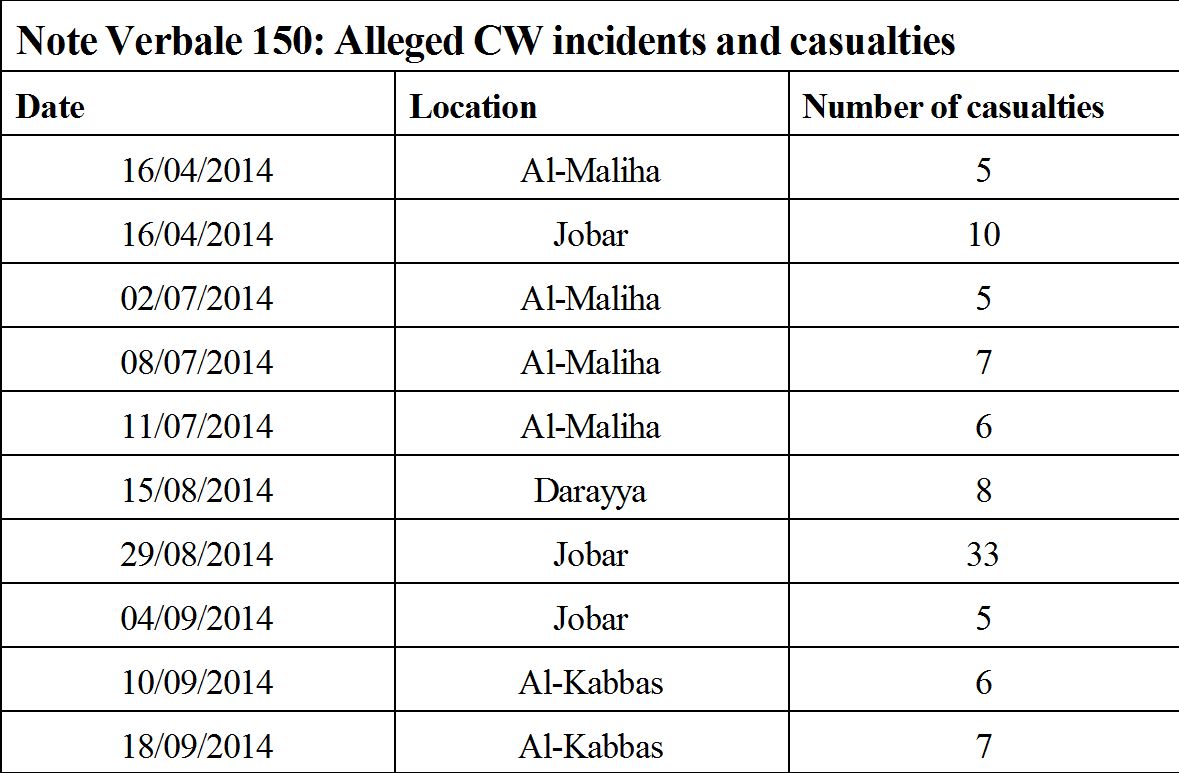
Summary of allegations in Note Verbale 150
Syria’s Permanent Mission to the OPCW delivered Note Verbale 41 to the Technical Secretariat on 29 May 2015. It lists 13 separate incidents, five of which preceded Syria’s accession to the CWC, four whose dates fall within the date range of Note Verbale 150 and an additional four that took place early in 2015. These attacks allegedly occurred in the areas surrounding Aleppo and Damascus. Although this note is less explicit about the nature of the victims, it lists a minimum of 317 casualties, including at least five civilians. The document offers details on suspected chlorine use. The Syrian authorities requested members of the advance team (who deployed to Syria from 25 to 29 May 2015) that these events be included in the scope of the FFM. That, however, proved impossible without a new mandate covering additional events.
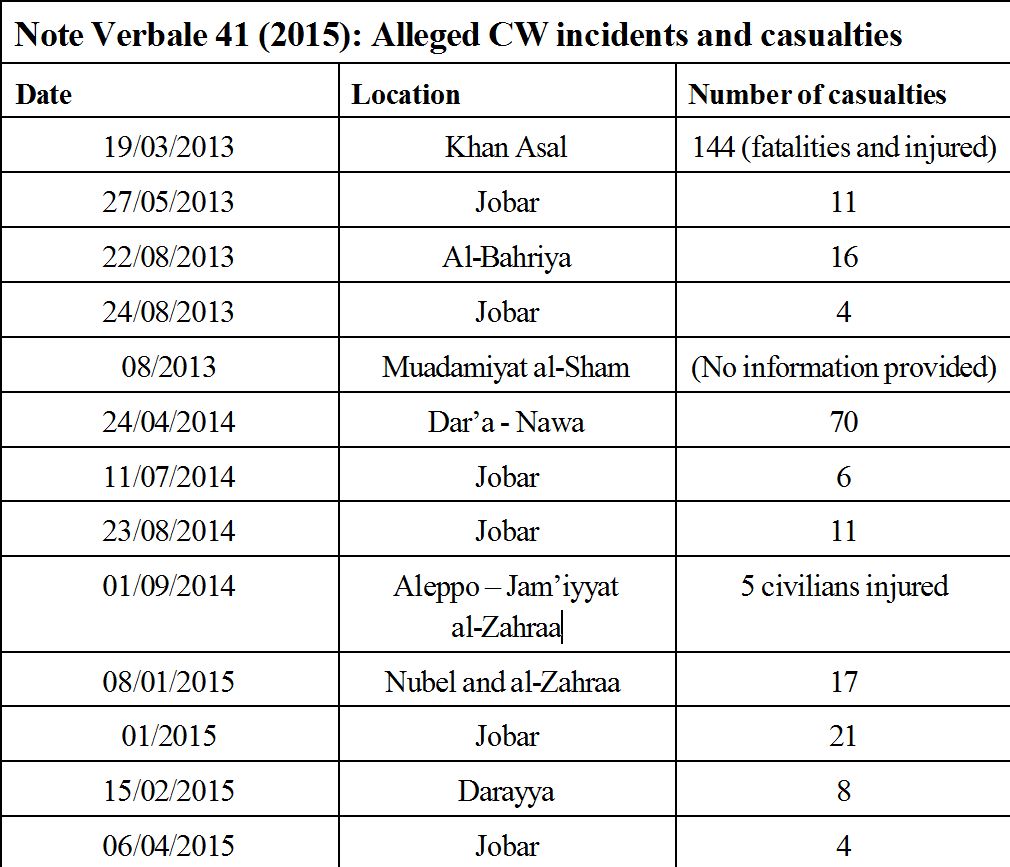
Summary of allegations in Note Verbale 41
It is interesting to note that some of the incidents predating Syria’s accession to the CWC had already been examined by the UN investigative team in August and September 2013. That investigation corroborated allegations of CW use at Khan Al Asal and described the incident as ‘a rapidly onsetting [sic] mass intoxication by an organophosphorous compound in the morning of the 19 March 2013’, but added that ‘the release of chemical weapons at the alleged site could not be independently verified in the absence of primary information on delivery systems and of environmental and biomedical samples collected and analysed under the chain of custody’.
The two other incidents alleged in Note Verbale 41 took place immediately after the infamous Ghouta attack of 21 August 2013 and had also been investigated by the UN team. Of the one at Al-Bahriya (spelt as Bahhariyeh in the UN report) on 22 August 2013, the UN team could not corroborate the allegation. Blood samples all tested negative for any known signatures of chemical warfare agents.
With respect to the incident at Jobar on 24 August 2013 the UN report confirmed a ‘relatively small scale’ use of sarin against soldiers. However, again ‘in the absence of primary information on the delivery system(s) and environmental samples collected and analysed under the chain of custody, the United Nations Mission could not establish the link between the victims, the alleged event and the alleged site’.
Note Verbale 41 is equally intriguing for the absence of several other alleged incidents between March and September 2013 investigated by the UN team. These presumably concerned the investigation requests by France, the UK and the USA included in the mandate of the investigators by UN Secretary-General Ban Ki-moon. Note Verbale 41 also lists some incidents not addressed by the UN team.
It is clear that the OPCW has all but ignored the allegations prior to Syria’s accession to the CWC.
Note Verbale 43 dated 3 June 2015 reports three additional incidents in May 2015.
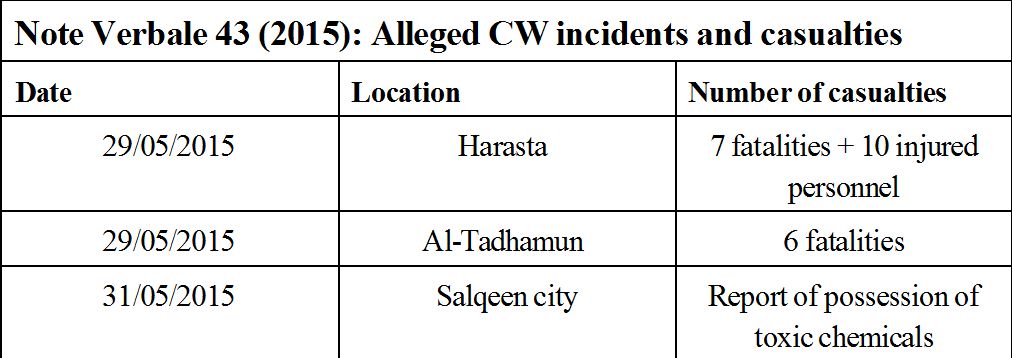
Summary of allegations in Note Verbale 43
Note Verbale 47 dated 15 June 2015 comprises six incidents that had already been mentioned in Note Verbale 41, but offers more background information, including greater detail on events, greater precision of sites of alleged attacks, and references to symptoms suffered by the exposed victims.
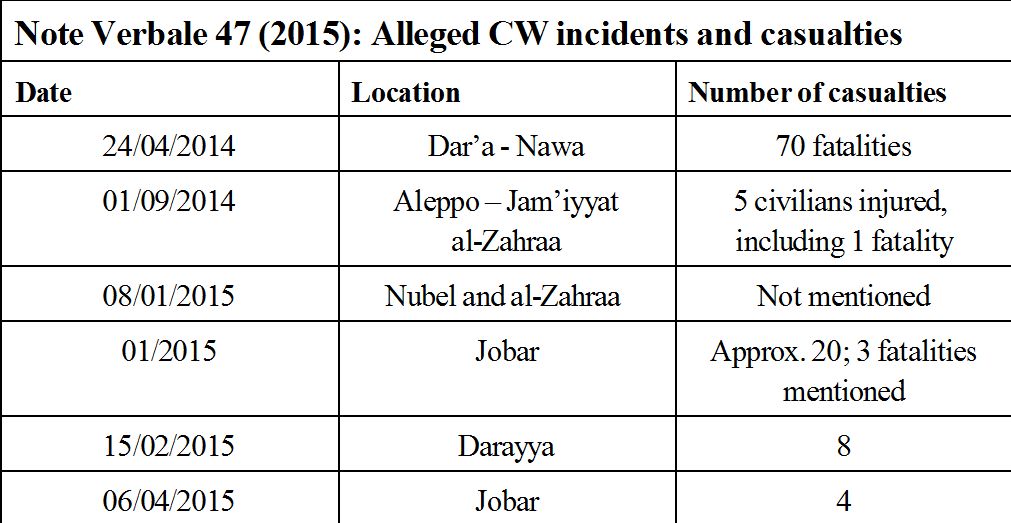
Summary of allegations in Note Verbale 47
Based on Notes Verbales 41, 43 and 47, the FFM was dispatched for a second investigative deployment.
Assessment of the alleged incidents
In view of the large number of allegations, the FFM was unable to investigate each one or had to sequence investigations based on the severity of allegations. Thus it was agreed with the Syrians that the FFM would focus initially on the Jobar event of 29 August 2014 because it involved the highest number of reported casualties in Note Verbale 150.
After receipt of the additional Notes Verbales, the FFM proposed additional investigation of two allegations in 2014 and one in 2015. Based on additional data supplied by the Syrian government, the investigative team eventually looked into five reported events during its second deployment: Al-Maliha on 16 April and 11 July 2014, Al-Kabbas on 10 September 2014, Nubel and al-Zahraa on 8 January 2015, and Darayya on 15 February 2015.
The report of 29 October indicates that the FFM completed its mandate for the Jobar investigation. It expresses considerable frustration about the dearth of additional evidence to support the allegation:
The FFM is of the opinion that it would have been able to be more precise in its findings if further objective evidence, complementing what was provided by the authorities of the Syrian Arab Republic, had been made available to the team. The FFM was not able to obtain hard evidence related to this incident, either because it was unavailable or because it was not generated in the first place. The lack of hard evidence precluded the FFM from gathering further facts in a definitive way.
While interviews with soldiers point to the possibility ‘of exposure to some type of non-persistent, airborne irritant secondary to the surface impact of two launched objects’, the FFM could not confidently determine whether such exposure might have resulted from the payload of the projectiles or from another source (propellant, a chemical stored in the area of impact, detonation products, etc.) because of insufficient evidence presented by Syria, insufficient details in reviewed medical records, and inconsistencies in the narratives of interviewees. So, the FFM concluded that:
while the general clinical presentation of those affected in the incident is consistent with brief exposure to any number of chemicals or environmental insults, the visual and olfactory description of the potential irritant does not clearly implicate any specific chemical.
This particular investigation was also hampered by the delay of some nine months between the alleged incident and the start of the mission. Notwithstanding, the FFM all but ruled out chlorine and organophosphorous compounds (e.g., sarin) as agents responsible for the described symptoms. High on the list of probabilities figures diBorane, which besides use as a rocket propellant also has application in electronic industries and the vulcanisation of rubber. As the report notes, these uses make it ‘relevant to the interests of a militarized non-state actor [and it is] also readily available in the region’. Many of the reviewed symptoms appear consistent with exposure to this non-persistent and volatile chemical.
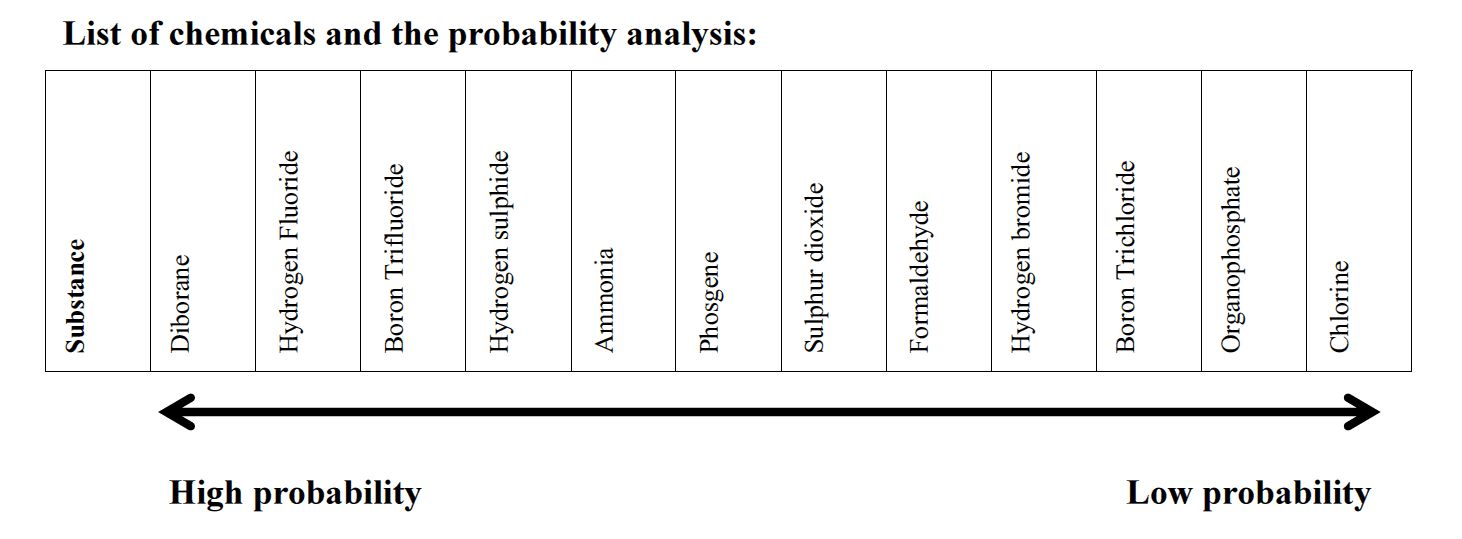
Jobar: Likelyhood of toxic chemicals to which victims might have been exposed (Source: OPCW)
The report on the allegations raised by the Syrian government is preliminary. The Jobar investigation is in the process of finalisation. The other mentioned incidents also remain under investigation pending final analysis. The interim report only contains an overview of activities undertaken until October 2015. These findings will also be included in the final report.
Innocence Slaughtered – Book launch at OPCW
Posted: November 19, 2015 Filed under: Chemical | Tags: Chemical warfare, OPCW, World War 1 Leave a comment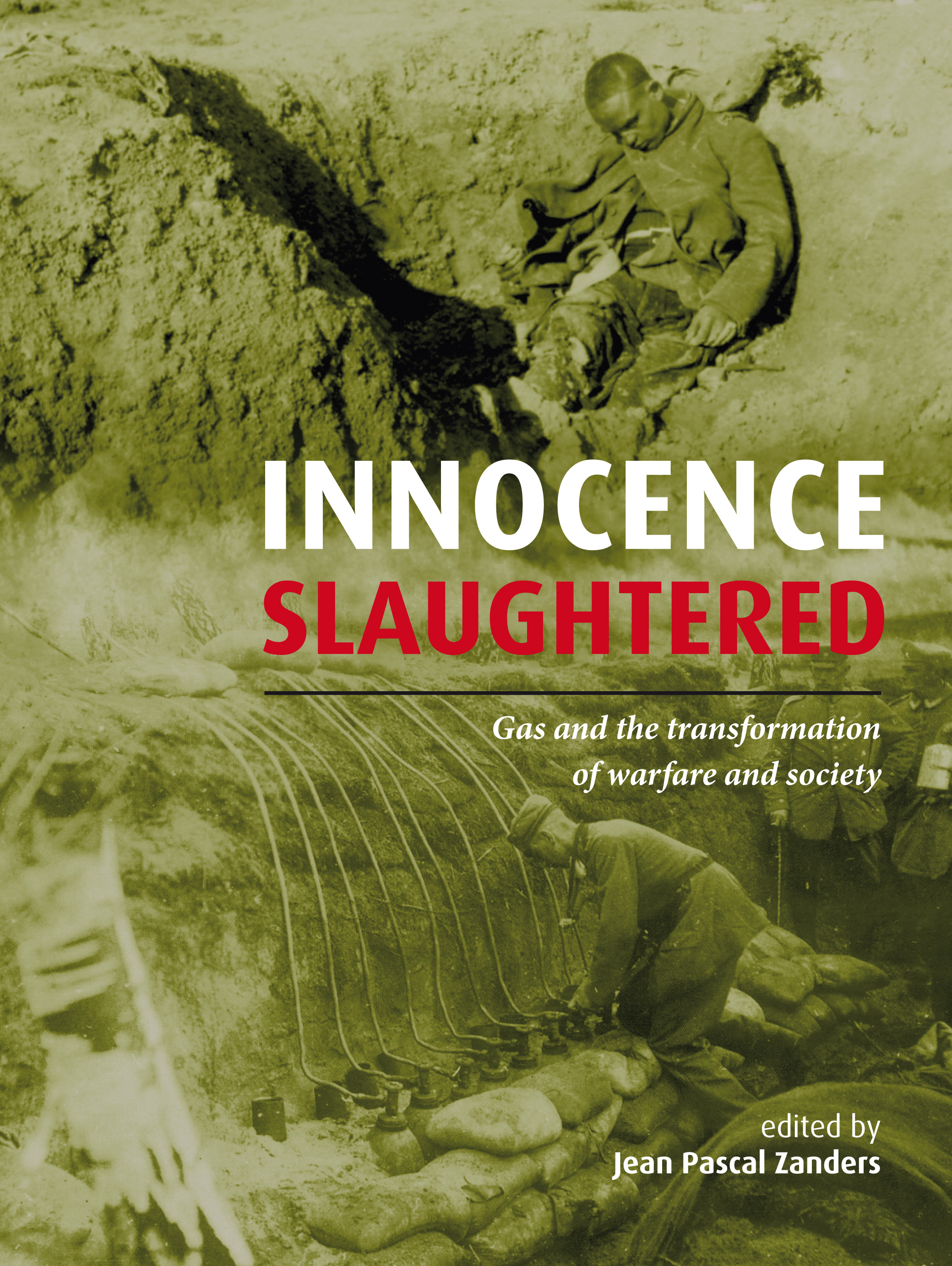 Described by Ambassador Ahmet Üzümcü, Director-General of the OPCW, as a ‘remarkable compilation of materials, rich in detail and edited in the finest traditions of highly readable scholarship’, Innocence Slaughtered is a new book that will launch with a panel discussion on 2 December, from 13.00-15.00 at this year’s Conference of States Parties to the Chemical Weapons Convention. Edited by Dr Jean Pascal Zanders, the book features the writings of eleven experts and historians on gas warfare and chemical weapons and is being published to coincide with the first phosgene attack in WWI on 19 December 1915.
The launch event will be a panel discussion with Dr Jean Pascal Zanders, Ambassador Ahmet Üzümcü, Mr Jef Verschoore, Deputy Mayor and Chairperson of In Flanders Fields Museum, Mr Dominiek Dendooven and Dr Leo van Bergen, both chapter authors. They will discuss the immediate impact of gas warfare, before exploring its subsequent effect on the use of science in future conflicts and the struggle to legally ban the use of chemical weapons in future conventions.
Book launch
Date & time: Wednesday, 2 December 2015; 13:00 – 15:00
Location: Ieper Room, OPCW Headquarters, Johan de Wittlaan 32, The Hague, Netherlands
Speakers:
- Ambassador Ahmet Üzümcü, Director-General, OPCW
- Mr Jef Verschoore, Deputy Mayor and Chairperson In Flanders Fields Museum
- Mr Dominiek Dendooven, Researcher, In Flanders Field Museum [Chapter author]
- Dr Leo van Bergen, Independent Researcher [Chapter author]
- Dr Jean Pascal Zanders, The Trench [Book editor and Chapter author]
Publisher’s information sheet. Copies of of the book will be available for purchase.
(A second book launch event will take place at In Flanders Fields Museum, Ypres on Thursday, 10 December.)
Investigation of alleged chlorine attacks in the Idlib Governorate (Syria) in March – May 2015
Posted: November 16, 2015 Filed under: Chemical | Tags: Chemical warfare, Chlorine, CWC, Investigation of use, OPCW, Syria Leave a comment[Cross-posted from The Trench.]
On 29 October, the Technical Secretariat of the Organisation for the Prohibition of Chemical Weapons (OPCW) circulated three reports on investigations of alleged chemical weapons (CW) use in Syria. On 5 November Reuters published some details from the one addressing the alleged use of sulphur mustard agent in Marea, a town to the north of Aleppo, on 21 August. The two other reports address a series of incidents between 15 December 2014 and 15 June 2015 at the request of the Syrian government and between 16 March and 20 May 2015 in the Idlib Governorate documented by a variety of non-governmental sources.
For the purpose of clarity, the OPCW maintains a single Fact-Finding Mission (FFM), which has so far produced six reports. Under the FFM, the OPCW may deploy different teams to different locations.
The most recent reports will be released as part of the monthly OPCW reports on Syria to the UN Security Council, presumbly at the end of this month following the special session of the Executive Council on 23 November called to consider the findings.
Incidents in Idlib Governorate, March – May 2015
The Idlib Governorate lies to the south-west of Alleppo. During the spring of 2015 the international press and social media reported a string of incidents suggesting the use of chlorine as a weapon.
This team of the Fact-Finding Mission received its mandate to investigate incidents involving the use of toxicants as a weapon based on open-source media, other sources of information and materials obtained from non-governmental organisations. The investigation could not take place under optimal conditions, because the OPCW inspectors were unable to visit the sites of alleged incidents shortly after their occurrence, take their own samples or review the records onsite. Instead they based themselves on interviews and supplementary materials submitted during the interview process. They were nevertheless able to conclude:
In itself, no one source of information or evidence would lend particularly strong weighting as to whether there was an event that had used a toxic chemical as a weapon. However, taken in their entirety, sufficient facts were collected to conclude that incidents in the Syrian Arab Republic likely involved the use of a toxic chemical as a weapon. There is insufficient evidence to come to any firm conclusions as to the identification of the chemical, although there are factors indicating that the chemical probably contained the element chlorine.
The report documents 17 incidents in 6 locations between 16 March and 20 May 2015. They were responsible for six fatalities.
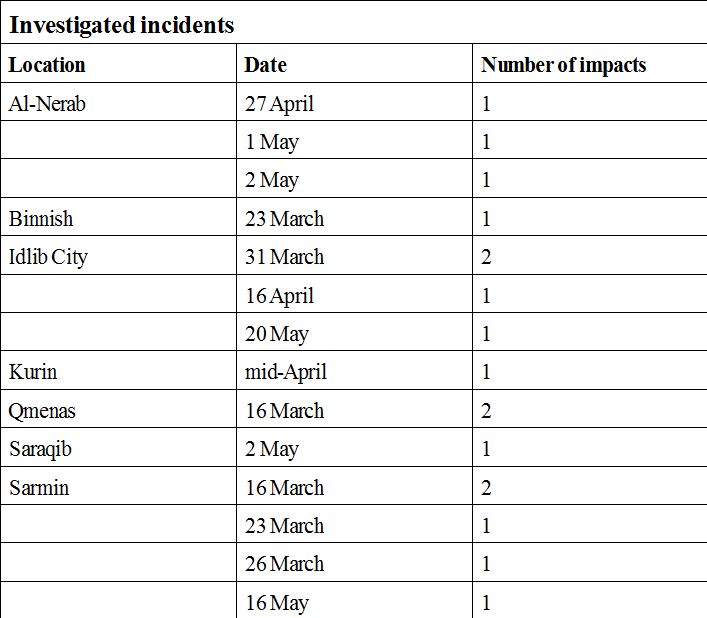
First depiction of a chemical barrel bomb dropped from helicopters
The report also included a depiction of a so-called barrel bomb, based on the various testimonials and collection of bomb fragments. It notes that the design of the improvised weapon underwent an evolution of their manufacture, probably driven by trial and error. However, only a singly type appears to have been used in the Idlib Governorate between March and May 2015.

Depiction of a chemical barrel bomb (Source: OPCW)
The configuration consists of 9 gas cylinders (green) presumably filled with poisonous chemicals. The report suggests that they may have been filled with a chlorine or chloride containing compound. The flasks with potassium permanganate (pink) would then have been used to oxidise the chlorine containing compound, resulting in Cl2. The potassium permanganate may be responsible for the purple–red colour occasionally seen in pictures and video footage of impact sites.
This depiction definitely explains how high concentrations of chlorine were achieved locally, earlier assessments of improbability having been based on the assumption of the dropping or firing of single gas cilinders fitted with a light detonator. Interestingly, the barrel bomb configuration would not have contradicted this assumption, given the individual rigging of gas cylinders (see Brown Moses’ speculation on this in 2014) and the focus of outside observers on those cylinders. To the best of my recollection, only a single report on developments in Syria in 2014 prepared by Human Rights Watch made a passing reference to the possibility: ‘evidence strongly suggests that Syrian government helicopters dropped barrel bombs embedded with cylinders of chlorine gas on three towns in Northern Syria in mid-April‘.
On the value of the evidence
As usual and for good reason, the reports by the Technical Secretariat remain careful in their conclusions. Determination of reponsibility for the violation of the Chemical Weapons Convention and other legal instruments banning chemical warfare is pre-eminently a political judgement. As noted earlier, the Executive Council will consider these findings (as well as those in the other two reports) on 23 November, after which they will be transferred to the UN Security Council. They will also inform the Joint Investigative Mission established by the UNSC in August, whose principal task it is to determine responsibility for chemical warfare in the Syrian civil war.
Meanwhile, the investigators assess their findings concerning the delivery system as follows:
The description of the alleged chemical weapon and its deployment derives from several inputs, as previously described. The features of the improvised chemical bomb are consistent with its being designed for deployment from a height. As most incidents happened during darkness, it is not surprising that no interviewees claimed to have seen the means of deployment. The deformation of the remnants is consistent with mechanical impact and explosive rupture, rather than explosion causing deflagration. Witnesses also reported a lesser explosive sound than for other more conventional types of bombs. Moreover, casualties’ signs and symptoms do not include physical injuries that would be expected from the deployment of an explosive device. The craters which have been claimed to have been caused by the device are also consistent with its being dropped from a height with lesser explosive power. It is therefore reasonable to assume that the devices were not designed to cause mechanical injury through explosive force but rather to rupture and release their contents.
 Arms Control Law