Iran’s Ballistic Missile Launches Do Not Violate UN Security Council Resolutions
Posted: March 11, 2016 Filed under: Nuclear 9 CommentsIran has on several occasions lately conducted ballistic missile tests. These are simply the latest in Iran’s longstanding efforts in development of its missile programs. I’ve noticed in media reports that both US officials and nonproliferation wonks have been saying that these missile tests violate UN Security Council resolutions. You can see such quotes in these articles – here and here. However this is incorrect.
There are several issues here. First is the Iranian standard rebuttal that none of their missiles are designed to carry nuclear weapons, and that therefore these tests do not run afoul of the precise language in relevant UNSCR’s. This is a technical argument that I’d really rather not wade into because it’s outside my expertise – i.e. when is a missile “designed” to carry a nuclear weapon.
But from a legal perspective, the assertion that Iran’s ballistic missile tests in the months since JCPOA Implementation Day (January 16, 2016) violate UN Security Council resolutions is incorrect because, as of Implementation Day, all UNSCR’s adopted prior to that date regarding Iran are terminated except for Resolution 2231. And the language that Resolution 2231 employs in addressing Iran’s ballistic missile activity is legally nonbinding language. Therefore there is no legal obligation on Iran touching its ballistic missile activity contained in Resolution 2231, and there can thus be no violation of a legal obligation that doesn’t exist. I’ll paste here a section from my forthcoming book explaining this point (exciting that I can do this now!):
In its Resolution 1929, adopted on June 9, 2010, the Security Council imposed a conventional arms embargo on Iran. It further addressed Iran’s ballistic missile program thus:
[The Security Council] Decides that Iran shall not undertake any activity related to ballistic missiles capable of delivering nuclear weapons, including launches using ballistic missile technology, and that States shall take all necessary measures to prevent the transfer of technology or technical assistance to Iran related to such activities.
Iran’s diplomats argued consistently that the Security Council’s arms embargo and proscriptions on Iran’s ballistic missile programs were unwarranted, and when negotiations began on the JCPOA they argued vigorously that they would not include their missile program on the agenda for negotiation along with their nuclear program. There is therefore nothing in the text of the JCPOA itself on the subject of Iran’s conventional weapons and missile programs. However, in Security Council Resolution 2231, the Council did make some changes to its treatment of these issues.
Annex B of Resolution 2231 provides for the temporary continuation of the international conventional arms embargo on Iran, inclusive of an exception for transfers approved by the Security Council. However, it further provides that the embargo will cease on the date five years from Adoption Day under the JCPOA. This date will be October 18, 2020.
With regard to Iran’s ballistic missile activities, Security Council Resolution 1929’s circumscription of course terminated, along with the Security Council’s other previous resolutions, on Implementation Day, January 16th, 2016. In its place, Security Council Resolution 2231 in Annex B provides the following text:Iran is called upon not to undertake any activity related to ballistic missiles designed to be capable of delivering nuclear weapons, including launches using such ballistic missile technology, until the date eight years after the JCPOA Adoption Day or until the date on which the IAEA submits a report confirming the Broader Conclusion, whichever is earlier.
The substitution of the leading phrase “calls upon” in this text in Resolution 2231 has legal significance, as I explained in Chapter 6. The change to this invitational yet legally nonbinding phrase in Resolution 2231 means that, as of January 16, 2016, Iran is no longer under a legal prohibition regarding its ballistic missile activity from the Security Council. The remaining hortatory expression in Resolution 2231 by its terms expires on October 18, 2023.
So, following JCPOA Implementation Day, Iran’s ballistic missile tests cannot accurately be said to violate UN Security Council resolutions. The most that could be said about them is that they are not in harmony with the UN Security Council’s legally nonbinding exhortation in Resolution 2231. This is not just semantic. The termination of Resolution 1929 on Implementation Day, and its supplantation with Resolution 2231, had many meaningful legal effects. This is one of them.
The Marshall Islands v. The U.K., Preliminary Memorials
Posted: March 10, 2016 Filed under: Nuclear Leave a commentI’ve now had a chance to review the Marshall Islands’ (RMI) memorial in its ICJ suit against the UK, and the UK’s preliminary objections memorial. Again, you can find these on the ICJ’s website. The juxtaposition of the two memorials is quite instructive.
The RMI’s memorial engages in page upon page of very dramatic and sweeping narrative about the general dangers posed by nuclear weapons. When it finally gets around to talking about the actual facts and law relevant to its case against the UK, the memorial is very weirdly and unclearly organized. The recitation of facts regarding the UK’s history of diplomatic engagement, or lack thereof, with efforts of nuclear disarmament comes first. Then the memorial switches to talking about why there is in fact a dispute in this case. This is followed by a long section addressing the negotiating history of the NPT and its object and purpose. Only at this point does the memorial actually address in a focused way Article VI of the NPT, which is the entire substantive legal basis of the RMI’s case.
Once the memorial does get around to analyzing Article VI, the legal discussion is decent, and brings out the main points of necessary interpretation. But having already discussed the facts and negotiating history at length in previous sections, the legal analysis of Article VI is not then followed by a clearly structured application of the law to the facts of the case, leaving the reader confused at the hodgepodge organization of the whole of the memorial.
Basic principles of professional legal writing and treaty interpretation would have recommended a much more clearly organized presentation, beginning with a rigorous interpretation and exposition of the law in Article VI, read in light of the provision’s context and the treaty’s object and purpose. Only after this exposition should a clearly structured application of law to facts be presented, showing how the respondent has failed to uphold its legal obligations, correctly interpreted.
So yes, what I’m saying is that the RMI’s memorial is shit legal writing.
Substantively, the RMI’s memorial also makes some completely unnecessary and confusing arguments about the erga omnes character of the obligations in NPT Article VI, and about the customary law nature of those obligations – neither of which arguments are at all necessary to make in the context of a respondent state which is without question a party to the NPT.
Turning then to the UK’s preliminary objections memorial, basically this memorial should serve as an instructive foil to the RMI’s legal team, helping them to see what a memorial submitted to the ICJ should look like. The UK’s memorial is well written and well organized. It focuses on the relevant legal questions the court needs to answer at this stage in the proceedings, and presents its legal arguments concisely and clearly, applying well-researched interpretations of law to facts.
I have to say also that substantively, I found the UK’s procedural arguments overall to be highly persuasive. This is particularly the case with regard to the UK’s arguments relative to the parties’ optional clause declarations. I can very easily see the court agreeing with these bases for dismissing the action.
I would take issue, though, with a couple of the UK’s substantive arguments. The first is the argument that the court cannot proceed jurisdictionally with this case against the UK alone as respondent, because the court’s considerations will necessarily implicate the legal interests of other states. I think the court would be perfectly capable in the merits phase of assessing the UK’s individual responsibility for its individual action or inaction in complying with its own individual obligation under NPT Article VI. The fact that Article VI imposes shared obligations on states does not produce a mutual exclusivity with its imposition in parallel of individual obligations on states. As I argued in my 2011 book, Article VI should be read as imposing obligations of effort upon states individually to pursue negotiations, and not as imposing only shared obligations of negotiation and result.
I also disagree with the UK’s argument that this is a case in which the court should withhold an assertion of jurisdiction because it would not be in a position to “render a judgment that is capable of effective application.” The NPT is ongoing in its application as a treaty between the parties to the dispute. The court could, at least in principle, give a declaratory judgment to the effect that the UK is in continuing breach of the NPT. It could also in principle order the UK to take individual efforts that would satisfy its individual obligations under NPT Article VI.
Marshall Islands ICJ Cases Get Underway and Bear Out My Concerns
Posted: March 9, 2016 Filed under: Nuclear Leave a commentThis week the oral arguments of the parties to the three remaining cases brought by the Marshall Islands against nuclear weapons possessing states in the International Court of Justice have finally gotten underway, and with them we now have a chance to also view the written submissions of the parties to this point.
Just to review, the Marshall Islands (RMI) brought suits in the ICJ against all nine nuclear weapons possessing states. However, only the cases against the United Kingdom, India, and Pakistan remain, because those are the only states among the respondent group that have consented to the compulsory jurisdiction of the ICJ. So to be clear, the cases against the U.S, Russia, France, China, Israel and North Korea, have already failed, and indeed never had a chance of succeeding based upon well-known jurisdictional limitations.
Readers will recall that I’ve discussed these cases before and expressed my concern about how they were being handled by the RMI’s legal team. Unfortunately, my concerns are being borne out through the pleadings that the RMI has made thus far.
Taking a look at the RMI’s application initiating proceedings against India, it should first be recalled that India is of course not a party to the NPT. In order for the ICJ to have jurisdiction, therefore, and certainly in order to prevail in the case, the RMI must show that the obligation in Article VI of the NPT has achieved customary international law status, in independent parallel to its existence as a treaty rule.
Readers may recall that Marco Roscini and I had a stimulating (at least to me) debate on this very subject here at ACL a couple of years ago. See here, here, here, and here. Now, compare this discussion to the RMI’s argument in pgs. 18-20 of their application, that NPT Article VI has achieved CIL status. The RMI here presents what is in my view an unforgivably superficial set of sources on which to base their argument on this subject – which again is absolutely vital to both their jurisdictional and merits assertions against India.
Basically what the RMI does is lean heavily on the ICJ’s 1996 advisory opinion, and particularly on one paragraph of the holding of that case, 105(2)(F), where the court states:
There exists an obligation to pursue in good faith and bring to a conclusion negotiations leading to nuclear disarmament in all its aspects under strict and effective international control.
This is obviously a partial quotation of the language in NPT Article VI. But the RMI’s lawyers say that, because the court didn’t explicitly restrict this statement to apply only to states parties to the NPT, therefore the court must have been asserting that this obligation has also become enshrined in customary international law.
That is pretty thin gruel.
The ICJ is perfectly capable of saying when it thinks a principle has achieved the status of customary international law, and it does not do so here. And there’s no other wording in the rest of the 1996 advisory opinion persuasively supporting the RMI’s interpretation of this one paragraph of the court’s judgement.
The RMI’s application then talks briefly about General Assembly and Security Council mentions of the NPT Article VI language, but never really gives a solid legal analysis demonstrating that there has been sufficient state practice and opinio juris expressed by states to support the conclusion that the NPT Article VI obligation has passed into parallel customary international law, binding upon India.
Recall that in my discussions with Marco on this subject I actually took a position which agrees in conclusion with what the RMI is arguing here. So my problem is not with their conclusion, but rather with the weak arguments that they have mustered in support of it. Honestly, I find this superficiality unprofessional. It reminds me of the kind of analysis I see in student papers, not in arguments before the ICJ on which the entire case of their client depends. A proper argument would have included a much more serious discussion of the manifestations of state practice and opinio juris that support the RMI’s argument, along with much more rigorous and comprehensive legal arguments, inter alia interrogating and rebutting the sorts of very valid concerns that Marco expressed in his discussion of the subject, including specially affected states.
I guess all I can say is that if the court somehow does allow the RMI’s case to go forward on the basis of a determination that NPT Article VI has achieved customary law status, and is therefore binding on India, it won’t be because of good lawyering on the part of the RMI’s legal team.
The oral arguments against the U.K. are scheduled for today and the RMI’s memorial, along with the UK’s preliminary objection memorial, have just been posted on the court’s webpage. We’ll see if the RMI can do any better against an actual NPT party.
My Iran Book Finally Done
Posted: March 7, 2016 Filed under: Nuclear 4 CommentsSorry for the radio silence from me over the past couple of months. I’ve been working hard to finish my Iran book, which I’m happy to report is now done and is in production with OUP. This is a very big deal for me, as I’ve been working on the manuscript for around three years now. I had been working on it for about two and a half years before the JCPOA was announced last summer, and had to pause for six months to await the deal’s implementation before writing the final chapter on it.
But it appears that the wait will soon be over. I’m being told it will be published sometime around June, and in a less expensive binding than my other books. I’m very pleased about that. I would really like this book to get a wide circulation and be read not just by academics and by students, but by government and international organizations officials as well.
Much more about the book to come in the next few months.
Nuclear Terrorism – book published
Posted: March 3, 2016 Filed under: Nuclear | Tags: nuclear security, nuclear terrorism, radiological terrorism Leave a commentNuclear Terrorism: Countering the Threat
Routledge, 262 pages
About the Book
This volume aims to improve understanding of nuclear security and the prevention of nuclear terrorism.
Nuclear terrorism is perceived as one of the most immediate and extreme threats to global security today. While the international community has made important progress in securing fissile material, there are still important steps to be made with nearly 2,000 metric tons of weapons-usable nuclear material spread around the globe. The volume addresses this complex phenomenon through an interdisciplinary approach: legal, criminal, technical, diplomatic, cultural, economic, and political. Despite this cross-disciplinary approach, however, the chapters are all linked by the overarching aim of enhancing knowledge of nuclear security and the prevention of nuclear terrorism. The volume aims to do this by investigating the different types of nuclear terrorism, and subsequently discussing the potential means to prevent these malicious acts. In addition, there is a discussion of the nuclear security regime, in general, and an important examination of both its strengths and weaknesses. In summary, the book aims to extend the societal and political debate about the threat of nuclear terrorism.
This book will be of much interest to students of nuclear proliferation, nuclear governance, terrorism studies, international organizations, and security studies in general.
Table of Contents
1. Introduction, Brecht Volders and Tom Sauer
2. The nuclear threat: a two-level analytical framework to assess the likelihood of nuclear terrorism, Brecht Volders
3. Internal dynamics of a terrorist entity acquiring biological and chemical weapons, Jean Pascal Zanders
PART I: Preventing Radiological Terrorism
4. Promoting alternatives to high-risk radiological sources, Miles Pomper and Aaron Gluck
5. Time for a convention on radiological security?, Sylvain Fanielle and Piotr Andrzejewski
6. The threat of a self-sustained chain reaction device, Ivan Andryushin, Eugeny Varseev and Gennady Pshakin
PART II: Preventing Attacks on Nuclear Facilities
7. Attacking nuclear facilities: hype or genuine threat?, Gary Ackerman and James Halverson
8. Nuclear security in Belgium: evolution and prospects, Rony Dresselaers and Sylvain Fanielle
PART III: Preventing the Detonation of a Crude Nuclear Device
9. Searching for the nuclear silk road, Steve Sin and Marcus Boyd
10. Securing Pakistan’s nuclear arsenal: the threat from within, Pervez Hoodbhoy and Zia Mian
PART IV: Nuclear Security Governance and Culture
11. Nuclear security culture: from concept to practice, Igor Khripunov
12. Nuclear security commitment making: results of the summit process, Michelle Cann
13. Nuclear security diplomacy beyond summitry, Trevor Findlay
14. Conclusion, Tom Sauer and Brecht Volders
Am I an academic?
Posted: March 3, 2016 Filed under: Miscellaneous | Tags: Academic research Leave a commentJean Pascal
Am I an academic?
‘We have invited think-tankers and academics’. This sentence, often spoken by conference organisers, never fails to annoy me. Certainly if in the next sentence gratitude is then expressed for the think-tankers’ willingness to convey the academics’ ideas to policy-makers. Read: nothing very substantial is expected from the think-tankers themselves. Their job is just to translate academic brilliance into terms that even practitioners, who apparently are even lower in the academics’ esteem, can understand.
This is like saying that there are British and European participants. Now, some of the former may wish to deny it, and some of the latter may sometimes wish that they were not, but all British really are Europeans. Just like all think-tankers are academics, only of a peculiar kind. But then all academics are peculiar. Or, let us say, all academics have their own very personal view of the world and an ego strong enough to provide them with the urge to put that into writing and share it with the world. If they do not, they should have chosen a real job. (My father, who was an engineer, which is a very real job, would have approved of this sentence, I like to think).
There is but one species therefore, academics, some of whom dwell in universities and some in think-tanks. Some (though not many enough) even move in between both habitats, as I do. (We have the benefit of being able to say, when our friends and family doubt whether reading, writing, travelling and attending receptions is in fact a real job: I teach). All of them write. The difference is perhaps that the think-tanking kind more often than the university-dwellers know why they write any particular paper.
The ‘So What’ question
Too often it strikes me, after listening to a conference paper or reading a journal article in my field, that I did not learn much that I did not know already. Except how to phrase something into such impenetrable jargon that it totally obscures the fact that the paper is merely stating the obvious. At night it is dark and there is sun in the daytime. (Or, as I write this in Belgium, there may be sun in the daytime). To quote François Mitterrand: Et alors? So what? This is the ultimate think-tank question. (And very useful as well when drafted on the jury for a PhD that is far beyond one’s expertise – if nothing else, one can always ask that). Now that we have been provided with this information, whether it is new or not, what do we make of it? What do we do with it?
What defines an academic is the urge to write. The immodest conviction that one has something to say that is worth publicising. And yes, the desire to see one’s name in print – vanity is the engine of science. Vice versa therefore, if one has nothing to say, please do not write about it. It would make the selection of what to read from the mass of books and articles that reaches one daily so much easier. If there is no message, do not publish it.
In political science, the academic branch that like the majority of academics in the think-tanks I belong to, that message has to relate to the real world. The point of political science is to say something useful about politics and policy. Useful for those who engage in politics and make policy: citizens, officials, and politicians. In that intuition is crucial, science is somewhat of an art, but still l’art pour l’art cannot be the organising principle. Society does not fund think-tanks and political science departments at universities just so that political scientists can talk among themselves in a language that ensures that nobody else can follow. If a paper cannot be understood by the diplomat or officer, for example, who happens to be working on the issue that the academic writes about, it is a bad paper.
That does not mean that every publication has to finish with three recommendations or ten commandments. Innovative analysis is useful as such. Policy-makers can benefit from seeing an issue from a new angle, highlighting connections that they were not aware of, or a part of the history that they had forgotten (for institutional memory is as short as rotation of staff is frequent), all of which helps the understanding of what is happening and will thus improve the quality of policy-making.
Concrete recommendations are of course a purpose too. But academics should not become too immodest either. Rare are the cases in which an actual policy can be traced back to a specific suggestion by a specific academic. What rather happens is that if an idea resonates, it will start circulating (to which the author can contribute by speaking about it as often as he or she can) and become part of the context. Within that context, the decision-makers eventually decide, taking from it and combining the elements that they deem useful. Laws are like sausages, Bismarck is reputed to have said, the less you know about how they are made the better – dissecting the sausage to ascertain which bit derives from which academic is too distasteful to attempt.
In my own experience, the time that I had the most influence is also the time that I had the least influence. In early 2010, a Spanish EU Presidency non-paper about ‘permanent structured cooperation’, the new mechanism to stimulate European defence introduced by the Lisbon Treaty, was almost entirely copied from one of my publications on how to implement this ‘PESCO’. It was also entirely ignored, for in the end PESCO was simply never implemented at all. The reader will understand that I remain somewhat sceptical of all those colleagues for example who claim that they have really inspired the 2003 European Security Strategy. For one, if all of them were right, the Strategy would have to be a lot longer than it is to accommodate so much brilliance.
In theory
Based on their analysis of concrete issues, academics also attempt to develop general theories. Here again, academics should take care not to make theory for theory’s sake. Theories, concepts, and definitions are not ends in themselves but tools, to serve the analysis of the real world. In other words, theory has to be useful just like any other product of political science. Usefulness requires elegance and clarity of expression. If a particular theory can only be understood by someone who has read all other theories on the same subject, that is, by someone who has nothing to do but dabble in theory, it definitely is not useful.
Furthermore, no single theory or concept can explain everything. It is great fun for example to invent labels, such as ‘normative power Europe’ or its opposite, ‘l’Europe puissance’ – I have tried to myself (and failed). If they catch on, their inventor’s wildest dream may be realised. Soon nobody will read the article in which you came up with it any longer. But forever more every use of your concept by every colleague will automatically trigger a bibliographic reference, and your citation record will explode. So far so good, as long as nobody begins to believe that any such theory or concept can do more than capture just one dimension of, in this case, Europe. For that belief quickly engenders the temptation to adjust reality so that no empirical material would distort the beautiful theory. (Which, I hasten to add, is an error more often made by overzealous disciples rather than by the originator of the concept).
Politics and policy are too complex to fit in a single explanation. Often indeed there is no big explanation, and developments result from incompetence and improvisation. Nevertheless, a combination of theories and concepts can help to understand and explain what is happening and to formulate recommendations on how to deal with it. Rarely however can they predict what will happen. But political scientists can help to recommend strategies that act as frameworks to assist the policy-maker to react to the unpredictable, by identifying what is vital and what is not.
Because of their respective employers’ expectations, university-based academics usually devote more time to the development of the tool, i.e. theory, than colleagues in the think-tanks. In the application of the tool, the latter will probably attempt more than the former not only to analyse and to understand but also to formulate recommendations. When it comes to setting the research agenda, choosing which area of politics or policy to analyse, universities leave the academic more freedom of choice than think-tanks, although the need to obtain project-based funding will be an important motivation here too. Think-tanks have to direct their research towards the areas of most interest to their funder. That funder (which, for European think-tanks, often is government) may have a political agenda to which the think-tank has to subscribe. But these are broad agendas which do not detract from the academic freedom, for example to promote European integration. If the political agenda goes further, for example to promote the Christian-democratic view of European integration or to stimulate the acquisition of the Rafale fighter aircraft, we are no longer talking about a think-tank, but about a lobbyist or a party research service.
Rather than an absolute division of labour and method between universities and think-tanks, all of this is a matter of degree. Essentially university-based academics and think-tanking academics (including those who used to be practitioners) do the same thing: producing a message that is of use for politics and policy, in a spirit of complete intellectual freedom, and living up to rigorous scientific standards.
Tittle-tattle over a glass of wine
University professors and think-tankers would do well to continuously interact with each other therefore. The former should consider to once in a while distil a shorter policy paper from a learned journal article, in order to more easily reach an audience of practitioners. The latter should from time to time compile the findings of some of their short-term policy papers and produce journals and books that have a much longer shelf-live. The former should regularly participate in policy seminars, to ensure that they remain in touch with the world that they are studying. The latter should occasionally attend scientific conferences to make sure that they keep abreast of scientific developments in their field.
In fact, attending one of the big academic conferences is not that different from what think-tankers do every day. At an academic festival such as the annual convention of the International Studies Association (ISA), where thousands of academics mingle, the key thing is to have a lunch and a dinner appointment every day. Time allowing, one can attend the odd panel in between, but networking is the added value of such events. This is exactly how an academic, whether from a think-tank or a university, can collect the most insights about his object of study: talking with practitioners over lunch or dinner or at receptions. Or even just over a cup of coffee, for the more ascetic among us, but in any case in an informal setting. Admittedly, such tittle-tattle, as the editor of a special issue (and a close friend) once dubbed the sources of my submission, is not easy to include in the references of one’s paper. But it is often much more productive than a formal interview.
Not every statement in every paper can be based on another written source anyway. If it is not allowed to write something down unless it has been written before, political science is hardly going to progress. The real added value of a paper will always be the author’s personal opinion – his message. An academic should never hesitate therefore and use his liberty to engage in franc-parler to the utmost. Many official documents are bland enough – there is no reason for us academics to use stale language as well. Why should one read between the lines of an academic paper? Just say things as they are, because you have the unique freedom to do so.
Official documents are of course an important source of information. But one should take care not to over-interpret them. True, when they are being negotiated, every point and comma counts. But two years later, nearly all officials involved in the drafting will have moved on to another post, often in another country or another organisation. Those who succeeded them will have no idea why this particular comma is indeed a comma and not a semi-colon. An academic’s own output consists mostly of his or her writings. Quite understandably one hopes, against better knowledge, that writings can change the world. Alas, it is not because the European Security Strategy, the subject of much of my own work, says something, that this is how things really are. There was much rejoicing in certain circles when the 2008 Report on the Implementation of the Strategy referred to the notion of human security. But I distinctly remember a Commission official, who had pushed for this, replying to me: ‘Well, now that it is in there, we better come up with a definition of what we mean by it’.
Once again, speaking with practitioners is indispensable to get as a complete a picture as possible and to ensure that one does not stray too far from reality. An academic’s job is to think outside the box, to link seemingly disparate dimensions and facts, and to be creative and innovative – but these are not synonyms for unrealistic. Strategy can be daring, and strategy must determine the allocation of the means – but its formulation will be influenced by the knowledge of which means can realistically be made available, and of the obstacles to be overcome. To be useful to policy-makers an academic must be a pragmatic idealist: he or she needs to have a concept of the big ideal, in order to give a sense of where to go, in the full knowledge that one will reach there by incremental, pragmatic steps.
Political science cannot function in splendid isolation, without permanent interaction with the people who operate in the areas that it studies. Or one will end up in the position of the colleague who ‘proved’ in her presentation at a big conference that the EU’s European Security and Defence College did not exist – at a moment when I had been lecturing for it for three years. My point in the ensuing Q&A – ‘I teach, therefore it is’ – was not well-received, but the embarrassment was perfectly avoidable.
In conclusion…
Am I an academic? Yes – and I would not want to be anything else. Given that it is unlikely that the people will call on me to become the High Representative for EU foreign policy.
No humanitarian justification for biological weapons
Posted: January 15, 2016 Filed under: Biological | Tags: biological weapons, BTWC, Entomological warfare, International Humanitarian Law, international law 2 Comments[Cross-posted from The Trench]
On 11 January Digital Journal, an online publication touching upon current events and with a penchant for science and technology affairs, published an Op-Ed by Megan Hamilton, an animal and nature-loving journalist based in Costa Rica, on Technology and the art of modern warfare. The piece is worrying enough for all the new technologies under consideration: fast-firing guns that could be deployed on satellites, direction-changing bullets, laser guns to knock out enemy drones, and so on.
The item that caught my attention was a discussion about a project once run by US Defense Advanced Research Projects Agency (DARPA) that turned insects into surveillance cyborgs (See also the Gizmodo blog). As Hamilton described it:
How? Through the HI-MEMS, or Hybrid Insect Micro-Electrical-Mechanical System concept. Electrical circuits are implanted in bugs while they are in the pupa stage. Once they become adults, signals sent through radio waves trigger the circuits, meaning that the insect is now remote-controlled. Surveillance equipment is attached, meaning these bugs are now invaluable and undetectable tools for battlefield exploration.
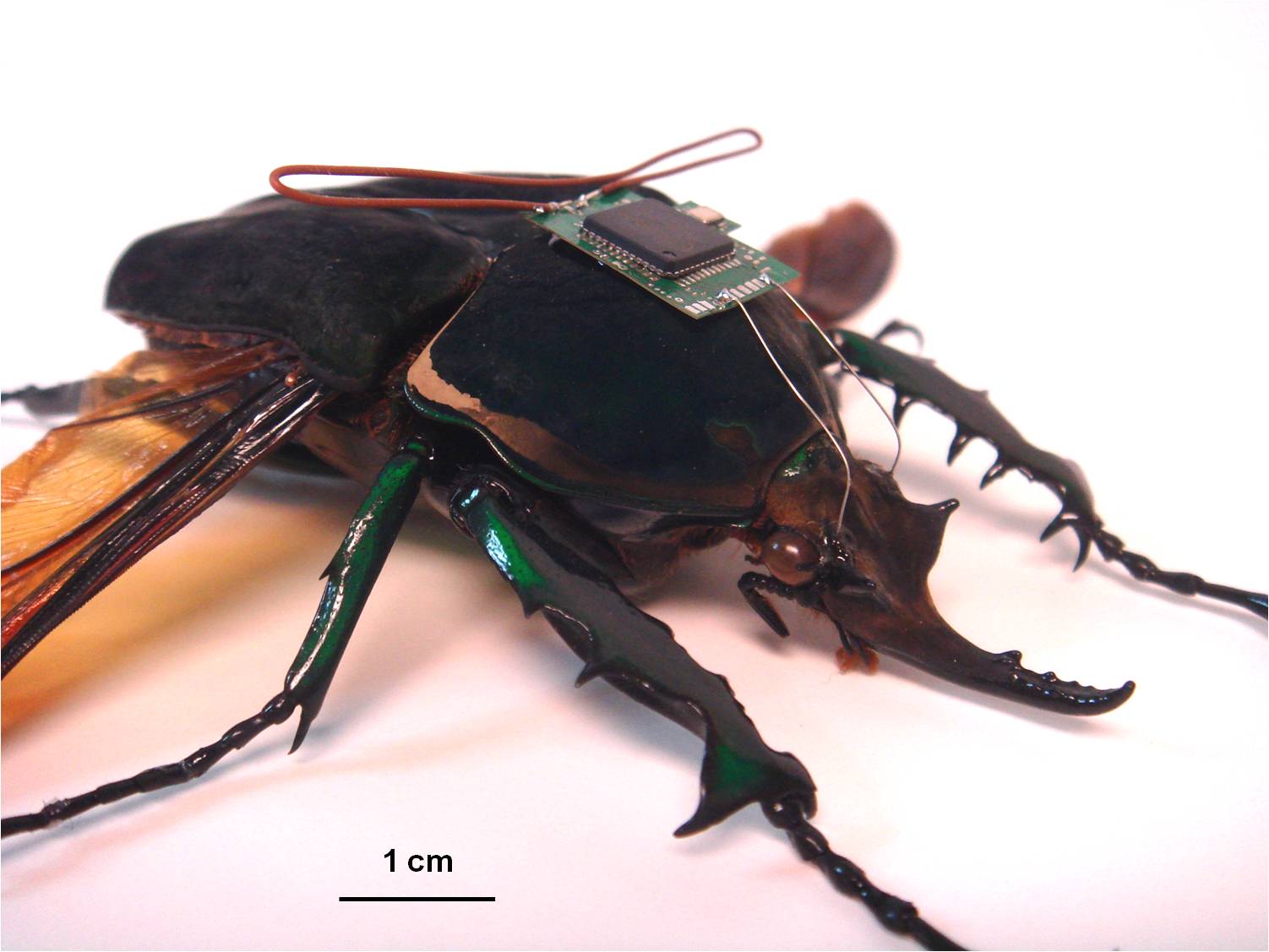
Insect cyborg (Source: Gizmodo, Australia)
DARPA cancelled the project. Hamilton, however, explored the topic of entomological warfare further with Jeffrey Lockwood, author of Six-Legged Soldiers: Using Insects as Weapons of War (Oxford University Press, 2010). It reveals interesting insights. For instance, technology has not yet been able to develop a drone the size of an insect—an entomopter—because of the size needed for an on-board energy source.
Once past the technological fascination of this type of weapon design for warfare or intelligence gathering, Hamilton pressed Lockwood on the morality of such projects and human and animal rights. Here things do get hairy.
Morality of entomological warfare
Lockwood took a kind of long-winded approach to answering the question. First, he mentioned the standards set by ‘just war theory’. Under jus in bello one imagines that formally prohibited weapons would be banned in warfare. He is generally correct when positing:
And then, deploying a weapon system of creatures to inflict harm on other humans surely constitutes a form of biological warfare (although international law is surprisingly vague on insects—microbes are quite another matter).
But then he wondered if biological warfare is necessarily wrong. He referred to the scenario of a debilitating but not deadly disease being transmitted by mosquitoes to enemy combatants such that it weakens the opposing forces and the goal of the attack can be achieved with considerably less loss of human life than would be the case with conventional weapons. He continued:
Of course, this supposes that one has adopted a consequentialist (probably utilitarian) ethics in which all that matters is the outcome. Such an ethical system might well conflict with the decisions made using a deontological approach in which duties/rights provide the moral constraints (rather than outcomes). So to return to your question, we might violate the rights of humans or other creatures (most often thought to be sentient which then raises the questions of whether insects can suffer—I think so, but many would disagree) by using the entomological weapons even if these arms reduced human deaths relative to other tactics.
[I assume that the passages between parentheses in the above quotes are Hamilton’s asides.]
The interview passage mixes up a few aspects of constraining biological warfare, namely the use of pathogens as a method of warfare, the deployment of insect vectors to propagate the disease agent, and the resort to insects in combat.
Yes, biological warfare is necessarily wrong
On the first issue whether all biological warfare is necessarily wrong, the answer is an unambiguous ‘yes’. The 1972 Biological and Toxin Weapons Convention (BTWC) contains no criteria of lethality or incapacitation to prohibit the development, production, stockpiling or any other form of acquiring microbial or other biological agents. This ban is absolute and therefore accepts no exceptions. Indeed, according to Article I, para. 1 of the BTWC the retention of disease agents is only justified for prophylactic, protective or other peaceful purposes. And then only if the nature or volume of the agent in possession conforms to those purposes.
This principle is known as the General Purpose Criterion. It emerged during technical discussions in the late 1920s and early 1930s in preparation of the disarmament conference due to start in 1933 as a way to address the dual-use problem, capture future scientific discoveries and technological developments, and frame a definition of chemical and biological weapons that does not allow for any exception. A criterion such as lethality was explicitly rejected, because the then proposed definition for chemical weapons had to capture irritants and incapacitants, such as riot control agents. Both the BTWC and the 1993 Chemical Weapons Convention have the General Purpose Criterion at the heart of their respective prohibitions.
While it is true that the BTWC does not explicitly refer to the use of biological weapons, it makes explicit reference to the 1925 Geneva Protocol banning the use of both chemical and biological modes of warfare. Moreover, at the Fourth Review Conference in 1996, the states parties to the BTWC explicitly recorded their understanding that the comprehensive prohibition on biological weapons in Article I covers their use too.
So, yes, all biological warfare is necessarily wrong, even if certain modes of pathogen use may appear more humane on the surface.
Yes, the BTWC bans the use of insects to spread disease
The second issue raised in the interview concerns the use of insects. In the past, insects have been both considered and used as vectors to spread disease. For instance, during the Second World War Japan notoriously deployed infected fleas to provoke plague epidemics in China. Allied Powers too investigated the option.
Again the BTWC’s prohibition is explicit. Article I, para. 2 proscribes the development, acquisition by any means and possession of weapons, equipment or means of delivery designed to use such agents or toxins for hostile purposes or in armed conflict.
So, yes, developing, cultivating or possessing insect vectors with the intent of having them deliver a pathogen is proscribed. No exceptions allowed.
In my opinion, although I am not aware of any legal expert ever having made that point explicitly, the use of insects with the intent to have them sting or bite humans or animals would also be prohibited under the BTWC as the insects would almost invariable inject some kind of poison—a toxin—into the victim.
But does the BTWC ban the use of insects?
The third question whether the use of insects in more generic ways is a proscribed mode of warfare is more ambiguous. The BTWC does not mention insects per se. Biological agents cover human, animal and plant diseases. Certain insects attack plants and may destroy agricultural crops. Again, in the past belligerents have not shied away from deploying them to harm the enemy in both open and covert warfare operations. Psychologically, agricultural warfare lies close to biological warfare. Thus, for example, Protocol III (and Annexes) on the Control of Armaments of 23 October 1954 to the Treaty of Economic, Social, and Cultural Collaboration and Collective Self-defence (also known as the Brussels Treaty) of 17 March 1948 defined biological weapons as follows [emphases added]:
(a) A biological weapon is defined as any equipment or apparatus expressly designed to use, for military purposes, harmful insects or other living or dead organisms, or their toxic products.
(b) […], insects, organisms and their toxic products of such nature and in such amounts as to make them capable of being used in the equipment or apparatus referred to in (a) shall be deemed to be included in this definition.
(c) Such equipment or apparatus and such quantities of the insects, organisms and their toxic products as are referred to in paragraphs (a) and (b) which do not exceed peaceful civilian requirements shall be deemed to be excluded from the definition of biological weapons.
The protocols to the Brussels Treaty allowed Germany and Italy to join the Western European Union, which in turn paved the way to their NATO membership.
Would the states parties to the BTWC consider an allegation of insect use as a possible violation of the convention? Actually, yes. They did so in 1997.
As I summarised developments in the 1998 and 1999 editions of the Yearbook published by the Stockholm International Peace Research Institute (SIPRI), on 30 June 1997 Cuba submitted a request to Russia, one of the three co-depositories of the BTWC, to convene a formal consultative meeting to investigate an alleged US attack with BW agents in October 1996.
That was the first time since the entry into force of the BTWC in 1975 that a state party formally requested the international community to investigate a breach of the convention. Cuba did not lodge a complaint with the UN Security Council under Article VI of the BTWC but invoked a procedure to strengthen the implementation of Article V adopted by the Third Review Conference of the BTWC in 1991. According to this procedure, the formal consultative meeting must be preceded by bilateral or other consultations among the states involved in the dispute. Following the submission of the request, the depositories of the BTWC must convene the formal consultative meeting within 60 days of the receipt of the request.
According to the allegation, a US anti-narcotics fumigation plane flying from Florida to Grand Cayman crossed Cuba with Cuban authorization on 21 October 1996 and was observed by a Cuban civilian aircraft to spray unknown substances intermittently. On 18 December the first signs of a plague with Thrips palmi karay, a minute insect belonging to the order of Thysanoptera which are plant eaters and may transmit virus diseases of plants, appeared. While Thysanoptera live wherever plants are, Cuba stated that this particular insect was indigenous to Asia and exotic to Cuban territory, although since 1985 its presence has been noted on several Caribbean islands. By January 1997 other parts of Cuba had also been affected and the insects continued to spread throughout the island in the spring and affected many crops. In October, the Cuban government reported that 20,000 tonnes of produce, including 18,000 tonnes of potatoes, had been lost to Thrips.
Following a request in December 1996 to clarify the incident, the US stated on 12 February 1997 that the pilot had noted the Cuban civilian aircraft but was unsure whether he had been seen and therefore used the smoke generator of his aircraft to secure a positive visual contact ‘following prudent and safe aviation procedures’. The US further added that the tanks for the aerosol sprinkling system had actually been used to carry fuel in view of the long-distance flight. On 28 April, in a note to the UN Secretary-General, Cuba formally accused the United States of biological warfare. The US State Department rejected the Cuban accusations and made its own version of events public on 6 May. Cuban officials discarded the statement for its ‘lack of seriousness’. In a second letter dated 27 June to the UN Secretary-General Cuba formally rejected the US explanations: (a) the regulations of the International Civil Aviation Organization do not mention the use of smoke generators to signal the position of aircraft in flight and such use is not a known practice except for aerobatics; (b) crop duster planes manufactured and operated all over the world are not equipped with smoke generators; and (c) the plane had no requirement to carry extra fuel in the herbicide tank since its normal fuel load sufficed amply for the flight. Even if some extra fuel had been carried in the tank, then it was technically feasible to fill it with another substance too, allowing for initial consumption of fuel and then for spraying.
The formal consultative meeting began in Geneva on 25 August in closed session, but failed to resolve Cuba’s claim after three days of talks, because, according to the chair, British Ambassador Ian Soutar, ‘it was not possible to draw a direct causal link’ between the overflight and the outbreak. As the Thrips palmi occurs in Haiti, the Dominican Republic, Jamaica and in Florida, the main unresolved question is whether the insect could have been introduced to the Cuba in another way. The meeting mandated Ambassador Soutar to further investigate the allegation and prepare a report by 31 December 1997.
His report, delivered on 15 December 1997, concluded that ‘due inter alia to the technical complexity of the subject and to passage of time, it has not proved possible to reach a definitive conclusion with regard to the concerns raised by the Government of Cuba’. Twelve states parties to the BTWC had submitted comments, which were annexed to the report. All agreed that insufficient evidence was available to establish a causal link between the outbreak of Thrips palmi in Cuba in December 1996 and the overflight of the US plane two months earlier. The report noted that throughout the process general agreement existed that the requirements of Article V of the BTWC and the consultative process established by the 3rd Review Conference had ‘been fulfilled in an impartial and transparent manner’.
The interesting thing is that while the BTWC states parties decided to take up the Cuban allegation of entomological warfare, in their conclusions they carefully avoided naming the incident a case of biological warfare. As Nicholas Sims of the London School of Economics and Political Science noted in his SIPRI book The Evolution of Biological Disarmament (Oxford University Press, 2001),
Denmark and the Netherlands expressed doubt, which other parties are known to have shared, over the question of whether insects or other pests such as Thrips palmi fall within the scope of the BTWC. Both states included statements that their participation in the consultative process was without prejudice to their national positions on this question.
Cuba, having raised the matter under the BTWC, made it politically difficult for the United States to invoke a legalistic argument to avoid addressing the concern. The documents of the consultative meetings have not been published—Sims does quote some extracts from them—and there is no indication that the incident was precedent-setting in the minds of the states that participated in the exercise.
So to answer the question whether the BTWC bans the use of insects other than for the delivery of a pathogen or toxin, one can only note equivocalness: not prima facie, but in practice some scope may exist to lodge a complaint about malicious use of insect vectors against agriculture with one of the three BTWC depositary states.
Conclusion
To come back to the Jeffrey Lockwood’s suggestion that not all biological warfare may necessarily be wrong, my answer is unequivocally: WRONG!
International law, in the form of the BTWC, allows no exceptions on the use of pathogens or toxins as weapons of war. There have been and still are important reasons why lethality or other humanitarian considerations were discarded as criteria for defining biological and toxin weapons. Any suggestion to the contrary might open up a loopholes that proponents of so-called non-lethal warfare would be all to happy to exploit today and tomorrow.
Investigation of alleged CW use in Syria: The reports 2013–15
Posted: January 5, 2016 Filed under: Chemical | Tags: Allegation, Chemical warfare, Chlorine, Investigation of use, Mustard agent, Sarin, Syria Leave a comment[Cross-posted from The Trench]
Investigations under the UN Secretary-General’s Mechanism
- Report on the Alleged Use of Chemical Weapons in the Ghouta Area of Damascus on 21 August 2013 (16 September 2013)
- United Nations Mission to Investigate Allegations of the Use of Chemical Weapons in the Syrian Arab Republic: Final report (12 December 2013)
Investigations by the OPCW Fact-Finding MIssion
- Summary report of the work of the OPCW Fact-Finding Mission in Syria covering the period from 3 to 31 May 2014 (16 June 2014)
- Second report of the OPCW Fact-Finding Mission in Syria: Key findings (10 September 2014)
- Third report of the OPCW Fact-Finding Mission in Syria (18 December 2014)
- Report of the OPCW Fact-Finding Mission in Syria regarding the incidents described in communications from the Deputy Minister for Foreign Affairs and Expatriates and Head of the National Authority of the Syrian Arab Republic from 15 December 2014 to 15 June 2015
- Interim report (29 October 2015)
- Final report (17 December 2015)
- Report of the OPCW Fact-Finding Mission in Syria regarding alleged incidents in the Idlib Governorate of the Syrian Arab Republic between 16 March and 20 May 2015 (29 October 2015)
- Report of the OPCW Fact-Finding Mission in Syria regarding alleged incidents in Marea, Syrian Arab Republic August 2015 (29 October 2015)
The Trench blog comments
- 16 November: Investigation of alleged chlorine attacks in the Idlib Governorate (Syria) in March – May 2015
- 23 November: CW incidents alleged by the Syrian government: an industrial chemical as likely cause?
- 3 January: Syrian soldiers exposed to ‘sarin or a sarin-like substance’
Syrian soldiers exposed to ‘sarin or a sarin-like substance’
Posted: January 3, 2016 Filed under: Chemical | Tags: Chemical warfare, Chlorine, Investigation of use, Mustard agent, OPCW, Syria Leave a comment[Cross-posted from The Trench]
In November I presented the main findings of the preliminary Fact-Finding Mission (FFM) report of 29 October. This particular investigation of alleged use by the Technical Secretariat of the Organisation for the Prohibition of Chemical Weapons (OPCW) had been requested by Syria. Government officials had transmitted four Notes Verbales alleging 26 chemical weapon (CW) events resulting in 432 casualties. The preliminary report focussed primarily on incidents at Jobar (northeast of Damascus) on 29 August 2014. While the investigators believed that government soldiers had been exposed to an irritant, they could not confirm that the chemical had been used as a weapon. They as good as ruled out chlorine or a neurotoxicant, such as sarin, as the causative agent.
However, the investigative team also looked into five other events reported by the Syrian government: Al-Maliha on 16 April and 11 July 2014, al-Kabbas on 10 September 2014, Nubel and al-Zahraa on 8 January 2015, and Darayya on 15 February 2015.
On 17 December the Technical Secretariat circulated the final report on those allegations by the Syrian government. Whereas the interim report of 29 October comprised 59 pages, the final report almost doubled in size to 106 pages.
The final report repeats the findings about Jobar. With respect to the five other incidents, it reaches similar conclusions. However, as regards Darayya it summarised:
From the results of blood sample analyses, the FFM is of the opinion that there is a high degree of probability that some of those identified as being involved in the alleged incident in Darayya on 15 February 2015 were at some point exposed to sarin or a sarin-like substance. In order to determine how, when, or under what circumstances the exposure occurred, further investigation would be required to complement the interviews carried out and the documents reviewed.
It does not say that those individuals were exposed to the neurotoxicant at Darayya, nor does it confirm that such exposure was the consequence of combat operations.
Investigating possible use of irritant chemicals as a weapon
With regard to the alleged incidents in Jobar on 29 August 2014 (for details, see my earlier posting), al-Maliha on 16 April 2014 and 11 July 2014, al Kabbas, Damascus on 10 September 2014 and Nubel and al-Zahraa on 8 January 2015, the report offers parallel conclusions. These are:
- The affected soldiers ‘may have been exposed to some type of non-persistent, irritating airborne substance, secondary to the surface impact of the launched objects’.
- The investigators could not determine with any degree of confidence as to whether exposure was the consequence of the irritant being delivered as the payload of a projectile, or whether the irritant had another source of origin (combustion product of a propellant, detonation of a conventional or improvised explosive device on a stored chemical already in-situ, some combination of substances mixed with surface soil and dust, or a combination of all mentioned factors).
- The affected soldiers in question present clinical symptoms that are ‘consistent with a brief exposure to any number of chemicals or environmental insults’. Furthermore, ‘the visual and olfactory description of the potential irritating substance does not clearly indicate any specific chemical’.
In each of the five cases, the investigators pointed out that the lack of hard evidence precluded them from gathering facts in a definitive way. Little ‘objective evidence’ was made available to the team to complement the materials given by the Syrian authorities, ‘either because it was unavailable or because it was not generated in the first place’. The report lists the types of evidence that would have been crucial to establishing facts with a higher degree of confidence:
- Photographic or video recordings of the incident;
- A visit to the site where the incident took place;
- Detailed medical records including, inter alia, X-rays, pulmonary function tests, and timely blood laboratory values;
- Timely biomedical samples from the patients;
- Remnants of any ordnance, launching system, or other forensic evidence retrieved from the location of the incident;
- Unfired ordnance similar to that used in the incident;
- Environmental samples from the surroundings of the location of the incident, including background samples;
- Comprehensive contemporaneous incident reports generated by the chain of military command and the medical system; and
- Comprehensive witness testimonies generated at the time of the incident.
Concerning some alleged incidents, the investigators would have also welcomed:
- A greater sample of witness testimonies (al Maliha, 11 July 2014; Nubel and al-Zahraa, 8 January 2015); and
- Samples from remnants of cylinders or other containers alleged to have been used in the incident and retrieved from the incident location (al Kabbas, 10 September 2014; Nubel and al-Zahraa, 8 January 2015).
Exposure to a nerve agent-related substance
According to Note Verbale 41 (29 May 2015), a follow-up to the initial document submitted by the Syrian government on 15 December 2014 that led to the FFM investigation, eight military personnel became casualties in an alleged CW incident on 15 February 2015. It provided a brief description of the incident, signs and symptoms, a more precise location, the hospital where casualties received treatment, and the names of the victims. The incident appeared sufficiently grave for the FFM to investigate it.
The FFM conducted interviews with medical staff and casualties relevant to the allegation and visited hospitals and research laboratories where tests on victim blood samples had been conducted. It also visited the Centre for Studies and Scientific Research Institute in Barzi, Damascus, on 12 and 14 August 2015. On the first day, team members had a discussion with the head of the research institute on the storage and research methods for blood collected for acetyl-cholinesterase (AChE) analysis and were made aware of the existence of several blood samples stored onsite related to the Darayya incident. Two days later the FFM revisited the institute to seal the selected blood samples.
In the course of the investigation the FFM received a variety of documents, including battlefield and medical reports, video footage and images from GoogleEarth indicating exact locations. These documents included the medical records of the eight reported casualties and the AChE analyses of six alleged victims. In several cases the investigators were granted access to requested documents, albeit without being provided with photocopies. Four of the reported casualties were given HI-6 (asoxime chloride) and dematropine, both nerve agent antidotes.
The retrieved blood samples were forwarded to OPCW-certified laboratories for analysis and a certified laboratory conducted DNA analysis to link the samples to the casualties.
In its medical review the FFM report draws a sharp distinction with the other investigated Syrian allegations:
The Darayya incident was the only reviewed incident wherein the alleged victims had a prolonged recovery phase of 10-12 days. This departed from all other alleged incidents wherein recovery was rapid and rarely resulted in hospital observation for more than two nights. Darayya is also the only alleged incident wherein antidotes and specific treatments such as oximes and atropine were employed, or were even mentioned. Finally, and perhaps most notably, this was the only incident wherein blood analysis was performed with quantitative results noted in the medical records. Though such results are precisely the type of objective evidence the medical team would have preferred to have had in the aforementioned incidents, in the case of Darayya the presented test results proved more confounding than helpful, as they were significantly outside of the expected range for such a scenario.
As a consequence, the report notes, the recovered blood samples had to be forwarded to an independent laboratory for further assessment. The final results were still pending when the report was issued. In its absence the medical evaluation necessarily rests on the interviews and provided documents, but given the shortcomings of the methodology and gaps, these merely contribute to the uncertainties that permeate the entire report on the allegations by the Syrian authorities. (It should be noted that Appendixes 8 and 9 provide detailed results of the analyses of the blood samples suggesting exposure to neurotoxicants in all tested samples collected from casualties, so that paragraph 90 of the report may either indicate failure to delete language from an earlier draft or point to additional laboratory testing.)
As with the investigation of the other incidents, the FFM noted that the Syrians could have supplied more documentary evidence or undertaken certain actions to corroborate the testimonies of the casualties and witnesses it interviewed and establish the value of the evidence supplied:
- Immediate notification to the OPCW that a suspected chemical attack had occurred would have allowed the prompt deployment of the FFM to gather primary evidence and establish the facts surrounding this incident;
- Photographic or video recordings of the incident;
- Visit to the site where the incident took place;
- Detailed medical records including, inter alia, X-rays, pulmonary function tests, as well as timely and complete blood laboratory values;
- Remnants of any ordnance, launching system, or forensic evidence retrieved from the incident location;
- Unfired ordnance similar to that used in the incident;
- Environmental samples, including animal tissue, from the surroundings of the incident location as well as background control samples;
- Comprehensive contemporaneous incident reports generated by the chain of military command and the medical system;
- Comprehensive witness testimonies generated at the time of the incident; and
- A greater sample of witness testimonies.
On the basis of the evidence collected, the FFM concludes that:
there is a high degree of probability that some of those involved in the alleged incident in Darayya on 15 February 2015 were at some point exposed to sarin or a sarin-like substance. However, the FFM could not confidently link the blood sample analyses to this particular incident nor determine how, when, or under what circumstances the exposure occurred.
The one sarin-like substance the report mentions is chlorosarin (O-isopropyl methylphosphonochloridate), a final precursor to the manufacture of sarin. However, the analysis did not indicate a specific date of exposure, nor a specific time that the blood was drawn. The FFM was also unable to verify the chain of custody between the time the blood was drawn from the casualties and the time it sealed the samples. In addition, blood sample analyses indicated that four of the eight individuals were at some point exposed to sarin or a sarin-like substance, but the investigators were unable to link these results to the Darayya incident of 15 February 2015 as reported by the Syrian government. It is in this context that the report observes that the immediate notification to the OPCW of the suspected chemical attack would have allowed the prompt deployment of the FFM to gather primary evidence and establish the facts surrounding this incident.
Some observations
A striking feature of the general debate at the 20th Session of the Conference of States Parties (30 November–4 December 2015) was that not a single country referred to the preliminary FFM report on the allegations put forward by the Syrian government. As one participating diplomat put it to me, conclusions were not yet definite. He added that ‘the Executive Council had kicked the can down the road’ and that the findings would make for a difficult meeting early in 2016. Indeed, a week earlier, on 23 November, the Executive Council had noted the FFM’s inability to confidently determine whether or not a chemical was used as a weapon. It further noted that the FFM report was an interim report and that other incidents under investigation are pending final analysis and will be included in the final report.
The paragraph stands in stark contrast to the previous one addressing the FFM reports on alleged CW use in Marea and Idlib province, where the Executive Council
Expresses grave concern regarding the findings of the Fact-Finding Mission that chemical weapons have once again been used in the Syrian Arab Republic, and in this regard:
(a) underscores that, with respect to the incident in Marea, Syrian Arab Republic, on 21 August 2015, the report of the Fact-Finding Mission confirmed “with the utmost confidence that at least two people were exposed to sulfur mustard” and that it is “very likely that the effects of sulfur mustard resulted in the death of a baby” (S/1320/2015); and
(b) further underscores that, with respect to several incidents in the Idlib Governorate of the Syrian Arab Republic between 16 March 2015 and 20 May 2015, the report of the Fact-Finding Mission concluded that they “likely involved the use of one or more toxic chemicals—probably containing the element chlorine—as a weapon” with an “outcome of exposure [that] was fatal in six cases in Sarmin,” including those of three children in the same family (S/1319/2015).
Reading the latter two documents, I was struck by the fact that despite the difficult circumstances in which the investigations had to be conducted, the reports were still able to advance conclusions with fair to very high degrees of confidence that toxic chemicals had been used as a weapon. The investigators also indicated which chemicals may have been involved and proffered details about the munitions that delivered the agents. Indeed, the Idlib report contained a detailed graphical reconstruction of the barrel bombs dropped from helicopters to deliver the chlorine (see my earlier posting). All the evidence collected from Idlib province leaves little doubt that government units were responsible for those attacks. Concerning the mustard agent attack at Marea, the report does not implicate the Syrian government despite the certainty of its conclusions. Press and NGO reports have pointed the finger to the Islamic State of Iraq and the Levant (ISIL). The OPCW and Iraq are collaborating on the investigation into a similar incident implicating ISIL near Mosul last summer.
During the Conference of States Parties the Syrian delegate vehemently denied that his country had ever launched a CW attack. In 2013 Damascus requested the UN Secretary General to investigate certain allegations of chemical warfare; the UN investigative team was in the Syrian capital when sarin-filled rockets hit the Ghouta suburb. The offer to accede to the CWC and have its chemical warfare capacity eliminated under international supervision averted international military strikes and ensured regime survival, at least in the short term.
The request for an investigation submitted in December 2014 was the first since Syria had joined the OPCW. One imagines that the Syrian government would have mobilised all possible resources to substantiate its allegements to the greatest possible extent. Trivial or plainly false allegations would inevitably undermine the country’s standing and the international community will tend to brush off any future accusations as a figment of a desperate government’s imagination.
Investigating false accusations also drains the OPCW’s limited budget resources. Unfortunately, no arms control or disarmament treaty currently in force envisages specific penalties for false allegations. Before entry into force of the CWC the Preparatory Commission (PrepCom) of the OPCW held consultations on the ‘costs of abuse’ detailing what direct and indirect costs should be covered by the State Party requesting a challenge inspection should the Executive Council rule that the requesting state party abused its right to request such an inspection. However, the PrepCom transferred the question as one of the outstanding issues to the OPCW and 18 years after the entry into force of the CWC this particular question remains unresolved. [Per Runn, Verification Annex, Part X, in W. Krutzsch, E. Myjer, and R. Trapp (eds.), The Chemical Weapons Convention: A Commentary (2014), p. 618.] Whichever way, since Syria claims that it cannot pay for verification and other operations for which a state party should cover the costs, the international community must cough up the money.
What Syrian objectives may lie behind the accusations? First, the government may genuinely believe that it has been the victim of chemical attacks. In that case, one would expect government officials forthcoming with evidence. Even lacking experience in dealing with such a situation, the questions and requests for further evidence they could address in such a way that either it complements initial information with supplementary evidence or demonstrates that the desired data are genuinely not available, for instance, as a consequence of war circumstances.
Second, the accusations could be part of a broader scheme to deflect responsibility for the Syrian regime’s own chemical attacks or to deny the international community evidence that later might inculpate Syrian officials for war crimes. If the allegations are indeed part of a plan to deflect responsibility for CW use, an outside observer’s impressions can only vacillate between sloppiness and sheer incompetence, on the one hand, and unwillingness to provide relevant documentation (which many or may not have been deliberately destroyed or hidden), on the other hand. Alas, the latter concern is one I have also often heard mentioned in connection with Syria’s declarations as part of its disarmament obligations.
There is a third possibility, but here one can only hope that the request for an investigation was not part of an exercise to learn how to better disguise chemical warfare attacks or to manufacture evidence in support of alleged insurgent use of toxicants.
Should False Assumptions about Iran´s Nuclear Program be Reviewed by EU Courts?
Posted: December 30, 2015 Filed under: Nuclear Leave a commentI’m very pleased to host a guest post by Dr. Katariina Simonen, who is a Senior Researcher on the Faculty of Law at the University of Helsinki (see fuller bio below). Dr. Simonen writes in this post on a very interesting question of European Union law. Hopefully some of our other contributors and readers with a background in EU law can engage with her analysis.
——————————————-
Should False Assumptions about Iran´s Nuclear Program be Reviewed by EU Courts?
By: Katariina Simonen
While reading the recent General Court (EU) Judgment in Case T-564/12, Ministry of Energy of Iran versus the Council of the European Union, regarding the annulment of certain restrictive measures imposed against the applicant, the Finnish version of the Judgment caught my attention since paragraph two of the Judgment speaks of sanctions imposed in order to apply pressure to Iran to end nuclear weapons related proliferation sensitive activities and the development of nuclear weapon delivery systems. This linguistic glitch, which was polished in the English version to cover “proliferation-sensitive nuclear activities” and “the development of nuclear weapon delivery systems”, made me realize that the EU restrictive measures may, in fact, be based to a great extent on the assumption of Iran´s nuclear weapons program and related activities.
However, such an assumption is not correct, at least after 2003. We know this from the IAEA, which, in December 2015, released its report on Past and Present Outstanding Issues regarding Iran´s Nuclear Programme which was followed by the adoption by the Board of Governors of a resolution on 15 December 2015, in which Director General Amano explicitly summarized the main findings of his report:
“The Agency assesses that a range of activities relevant to the development of a nuclear explosive device were conducted in Iran prior to the end of 2003 as a coordinated effort, and some activities took place after 2003.
The Agency also assesses that these activities did not advance beyond feasibility and scientific studies, and the acquisition of certain relevant technical competences and capabilities.
The Agency has no credible indications of activities in Iran relevant to the development of a nuclear explosive device after 2009. Nor has the Agency found any credible indications of the diversion of nuclear material in connection with the possible military dimensions to Iran’s nuclear programme.”
The report closes Iran´s PMD file, allowing the JCPOA to go forward. Even so, the IAEA was heavily criticized by specialists for failures to address past allegations and its intelligence gathering proceedings relating to its 2011 report. Robert Kelley has just addressed the issue in LobeLog here, Paul Jenkins here and the IAEA´s former Director General El Baradei here. Also, there is a good article by Pierre Goldschmidt here regarding the IAEA´s lack to address properly Iran´s non-compliance issues.
These references serve to point to my question: if the EU restrictive measures have been imposed explicitly on the factual assumption that a nuclear weapons program exists in Iran, and since we now know from the IAEA that that such assumption is not correct, should not the European Courts acknowledge somehow this fact when reviewing EU restrictive measures against Iran?
I believe the answer is positive. I will address the issue shortly by sketching the outlines for the authority of the EU Judicature so to act.
First, let us remember that there is no automatism in the implementation of diverse UNSC resolutions into the community legal system. Since the seminal Kadi –saga the European Courts have reserved themselves the right of independent legal review of validity of any community measure, and this applies to the UNSC resolutions, too. See Conor Gearty´s recent article on this point here.
In Kadi I (Joined Cases C-402/05 P and C-415/05 P), the European Court of Justice (ECJ) considered that the review of the validity of any Community measure in the light of fundamental rights must be considered to be the expression, in a community based on the rule of law, of a constitutional guarantee stemming from the EC Treaty as an autonomous legal system, which was not to be prejudiced by an international agreement – namely, in the case in question, the Charter of the United Nations (para. 316). The ECJ issued its judgement in the Grand Chamber formation, with the clear intention of delivering a judgment establishing certain principles.
The ECJ regarded that the General Court´s reasoning in first instance (Case T-306/01 and Case T-315/01) contained an error of law because the General Court had considered that short of extreme situation of a violation of jus cogens, the Security Council could do what it wanted. Already the Advocate General Maduro had disagreed with the General Court dismissing EU´s own human rights and rule-of-law traditions.
And the ECJ agreed with Maduro. It stated clearly that the Community judicature must, in accordance with the powers conferred on it by the EC Treaty, ensure the review, in principle the full review, of the lawfulness of all Community acts in the light of the fundamental rights forming an integral part of the general principles of Community law, including review of Community measures which, like (then)) Regulation No. 881/2002, are designed to give effect to the resolutions adopted by the Security Council under Chapter VII of the Charter of the United Nations (paras. 326-327). This case law was now clear in that European Union measures implementing restrictive measures decided at international level enjoy no immunity from jurisdiction. The same conclusion was confirmed, word for word, in later judgments, see Hassan and Ayadi; Bank Melli (2011). The ECJ annulled the regulation on the basis of violations to Mr. Kadi´s rights of the defence, in particular the right to be heard and the right to effective judicial review (paras. 345-353).
The Kadi –saga did not end there. The annulled regulation was kept in force for three months in which the Council would have to rectify the defaults identified. The removal of control was never considered, and Kadi´s listing was confirmed by a new community regulation on 28 November 2008. A new legal round had to be started by Kadi to get annulled those community measures which implemented his listing by the UN Sanctions Committee (General Court T-85/09; ECJ Joined Cases C-584/10 P, C-593/10 P and C-595/10 P).
Second, the new round of Kadi judgments makes it even more clear what the European Judicature should pay attention to when evaluating restrictive measures and their compatibility with the EU legal order. The Court´s requirement for full and effective judicial review is tied to Article 47 of the Charter of Fundamental Rights of the European Union, and it requires, inter alia, that the Courts ensure that the measure in question, which affects the person or entity concerned individually, is adopted on a sufficiently solid factual basis (Fulmen and Mahmoudian). The General Court specified in Kadi II that the full judicial review will have to be conducted at the very least, so long as the re-examination procedures operated by the UN Sanctions Committee clearly fail to offer guarantees of effective judicial protection required in European level (paras. 126-127). The call for the full and rigorous judicial review gained more strength from -often- the draconian character of fund freezing measures and the long-lasting effect on fundamental rights of the persons concerned (para. 151).
Having said all this, it has to be also bore in mind that since Kadi I the ECJ has been was careful to underline the primary responsibility of the Security Council for the maintenance of international peace and security and its task to determine what constitutes a threat to international peace and security and to take the necessary measures. But the ECJ has thought it proper to underline, also, that such Security Council work is to be carried out in accordance with the purposes and principles of the United Nations, including respect for human rights.
Third, general legal principles play also a considerable role in the European legal order. According to the principle of legal certainty, which the European Court of justice has deemed a general principle of European legal order since the 1960s, laws which will have legal effect in the European Union must have a proper legal basis. Hence, it is not at all unusual to contest a legal basis of a community act (e.g. C-370/12 Pringle). Since Kadi, the EU Courts have acknowledged that this can mean also a simultaneous inquiry in the work done by the Security Council, especially when previous defaults have been detected, like in the work of the Sanctions´ Committees. Another principle, which has high relevance for our initial question regarding the eventual review of EU restrictive measures, is the principle of proportionality, which was put into effect, for instance, in Bank Melli (2013). The General Court emphasized that the by virtue of principle of proportionality, which is one of the general principles of EU law, the lawfulness of the prohibition of an economic activity is subject to the condition that the prohibitory measures should be appropriate and necessary in order to achieve the objectives legitimately pursued by the legislation in question. The lack of proportionality was also echoed by the Courts in Kadi, when the Courts paid attention to the totality of consequences for Kadi´s rights ensuing from his initial listing already in 2001.
Thus, the legal basis of community restrictive measures can be contested as part of normal judicial procedure, even if the EU community measures implement previous UNSC resolutions. In the case of Iran, greater vigilance by the EU Courts can be recommended regarding factual assumptions on Iran´s nuclear program, which serve as a basis of EU restrictive measures. The EU Court review should take properly into account the latest IAEA´s findings on Iran and its nuclear activities when considering if there is a sufficiently solid factual basis for sanctioning the person or entity in the first place. Furthermore, if contested restrictive measures include explicit references to highly contested documents, like the IAEA 2011 report, such vigilance is even more imperative from the point of view of legal certainty. It may be that the preceding wrong by Iran is lacking in the light of the IAEA´s December 2015 findings, which means that the alleged legal basis of diverse EU restrictive measures against Iran on non-proliferation grounds may have to be seriously reconsidered.
Katariina Simonen, LL.D. in international law, is a Senior Researcher at the Faculty of Law, University of Helsinki and Member of the Pugwash Executive Council. She has held diverse legal positions in the European Union (Court of Justice, European Parliament). She is currently on leave of absence from her position as a Senior Advisor for Research at the Finnish Ministry of Defense, working on her book on just warfare conceptions in 12. Shi´a Islam. Her publications focus on diverse aspects of justice in international law, and her latest monograph is The State versus the Individual. The Unresolved Dilemma of Humanitarian Intervention (Brill 2011).
 Arms Control Law