Surveillance Like a Cancer Grows? The Implications of NSA Intelligence Activities on the Non-Proliferation & Arms Control Communities
Posted: July 17, 2013 Filed under: Biological, Chemical, Cyber, Nuclear, Terrorism | Tags: cyberspace, Edward Snowden, NSA, Surveillance, WMD 10 CommentsELECTRONIC SURVEILLANCE AND THE COMMUNITIES INVOLVED IN NON-PROLIFERATION AND ARMS CONTROL
In a comment to Dan Joyner’s post on Lawyers, Guns, and Money, Yousaf Butt raised the need to link the disclosures being made about NSA surveillance to the work of people engaged on non-proliferation and arms control issues. In particular, he cited a July 6, 2013, New York Times article by Eric Lichtblau entitled “In Secret, Court Vastly Broadens Powers of N.S.A.” This article was widely read, as evidenced by The Economist basing a story on it. In the Times article, Lichtblau reported US intelligence officials obtaining “access to an e-mail attachment sent within the United States because they said they were worried that the e-mail contained a schematic drawing or a diagram possibly connected to Iran’s nuclear program.” Yousaf asked whether this example means anyone discussing nuclear proliferation could be subject to NSA surveillance. Or, more broadly, could electronic communications about WMD proliferation challenges to US national security be subject to NSA collection activities? Yousaf thought such surveillance could create a “chilling effect” that might adversely affect “free discourse” in the non-proliferation area. Dan asked me to share my thoughts on this issue, so here goes . . .
THE NUCLEAR PROLIFERATION CASE CITED IN THE TIMES ARTICLE
Section 702 of FISA
Let me start with the case reported in the Times and cited by Yousaf. Apparently, the e-mail communication that contained the attachment accessed by US intelligence officials was sent and received in the US, so, if accurately reported by the Times, this case does not involve the authority created in the Foreign Intelligence Surveillance Act (FISA) Amendments Act of 2008 that permits the FISA Court to authorize “the targeting of persons reasonably believed to be located outside the United States to acquire foreign intelligence information,” including communications involving US persons (Section 702, Foreign Intelligence Surveillance Act, 50 USC sec. 1881a(a)). Even though this case does not involve this authority, the free speech concerns raised by lawyers, journalists, and human rights activists in Clapper v. Amnesty International (decided on standing grounds, 133 S.Ct. 1138 (2013)) apply to persons engaged in electronic communications with foreign nationals located overseas on issues relating to US national security.
FISA defines “foreign intelligence” to include “information that relates to . . . the international proliferation of weapons of mass destruction by a foreign power or an agent of a foreign power” (50 USC sec. 1801(e)(1)). As the challenge mounted in Clapper indicates, many communities of interest are concerned about the “chilling effect” of the surveillance authority created by the FISA Amendments Act. The inclusion of WMD proliferation in the definition of foreign intelligence means the non-proliferation and arms control communities have been on notice about this US government power since 2008.
However, Snowden’s disclosures of PRISM (the NSA program operated under Section 702 of FISA) revealed how the US government uses this power. People in communities of interest not previously nervous about Section 702 of FISA might now be concerned about their communications with foreign nationals, and perhaps, as Yousaf’s comment suggests, this includes persons working on non-proliferation and arms control questions. So, as with other interested persons and organizations, the non-proliferation and arms control communities should monitor what happens next with this controversy, including law suits already filed in federal court challenging PRISM.
US Communications, Metadata, and Access to the Content of Communications
However, the case reported in the Times involved an e-mail and its attachment sent and received in the US, meaning that different aspects of FISA applied to this surveillance activity. The Times article is not exactly clear what happened, when it happened, what the FISA court did, and why it did what it did (at least these things are not clear to me from the article). My point is not that the Times article is wrong; my point is that it raises more questions than it answers, and trying to answer some questions proves difficult because of a lack of information. As explained below, these questions require more scrutiny of the Times article’s claim that the FISA court “vastly broadens powers of the N.S.A.” In short, we should not jump to conclusions about the Times article and its implications. In what follows, I try to sort through what the article does contain.
Collecting Internet and E-Mail Metadata
US intelligence officials probably picked up information from collecting and analyzing “metadata” on e-mail traffic that triggered a desire to see the e-mail attachment in question. Part of Snowden’s disclosures included information about the US government’s collection of e-mail and other Internet metadata within the US after 9/11 through 2011, when this aspect of NSA surveillance was apparently terminated. Initially undertaken by the Bush administration outside FISA, the collection and analysis of e-mail and other Internet metadata came within FISA court review and approval in 2004, after which the FISA court reviewed and approved orders for such surveillance periodically until 2011, when the Obama administration stopped this particular metadata surveillance effort.
Application of the “Special Needs” Exception to Collection of Internet and E-Mail Metadata under FISA
According to the Times article, the FISA court determined that such metadata surveillance did not violate the Fourth Amendment and relied, apparently, on the “special needs” exception to the Fourth Amendment’s warrant requirement. Generally, the “special needs” exception allows the government to undertake a search without a Fourth Amendment warrant to gather information unrelated to law enforcement purposes (e.g., drug tests of railway workers; passenger screening at airports). Referring to outside legal experts, the Times article commented that this application of this exception “is significant . . . because it uses a relatively narrow area of the law . . . and applies it much more broadly, in secret, to the wholesale collection of communications” for foreign intelligence purposes, including countering terrorism, WMD proliferation, espionage, and cyber attacks. This alleged expansive use of the “special needs” doctrine by the FISA court forms part of the Times article’s observation that this court is perhaps becoming “almost a parallel Supreme Court” because it regularly assesses “broad constitutional questions” and establishes judicial precedents for foreign intelligence surveillance.
Here is where the questions about the article begin to multiply. For starters, telephony and Internet metadata is not protected by the Fourth Amendment under existing jurisprudence, so, presumably, the FISA court does not need the “special needs” exception to the Fourth Amendment to review and approve collection of metadata. As Orin Kerr commented, if the FISA court “has ruled that all metadata is outside the Fourth Amendment, that’s not a surprise.”
Next, the “special needs” exception has long been associated with the gathering of foreign intelligence by the US government and with FISA itself. As Kris and Wilson put it, “Congress enacted FISA explicitly to serve as a special need not related to ordinary law enforcement: foreign intelligence and counter-intelligence. The courts have upheld FISA under a special-needs theory against multiple constitutional challenges” (David S. Kris and J. Douglas Wilson, National Security Investigations & Prosecutions (2007), sec. 11:12, p. 11-30). So, foreign intelligence activities subject to FISA fall under the “special need” exception for foreign intelligence gathering under existing law and jurisprudence. Again, Kerr commented that, if the FISA court has held that foreign intelligence efforts to locate terrorists fall under the “special needs” exception, then “that’s not noteworthy.” The same applies to foreign intelligence gathering for other serious national security threats, such as WMD proliferation.
These observations suggest that the FISA court is not vastly increasing the powers of the NSA or acting as a “parallel Supreme Court” but is operating within existing jurisprudence and statutory law. So, what’s going on here? I’m not sure based on what the Times article contains. Now, people might be worried about the powers existing jurisprudence and statutory law give the NSA and the FISA court–but the Times article claims something new, different, and secret is happening that does not track case precedents and legislation.
Accessing the E-Mail Attachment Related to Nuclear Proliferation
As noted above, the Times article reported that US intelligence officials went beyond metadata collection and accessed the content of an e-mail communication in the form of an attachment the officials feared “contained a schematic drawing or diagram possibly connected to Iran’s nuclear program.” The Times article is not clear how, and under what authority, the US intelligence officials accessed the content of this e-mail communication. The article states that gaining such access “[i]n the past . . . probably would have required a court warrant because the suspicious e-mail involved American communications.”
Well, if the US government wanted access to the e-mail attachment for foreign intelligence purposes, then FISA requirements for obtaining a FISA court order to undertake such content-based surveillance within the US apply. However, the Times article is not clear whether US intelligence officials obtained a FISA court order to access the content of the e-mail communication in question. Confusingly, the article follows up its statement about the probable need for a “court warrant” with a description of the broadening of the FISA definition of “foreign intelligence” in 2008 to include information related to WMD proliferation–information that is not helpful to understanding whether the US government obtained FISA court approval to access the e-mail attachment in question.
If the government obtained the FISA court’s specific approval for its access to the e-mail attachment, then the government complied with the relevant law–nothing new, then, legally speaking. However, if the FISA court has constructed some “special needs” exception to the FISA requirement to obtain a specific order for electronic surveillance in the US for foreign intelligence purposes, then we might have something new to ponder. But the Times article does not provide enough information to pursue this inquiry in any productive manner. We would have to be able to examine the FISA court decisions mentioned in the article, but those remain secret.
CONCLUSION
OK, so what does all of this mean for communities interested in non-proliferation and arms control that communicate through e-mail and other electronic means with people inside and outside the US? Based on what’s in the Times article, here’s my answer:
- Since the FISA Amendments Act of 2008 added Section 702 to FISA, it has been clear that electronic communications by US persons with foreign nationals could be subject to broad, FISA court-approved surveillance to acquire foreign intelligence through targeting persons reasonably believed to be located outside the US. The Times article does not change what we have known for quite some time on this aspect of FISA.
- The Times article’s reference to the “special needs” exception creates more questions than answers, meaning that, in such a state of affairs, it is best not to rage first and ask legal questions later. We know enough to wonder whether the article is accurately describing what’s actually happened in the FISA court. But, given recent disclosures, we also know enough to worry that we don’t know everything we need to know to assess what’s going on.
- What exactly the FISA court has done in the rulings mentioned in the Times article remains unclear, and the rulings remain secret. For the time being, we don’t know what we don’t know concerning the legal reasoning used by the FISA court.
My intent is not to promote a “don’t worry, be happy” attitude about the implications of NSA surveillance programs disclosed in recent weeks either generally or specifically to work that you might do. Like many people, I worry about the scale of the surveillance the disclosures have revealed and about some legal justifications given for these secret programs. But I am also concerned that the incomplete information we are getting through leaks in dribs and drabs is creating and agitating fears that, like a toxic miasma, government surveillance is permeating everything, everywhere and affecting everybody without meaningful limits or oversight. To prevent actual and imagined surveillance from doing more damage to the body politic, more transparency is required politically and legally.
Report on the CWC and Regulation of “Wide Area” Riot Control Agent Delivery Mechanisms
Posted: June 20, 2013 Filed under: Chemical Leave a commentThe University of Bradford Non-Lethal Weapons Research Project and the Omega Research Foundation have produced a report written by Michael Crowley entitled Drawing the Line: Regulation of “Wide Area” Riot Control Agent Delivery Mechanisms under the Chemical Weapons Convention (Apr. 2013).
The report notes (1) the CWC’s prohibition against use of riot control agents (RCAs) as a method of warfare and against the development of RCA munitions for use in armed conflict; and (2) the permissibility under the CWC of the use of RCAs for law enforcement purposes, including domestic riot control. However, the report identifies questions about the “regulation of large caliber munitions and delivery systems that can be utlised for dispersing significant amounts of RCA over wide areas and/or over extended distances[,]” specifically whether such wide-area RCA munitions and delivery systems qualify as appropriate for law enforcement use of RCAs under the CWC. It discusses potential problems with these wide-area mechanisms, including their use in armed conflict, proliferation to non-state actors, and use for law enforcement purposes.
The report recommends that the OPCW:
– Develop a process for determining prohibited means of RCA delivery;
– Develop a clarifactory document detailing prohibited RCA means of delivery;
– Strengthen existing RCA declaration and reporting measures, and explore the feasibility and utility of introducing appropriate monitoring and verification measures.
New US-Russia Cooperative Threat Reduction Agreement
Posted: June 19, 2013 Filed under: Biological, Chemical, Nuclear Leave a commentThe United States and Russia have reached a new agreement on bilateral efforts to dismantle and secure WMD in Russia. This accord replaces the now-expired agreement that supported the long-running Cooperative Threat Reduction Program, otherwise known as the Nunn-Lugar program. On June 17, the White House released a fact sheet on the new agreement, which reads:
On June 14, the United States and the Russian Federation signed a new bilateral framework on threat reduction that reinforces our longstanding partnership on nonproliferation. This new framework builds upon the success of the 1992 Agreement between the United States of America and the Russian Federation Concerning the Safe and Secure Transportation, Storage and Destruction of Weapons and the Prevention of Weapons Proliferation, commonly known as the Nunn-Lugar Cooperative Threat Reduction (CTR) Umbrella Agreement that expires today.
As long-time partners with a mutual interest in promoting nuclear security, the United States and the Russian Federation have successfully partnered on a broad range of activities designed to prevent the spread of weapons of mass destruction (WMD) by securing and eliminating WMD-related materials and technology, and engaging relevant expertise. Joint U.S. and Russian nuclear security activities will be conducted under the Framework Agreement on a Multilateral Nuclear Environmental Programme in the Russian Federation (MNEPR) and a related bilateral Protocol. This new bilateral framework authorizes the United States and the Russian Federation to work in several areas of nonproliferation collaboration, including protecting, controlling, and accounting for nuclear materials.
The signing of the new bilateral framework demonstrates that the United States and the Russian Federation remain committed to nuclear security and other mutual nonproliferation objectives.
Global Security Newswire has two stories on the new agreement from June 17 and June 18, which included the statement that “[w]hat exactly U.S. nonproliferation programs . . . will be able to do in Russia under the new agreement remains unclear[.]”
UN Human Rights Council: Claims of CW Use in Syria, But No Proof
Posted: June 4, 2013 Filed under: Chemical, War | Tags: 1925 Geneva Protocol, Chemical warfare, chemical weapons, CWC, Human Rights Council, International Humanitarian Law, Rome Statute, Syria 2 CommentsThis morning the UN Human Rights Council published the report of the Independent International Commission of Inquiry on the Syrian Arab Republic (ICI).
While detailing the horrors of the escalating civil war and the atrocities committed by both sides, the document was eagerly awaited after Commissioner Carla del Ponte had claimed on Swiss-Italian television four weeks ago that the ICI has evidence of rebel use of chemical weapons (CW). She added that it still had to see direct evidence of government chemical warfare. The next day the ICI clarified that ‘it has not reached conclusive findings as to the use of chemical weapons in Syria by any parties to the conflict. As a result, the Commission is not in a position to further comment on the allegations at this time’. Despite its terseness, it did not exactly refute del Ponte’s asseveration.
The 29-page ICI report, however, supports none of the details in her television interview. The introductory summary notes that ‘there are reasonable grounds to believe that chemical agents have been used as weapons’, but ‘the precise agents, delivery systems or perpetrators could not be identified’. CW are addressed in more detail in Part IV(D) on Illegal Weapons:
136. As the conflict escalates, the potential for use of chemical weapons is of deepening concern. Chemical weapons include toxic chemicals, munitions, devices and related equipment as defined in the 1997 Convention on the Prohibition of the Development, Production, Stockpiling and Use of Chemical Weapons and Their Destruction. Also applicable is the 1925 Geneva Protocol which Syria has ratified. The use of chemical weapons is prohibited in all circumstances under customary international humanitarian law and is a war crime under the Rome Statute.
137. The Government has in its possession a number of chemical weapons. The dangers extend beyond the use of the weapons by the Government itself to the control of such weapons in the event of either fractured command or of any of the affiliated forces gaining access.
138. It is possible that anti-Government armed groups may access and use chemical weapons. This includes nerve agents, though there is no compelling evidence that these groups possess such weapons or their requisite delivery systems.
139. Allegations have been received concerning the use of chemical weapons by both parties. The majority concern their use by Government forces. In four attacks – on Khan Al-Asal, Aleppo, 19 March; Uteibah, Damascus, 19 March; Sheikh Maqsood neighbourhood, Aleppo, 13 April; and Saraqib, Idlib, 29 April – there are reasonable grounds to believe that limited quantities of toxic chemicals were used. It has not been possible, on the evidence available, to determine the precise chemical agents used, their delivery systems or the perpetrator. Other incidents also remain under investigation.
140. Conclusive findings – particularly in the absence of a large-scale attack – may be reached only after testing samples taken directly from victims or the site of the alleged attack. It is, therefore, of utmost importance that the Panel of Experts, led by Professor Sellström and assembled under the Secretary General’s Mechanism for Investigation of Alleged Use of Chemical and Biological Weapons, is granted full access to Syria.
Is there anything new?
The strongest refutation of del Ponte comes in §138: insurgents ‘may access and use’ CW refers to a future possibility, not events in a recent past. The 430 interviews and other evidence collected between 15 January and 15 May 2013 yielded ‘no compelling evidence that these groups possess such weapons or their requisite delivery systems’.
Although the next paragraph states that ‘allegations have been received concerning the use of chemical weapons by both parties’, it does not specify from whom the ICI obtained this information. Listing the main allegations between March and mid-May, the sources may just as well have been the UN Secretary General, the formal requests to Ban Ki-moon by Syria, UK and France to launch a formal investigation of alleged use, or the many media reports. It does not assert, as del Ponte did, that ‘Our investigators have been in neighbouring countries interviewing victims, doctors and field hospitals and, according to their report of last week which I have seen, there are strong, concrete suspicions but not yet incontrovertible proof of the use of sarin gas, from the way the victims were treated.’ As a matter of fact, the ICI document does not mention sarin a single time. The mere assumption that no UN member would submit to the Secretary general a frivolous request for an onsite investigation allows the Commissioners to write in the introductory summary that there are reasonable grounds to believe that CW have been used, possibly by both sides. In §140 the ICI nonetheless comes to the obvious conclusion that confirmation or refutation of the allegations will be possible only after samples retrieved directly from victims or the site of the alleged attack by an independent international expert team have been tested.
Much ado about nothing?
It is a plain shame that Carla del Ponte has felt the need to join the global chorus of blabberati. Commentaries will invariably focus on her statements, or on whether the ICI document buttresses the Obama Administration’s position that its self-proclaimed red line has not yet been crossed.
Yet, despite the brevity of the section on CW allegations, the report adopts some remarkably thinking in §136:
- It accepts the Chemical Weapons Convention (CWC) as a foundation of international criminal law. In particular, it embraces the wide-ranging definition of a CW, which means that for criminal prosecution no discrimination between warfare agents based on an ill-defined lethality criterion is acceptable. The CWC applies to incapacitants and irritants (such as riot control agents, for instance, tear gas), as well as to industrial chemicals such as chlorine (a warfare agent of World War I vintage). Whatever toxicant any belligerent may choose to use, it will fall under the remit of an international criminal court for Syria. This statement may well be a first! (See, for example, Yasemin Balci’s discussion of criminal law in Future of the CWC in the Post-Destruction Phase.)
- It also refers to the applicability of 1925 Geneva Protocol prohibiting the use of chemical and biological weapons in armed conflict and emphasises Syria’s ratification. The phrasing is interesting, because it juxtaposes rather than cascades both international agreements, thus implying that the scope of the CWC definition of a CW also applies to the Geneva Protocol.
- It declares CW use as prohibited in all circumstances under customary international humanitarian law and determines that it is a war crime under the Rome Statute. Most significantly, it does so in a separate sentence and without specific referral to the Geneva Protocol. Usually, scholars, lawyers and officials will assert that the Geneva Protocol has entered customary international law. According to their phrasing, the ICI Commissioners strongly suggest that the CWC equally informs the customary norm, which is not without consequence given their emphasis on the CWC definition of a CW. It definitely sharpens the boundaries of a war crime as defined under the Rome Statute.
These points will be and have to be the subject of legal debate to bolster the CW prohibition under any and all circumstances.
Let’s Get Syri-ous About Chemical Weapons
Posted: May 25, 2013 Filed under: Chemical, War | Tags: Chemical warfare, Chlorine, Middle East, Sarin, Syria 10 CommentsA few days ago Robert Serry, the UN Middle East peace envoy, informed the Security Council of increasing reports on chemical weapon (CW) use in the Syrian civil war. He was right of course: in the first four months of 2013 the total number of alleged incidents had already risen by 500% compared to the whole of 2012. Last year there was one claim of CW use with a specific place and time: an attack with an incapacitating agent—sometimes referred to as BZ, other times as (the non-existent) Agent 15 (part of the Iraq invasion lore) near Homs.
Up to 30 April 2013 five such site- and time-specific reports emerged:
- 19 March: The Syrian government accused the insurgents of a chemical attack in Khan al-Assal, Aleppo province. The chlorine (which incredibly turned into sarin over time, and ultimately became bleach) in the rocket killed 16 people according to early reports, a figure that eventually rose to 31. Rebel forces quickly put the blame on the Syrian armed forces. As written in an earlier Arms Control Law contribution, pictures and film footage did not support the allegation.
- 19 March: Rebel allegation of CW attack at Al-Otaybeh, east of Damascus, involving organophosphates. This incident yielded the image of man with foam around the mouth. Foaming is typical of drowning, so the accusation might have had some foundation if the rebels had alleged phosgene use. (Phosgene causes the lungs to be filled with fluid, producing a condition known as ‘dry land drowning’.) However, it is not characteristic of exposure to a nerve agent. A morgue allegedly held six CW fatalities, but not all victims came from Al-Otaybeh.
- 24 March: Rebels allege the use of ‘chemical phosphorus’ bombs at Adra, near Douma. As they did not report burns, the term could have been a misuse for organophosphates. The reports also referred to poisonous gas of some variety producing convulsions, excess saliva, narrow pupils and vomiting.
- 13 April: Two women and two children reportedly died from a chemical agent in a bomb dropped by the Syrian air force in Sheikh Maqsoud, Aleppo District. The death toll, however, varied. Twelve people were also reported to have been injured after contact with the initial victims and responded well to atropine treatment.
- 29 April: Eight people reportedly suffered from vomiting and breathing problems after helicopters had dropped canisters over Saraqeb. One woman later died. One observer presented pictures of canisters similar to one found in Sheikh Maqsoud. While apparently correct, nothing indicates what their contents might have been (some pictures appear to show a bullet exit hole in a canister).
I cannot judge from afar whether these allegations are correct or not. However, I do remain surprised by the lack of visual evidence. In these days of the Internet and when every participant in the Arab uprisings seems to own a camera-equipped smart phone, I cannot find any images or film of victims displaying outward symptoms that correspond with the claimed agent. No images of fatalities; and no images of the areas where the actual attacks took place. Yes, one [1] picture showed a purported site, but did the scattered animals really die from a CW attack?
More strikingly, the allegations lack density. One would/should expect a multitude of reports with a variety of witnesses recounting a more or less similar incident. One would/should expect them evoke different imageries to express their respective emotions and experiences. These help to reconstruct a testable reality, even from afar. For instance, based on the many television reports in the immediate aftermath of the chemical attacks against Halabja in March 1988—internet and mobile phone prehistory!—I was able to sketch a map of the affected area. The layout later proved to be remarkably similar to the drawing in the report by experts from the Belgian-Dutch Médecins sans frontières who were the first foreigners to reach the town. (As I had no sense of distance, dimensions did differ.) If I read that the US State Department is working behind the scenes to identify medical professionals with proof of CW use and planning to move them out of Syria to meet with UN investigators in Turkey, then I really begin to wonder how scant all other evidence now available to governments must be.
Let’s get serious about chemical weapons in Syria
Based on materials available so far, I continue to find it difficult to give any credence to the CW allegations. The claims do not match reported symptoms. There is no evidence-based back-up of specific allegations from different (including government) sources. Nobody has offered serious refutation of plausible alternative explanations for the described phenomena.
With the passage of time even the narrative has changed: a Midas touch has turned chlorine to sarin, the golden accusation of evil (think Saddam; think Aum Shinrikyo). Indeed, the allegations have mouldered into amorphous compost fertilising calls for humanitarian or military intervention, arming the insurgents and regime change. Particularly, US President Barack Obama’s drawing of a red line with regard to chemical warfare in August 2012 and the questioning of his willingness to follow up on his threat in the light of more recent allegations have distorted discussion of what is actually happening on the ground. More to the point: all these issues have little bearing on whether CW were used or not. If humanitarian law judges 80,000 dead in the civil war as insufficient to justify foreign military intervention, then why would a few scores of fatalities from (supposed) chemical attacks sway the international community, represented by the UN and other regional security and humanitarian institutions? Is it perhaps that ‘eighty thousand’ already represents a ‘statistic’, while politicians today are desperately looking for a ‘tragedy’?
There are serious indications—no proof—that something is amiss in Syria. That something is poisoning the air, literally and metaphorically. For this reason alone, credible and independent investigation of incidents is overdue by long. We surely do not want another Curveball knocking democracy unconscious. Or do we?
Posted: May 7, 2013 Filed under: Chemical 30 Comments
We’re all trying to sort through the reports and evidence about the use of chemical weapons, specifically sarin gas, in Syria, allegedly by Syrian government forces. A lot is being said about whether the evidence of use is persuasive, and if so what sort of use it likely was/is – i.e. intentional use by government forces, an accident, etc.
I thought I’d chime in on the question of international law relevant to the use of chemical weapons by Syrian government forces, if that is indeed what has occurred. Chemical weapons possession and use is comprehensively regulated and essentially prohibited by the 1993 Chemical Weapons Convention (CWC), which is a masterwork of treaty drafting and construction. See Chapter 2 in my 2009 book for a thorough explication of the CWC.
The CWC built upon the 1925 Geneva Gas Protocol, which proscribed the use of chemical and biological weapons in war.
Specifically on the use of CW, Additional Protocol I to the 1949 Geneva Conventions, of which Syria is a party, prohibits the use in armed conflict of weapons “of a nature to cause superfluous injury or unnecessary suffering.”
Syria is not a party to the CWC. However, it is beyond doubt that the essential prohibitions contained in the CWC regarding both possession and use of CW, have passed into customary international law, and are thus binding on all states, including Syria. Syria is, though, a party to the 1925 Geneva Gas Protocol, so there is no question that Syria is bound by both conventional and customary international law to not use CW in war. I have seen it written that the 1925 Geneva Protocol “implicitly, does not cover internal or civil conflicts.” I actually don’t think that’s accurate, given later developments in the law of armed conflict, in which the essential rules of the LOAC have been understood to have both passed into customary law, and to apply to both international armed conflicts and non-international armed conflicts.
In a case like Syria, where we are undoubtedly dealing with a non-international armed conflict, the essential rules of the LOAC apply, and this includes the 1925 Geneva Protocol as well as Additional Protocol I to the Geneva Conventions. These conventions and the parallel customary international law attached to them, very clearly prohibit the use of chemical weapons during armed conflict. So I think there is no doubt that, if indeed chemical weapons have been utilized by Syrian government forces, Syria has violated the law of armed conflict.
So where does that take us? Well, as we all know, President Obama has said that the use of CW in Syria would be a “game changer” and would cross a “red line” (a whole new vocabulary we seem to be working with here!). This raises the question, why would the use of CW by the Syrian regime be such a game changer and cross such a red line, when we’ve been watching the regime slaughter its people with conventional weapons for years? This is a good question. I think it’s best answered by Max Fisher in the New York Times:
[T]he reason is about more than just Syria: it’s about every war that comes after, about what kind of warfare the world is willing to allow, about preserving the small but crucial gains we’ve made over the last century in constraining warfare in its most terrible forms.
One of the few positive outcomes of World War I was the Geneva Protocol of 1925, in which world leaders agreed that they would no longer use chemical or biological weapons. They wanted to change not just international law but international norms, both of which were further codified by the 1972 biological weapons convention and the 1993 chemical weapons convention. The idea was that war, sadly, is going to happen. But if we can all agree not to use chemical weapons, warfare will be less terrible.
It’s largely worked: With a few notable exceptions, the taboo against chemical weapons has held up. Even in some of the most vicious conflicts of the past few decades, otherwise ruthless armies and rebels have largely refrained from using chemical weapons. That’s a remarkable achievement and one of the world’s few successes in constraining warfare. Keeping Syrian leader Bashar al-Assad’s regime from breaking the chemical weapons taboo is about more than just what happens in Syria: It’s about maintaining the international norm against chemical warfare, about ensuring that present and future wars will not redeploy the awful chemical weapons that made the First World War so much worse than it would have otherwise been.
I agree with Fisher that this is a norm worth supporting. But from a legal perspective, just because CW are used in a non-international armed conflict like Syria, it doesn’t automatically give third states a legal justification for intervening in the conflict to stop their use. That may sound ridiculous to the non-lawyers out there. But international law still stakes Westphalian sovereignty very seriously, and does not permit interventions into sovereign states’ territory without a legal justification that can form an exception to the U.N. Charter’s broad prohibition on international uses of force in Article 2(4).
Over at Opinio Juris, there are a couple of thoughtful pieces by Julian Ku and Deborah Pearlstein on this subject of on what international legal justification an intervention into Syria by the US could be based. Julian particularly references an earlier post of his, and links to responses to that post by Daniel Bethlehem and Ashley Deeks. I encourage readers to view these posts, as they will give you the contours of the legal debate.
I personally am not very persuaded by either Bethlehem’s or Deeks’ legal justifications for a US intervention, even if CW have been unlawfully used by the Syrian regime. I share Julian’s essential skepticism that such an international use of force would be lawful.
That being said, I’ve thought for some time now that more should be done by the US to support the Syrian opposition forces against the Assad government forces. From supplies of both food and military materiel, to the establishment of no-fly zones enforced by US aircraft, I would support any and all such measures that wouldn’t put US boots on the ground, but would significantly support the opposition in Syria. I know there are a lot of problems with identifying who the opposition is, and a lot of concern about what comes next after Assad falls. But it seems to me that the opposition, even with its fractures, appears to represent the Syrian people much better than the Assad government ever has. And if the regime is now using chemical weapons against the opposition and civilians, I don’t think that the US can sit by any longer and watch this humanitarian tragedy unfold.
As usual, I’m trying to separate what I think the correct analysis of the lex lata is, from what I think should actually be done in the situation. I don’t like fudging the law to support what I think should be done. Here, I think the law is against outside intervention by the US, even if CW have been used. But I don’t think that should be the only factor in considering whether humanity and morality dictate action.
First modern chemical warfare: 98th anniversary today
Posted: April 22, 2013 Filed under: Chemical, History, War | Tags: Battle of Ypres, Chemical warfare, Chlorine, History, World War 1 4 CommentsOn this day, 22 April at 5 p.m. CET the first major chemical attack in modern warfare began 98 years ago, when German Imperial Forces released between 150–168 tonnes of chlorine gas from almost 6000 cylinders along a 700-metre front near the Belgian town of Ieper.
In a study for SIPRI published in 1997, I summarised the opening of the 2nd Battle of Ypres as follows:
Modern chemical warfare is regarded as having begun on 22 April 1915. On that date German troops opened approximately 6000 cylinders along a 7-km line opposite the French position and released 150–168 tonnes (t) of chlorine gas. Tear-gas (T) shells were also fired into the cloud and at the northern flank, the boundary between French and Belgian troops. Between 24 April and 24 May Germany launched eight more chlorine attacks. However, chemical warfare had not been assimilated into military doctrine, and German troops failed to exploit their strategic surprise. Chemical weapon (CW) attacks in following weeks were fundamentally different as they supported local offensives and thus served tactical purposes. In each case the amount of gas released was much smaller than that employed on 22 April, and crude individual protection against gas enabled Allied soldiers to hold the lines.
Prior to the April 1915 use of a chlorine cloud, gas shells filled with T-stoff (xylyl bromide or benzyl bromide) or a mixture of T-stoff and B-stoff (bromoacetone) had been employed. In addition, as early as 14 February 1915 (i.e., approximately the same period as CW trials on the Eastern front) two soldiers of the Belgian 6th Division had reported ill after a T-shell attack. In March 1915 French troops at Nieuwpoort were shelled with a mixture of T- and B-stoff (T-stoff alone had proved unsatisfactory). In response to the British capture of Hill 60 (approximately 5 km south-east of Ypres), German artillery counter-attacked with T-shells on 18 April and the following days. In the hours before the chlorine attack on 22 April the 45th Algerian Division experienced heavy shelling with high explosive (HE) and T-stoff.
Such attacks continued throughout the Second Battle of Ypres. Although Germany overestimated the impact of T-shells, on 24 April their persistent nature appears to have been exploited for the first time for tactical purposes. Near Lizerne (approximately 10 km north of Ypres) German troops fired 1200 rounds in a wall of gas (gaswand) behind Belgian lines to prevent reinforcements from reaching the front. The park of Boezinge Castle, where Allied troops were concentrated, was attacked in a similar manner.
Just a small thought that almost a century later we are still worrying about the possibility of the use of gas in war.
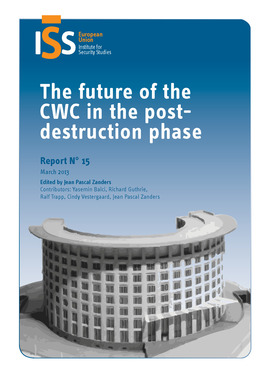
Future of the CWC in the post-destruction phase
Posted: March 27, 2013 Filed under: Chemical | Tags: Chemical warfare, chemical weapons, CWC, Disarmament, European Union, OPCW, Review conference, Science, Verification 3 CommentsThe future of the CWC in the post-destruction phase
Report – No15 – 27 March 2013
Yasemin Balci, Richard Guthrie, Ralf Trapp, Cindy Vestergaard, Jean Pascal Zanders
edited by Jean Pascal Zanders
From the Foreword by Ambassador Jacek Bylica, Principal Adviser and Special Envoy for Non-proliferation and Disarmament, European External Action Service:
The international community can be justifiably proud of the Chemical Weapons Convention. It has banned an entire category of weapons of mass destruction and provided for their verifiable elimination under international supervision. A small but effective intergovernmental organisation, the Organisation for the Prohibition of Chemical Weapons (OPCW), has been created for this purpose.
[…]
In the present international situation it is important to note that the Convention has created a de facto legal norm against the production, possession and usage of chemical weapons for military purposes. This prohibition goes beyond the letter of the Convention and stems from the reactions to the tragic experience of World War I and more recent cases of CW usage, including against non-combatants.
[…]
This volume features contributions derived from some of the presentations made by world-class experts at the workshop organised by the EU Institute for Security Studies in cooperation with the European External Action Service on 10 September 2012. The workshop offered an opportunity to reflect on some of the challenges facing the CWC over the next decade in preparation of the Third Review Conference at The Hague in April 2013. I am confident that this report presents an invaluable contribution to the debate on the future direction of our joint efforts which aim at the total and irreversible elimination of chemical weapons from the face of the Earth.
Chemical Warfare allegations in Syria – An initial assessment
Posted: March 19, 2013 Filed under: Chemical, War | Tags: Chemical warfare, chemical weapons, Middle East, Syria 46 CommentsReports are coming in about the use of chemical weapons (CW) near Aleppo in Syria. The source is the Syrian government, who alleges a rebel attack. Up to 25 people may have been killed; scores more injured.
Russia confirms the reports in a strong-worded statement; the US denies the attacks, but is waiting for further analyses of the reports. The Director-General of the OPCW expressed his grave concern over the reports.
I just saw images from a hospital, where a lot of people wearing surgical masks attend to people having infusions, on BBC World. Sana-Syria has published pictures.
My quick take on these developments:
- I am not convinced that the footage and pictures I have seen prove a CW attack;
- There are no images of the site of the attack; just of some affected people. These people do not show outward symptoms of a CW attack. Definitely not mustard; definitely not a nerve agent.
- There are far too many people, including non-medical staff, around the affected persons. Apart from a surgical mask, nobody wears any protective garment or gas masks. If there would have been a CW attack with one of the agents known (or believed) to be in Syria’s arsenal, then most of the people present would have been fatally or seriously contaminated.
- I am deeply sceptical of allegations that the insurgents would have resorted to CW. There would have far greater propaganda benefits if they were to demonstrate to the world that they had overrun one of the storage or production facilities. In addition, insurgent spokespersons were very quick to deny the government allegation.
- Regarding a case of a transfer to (and, hence, use by) surrogates of the Syrian government, I have already expressed my views on such a scenario.
- Present-day battlefields are extremely toxic. Many materials may be propelled into the air and inhaled by bystanders. If some (toxic) chemical container were hit by a shell, then bystanders could be badly affected, as we have seen in a variety of recent internal conflicts (former Yugoslavia; Sri Lanka; Iraq; etc.). Bhopal reminds us of the large-scale effects of an industrial accident. Any investigation of the allegation must first exclude plausible alternative explanations.
Possible developments I do worry about include:
- Is the Syrian government allegation the type of statement often heard in the past to justify ‘retaliatory’ chemical attacks? If so, the next days and weeks may become very nasty indeed. Not just because of chemical warfare, but also because of the various red lines Western states, and the US in particular, have drawn if such an escalation with CW were to take place.
- Why has Moscow confirmed the Syrian allegation so quickly and in such strong words? What is the motive behind this? Just contradicting the West again? If not, why is it so tied to Bashar al-Assad? What can it gain from this position? Of course, Syria got most of the technology and expertise to set up and run its CW programme from the former Soviet Union. Did the former head of the Soviet CBW forces, Anatoly Kuntsevich, not die on his return from Syria in 2003? Furthermore, if Syria were ever to become a party to the CWC, it would have to declare the origins of its CW programme. Whatever we wish to believe, it potentially sets up Moscow against any country that might intervene militarily because of CW use.
- In three weeks time the States Parties to the CWC will convene for the 3rd Review Conference. Confirmation of the allegations or escalation described in the bullets above would have a most serious impact on the proceedings.
Anyway, this is just a quick take on an unfolding story. I am sure to follow up if anything further happens.
Thinking of Halabja Today – 25 Years Later
Posted: March 17, 2013 Filed under: Chemical, War | Tags: Chemical warfare, Halabja, Iran, Iran-Iraq War, Iraq, Kurdistan, Middle East, Saddam Hussein 46 Comments16 March marks the 25th anniversary of the chemical warfare attacks against the Kurdish town of Halabja. Since the First World War it was one of the few cases wherein chemical weapons (CW) were deliberately used against a civilian target. Human Rights Watch documented over 3,200 deaths and many times that number of other casualties. Since then, thousands more of people have succumbed to their injuries or preventable infections affecting organs damaged by exposure to gas. Many women also suffered extensive genetic damage, thus passing the consequences of the gas attacks down the generations.
The town of Halabja in northeast Iraq has become a modern-age symbol condemning chemical warfare. Together with Ieper, a medieval town in the Belgian province of West Flanders. On 22 April 1915, the day on which scientific research, industrial production and military art finally found each other, German Imperial troops released a chlorine cloud from thousands of canisters buried in the trenches on the northern flank of the Ieper salient. Two years later, in the night of 12–13 July 1917, the town became associated with the first use of a new chemical warfare agent—mustard gas (which the French subsequently called ‘Yperite’). Mustard was also one of Iraq’s agents of choice against both the Iranians and the Iraqi Kurds.
The Iran–Iraq war lasted twice as long as the First World War: from 1980 until 1988. Iraqi use of toxic chemicals against Iranian soldiers was first reported in 1982, but by the end of 1983 press outlets told of widespread usage of mustard gas and tabun, a nerve agent. In April of the next year, a UN team of experts confirmed chemical warfare. From then onwards, Iraqi chemical attacks escalated, reaching a first peak in 1986 in the southern marshes. Two years later Iraqi forces had also assimilated CW for offensive operations and employed them with increasing effectiveness until Iran’s capitulation on 8 August 1988.
Possibly earlier, but definitively from 1987, Saddam Hussein opened a second chemical front against the Iraqi Kurds in the north. Names of towns such as Erbil (Hewlêr in Kurdish) in the north of the country or Penjwin, east of Sulaymaniyah, recurred frequently in interviews I had with Kurdish Peshmergas coming for a break to Belgium. They recounted chemical strikes against agrarian communities in north and east Iraqi Kurdistan. They described how eating the vegetables from their fields poisoned women and children many weeks after a CW attack. Unwittingly, they ingested the mustard agent that had settled on the bottom side of the leaves. The Peshmergas also depicted bombing raids high in the mountains, after which the mustard gas rolled down the mountain sides, penetrating deep into any cave sheltering Kurdish fighters.
About two years later, when listening again to my recordings from 1987, I recognised another town being referred to—Helebce, since then better known in the West as Halabja. The local population had risen up against Saddam Hussein, who brutally crushed the revolt. Half of the city fled to Iran, about 15 kilometres to the east, according to the interview. When Kurdish guerillas fighting alongside Iranian troops ‘liberated’ Halabja on 15 March 1988, supreme vengeance against an insurrectionary town came the next morning in the form of a gas cloud. Attacks were to continue until the 18th. Privately I have always been convinced that the 1987 uprising together with the ‘betrayal’ of the Iraqi Kurds seeking to break Baathist control over northeast Iraq with Iranian help in 1988 provoked the extraordinary escalation of chemical warfare against Kurdish guerillas and civilians alike. From that perspective, Saddam Hussein’s campaigns against the Kurds through August and September 1988 merely systematised the Halabja method on an even grander scale.
Indelible impressions
A few weeks after the attacks against Halabja, members of the Kurdish community in the Leuven area (where many Iraqi Kurds stayed with relatives and local acquaintances for a breather from combat) took me to the Erasmus hospital in Anderlecht, just outside Brussels. It had accepted four or five victims of chemical warfare for treatment. One was an Iranian soldier badly affected by mustard gas; one was a boy aged around five recovering from the chemical attacks on Halabja; the remainder were farmers from a wide area surrounding the town. Iraqi chemical strikes had neither been limited to 16 March, nor to the town of Halabja, it became clear to me. Joost Hiltermann later confirmed this impression in his detailed study ‘A Poisonous Affair’ (2007).
Two things struck me during that visit. The local Kurdish community treated the young boy as one of their own. He was slowly recovering from a low red blood cell count (possibly from a cyanide breakdown product after tabun exposure), and by the time I visited him he was already sitting up surrounded by pretty expensive toys. Most striking was a large replica with moving wings of an F-14 jet, with which the child was playing most of the time I was there. The treating physician told me of his incomprehension of why the boy had been given so many war-related presents. He also remarked on how the boy winced whenever a commercial jetplane flew over, an observation that added to his puzzlement. Three years later, when I was intensely following developments in the war over Kuwait, my son was both restless and agitated. After asking in a supermarket for a small, but accurate metal model of the A-10 close air support aircraft, which he recognised from TV newscasts, he settled down markedly. It seemed as if by holding the object of his anxiety, he was able to control the source of his angst. The Kurdish boy had definitely seen Saddam’s fighter-bombers up close.
The second lasting impression was how my Kurdish hosts tore me away from the Iranian soldier. He was by far the worst victim of gas exposure in the hospital (he was to die not too long after my visit). His skin looked blackened where white ointment did not fully hide it. Lesions from the vesicles covered parts of his body and his difficult, assisted breathing betrayed internal injuries. A faint, but unforgettable smell of decayed flesh penetrated the dominant odour of disinfectants. He had fallen victim to mustard gas outside of Halabja, possibly being one of the soldiers along whose side the Peshmergas were fighting against Saddam Hussein. The Kurds, however, did not spare a thought for him. This somehow offended my unconscious belief that victims of chemical warfare are all equal. At least, I knew of no such distinctions being drawn between Allied and German gas casualties of the First World War. In Belgium, common cause is against chemical warfare, full stop. And 25 years ago, the suffering in the trenches was all still part of national living memory.
The other face of Halabja
This incident was my first concrete exposure to the deep ethnic, cultural and religious cleavages in the Middle East, difficult to bridge and a perennial source of misunderstanding and hostility. It also shows why Halabja can never be a symbol for Iran’s suffering from CW in the way Ieper does for all chemical warfare during the First World War. For a while Halabja stood for all atrocities committed during Saddam’s reign of terror; the new Iraqi regime now commemorates the Halabja attacks as a national tragedy. Iran widely publicised the gassing in the weeks and months after the air raids. Halabja, however, lay in occupied territory. UN experts could not enter the town without Iraq’s authorisation. Although access to the victims transferred to Iranian hospitals was possible, lack of onsite verification diminished the value of the findings. Moreover, most victims were not Iranians, but Kurds—an ethnic group whose members living inside Iran also suffered from violent oppression by the theocratic rulers.
Iran’s own Halabja is called Sardasht, a municipality without much military significance across the border north of Sulaymaniyah. Saddam’s air force hit the town on 28 June 1987, almost nine months before Halabja. Although initial reports of CW victims were low, it soon emerged that almost three quarters of a population of 12,000 had been exposed to the toxicants. Some 130 people died, most of them civilians. The international press barely noticed this strike on a target with hardly any military significance.
Sardasht emblemised Iran’s predicament. The Islamic revolution of 1979 bought the country few friends. With the hostage taking in the US embassy, pent up anger over Washington’s unwavering support for the Shah’s repressive regime exploded into the open. The new leadership also refused rapprochement to the Soviet Union. Meanwhile it called for Islamic uprisings against the corrupt, autocratic leaders in the Gulf and beyond. When Iraq invaded its neighbour, Saddam Hussein presented himself as the bulwark against Persian territorial designs and Islamic revolutionary fervour. Although the United States and the USSR found themselves on the same side of the war; having lost a major regional ally, Washington nevertheless sought to pry Iraq away from the Soviet sphere of influence. The tide soon turned against Iraq, but the international community could not afford to let it lose the war. Such geostrategic calculations were to clash with international law.
When Saddam Hussein ordered the first chemical attacks, he breached the 1925 Geneva Protocol. Both Iran and Iraq had been party to the agreement for many decades. To Iraq, CW were a force multiplier that arrested the incessant Iranian human wave attacks when it was about to lose the war. National governments expressed their outrage, but the UN Security Council, while condemning the chemical attacks, never specified Iraq as the perpetrator for the duration of the war with Iran.
Countries adopted national sanctions and restricted access to certain chemical warfare agents and their precursors, but, absent a specific designation of responsibility under international law, applied them to both belligerents. The Geneva Protocol did not deny Iran the right to retaliate in kind, but international ‘evenhandedness’ certainly precluded it from achieving a CW capacity before the war’s end. The international stance had its moral merit. This, however, did not apply to the refusal to assist Iran with defensive countermeasures, including gasmasks, decontamination equipment, other types of individual and collective protection or prophylaxis. In 1985–86 an Iranian delegate to the Conference on Disarmament in Geneva even had to travel to several European countries (including Spain) to procure active charcoal in order to develop chemical warfare defences in Iran. (I have detailed Iran’s defensive and offensive CW efforts in a study published by the Swedish Defence Research Agency in December 2003.) Often the Iranians were conned, leaving no option for the country to start developing its indigenous capacities—for CW defence as well as offense.
Just like Trotsky concluded after Russia’s capitulation to Germany in 1917, those experiences convinced Iran of the need to overcome technological backwardness in order to survive. They also taught the country that international law does not guarantee international justice, and it harbours deep misgivings about international promises for assistance. Adding insult to injury, from 1989 onwards US officials indicated several times that Iran rather than Iraq had gassed Halabja, a claim so preposterous that its motive remains a mystery to me until today. Self-sufficiency, self-reliance, autarky in all security-related matters drives today’s political leadership. Most Iranian politicians of all persuasions, as well as much of the population, belong to the generation that grew up on the battlefields of the Iran-Iraq war. War is therefore not necessarily a state of affairs they will seek to avoid in the pursuit of national interests. Nor do international confrontation or the threat of war particularly frighten them. Layer upon layer of fresh economic and political sanctions only confirm convictions that had eight long years to take root in the blood-soaked trenches along the Iran-Iraq border.
Halabja therefore also symbolises the long-term fallacy of short-term interests. It is the one lesson the world does not seem to have learned.
 Arms Control Law
