The banalisation of tear gas
Posted: August 17, 2014 Filed under: Chemical | Tags: chemical weapons, CWC, International Humanitarian Law, Riot control agent, Tear gas 6 CommentsI am not the only person who is concerned by the banalisation of tear gas as a riot control agent. Over the past few years, the intensity with which such agents have been used has increased markedly, to the point that whole sections of cities now routinely become saturated with the toxic chemicals. In particular Michael Crowley of Bradford University’s Non-Lethal Weapons Project has published studies on the fast technological development and growing global markets of riot control agents and their delivery systems: one in collaboration with the Omega Research Foundation, and one, co-authored with Dana Perkins, then expert of the 1540 Committee, for the Biochemical Security 2030 Project, University of Bath. Likewise, the Physicians for Human Rights issued a report in 2012 on the Bahrain government’s indiscriminate use of tear gas, and in 2013 another one on tear gas excesses in Turkey.
The recent massive use of tear gas by a highly militarised local police force to quell riots in Ferguson, Missouri, has drawn renewed attention to a weapon that the Chemical Weapons Convention bans as a tool of warfare.
Anna Feigenbaum has just published a historical overview of tear gas in The Atlantic, starting with the fist use of a chemical weapon by the French in World War 1 exactly 100 years ago this month.
Perhaps most striking is her compilation and mapping of global tear gas use during 2013 (my screenshot):

A PDF printout of the incidents she has listed runs for 19 pages.
Alas, if a riot control agent is used as a tool for law enforcement or domestic riot control purposes, then the Chemical Weapons Convention does not consider it as a chemical weapon and therefore falls outside its scope of application.
[Cross-posted from The Trench]
Gradually making sense of Syria’s CW declarations
Posted: August 11, 2014 Filed under: Chemical | Tags: chemical weapons, CWC, Disarmament, Mustard agent, OPCW, Ricin, Sarin, Syria, Verification 1 CommentSince my last update on the elimination of Syria’s chemical weapon (CW) capacities in May, all precursor chemicals have finally left the country. Some have been shipped to facilities in Finland and the USA, where they are in the process of being destroyed. The United Kingdom meanwhile completed the destruction of 190 tonnes of chemicals at an incinerator in Ellesmere Port.
As of 7 August, 74.2% of Syria’s entire stockpile of chemical warfare agent precursors have been destroyed. Other chemicals are meanwhile being neutralised on board of the US vessel Cape Ray in the Mediterranean, and the resulting reaction mass will eventually be commercially incinerated too.
The Organisation for the Prohibition of Chemical Weapons (OPCW) is gradually slipping off the radar screen of international media. The huge pressure of safely evacuating the precursor chemicals from the war-torn country now removed, the organisation can slowly return to its more familiar role in the background of international politics: monitoring compliance with the Chemical Weapons Convention (CWC) and resolving any outstanding issues. Syria will increasingly become more integrated as a ‘normal’ member of the OPCW. This, however, does not mean that the OPCW will relax its efforts to achieve full accounting of its chemical warfare programmes, clarification of allegations of CW use, or complete destruction of all relevant declared facilities. Syria’s recurring amendments to its initial declaration of 23 October 2013 demonstrate the grinding, but nonetheless steady progress the OPCW is making.
Two new elements (at least to outsiders) have surfaced over the past couple of weeks: Syria’s presentation of a destruction plan for abandoned chemical weapons (ACW) and the declaration of a CW production facility dedicated to ricin manufacture.
Re-hexamination of Syria’s sarin
The UN Secretary-General’s latest monthly progress report on the elimination of Syria’s chemical warfare capabilities refers to Syria’s submission on 14 July of a destruction plan for two sarin-filled munitions. Syria denies ownership of these CW and has therefore declared them as ACW.
The two munitions were recovered after the CW attack at Jobar, an eastern suburb of Damascus, on 24 August 2013 (i.e., three days after the Ghouta chemical attacks). Four days later, Syria notified the UN Secretary General of the use of an improvised explosive device (IED) releasing a foul and strange odour. The UN team investigating alleged CW use visited the site on 29 September. It was unable to examine the place of impact or recover munition fragments, because mine clearing operations had completely corrupted the surroundings. Syrian officials handed over IED fragments and contaminated soil samples, which they claimed came from the incident site. For obvious reasons, the UN team could not certify their chain of custody.
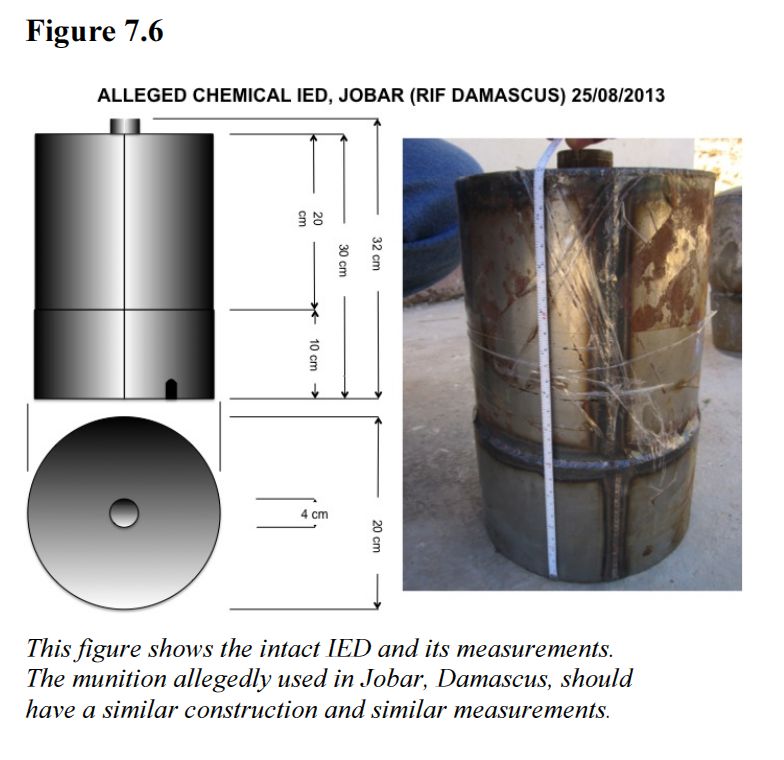
According to the Final Report by the UN Mission (p. 65), the investigative team ‘was also presented with two metal canisters discovered by Government soldiers during the offensive operations in Jobar on 25 August 2013 in the immediate aftermath of the incident and in close vicinity of the site of the alleged incident’. These were said to be identical to ones used in the chemical incident the day before. Made of steel sheeting of 1mm thickness, the plates were bent and welded together manually at a sub-industrial standard. The canisters nevertheless revealed a high degree of expertise with the electric welding process. The UN investigators were also able to establish that ‘a detonator and a coiling of the detonating cord, acting as a booster, composed the fire train, electrically initiated’. They had an internal fill capacity of up to approximately 4 litres (see figure below). The two metal canisters are the ACW Syria declared to the OPCW. (This description corrects the suggestion in my posting of 26 May that the two ACW were Volcano rockets. The claim that Syria did not declare any Volcano rockets as CW still stands, however.)
Analysis of their contents by the OPCW confirmed sarin as their payload. Moreover, the filling displayed all the characteristics of sarin as produced by the Syrian government, the principal telltale sign being the presence of hexamine (hexamethylenetetramine). Since its presence in samples was first reported by the UN investigative team last September in relation to the Ghouta attack and the OPCW later released that Syria had declared 80 metric tonnes of the chemical in connection with sarin production, there has been furious speculation as to its exact role. In a recent analysis focussing explicitly on the role of hexamine, UK-based CW expert Daniel Kaszeta argued that the Syrians used the compound as an acid scavenger in the final reaction of their rather unique sarin production process. Reacting DF (methylphosphonyl difluoride) with isopropanol yields sarin and hydrofluoric acid, the latter being a toxic and extremely corrosive gas that would have quickly damaged the production and agent filling installations. Hexamine binds this acid, and does so more efficiently than other amino compounds.
However, recent discussions with officials from some Western states indicate two other roles of hexamine, namely as catalyst and stabiliser. The catalyst function is probably closely tied to the acid scrubber role. In an e-mail exchange today, Ralf Trapp, a chemist and consultant to the OPCW, confirmed that hexamine increases the yield of the chemical reaction by pulling the equilibrium between the precursors and reaction product (sarin) in favour of the latter. As a result, the sarin concentration receives a significant boost, possibly up to 60%. This degree of purity is considerably higher than the yields achieved by Iraq in the 1980s.
As a stabiliser, hexamine probably allowed the Syrians to store freshly produced sarin for days, if not several weeks. This understanding is more compatible with views before the civil war that Syria’s CW served strategic deterrence. Munitions declared to the OPCW last autumn also seem to validate those views. Initiating the final reaction shortly before use, as was the case in Iraq, would have undermined this doctrinal role. The insight also raises fresh questions about the curious White House claim last August that the United States had observed Syrian preparations for three days prior to the Ghouta attacks.
Strictly speaking, the chemical analysis of the sarin in the two ACW confirms beyond any doubt that the nerve agent was produced by means of the same process as the one used by the Syrian government. The distinctive signature, however, cannot exclude the possibility that insurgents might have captured some CW. Western officials tend not to give much credence to this hypothesis.
Castor beans: cancer research, castor oil, or ricin?
The latest monthly progress report also reveals that on 14 July Syria submitted yet another amendment to its initial declaration. The document lists a dedicated ricin production plant. As a weapon the toxin is banned under both the Biological and Toxin Weapons Convention (BTWC) and the CWC. The CWC requires the verified destruction of CW production facilities, but the amendment claims that it is located in an area not under government control. It also states that the entire quantity of ricin produced was eliminated prior to the entry into force of the CWC for Syria. If correct, then Syria need not declare its past toxin weapon holding. CW disarmament in Syria, however, is hardly a normal operation. As with its claimed destruction of 200 tonnes of mustard agent early in 2013, the OPCW must investigate those statements to ascertain that the country is not hiding any residual CW.
This progress report was the first to publicly mention ricin production. Last April concerns about the toxin had already filtered out of the United Nations, but they have thus far remained a relatively low-level matter at the OPCW. This was in part a consequence of the high-priority preoccupation with getting the precursor chemicals out of Syria, and in part because nothing seems to indicate that the country presently has ricin weapons. Questions remain nonetheless.
Syria apparently cultivated castor oil plants (Ricinus communis) on several tracts the size of football fields. In itself, this is no so unusual as the oil makes for an excellent lubricant for heavy engines, such as those in military lorries. However, Syria’s initial explanation referred to cancer research and treatment, which was wholly implausible in view of the minute quantities of ricin required for research. Castor oil also lacks any medicinal value to cure cancer. It was used to deliver some chemotherapy drugs to tumours, but occasional side effects, such as allergic reactions, have led to the adoption of alternatives. Starting in the 1980s, Texas Tech University and Texas Tech University Health Sciences Center conducted long-term research on the oncological application of genetically modified ricin to kill diseased cells. According to a press release of October 1998, ‘just two acres of land, given the right castor seed, could produce enough ricin to meet the world’s pharmaceutical supply need for cancer treatment’. Ricin is also being investigated in relation to neurological degenerative disorders and in the treatment of intractable painful neuropathies. It is rather hard to think of Syria as a global supplier of medicinal ricin many times over.
This leaves the question of ricin as a weapon. Ricin is an instrument of choice for assassinations, as befell Bulgarian dissident writer Georgi Markov in London in 1978. More recently clumsy attempts to send ricin-filled letters to hated persons, including President Barack Obama, have also put the spotlight on the agent. Since the First World War many states considered ricin as a possible tool of warfare, but they have never incorporated it as a standard agent into their chemical and biological warfare arsenals. Despite the military attractiveness of its toxicity, the toxin poses several serious problems in relation to large-scale production, longer-term storage (unless turned into a solid), and dissemination techniques. While none of these problems are insurmountable, the net effect is that the agent is more cumbersome to weaponise or less effective on the battlefield than alternatives.
Right now the reason behind Syria’s declaration of a CW production facility exclusively dedicated to ricin manufacture remains murky. On the one hand, in view of the many publicly available accounts describing the many difficulties of producing and especially storing the toxin in free state for longer periods of time, it almost seems implausible that Syria would have embarked on a major ricin weapon programme. Interestingly, several Western officials I recently spoke to tend to discount public Israeli reports on Syria’s ricin programme. The annual US State Department report on arms control treaty compliance for 2014 dropped the reference to ricin-based biological weapons in the BTWC section and does not mention the toxin in the separate CWC compliance report. The 2013 treaty compliance document still stated: ‘In 2004, Israel’s Intelligence and Terrorism Information Center said in a report on Syria that the Scientific Studies and Research Center had been developing ricin-based biological weapons’.
On the other hand, if the Syrian factory was indeed dedicated to the production of oil or lubricants, the possibility exists that it used a cold hydraulic pressing technique, in which case 1–5% by weight of ricin might remain in the resulting mash. A fact sheet on ricin by the OPCW Science Advisory Board (SAB) released in February 2014 notes that castor oil production plants are not subject to Schedule 1 inspections under Article VI of the CWC. The SAB therefore recommended that the Director-General encourage National Authorities in producing countries to promote hot pressing and other techniques that ensure inactivation of residual ricin in the waste mash. In other words, the Syrian amendment might reflect a compromise with the OPCW to remove any ambiguity about the purpose of the ricin resulting from a particular production process in view of the need for absolute certainty that all aspects of the country’s CW programme have been eliminated. A future oil-extraction plant using a process that inactivates residual ricin could then be constructed without the need for long-term verification modalities for that installation.
A possible explanation for the ricin factory declaration for sure, but more details are required to confirm the scenario. To be continued.
And the destruction of mustard agent?
As I reported in May, OPCW inspectors were looking into Syria’s claim earlier this year that it had destroyed some 200 tonnes of mustard agent in the spring of 2013. They are still trying to obtain further documentation substantiating these destruction operations. Onsite inspections of the disposal sites are still pending before this particular file can be closed.
[Cross-posted from The Trench.]
New article on the WMD-free zone in the Middle East
Posted: July 28, 2014 Filed under: Biological, Chemical, Nuclear 1 CommentI would like to alert our readers on a chapter I have written for Grø Nystuen, Stuart Casey-Maslen and Annie Golden Bersagel’s forthcoming edited book Nuclear Weapons under International Law (Cambridge University Press, 2014). My contribution, which can be downloaded from here, discusses the international law issues arising from the treaties establishing nuclear weapon-free zones in inhabited regions of the world. In particular, it focuses on the proposed zone free of weapons of mass destruction in the Middle East, identifying the potential legal problems and making suggestions for possible solutions.
Comments are as always welcome.
Chemical Weapons before the US Supreme Court: Bond v. United States
Posted: July 9, 2014 Filed under: Chemical Leave a commentI’m very pleased to host another guest post from Dr. Daniel Rietiker. This time Daniel provides a review and commentary of the recent decision of the U.S. Supreme Court in the Bond case.
————————————————————————-
Chemical Weapons before the US Supreme Court: Bond v. United States, June 2, 2014 (case note)
Daniel Rietiker, PhD
It is rare that the Supreme Court of the United States deals with arms control or disarmament issues. It did so recently and delivered its opinion in the case of Bond v. the United States on June 2, 2014. The case arose from a lurid domestic dispute that started when a Pennsylvania woman, Ms. Bond, a microbiologist, learned that her husband was the father of her best friend’s child. This curious case deals with the obligation to implement the provisions of the 1993 Convention on the Prohibition of the Development, Production, Stockpiling, and Use of Chemical Weapons and on Their Destruction (CWC), and there deserves the following brief considerations.
[For the text of the opinion: http://www.supremecourt.gov/opinions/13pdf/12-158_6579.pdf%5D
The Facts of the Case
Petitioner Bond sought revenge against H with whom her husband had carried on an affair. She stole a quantity of 10-chloro-10H-phenoxarsine, an arsenic-based compound, from her employer, a chemical manufacturer. She also ordered a vial of potassium dichromate, a chemical commonly used in printing photographs or cleaning laboratory equipment, on Amazon.com. Both chemicals are toxic to humans and, in high enough doses, potentially lethal. It is undisputed, however, that Bond did not intend to kill H.
She then spread the two toxic chemicals on H’s car, mailbox, and door knob in hopes that H would develop an uncomfortable rash. On one occasion H suffered a minor chemical burn that she treated by rinsing with water, but Bond’s attempted assaults were otherwise entirely unsuccessful. The local authorities decided not to pursue the matter, but federal prosecutors charged Bond with violating, among other things, 18 U.S.C. Section 229(a), that is based on the 1993 Chemical Weapons Convention to which the US is a party. Bond moved to dismiss the chemical weapons charges on the ground that the Act violates the Tenth Amendment. When the District Court denied her motion, she pleaded guilty but reserved the right to appeal. The Third Circuit initially held that Bond lacked standing to raise her Tenth Amendment challenge, but the Supreme Court reversed. On remand, the Third Circuit rejected her Tenth Amendment argument and her additional argument that Section 229 does not reach her conduct.
NPT Article VI and BTWC Article IX
Posted: May 28, 2014 Filed under: Biological, Chemical, Nuclear | Tags: BTWC, CWC, Disarmament, NPT 1 CommentThis discussion between Marco and Dan on Article VI of the NPT and customary law is instructive.
In this particular case, Marco’s application of the notion to a single article rather than the totality of the treaty puzzles me. I would tend to agree with Dan’s counterpoint. However, Dan then refers to the CWC in its entirety to draw an analogy. In my mind a bit problematic for two reasons:
1. The CWC is a disarmament, rather than a non-proliferation treaty. It means that the weapon category in its entirety is banned and no exeception exists for any state, whether big or small; whether powerful or weak. However, more to the present discussion, as a consequence of the CWC being a disarmament treaty (i.e., going to zero and remaining at zero in the future), the convention is final. It does not have aspirational articles with regard to ambitions not covered by its own text.
2. Article VI of the NPT resembles more of Article IX of the BTWC:
Each State Party to this Convention affirms the recognized objective of effective prohibition of chemical weapons and, to this end, undertakes to continue negotiations in good faith with a view to reaching early agreement on effective measures for the prohibition of their development, production and stockpiling and for their destruction, and on appropriate measures concerning equipment and means of delivery specifically designed for the production or use of chemical agents for weapons purposes.
I find it difficult to see how this article could have turned the BTWC into a CW disarmament treaty (as proponents of nuclear disarmament often tend to do with regard to Article VI of the NPT) or how it could reflect on customary law regarding CW, even if considering that most people view the 1925 Geneva Protocol banning the use of chemical and biological weapons as having entered into customary law.
Just like the CWC, the BTWC is also a disarmament treaty and has similiar finality with regard to biological and toxin weapons. Nevertheless, I would argue that the BTWC today, despite having fewer parties than the CWC, fits more firmly into customary law: no state actually claims having BW or maintaining an offensive BW programme. (For example, in an interview in Der Spiegel on 19 January 2009, Bashar al-Assad more than implicitly admitted to CW, but flatly denied BW.) This has important implications from an armament/disarmament perspective: there is no space whatsoever for testing weapons in the field, training troops or developing military doctrines for their use on both the strategic and tactical levels. Even for states not party to the BTWC. Such types of preparations can be and would be detected.
But back to BTWC, Article IX: between 1975 (EIF for the BTWC) and 1993 (Opening for signature of the CWC) we witnessed an accelerated CW armament competition between the US and the USSR (including the startup of the US binary production programme), the start of Iraq’s CW programme culminating in gas being used in the 1980-88 Gulf War; Libya’s CW programme, Syria’s, …
So, as far as the analogy with Dan’s argument goes (I am discussing 2 different weapon categories mentioned in a single treaty): each party to the BTWC, whether a possessor or non-possessor of CW was bound to negotiate the CWC, but it did not prevent several among them to develop, produce, or even use CW during the intervening period.
Syria: Disarmament in animated suspense
Posted: May 26, 2014 Filed under: Chemical | Tags: chemical weapons, CWC, Disarmament, OPCW, Syria, Verification 2 CommentsSyria has now missed about every single deadline since it was unable to move the Priority 1 chemicals out of the country by the end of last year. These even include renegotiated time frames and the self-imposed final date of 27 April. One more fixed date is pending: 30 June, by which time all precursor chemicals should have been neutralised.
It would now seem that the world will sigh with relief if everything is aboard the Danish and Norwegian freighters by the end of next month. US officials envisage 60 working days to neutralise the volume of precursor chemicals and hydrolyse the mustard agent on board the US ship Cape Ray. The end of this mission could be pushed back even further if factors such as bad weather or sea states exceeding safety standards interrupt activities. In addition, the original schedule foresaw incineration of the reaction mass by the end of 2014. However, one of the companies selected by the Organisation for the Prohibition of Chemical Weapons (OPCW), Finland’s Ekokem, requires at least nine months. This potentially pushes completion of the disarmament tasks agreed in the US-Russian framework agreement of September last year into the second quarter of 2015. Consequently, the disarmament mandate established by UN Security Council resolution 2118 (2013) can be expected to remain in place at least as long.
Similar delays affect the final destruction of former CW production facilities (CWPF). Different interpretations about the perimeter of several CWPFs block consensus decision-making on the formal destruction plan in the Executive Council of the OPCW, and hence progress in the field.
Finally, concerns have emerged whether Syria has declared its entire CW stockpile. In particular, the country has claimed destruction of 200 metric tonnes of mustard gas in March 2013, but initially failed to declare this to the OPCW.
Remaining precursor chemicals
Syrian authorities have consistently claimed that heavy fighting at key sites and high security risks along the transportation routes make it all but impossible to transfer the precursor chemicals to the port of Latakia within the set deadlines. The Joint OPCW-UN Mission has tended to confirm these security assessments. It has also reported shelling into Latakia in March and intensive combat operations around the final storage site.
According to the 7th monthly report submitted to the UN Security Council on 25 April, 96.45% of declared Priority 1 chemicals and 81.09% of declared Priority 2 chemicals had been moved onto the Danish vessel Ark Futura and the Norwegian freighter Taico respectively. Combined they amounted to 92.03%. The remaining 8%—about 100 metric tonnes of precursors—consisted of
- Priority 1 chemicals:
- B salt (N (2-chloroethyl)-N-ethyl propan 2 amine salt)
- DF (methylphosphonyl difluoride)
- Isopropanol
- Priority 2 chemicals
- Butan-1-ol (alcohol)
- HCl (hydrogen chloride)
- HF (hydrogen fluoride)
- Hexamine
On 20 May, the OPCW–UN Joint Mission confirmed the destruction of all isopropanol. (It should be noted that ‘B salt’ did not figure in the initial list of precursors and was included in one of the revised declarations by Syria. It is possible that a declaration error was made concerning ‘BB salt’.)
The 7.2% of chemicals that must still be shipped out remain trapped at Al Sin. Very little is known about the military site, except for its identification as a CW production facility in the 3rd monthly report of last December (Annex, paragraph 15). ‘Al Sin’ features in a few combat reports by insurgent factions published to the internet on 20 March, and are described as depots or an airport. Some press accounts suggest that the chemicals are at an airbase.
Battalion 559 of the Syrian armed forces holds a storage base that fits the descriptions. It is located about 63km to the northeast of Damascus along a major road travelling from the Adra suburban area in the general direction of Palmyra (Tadmur). About 14km to the south of Al Sin lies the Sayqal Military Airbase, which also houses several ammunition storage installations.
Al Sin has two major access routes (presumable the aforementioned main road going either northeast or southwest) and a secondary road travelling through the mountains. At present, the main access routes are unusable because they are controlled by insurgents or within easy targeting range of their heavier weaponry. The secondary road is impractical, considering that the DF has been transferred into large 2000-litre reinforced containers and the highly dangerous and volatile HF is contained under pressure in industry-standard cylinders. Transport in a large, escorted convoy along a mountainous track not only runs a high risk of accidents, the surroundings also offer many opportunities for ambushes. The Syrian army is currently mounting major military operations to clear (one of) the two principal routes out of Al Sin. Once achieved, the evacuation of the final precursors to Latakia is expected to be completed shortly afterwards.
Destruction of CW production facilities at an impasse
Political blockage over the destruction of Syria’s twelve CWPFs prevents progress on an important dimension of the elimination of the country’s chemical warfare capacity. The Chemical Weapons Convention (CWC) refers to CWPFs in many articles and sections of the Verification Annex. Article II, 8 defines it in terms of equipment for producing or filling certain types of chemicals and buildings that house such equipment. They must be irreversibly destroyed under a detailed destruction plan, although some buildings can be converted under strict conditions to purposes not prohibited by the convention. Despite Syria’s request, the Executive Council of the OPCW has refused to authorise conversion of some facilities.
In contrast, CW storage facilities (CWSF) are discussed only in the Verification Annex, Part IV(A) in relation to the presence of CW, their verification and destruction. A party to the CWC must declare a CWSP’s name, exact coordinates and a detailed site diagram, including a boundary map and the location of bunkers/storage areas within the facility. It must also provide a detailed inventory of the CW they contain. No treaty provision, however, demands the destruction of CWSFs.
Syria has apparently five underground structures, tunnels shaped in the form of a staple. They comprise three major sections. Each of the two extremities offers entrance to the complex. However, only one of the arms is the actual CWPF; the two other sections Syria has declared as storage sites. Following extensive discussions with OPCW technical staff and onsite visits at the end of March, a CWPF destruction plan was proposed to the Executive Council, which it rejected. The United States and other members of the Western Europe and Other States Group represented on the Executive Council argued that the storage areas form an integral part of the production site, and that therefore Syria’s circumscription of the CWPFs is incomplete. In addition, the argument has been put forward that via a network of tunnels they link up to other parts of a larger military complex.
It is difficult to see how the impasse can be overcome soon. The Executive Council habitually decides by consensus. If the United States and its partners press for a vote, they are by no means certain of gaining a majority. Even if they do, there may be ramifications in other areas of treaty implementation further down the road. Syria, for its part, has adopted a very assertive posture since becoming an OPCW member last October and is unlikely to budge on anything that does not represent a formal, unambiguous obligation under the CWC or without pressure from Russia. The current frosty relations between Moscow and Washington are not helpful either.
Did Syria declare all?
Over the past month or two several questions have arisen as to whether Syria declared its full chemical warfare capacity. They are in part due to the recent attacks with barrel bombs allegedly containing chlorine canisters, and in part to the amendments to its formal declarations to the OPCW. The latter are the result of normal verification routines by OPCW staff, which it undertakes for all parties to the OPCW. Analysis of declarations and onsite inspections often lead to the discovery of inconsistencies, contradictions or even missing information, which yield lists of questions and issues that the state party must resolve. Syria is no exception, and a significant new amendment to earlier declarations is expected in the near future. Although it will not contain new types of chemicals, there will be variations in the volumes of declared precursors without much changing the overall total of 1,300 metric tonnes. In contrast, it will include a thus far undeclared CW research centre near Damascus. (Readers of this blog will recall that the Executive Council and UN Security Council decisions of 27 September compel Syria to declare research facilities, even though this is not required by the CWC.)
A initial team of 8 OPCW inspectors left for Syria on 2 May and they were joined by an additional 5 personnel on 12 May to investigate the chlorine attack allegations. They can have access to the one site where the government has claimed that the rebels used a chlorine weapon, but until now have been refused entry into the rebel areas. Negotiations with insurgents to enable the safe transit of the precursor chemicals to the port of Latakia or for OPCW-UN Joint Mission staff to have access to sites in rebel-controlled territory are conducted through the office of Lakhdar Brahimi, the Joint Special Envoy of the United Nations and League of Arab States for Syria. While the office continues to function, Brahimi’s resignation on 13 May, effective at the end of the month, implies the loss of a lot of political clout with the insurgents. It’s impact on the disarmament process is unclear for the time being, but the convoys transporting the precursor chemicals and the OPCW–UN Joint Mission may face growing security and safety challenges if the current lack of progress continues for any significant length of time. Future investigations of alleged used of CW may also be compromised.
Another element that tends to contribute to the unease about Syria’s truthfulness is the fact that until today the government has not declared owning any of the Volcano rockets believed to have delivered sarin nerve agent against the Ghouta district last August. It did report two such missiles, but stated that it had found them and that it was not their possessor. Many countries and observers blame the Syrian military for the Ghouta attacks and other chemical strikes.
Finally, the questions if Syria has declared all its ‘weaponised’ warfare agents revolve around whether it has irreversibly disposed of about 200 metric tonnes of mustard gas. Syrian officials claim that the stock was destroyed at three sites in March 2013, around the time of the chemical attacks in Khan al-Assal near Aleppo and several months before the Ghouta sarin strikes. (No allegation of a mustard attack has so far been recorded.) Interestingly enough, Syria apparently mentioned these destruction activities before or during the US-Russian bilateral negotiations in Geneva last September, but the issue has only been picked up more recently. The Syrian government has now supplied the OPCW with details of these operations, which still require confirmation. OPCW inspectors plan to verify the claim and the veracity of its particulars by means of interviews, record analysis and on-site sampling. UNSCOM inspectors in Iraq during the 1990s occasionally had to resort to similar methodologies to determine whether the claimed volume of agent destroyed without international supervision corresponded to reality. Syria formally declared 20.25 metric tonnes of mustard agent (an amount relatively small compared to the overall volume of declared nerve agent precursors), which will be hydrolysed on board the Cape Ray. Inevitably, the episode has raised concerns among some OPCW members about possible undeclared ‘weaponised’ nerve agents.
More to follow over the next weeks, I am sure.
Postscript: Two hours after posting this contribution, the OPCW published an updated report on the status of CW disarmament in Syria.
[Cross-posted from The Trench.]
Until silence
Posted: May 24, 2014 Filed under: Chemical, War | Tags: Chemical warfare, International Humanitarian Law, Syria 2 CommentsChildren and babies—whether born or unborn—suffer immensely in any armed conflict. Mental trauma from witnessing human wasting, which no person should really be exposed to anymore. Physical injuries that scar the young ones for the rest of their lives, even if a sense of normalcy could ever be recaptured. And death, often considered the worst possible outcome, but nonetheless a fortuitous escape from a lifelong suffering inflicted by a senseless war ripping apart the early stages of their far too many young lives. For the survivors—bereft parents and mothers of the stillborn one—deep-reaching psychological wounds far beyond consolation.
Until the silence says goodbye
Addressing her companion after a mutual acquaintance, a British naval officer who had served in World War 1, suddenly passed away in 1923, Vera Brittain (Testament of Youth, Chapter XXII, 4) wrote:
I don’t think victory over death is anything so superficial as a person fulfilling their normal span of life. It can be twofold; a victory over death by the man who faces it for himself without fear, and the victory by those who, loving him, know that death is but a little thing compared with the fact that he lived and was the kind of person he was … That’s why those war victories with which I was especially associated are still incomplete. That the people faced their own deaths without fear I have no doubt. It is through me that the victory is incomplete, because I cannot always quite feel that their deaths matter less to me than the fact that they lived, nor reconcile their departure, with all their aspirations unfulfilled, with my own scheme of life.
Having lost her fiancé, two brothers and a close friend in the Great war, she was still struggling make sense of death, despite a self-induced mental numbness to cope in a post-war British society that had no time or space to embrace its many scarred veterans with the human carnage she saw firsthand as a voluntary nurse.
No pantomime of time to heal…
For the unborn child or infant physically or psychologically mauled by detonating bombs or shells, there is no victory for having lived that parents could savour. Chemical weapons add to that despair: a person living under their threat has no sense of being able to escape them. There is simply no place to run (to paraphrase Tim Cook’s magnificent book on Canadian soldiers’ adaptation to survive under a perpetual gas blanket during World War 1).
Hurt and fear are overwhelming emotions. Children and gas, when combined, allow for easy, but powerful manipulation of public opinion beyond the battlefield, often for purposes that have little bearing on relieving the plight of those actually facing the threats. Add a couple of graphic pictures; throw in one or two names to make the suffering tangible and direct public emotions to these few foci in order to momentarily blur out the 150,000 fatalities and millions of other casualties shared by all sides in the Syrian civil war. Can a policy maker or shaper fail to respond to such concentrated emotion? This is why I reacted strongly to the unsubstantiated claims that sarin exposure was causing the deformed babies in ‘Must the Belgian babies be bayoneted all over again?’
Today, a week or so after The Telegraph (London) and The Daily Star (Beirut) ran their respective ‘scoops’, no additional claims, no new names of children from the Ghouta area, have surfaced. A few media outlets reported on the original stories, but to the best of my knowledge, nobody seems to have delved further into the matter. Claims of sarin’s mutagenic properties appear to have vanished into thin air.
Survive to die alive
In contrast, other factors that may explain the incidence of miscarriages and malformed babies have come to the fore: prolonged extreme stress, concussion, exposure to high levels of dust, malnourishment, unsanitary conditions (at home, in shelters or in hospitals), etc.
Last December, many months before the sarin claims, a trained paediatrician with 20 years experience working Médecins sans frontières attributed the malformations in Syrian infants she was treating to possible deprivation of folic acids. No or insufficient intake during especially the first four weeks of a pregnancy profoundly compromises the neurulation process, which in turn leads to severe congenital deformity.
If this doctor’s surmise is correct, then the rising incidence of stillborn or malformed babies testifies to the dreadful state of Syria’s health system more than anything else.
She also described the wrenching plight of two pregnant women caught up in aerial bombing on their way to the market one sunny day. One lost her baby in her struggle to survive …
No hint of sarin or chemical warfare in her accounts.
There is simply no need to add gas to feel the pain of Syrian mothers …
[Cross-posted from The Trench]
Must the Belgian babies be bayoneted all over again?
Posted: May 19, 2014 Filed under: Chemical | Tags: Allegation, Chemical warfare, Chlorine, Propaganda, Sarin, Syria 1 CommentAugust, 100 years ago: the Hun from the east invaded little, neutral Belgium. In the opening weeks of the campaign the Hun was not a good boy. He willfully executed civilians, raped women, destroyed historical monuments and burned down university libraries—all war crimes that have been extensively documented. The worst barbarian acts, however, he committed against babies. He cut off their hands, so that the grownup man could never take up arms against the Hunnic master. Worse, he tossed them in the air and caught them on his bayonet. Alas, each investigated claim proved to be a myth. Meanwhile, many a Brit had enlisted to revenge the ‘Rape of Belgium’.
Similar stories appealing to public emotion circulated before the outbreak of World War I. And they have been fabricated since. Remember the Iraqi invasion of Kuwait in August 1990 and Nayirah’s testimony before the Congressional Human Rights Caucus? Nayirah, then 15 years old, told of Iraqi soldiers seizing incubators from Kuwaiti hospitals and leaving the babies to die on cold floors. Nayirah turned out to be the daughter of Kuwait’s ambassador to the US, and the accusations were reportedly coached by a US-based PR company contracted by the Kuwaiti government. However, the tale received a huge credibility boost from Amnesty International. The human rights watchdog claimed in a December 1991 report that its investigation team talked with several doctors and nurses who ‘gave details of the deaths of 300 babies removed from incubators in hospitals by Iraqi troops and left to die on cold floors’ (Douglas Walton, 1995, p. 772). (Amnesty international eventually retracted its report, unlike Human Rights Watch today, which released a dubious report on the Ghouta attacks and—in a modern version of the Vietnam-era ‘destroy the town to save it’—seized on the chemical weapon allegations to call for military strikes against Syria.)
Which brings us to current press reports of genetically malformed babies as a consequence of chemical warfare in Syria.
Deformed babies after the Ghouta attack
A few days ago, The Telegraph (London) and the Daily Star (Beirut) published testimonies and pictures of children born with genetic defects from the Ghouta district near Damascus. Other babies were reported to have been stillborn. Parents and attending physicians attributed the occurrences to the chemical attacks there last August. The UN investigative team confirmed the use of the nerve agent sarin in those attacks.
Many toxic chemicals are known mutagens. Some directly damage the DNA, resulting in replication errors. Some interfere with the replication process itself, and yet other ones can create mutagenic metabolites. Certain cancers may result from genotoxic properties of chemicals. As a matter of history, research into the physiological consequences of exposure to mustard agents after World War I and during World War II contributed to the development of chemotherapy against cancer. Chronic exposure to such genotoxicants may also lead to transgenerational genetic effects. Images of mutant fish and amphibians living in polluted water reservoirs come to mind. The severely malformed infants of Vietnamese parents and US veterans who were exposed to large doses of Agent Orange sprayed to defoliate forests during the Indochina war remain living proof of the transgenerational mutagenic and teratogenic consequences of certain chemical warfare agents. Research into the long-term health implications of the chemical bombing of the Kurdish town of Halabja in March 1988 has revealed similar transgenerational effects of mustard agent.
The main problem with the current claims of genetically malformed babies in the Ghouta area is that no indicators are available to conclude that the nerve agent sarin provokes cancer or leads to genetic defects.
Long-term research into the effects of sarin
As a consequence of the prevalence of illnesses related to the 1990–91 Gulf War among US military personnel, the United States conducted extensive investigations into the consequences of exposure to nerve agents. One report, published in 1996, failed to link the neurotoxicants to cancers or mutations (GB is the US military code for sarin):
Carcinogenicity, Mutagenicity, Teratogenicity
Organophosphates are not recognized as being carcinogens. No evidence was found to suggest that GB has carcinogenic potential. In a follow-up study of approximately 995 U.S. Army volunteers who participated in anticholinesterase experiments at the U.S. Army laboratories, Aberdeen Proving Ground, Edgewood, Maryland during 1955-1975, no consistent pattern of increased risk of cancer was found (NRC, 1985). The study was of relatively low statistical power, and was only able to identify large differences. The investigators concluded that, based on these findings, and the 10 lifetime studies of carcinogenicity of organophosphates sponsored by the National Cancer Institute, that anticholinesterase compounds did not induce malignancies among the Edgewood subjects.Goldman, Klein, Kawakami and Rosenblatt (1987) concluded that GB is not mutagenic based on both in vivo and in vitro evaluations. Negative results were found in the Ames Salmonella bacterial gene mutation assay using 5 different strains exposed to a range of concentration of GB. Mouse lymphoma cell tests, Chinese hamster ovary cell tests, including sister chromatid exchange assays, and rat hepatocyte assays (for unscheduled DNA synthesis and damage) were all negative for mutagenic activity.
No evidence of teratogenicity of GB was found. Organophosphates are generally not considered to have significant reproductive effects; no studies to directly evaluate this characteristic in GB were found. In their study of the toxicity of chronic exposure of dogs to GB, Jacobsen, Christensen, DeArmon, and Oberst (1959) had the male animals bred after 25 weeks of daily moderate doses of GB; the offspring were normal.
In their one year, low-dose GB inhalation exposure study of a variety of animals, Weimer et al (1979) found no abnormalities in reproduction and fertility, fetal toxicity, or teratogenesis in Sprague-Dawley/Wistar rats. Testicular atrophy was noted in the Fischer rat, but the authors speculated other causes, since later experiments (using a different route of exposure) did not replicate the finding. In their report, the authors also cite work conducted by J. R. Denk (EB-TR-74087 Effects of GB on Mammalian Germ Cells and Reproductive Performance, February 1975) which came to the same negative conclusions.
Similarly, an Emergency Response Card, last reviewed by the Centers for Disease Control on 12 May 2011, notes:
EFFECTS OF CHRONIC OR REPEATED EXPOSURE: Limited data are available on chronic or repeated exposure to sarin. The available data however, suggest that sarin is not a human carcinogen, reproductive toxin, or developmental toxin. Limited data suggest that chronic or repeated exposure to sarin may result in a delayed postural sway and/or impaired psychomotor performance (neuropathy).
Attribution to chlorine and mustard agent exposure
The Daily Star also offered a bizarre linkage with chlorine, the agent of recent chemical warfare allegations in Syria:
While stressing that he was not a doctor, chemical weapons expert Hamish de Bretton-Gordon pointed to similar birth defects witnessed after the 1988 Halabja massacre, when the Iraqi government launched a chemical attack against the local Kurdish population.
De Bretton-Gordon, CEO of SecureBio, a UK-based Chemical Biological Radiological and Nuclear consultancy firm and former commander of the British military’s CBRN forces, said of the images of Joud: ‘Yes I think there is something in this and we saw similar from Halabja victims. I’m obviously not a doctor but chemical weapons, including chlorine, are known to be carcinogenic and mutanogenic.” (Sic)
The Center for Disease Control, the U.S. national public health institute, states that in the use of organophosphates such as sarin, ‘the possibility that birth defects could occur has neither been confirmed nor ruled out.’ Chlorine is not included in this nerve agent category, as it is a blister agent.
The Health Protection Agency (today Public Health England) published a toxicological overview of chlorine (2007) and excluded any of the above cited consequences from exposure:
Genotoxicity
No data are available on the mutagenicity of chlorine gas per se, although the mutagenicity of solutions of chlorine in water (hypochlorite and its salts) has been investigated. Sodium hypochlorite has been shown to have some mutagenic activity in vitro (both bacterial and mammalian cells) that may be due to the generation of reactive oxygen species. However, there is no evidence for activity in vivo. Negative results were obtained in bone marrow assays for clastogenicity (chromosome aberrations and micronuclei) in mice. The negative results reported in the carcinogenicity bioassays also support the view that hypochlorite does not have any significant mutagenic potential in vivo.
Carcinogenicity
Negative results were obtained when chlorine (dissolved in drinking water) was investigated in a National Toxicology Program (NTP) carcinogenicity bioassay in rats and mice; concentrations of up to 275 ppm chlorine were used. Previously, the International Agency for Research on Cancer (IARC) had evaluated the carcinogenicity of hypochlorite salts and concluded that there was no data available from human studies and that the data from experimental studies in animals was inadequate. Therefore, hypochlorite salts were assigned to Group 3, i.e., compounds that are not classifiable as to their carcinogenicity in humans.
Reproductive and developmental toxicity
In general, animal studies have demonstrated no reproductive or teratogenic effects of chlorine. The effects of water chlorinated to a level of 150 mg L -1 were investigated in rats over 7 generations. No effects were observed on fertility, growth or survival.
Whether the interviewed expert actually expressed the words as recorded in the Daily Star is uncertain. The last sentence in the newspaper quote may indicate a mixup on the part of the journalist: ‘Chlorine is not included in this nerve agent category, as it is a blister agent.’ Chlorine, of course, is a choking agent, not a vesicant such as mustard gas.
As noted above, Saddam Hussein’s forces did employ mustard agent against Halabja and exposure to the agent can have genetic consequences for the survivors. However, nobody has ever alleged mustard gas use with respect to the chemical weapon attacks against Ghouta (or for that matter during the Syrian civil war). Therefore, speculating on the consequences of an agent not at issue is entirely irrelevant.
Spurious argumentation
Substantiation of the claims rests on impressions and convictions of the affected families and some doctors working in the field making straightforward linkages between an observed phenomenon and the appearance of supposed consequences a while later. The articles offer no independently verified facts on the previous incidence of malformed children in the affected area or within the families.
The mothers in question are all reported to have been pregnant at the time of the gas attacks against Ghouta. Certain chemicals are known to affect the development of the foetus, the consumption of alcohol and smoking during pregnancy being prime examples. Sarin, however, does not appear to have such an impact, although, of course, one cannot exclude that the ways in which the body responds to the poisoning and the administered antidotes may impact on foetal growth.
Instead of exploring the deeper connections between cause and effect, The Telegraph chose to refer to the testimony by Dr Christine Gosden before the US Congress (which actually took place on 22 April 1998). She described how the inhabitants of Halabja were exposed to a cocktail of chemicals. With regard to the impact of mustard gas, she noted:
Long term effects. The most serious of the long term effects arise because mustard gas is carcinogenic and mutagenic. In the respiratory system there are increased risks of chronic lung disease, asthma, bronchitis. Permanent impairment of vision may occur and eye damage may be severe, leading to blindness. Skin lesions and burns may be severe with persistent changes and hypersensitivity to mechanical injury. Carcinogenic and mutagenic effects can result in cancers, congenital malformations and infertility. Long term effects (mutagenesis, carcinogenesis, eye, skin, lung, fertility, etc.) are dose and route dependent.
She does not claim similar consequences from exposure to nerve agents. Most importantly, the remainder of her testimony details the various short- and long-term symptoms observed in the victims over a 10-year period, but does not attribute any one of them to a specific warfare agent. In other words, invoking Gosden’s report as evidence in support of the claims regarding the consequences of the Ghouta attack is misleading, more so as the only agent that might strongly suggest carcinogenic or mutagenic consequences was not used in Syria.
The Telegraph article (unwittingly?) offers a very good alternative explanation for the genetic malformations (emphasis added):
‘We are receiving pregnant women in Arsal from many areas such as Qusair, Homs, Kalamoon, and [outer] Damascus, they come across the border for giving birth but in some cases the result is tragedy.’
‘We are receiving around 100 births a month in Arsal, about 12 per cent in the average out of them are stillborn,’ [Dr Kasem al-Zein] said. ‘The problems for newborn children are mostly occurring in women who were exposed to the chemical weapons, but also we have noticed that all women who lived in areas exposed to shelling by barrels and missiles are suffering fetal diseases.’
Arsal lies to the northeast of Baalbek in Lebanon. Since the reported cases attributed to chemical attacks are all from the last week or two, it is very difficult to determine how large a part of the monthly average they (can) represent. In contrast, the numbers do hint at possible roles of prolonged extreme stress, concussion, exposure to high levels of dust, malnourishment, and so on, in the incidence of miscarriages and malformed babies.
Déjà vu
The story leaves a distinct impression of having seen it all before. The Telegraph came up with a defector, General Zaher al-Sakat, who had replaced sarin with Eau de Javel, a story that did not get much traction. Last month, it offered proof of chlorine use, which it claimed to be on a par with the methodologies applied by the Organisation for the Prohibition of Chemical Weapons. And interestingly enough, as the Christian Science Monitor wrote on 6 September 2002, ‘the first mention of babies being removed from incubators appeared in the Sept. 5 [1991] edition of the London Daily Telegraph’. That was on the eve of the decision to authorise military force to eject Iraq from Kuwait.
Seeking out plausible alternative explanations for observed phenomena and then eliminating them systematically goes a long way to establishing the credibility of an allegation. Are the current claims of mutagenic consequences of the chemical strikes in Ghouta part of a concerted ploy to again build a humanitarian case for Western military intervention against the regime of Bashar al-Assad? If so, it smacks of bayoneted Belgian babies all over again.
[Cross-posted from The Trench]
Green is the colour
Posted: May 2, 2014 Filed under: Chemical, War | Tags: Allegation, Chemical warfare, Chlorine, Investigation of use, OPCW, Syria 1 CommentThe Organisation for the Prohibition of Chemical Weapons (OPCW) is about to investigate the various allegations of the use of chlorine in Syria over the past few weeks. It is the right decision. It is the only decision possible in view of the many witness accounts and footage available on internet sites. However, the hope that the announcement of the fact-finding mission on 29 April might deter the perpetrator from future chlorine attacks was quickly dashed: a new chlorine bombing took place a day later.
The symbolism of the date cannot be overstated. 29 April was the 17th anniversary of the entry into force of the Chemical Weapons Convention (CWC). 29 April is the UN’s annual Day of Remembrance for all Victims of Chemical Warfare. And now, 29 April is also the day on which for the first time the potential violation of the ban on the use of chemical weapons (CW) by a state party to the CWC was officially recognised. A mere six months after Syria joined the convention. And 99 years after chlorine ushered in the age of modern chemical warfare.
On the same day, a British newspaper, The Daily Telegraph, felt the need to headline that it had the proof that Assad launched the chlorine attacks. It caused a stir, not in the least because the article ended with the claim that the newspaper’s investigation was on a par with OPCW procedures. Hardly.
No stranger to the battlefield of world opinion
It is worth recalling that initial accounts on the chemical attack at Khan al-Assal (near Aleppo) on 19 March 2013 referred to chlorine. Early press reports mentioned 26 fatalities, a figure that would eventually rise into the low thirties, and scores of otherwise harmed individuals. I was not convinced that the observed effects correlated with claims about the agents used. In a March 2013 brief for the EU Institute for Security Studies I wrote:
This claim is intrinsically problematic. Exposure to chlorine stored in a warehouse or near a production installation hit by a shell could account for respiratory problems and skin irritation, but not for a high number of fatalities. One would need a very high volume of the agent to obtain lethal doses in open air; the explosion would most likely destroy part of the agent; and highly recognisable evidence of corrosion at the site of attack could not be missed.
More recent accounts specify that Islamic extremists filled a home-made rocket with chlorine dissolved in a saline solution. The agent would thus amount to Eau de Javel (bleach). Even in its highest industrial concentration of 40%, the agent cannot explain the fatalities, even if one were to assume that a very large number of home-made rockets hit the target in a tight cluster.
A month later, I remained just as unconvinced. In the meantime, having reviewed all CW references I had collected since the start of the Syrian civil war, I was struck by how stories on a particular incident may change with time. As a rule of thumb, everything ultimately turned into sarin. And as suggested in the quote above, sarin could become bleach. It is worth retracing that metamorphosis.
The Khan al-Assal attack of 19 March prompted the Syrian Government to request the UN Secretary General to conduct an investigation of alleged use. As already mentioned, reports at the time were referring to chlorine or witnesses recalling a chlorine smell. Chlorine was also what the Syrian government reportedly cited in its letter to Ban Ki-moon. Already early in December 2012, the Syrian Foreign Ministry had warned of possible insurgent use of CW in letters to the UN. It alluded to a Syrian-Saudi factory SYSACCO near al-Safirah (southeast of Aleppo), which had just been captured by militants from the jihadist Al-Nusra Front. That factory produced sodium hydroxide (caustic soda) and hydrochloric acid (HCl). Not only did this claim prepare a plausible foundation for the chlorine allegations three months later, it also gets close to the bleach (sodium hypochlorite), commercially known as Eau de Javel in Europe.
Four days after the alleged attack we learn that ‘the Syrian military believe that a home-made locally-manufactured rocket was fired, containing a form of chlorine known as CL17, easily available as a swimming pool cleaner. They claim that the warhead contained a quantity of the gas, dissolved in saline solution’. Now, what form of chlorine is Cl17? A look at the Mendeleev’s Periodic Table teaches us that Cl is the chemical abbreviation of chlorine and 17 is its chemical number. However, this demystified CL17 is contained in a saline solution, which is, of course, sodium hypochlorite. I use it to disinfect my toilet. Eau de Javel as a chemical warfare agent, that was new to me. (However, do note the source of that story.)
So, please forgive me if I seem to demand a higher level of convincing.
Questions I would like to see answered
- From some of the footage available on the internet, I do think that a toxic substance must have affected a number of people. However, I am less sure about the more precise elements in the accusations. For example, based on the pictures of one of the flasks, I gather that a substance (in this case, liquid chlorine, I presume, but then letters with white powder are also often marked ‘anthrax’) was contained in a small industry-standard vessel (apparently of Chinese origin & and marked Cl2). What I would like to know is how much explosive it would take to break open such a container? How much chlorine (if this is what was inside) would have been destroyed or burned by that explosion? What are the dynamics of chlorine release in the scenario that the amount of explosives is sufficient just to break the seal / valve of the vessel? I have been told that such an amount would be very small, but how does the resulting aperture affect the dynamics of gas release? Was the vessel contained inside a drum (i.e., a confined space), as some reports suggest? If so, how does that affect the dynamics of the explosion and gas release? What would the impact of an explosive devise have on the rate of release of the chlorine and how much of the chlorine would actually remain after the rupture of the container?
- How much chlorine (if this was what it was) was inside the vessel? How would sufficient chlorine be built up locally to seriously injure or even kill people? In what environment was the chlorine released (e.g., closed space of a room or outside in the open air)? Chlorine is perceptible to humans in very low concentrations, so why would people remain in close vicinity of the devise long enough to absorb a harmful dose of chlorine? Following the blast, I have been told, people in close proximity of the bomb may be dazed and confused and in their disorientation may consequently not escape from the area. Was this the case?
- Would an industry-standard container rupture simply by dropping it from a helicopter?
- One film clip on Brown Moses’ blog shows a helicopter dropping something, followed by a – in my mind – big flash. Would chlorine withstand the forces and heat of such a detonation? Detonation of chlorine was pretty ineffective in Iraq (at least as regards the impact of chlorine on the targeted group of people).
- Are there any reports of corroded metals in the vicinity of the area of release? (Moisture in the air acts as a catalyst for chemical reactions with chlorine, and the agent is very aggressive on metals and alloys.)
- Why do press reports refer to a ‘yellow’ smoke or powder (as one Beirut-based journalist described the observations to me)? Chlorine tends more towards pale green, sometimes with a yellowish hue. However, the yellow might dominate in a sun-swamped environment and an overall sandy-colour backdrop. I do not know. A BBC clip (2nd clip, middle article, final seconds) posted on 28 April, shows yellow smoke from a barrel bomb attack in which no chlorine was used. So, can we see similarities of symptoms and phenomena between different types of attack, but which witnesses do not or cannot differentiate? Another example: as for the reports of a chlorine smell near the scene of the Khan al-Assal attack in March 2013, chemical weapons expert and chief operating officer of SecureBio, Hamish de Bretton-Gordon, then said that conventional high explosives can also produce an odour which might be mistaken for chlorine.
- Would one expect a hissing sound as the chlorine under pressure escapes from the container? Have we seen any such witness accounts?
- Are we looking at a case of what I call ‘opportunistic use of toxic chemicals’, where people (government soldiers, their allies, or insurgents) took hold of containers at an industrial site and improvised a new device of war? In other words, are we looking at a case of deliberate preparation for chemical warfare by whoever is responsible for the events?
A good call
The OPCW Director-General’s decision is the right one. Ambiguity and speculation must be removed—and fast. The lack of precise timing (or explanation of the necessary preparations and precautions) in the OPCW press statement is worrying, and not just because this is the first time the organisation is called upon to launch an investigation of use all by itself (in previous investigations the OPCW assisted the UN Secretary-General, as Syria was not yet a party to the CWC). Chlorine is a very volatile element, so the critical question is how long the agent might reside in the soil, on other surfaces or inside containers? The answer is not long, especially not in the heat of Syria.
Still, the exercise should not be futile. Investigations of alleged use typically apply various methods (medical analysis, identification of plausible witnesses and corroboration of individual stories, matching pictures and film footage based on the stories by the carefully selected witnesses, etc.), whose independent results should contribute to building a more or less consistent picture of events. The OPCW inspectors would deploy sophisticated detection equipment. Any evidence brought back from the incident sites would be subject to strict procedures to preserve the chain of custody and then divided over multiple OPCW-certified laboratories for analysis.
And oh, just as a small afterthought: with an OPCW investigation, one of course does not have to wonder who has paid the piper.
[Cross-posted from The Trench]
After 99 years, back to chlorine
Posted: April 22, 2014 Filed under: Chemical, War | Tags: Chemical warfare, Chlorine, CWC, OPCW, Syria, World War 1 Leave a commentToday is the 99th anniversary of the first massive chemical warfare attack. The agent of choice was chlorine. About 150 tonnes of the chemical was released simultaneously from around 6,000 cylinders over a length of 7 kilometres just north of Ypres. Lutz Haber—son of the German chemical warfare pioneer, Fritz Haber—described the opening scenes in his book The Poisonous Cloud (Clarendon Press, 1986):
The cloud advanced slowly, moving at about 0.5 m/sec (just over 1 mph). It was white at first, owing to the condensation of the moisture in the surrounding air and, as the volume increased, it turned yellow-green. The chlorine rose quickly to a height of 10–30 m because of the ground temperature, and while diffusion weakened the effectiveness by thinning out the gas it enhanced the physical and psychological shock. Within minutes the Franco-Algerian soldiers in the front and support lines were engulfed and choking. Those who were not suffocating from spasms broke and ran, but the gas followed. The front collapsed.
The impact of this gas attack surprised the German Imperial troops too. Their cautious advance behind the chlorine cloud, their hesitation in the confusion about what was happening despite having secured their initial objectives within an hour, and their halt after darkness fell meant that they almost immediately lost the strategic surprise. They would never regain it.
A first generation warfare agent in worldwide industrial application
How ironic it is that today, almost a century later, the latest chemical warfare allegations in the Syrian civil war concern chlorine once again. Everybody knows about the dangers of the chemical element, but nobody really considers it any longer as a militarily useful agent. At least not in standard warfare scenarios.
Chlorine and derived products are in massive industrial production. According to the World Chlorine Council, there are more than 500 chlor-alkali producers at over 650 sites around the globe, with a total annual production capacity of over 55 million tonnes of chlorine. Based on the low threat assessment and its wide relevancy to the chemical industry and trade, the Chemical Weapons Convention (CWC) does not even list it in Schedule 3 of toxic chemicals (Phosgene, another widely used chemical and World War 1 agent, is).
An oversight by the CWC negotiators? Hardly. Books on the toxicology and treatment of chemical warfare agents published between 1992—year of successful conclusion of the negotiations—and 1997—year of entry into force of the CWC—hardly mention chlorine. Chemical Warfare Agents, edited by Satu Somani (Academic Press, 1992), presents a few scattered references, mostly in relation to other agents or public health. Another book featuring the same title, written by Timothy Marrs, Robert Maynard and Frederick Sidell (Wiley, 1996), gives it a four-line acknowledgment in the opening historical section. And the monumental Medical Aspects of Chemical and Biological Warfare, edited by Frederick Sidell, Ernest Takafuji and David Franz (Office of the Surgeon General, US Army, 1997), accords it about two pages out of 721 in a subsection entitled ‘Historical War Gases’.
Today, chlorine is mostly viewed as a public health or environmental hazard resulting from occupational exposures, industrial accidents or the malfunctioning of pool chlorination systems.
Back to World War 1
It goes without saying that during and after World War 1 perceptions of chlorine as a combat agent were quite different. Despite having been replaced by much more potent toxic chemicals, belligerents released chlorine gas until the final month of the war. Considering that the first contingents of the American Expeditionary Forces arrived in Europe in June 1917, but saw their first major military engagements in May/June 1918, the US War Department registered and examined 838 ex-service men who had been gassed with chorine (and survived their experience). A closer medical examination of 98 victims to assess the long-term effects of exposure suggests that all US chlorine casualties were affected between July and October 1918. It is interesting to note that Maj. Gen. Harry Gilchrist, Chief of the Chemical Warfare Service, and Philip Matz, Chief of the Medical Research Subdivision of the Veterans’ Administration, devoted half of their medical study, The Residual Effects of Warfare Gases (War Department and US Government Printing Office, 1933), to chlorine, mustard being the other agent of their investigation.
Their description of chlorine remains interesting, because it departs from its utility as a warfare agent, rather than as a public health hazard. The element is almost 2.5 times heavier than air, which means that it will cling to the surface and sink into depressions. At 15° C liquefaction requires 4-5 atmospheres pressure. Upon release at 25° C, one litre of liquid chlorine will yield 434 litres of chlorine gas. Moisture stimulates the element’s chemical action, so the liquid gas must be thoroughly dehydrated for storage in steel cylinders.
Concentration and length of exposure both play a role in the physiological action of chlorine and their effects on humans and animals. The authors noted that ‘a concentration of 1–100,000 of chlorine gas is noticeable, 1–50,000 may cause inconvenience, while a concentration of 1–1,000 may produce death after exposure for five minutes’. (The numbers correspond to 0.01 mg/ml; 0.5 mg/ml and 1mg/ml respectively.) Experimental studies on dogs (carried out to determine the types of lesions various concentrations of chlorine will produce) showed that the animals died within 72 hours from acute effects at concentrations of 2.53 mg/l and higher. These concentrations were labelled as lethal. A small percentage of the animals recovered within a week. A concentration of 1.9–2.53 mg/l increased the recovery rate markedly, whereas dosages below the 1.9 mg/l were rarely fatal. Recovery rates were markedly faster at lower concentrations.
Concentrations required for injury and death are relatively high. For comparison, in the section on mustard (dichlordiethyl sulphide) Gilchrist and Matz deemed this oily compound to be 50 times more toxic than chlorine. It can be deadly in concentrations from 0.006 to 0.2 mg/l, but they considered 0.07 mg/l at an exposure of 30 minutes to be the lethal concentration.
Rewind to March 2013
Syria, just like any other country with a relatively advanced chemical industry, produced chorine in large quantities before the civil war. Readers will recall that early reports of chemical attacks at Khan al-Assal, west of Aleppo, in the middle of March of last year mentioned a strong smell of chlorine. To the east of Aleppo, there was a chlorine production facility (which the Jubhat Al Nusra, a jihadist rebel group ideologically similar to Al Qaeda, reportedly took over in December 2012). However, accounts also mentioned scores of fatalities, which would be inconsistent with a chlorine-filled rocket warhead. I have always been sceptical about those claims, precisely because of the agent’s chemical properties and physiological action. At the time, descriptions did not fit the claimed agents, whichever these might have been.
The need to compress the agent into a liquid has ramifications for delivery: the container must be sufficiently strong to withstand several atmospheres of pressure, and if dropped from an aircraft, sufficiently thin for the skin to break open. It must also be large enough so that a lethal concentration can be built up for a sufficiently long time. Given that humans smell chlorine at very low concentrations, the chances that they will remain at the site of impact are remote. The element is also not colourless; in fact, its name derives from the ancient Greek ‘khloros’, meaning pale green.
The same goes for rocket delivery of the warfare agent. Shells were attempted during World War 1, but this method for chlorine discharge was quickly abandoned in favour of much more potent munition fillings, such as phosgene.
So, it would be good to get more details on the recent incidents and review them in the light of possible chlorine delivery. Please note that I do not deny the possibility of toxic incidents over the past few weeks, but I would just like to see the various facts reconciled with the claimed chain of events. Given that Russian Foreign Minister Sergey Lavrov and French President François Hollande have once again waded into the controversy, politicisation of the ‘truth’ cannot be far away, alas.
Back to where it all started
So, as we reflect on that fateful 22 April in 1915, the sad thought is that chlorine is back, or at least, that people feel that chlorine is back as a possible lethal combat agent.
Allegations fly, but if confirmed, the incidents would be the first acts of chemical warfare committed involving a state party to the CWC. If Syria’s accusation of insurgent use is correct, then the government has every opportunity to demand an investigation from the OPCW and request assistance. If the insurgents’s claim of government use is correct, as non-state actors they cannot request the OPCW anything. However, any state party to the convention can demand an investigation of alleged use by the OPCW, and the Syrian government has no right of refusal (Verification Annex, Part XI). The opposite would be a serious material breach of its treaty obligations and tantamount to an admission of guilt. Or, the states parties can determine that the claims are insufficiently substantiated to warrant an investigation. In which case, it would be nice if they all were to sing the same tune.
So, which way shall the international community have it? The principal long-term casualty of those political games might be the CWC, even though, admittedly, we are still far away from the death knell that 22 April 1915 sounded for the 1899 Hague Declaration (IV, 2) concerning asphyxiating gases.
Postscript
Several recent reports have suggested that because chlorine or other toxicants, such as riot control agents or incapacitants, are not listed in one of the schedules, they are not covered by the CWC. This is a major error. Any chemical which through its chemical action on life processes can cause death, temporary incapacitation or permanent harm to humans or animals is a chemical weapon, according to Article II of the CWC. This is the default position. There are only four categories of purposes (Art. II, 9), under which a toxic chemical would not be considered a weapon.
 Arms Control Law