On 29 October, the Technical Secretariat of the Organisation for the Prohibition of Chemical Weapons (OPCW) circulated three reports on investigations of alleged chemical weapons (CW) use in Syria. On 5 November Reuters published some details from the one addressing the alleged use of sulphur mustard agent in Marea, a town to the north of Aleppo, on 21 August. The two other reports address a series of incidents between 15 December 2014 and 15 June 2015 at the request of the Syrian government and between 16 March and 20 May 2015 in the Idlib Governorate documented by a variety of non-governmental sources.
For the purpose of clarity, the OPCW maintains a single Fact-Finding Mission (FFM), which has so far produced six reports. Under the FFM, the OPCW may deploy different teams to different locations.
The most recent reports will be released as part of the monthly OPCW reports on Syria to the UN Security Council, presumbly at the end of this month following the special session of the Executive Council on 23 November called to consider the findings.
Incidents in Idlib Governorate, March – May 2015
The Idlib Governorate lies to the south-west of Alleppo. During the spring of 2015 the international press and social media reported a string of incidents suggesting the use of chlorine as a weapon.
This team of the Fact-Finding Mission received its mandate to investigate incidents involving the use of toxicants as a weapon based on open-source media, other sources of information and materials obtained from non-governmental organisations. The investigation could not take place under optimal conditions, because the OPCW inspectors were unable to visit the sites of alleged incidents shortly after their occurrence, take their own samples or review the records onsite. Instead they based themselves on interviews and supplementary materials submitted during the interview process. They were nevertheless able to conclude:
In itself, no one source of information or evidence would lend particularly strong weighting as to whether there was an event that had used a toxic chemical as a weapon. However, taken in their entirety, sufficient facts were collected to conclude that incidents in the Syrian Arab Republic likely involved the use of a toxic chemical as a weapon. There is insufficient evidence to come to any firm conclusions as to the identification of the chemical, although there are factors indicating that the chemical probably contained the element chlorine.
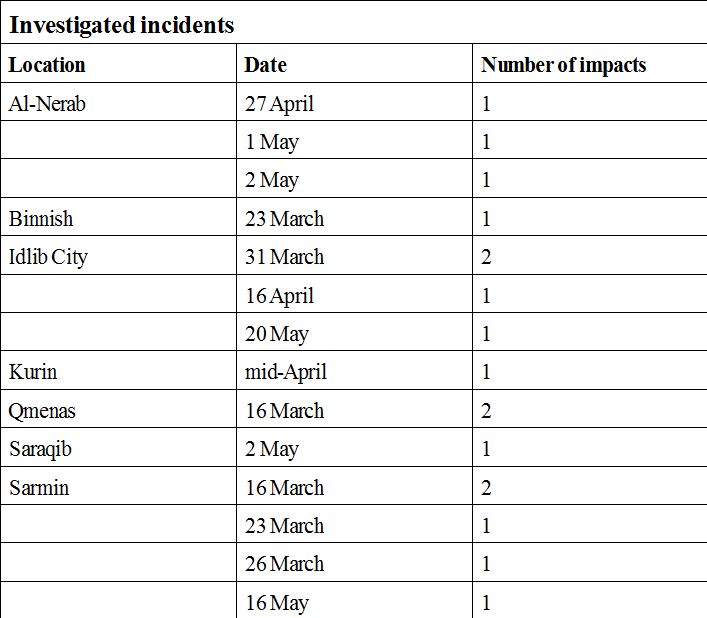
The report documents 17 incidents in 6 locations between 16 March and 20 May 2015. They were responsible for six fatalities.
First depiction of a chemical barrel bomb dropped from helicopters
The report also included a depiction of a so-called barrel bomb, based on the various testimonials and collection of bomb fragments. It notes that the design of the improvised weapon underwent an evolution of their manufacture, probably driven by trial and error. However, only a singly type appears to have been used in the Idlib Governorate between March and May 2015.
Depiction of a chemical barrel bomb (Source: OPCW)
The configuration consists of 9 gas cylinders (green) presumably filled with poisonous chemicals. The report suggests that they may have been filled with a chlorine or chloride containing compound. The flasks with potassium permanganate (pink) would then have been used to oxidise the chlorine containing compound, resulting in Cl2. The potassium permanganate may be responsible for the purple–red colour occasionally seen in pictures and video footage of impact sites.
This depiction definitely explains how high concentrations of chlorine were achieved locally, earlier assessments of improbability having been based on the assumption of the dropping or firing of single gas cilinders fitted with a light detonator. Interestingly, the barrel bomb configuration would not have contradicted this assumption, given the individual rigging of gas cylinders (see Brown Moses’ speculation on this in 2014) and the focus of outside observers on those cylinders. To the best of my recollection, only a single report on developments in Syria in 2014 prepared by Human Rights Watch made a passing reference to the possibility: ‘evidence strongly suggests that Syrian government helicopters dropped barrel bombs embedded with cylinders of chlorine gas on three towns in Northern Syria in mid-April‘.
On the value of the evidence
As usual and for good reason, the reports by the Technical Secretariat remain careful in their conclusions. Determination of reponsibility for the violation of the Chemical Weapons Convention and other legal instruments banning chemical warfare is pre-eminently a political judgement. As noted earlier, the Executive Council will consider these findings (as well as those in the other two reports) on 23 November, after which they will be transferred to the UN Security Council. They will also inform the Joint Investigative Mission established by the UNSC in August, whose principal task it is to determine responsibility for chemical warfare in the Syrian civil war.
Meanwhile, the investigators assess their findings concerning the delivery system as follows:
The description of the alleged chemical weapon and its deployment derives from several inputs, as previously described. The features of the improvised chemical bomb are consistent with its being designed for deployment from a height. As most incidents happened during darkness, it is not surprising that no interviewees claimed to have seen the means of deployment. The deformation of the remnants is consistent with mechanical impact and explosive rupture, rather than explosion causing deflagration. Witnesses also reported a lesser explosive sound than for other more conventional types of bombs. Moreover, casualties’ signs and symptoms do not include physical injuries that would be expected from the deployment of an explosive device. The craters which have been claimed to have been caused by the device are also consistent with its being dropped from a height with lesser explosive power. It is therefore reasonable to assume that the devices were not designed to cause mechanical injury through explosive force but rather to rupture and release their contents.
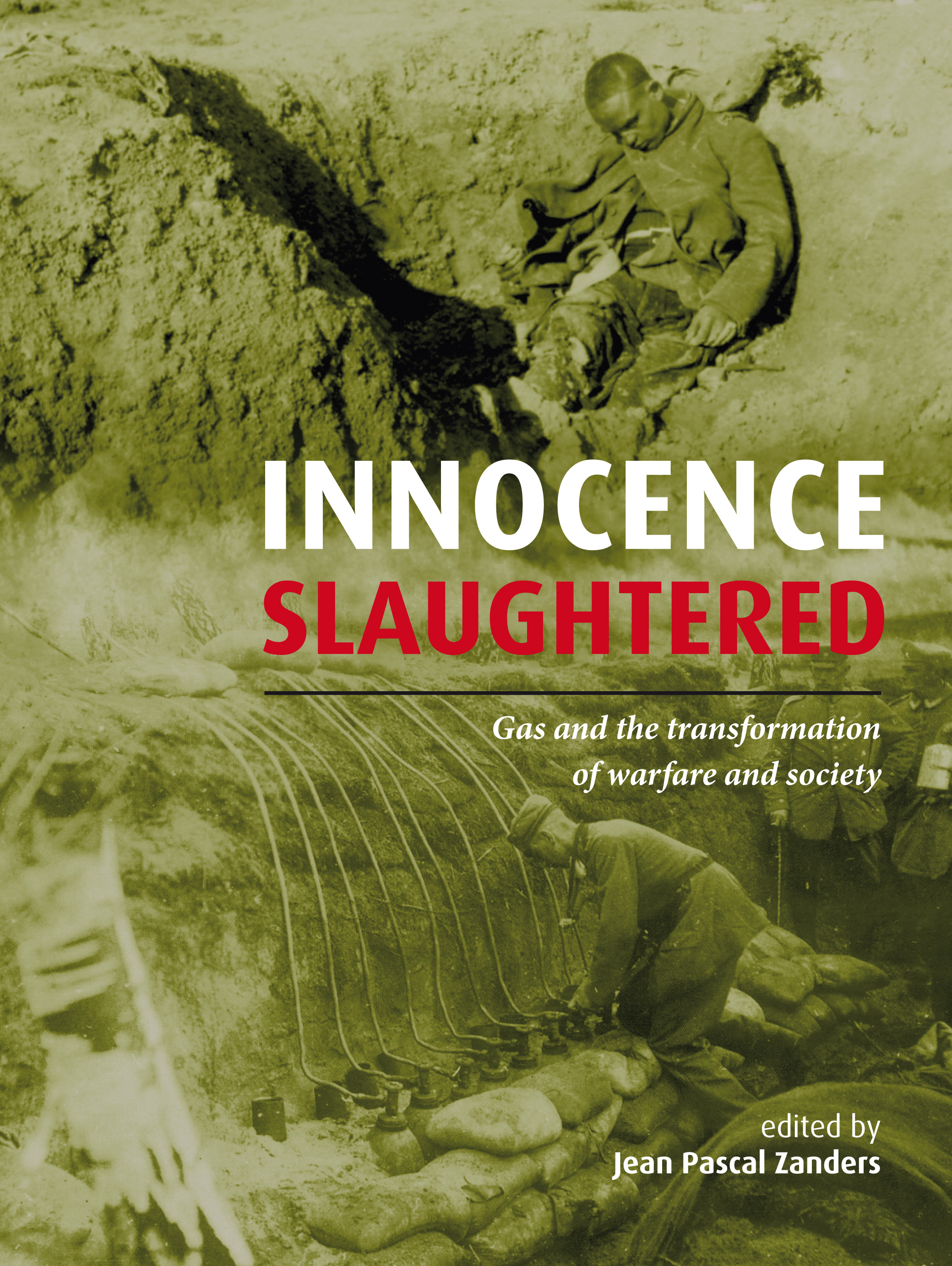
In November 2005 In Flanders Fields Museum organised and hosted an international conference in Ypres, entitled 1915: Innocence Slaughtered. The first major attack with chemical weapons, launched by Imperial German forces from their positions near Langemarck on the northern flank of the Ypres Salient on 22 April 1915, featured prominently among the presentations. I was also one of the speakers, but my address focussed on how to prevent a similar event with biological weapons. Indeed, it was one of the strengths of the conference not to remain stuck in a past of—at that time—nine decades earlier, but also to invite reflection on future challenges in other areas of disarmament and arms control. Notwithstanding, the academic gathering had a secondary goal from the outset, namely to collect the papers with historical focus for academic publication.
The eminent Dutch professor and historian Koen Koch chaired the conference. He was also to edit the book with the historical analyses. Born just after the end of the 2nd World War in Europe, he sadly passed away in January 2012. He had earned the greatest respect from his colleagues, so much so that the In Flanders Fields Museum set up the Koen Koch Foundation to support students and trainees who wish to investigate the dramatic events in the Ypres Salient during the four years of the 1st World War. The homage was very apt: Professor Koch had built for himself a considerable reputation as an author of studies on the 1st World War. Most remarkable: The Netherlands had remained neutral during the conflagration, which adds to the value of his insights.
Death, unfortunately, also ends projects. In the summer of 2014, while doing some preliminary research on the history of chemical warfare, I came across the manuscripts of the chapters that make up the bulk of this book. They were in different editorial stages, the clearest indication of how abruptly the publication project had screeched to an end. Reading them I was struck by the quality of the contents, rough as the texts still were. Together, the contributions also displayed a high degree of coherence.
One group of papers reflected on the minutiae of the unfolding catastrophe that the unleashing of chlorine against the Allied positions meant for individual soldiers and civilians. They also vividly described German doubts about the effectiveness of the new weapon, and hence its potential impact on combat operations. These contributions also reflected on the lack of Allied response to the many intelligence pointers that something significant was afoot. In hindsight, we may ponder how the Allied military leaders could have missed so many indicators. Yet, matter-of-fact assessments of gas use by Allied combatants recur in several chapters, suggesting either widespread anticipation of the introduction of toxic chemicals as a method of warfare or some degree of specific forewarning of the German assault. Gaps in the historical record, however, do not allow a more precise determination of Allied anticipation of chemical warfare. Still, a general foreboding may differ significantly from its concrete manifestation. From the perspective of a contemporary, the question was more likely one of how to imagine the unimaginable. Throughout the 2nd Battle of Ypres senior Allied commanders proved particularly unimaginative. In the end, the fact that German military leaders had only defined tactical goals for the combat operations following up on the release of chlorine, meant that they had forfeited any strategic ambition—such as restoring movement to a stalemated front, seizing the Channel ports, or capturing the vital communications node that Ypres was—during the 2nd Battle of Ypres, or ever after. The surprise element was never to be repeated again. Not during the 1st World War, not in any more recent armed conflict.
The second group of papers captured the massive transformation societies were undergoing as a consequence of industrialisation, science and technology, and the impact these trends were to have on the emergence of what we know today as ‘total war’. Chemical warfare pitted the brightest minds from the various belligerents against each other. The competition became possible because the interrelationship between scientists, industry, politicians and the military establishment was already changing fast. But chemical warfare also helped to effectuate and institutionalise those changes. In many respects, it presaged the Manhattan Project in which the various constituencies were brought together with the sole purpose of developing a new type of weapon. In other ways the competition revealed early thinking about racial superiority that was to define the decades after the Armistice. The ability to survive in a chemically contaminated environment was proof of a higher level of achievement. In other words, chemical defence equalled survival of the fittest. Or how Darwin’s evolutionary theory was deliberately misused in the efforts to justify violation of then existing norms against the used of poison weapons or asphyxiating gases.
During and in the immediate aftermath of the war, opposition to chemical warfare was slow to emerge. In part, this was the consequence of the appreciation by soldiers in the trenches and non-combatants living and working near the frontlines that gas was one among many nuisances and dangers they daily faced as its use became more regular. Defences, advanced training and strict gas discipline gave soldiers more than a fair chance of surviving a gas attack. The violence of total war swept away the humanitarian sentiments that had given rise to the first international treaties banning the use of poison and asphyxiating gases in the final year of the 19th century. Those documents became obsolete because people viewed modern gas warfare as quite distinct from primitive use of poison and poisoned weapons or the scope of the prohibition had been too narrowly defined. By February 1918 chemical warfare had become so regular that a most unusual public appeal on humanitarian grounds by the International Committee of the Red Cross (ICRC) badly backfired on the organisation. Throughout the 1920s the choice between an outright ban on chemical weapons and preparing populations for the consequences of future chemical warfare would prove divisive for the ICRC. In contrast, peace and anti-war movements in Europe campaigned against war in all its aspects and consequently refused to resist one particular mode of warfare before the Armistice. It is instructive to learn that opposition to chemical warfare specifically first arose far away from the battlefields—northern America and neutral Netherlands—and among a group of citizens not directly involved in combat operations: women. And perhaps more precisely, women of science who protested the misapplication of their research and endeavours to destroy humans. Just like the chlorine cloud of 22 April 1915 foreshadowed the Manhattan project, the Women’s International League for Peace and Freedom presaged the Pugwash Conferences on Science and World Affairs, who would bring together scientists, academics and political leaders to counter the growing menace of nuclear war and find solutions to other threats to peace and security.
It was clear to me that I should not remain a privileged reader of the manuscripts. They contained too much material and insights that the broader public should have access to. Piet Chielens, curator of the In Flanders Fields Museum, and Dominiek Dendooven, researcher at the Museum, could not agree more, and so a new publication project was born. However, since the centenary of the chlorine attack was only a few months away, reviving the academic product Koen Koch had been working on was initially not an option. So, the decision was to exploit modern communication technologies and produce the volume as a PDF file in first instance. However, by the time the electronic edition was ready for online publication, In Flanders Fields Museum had found a publisher willing and able to produce a formal edited volume before the end of the centenary year of the first modern gas attack. My gratitude goes to Ryan Gearing of Uniform Press for his guidance and concrete assistance in making this book a reality.
Time for preparing this publication was very short. To my pleasant surprise, every author in this volume responded favourably and collaboration over several intense weeks—both in the preparation of the original PDF version and the subsequent book project—proved remarkably gratifying and productive. Some contributors even took the time to introduce me to certain concepts widely accepted among historians, which I, with my background in linguistics and political science, had interpreted rather differently. For the experience in preparing this volume, I indeed wish to thank every single contributor.
22 April 1915 was not just the day when the chlorine cloud rolled over the battlefield in Flanders. It also symbolises the confluence of often decade-old trends in science, technology, industry, military art and the way of war, and social organisation. That day augured our modern societies with their many social, scientific and technological achievements. However, it was also a starting point for new trends that eventually led nations down the path of the atomic bomb and industrialised genocide in concentration camps. It also highlighted the perennial struggle of international law and institutions to match rapid scientific and technological advances that could lead to new weapons or modes of warfare. This volume captures the three dimensions: the immediate impact of poison warfare on the battlefield, the ways in which the events in the spring of 1915 and afterwards shaped social attitudes to the scientification and industrialisation of warfare, and the difficulties of capturing chemical and industrial advances in internationally binding legal instruments. Indeed, there can be no more poignant reminder that our insights into the trends that brought the chlorine release 100 years ago are crucial to our understanding of trends shaping our societies today and tomorrow.
Yes, the world has moved on since the 1st World War, even if the use of chlorine in the Syrian civil war one century later may seem to challenge the thought. Yet, one institution may unwittingly have come to symbolise the progression. Fritz Haber, the scientific and organisational genius who led Imperial Germany’s chemical warfare effort in 1915, was awarded the Nobel Prize for Chemistry in 1918. Typical for the day, the Nobel Committee detached scientific achievement from moral considerations. His contribution to the development of a synthetic fertiliser for agricultural use, for which he got the prize, equally enabled Germany to continue munition production in the face of an Allied blockade denying it access to foreign raw materials. Haber’s part in chemical warfare too fell entirely outside the Nobel Committee’s considerations. Ninety-five years later, in 2013, the Organisation for the Prohibition of Chemical Weapons received the Nobel Peace Prize for its progress in eliminating the scourge of chemical warfare. The decision represented a strong moral statement, for it reflected the (Norwegian) Nobel Committee’s views that today chemistry, and science in general, should serve peaceful purposes. Therefore it is indeed painfully paradoxical that the successful elimination of the most toxic substances developed and produced for warfare has resulted in the return of chlorine, today a common industrial chemical, as a weapon of choice in the Syrian civil war that started in 2011.
We indeed still experience the consequences of 22 April 1915: this dichotomy between the application of science and technology for life and their mobilisation for war continue to characterise our societal development today. This realisation explains why I thought that the papers, initially prepared under the guidance of Professor Koen Koch, should see the light of day. Particularly now.
The introduction of chemical warfare to the battlefield on 22 April 1915 changed the face of total warfare. Not only did it bring science to combat, it was both the product of societal transformation and a shaper of the 20th century societies.
This collaborative work investigates the unfolding catastrophe that the unleashing of chlorine against the Allied positions meant for individual soldiers and civilians. It describes the hesitation on the German side about the effectiveness, and hence impact on combat operations of the weapon whilst reflecting on the lack of Allied response to the many intelligence pointers that something significant was afoot.
It goes on to describe the massive transformation that societies were undergoing as a consequence of industrialisation, science and technology, and the impact these trends were to have on the emergence of what we know today as ‘total war’. Chemical warfare pitted the brightest minds from the various belligerents against each other and in some ways this competition revealed early thinking about intellectual superiority that was to define the decades after the Armistice. The ability to survive in a chemically contaminated environment was proof of a higher level of achievement. In simple terms, chemical defence equalled survival of the fittest.
Edited by Dr Jean Pascal Zanders
Introduction by Ahmet Üzümcü, Director-General of the Organization for the Prohibition of Chemical Weapons (OPCW)
Ahmet Üzümcü (Director-General Organisation for the Prohibition of Chemical Weapons): Preface
Jean Pascal Zanders: Introduction
Jean Pascal Zanders: The Road to The Hague
Olivier Lepick: Towards total war: Langemarck, 22 April 1915
Luc Vandeweyer: The Belgian Army and the gas attack on 22 April 1915
Dominiek Dendooven: 22 April 1915 – Eyewitness accounts of the first gas attack
Julian Putkowski: Toxic Shock: The British Army’s reaction to German poison gas during the Second Battle of Ypres
David Omissi: The Indian Army at the Second Battle of Ypres
Bert Heyvaert: Phosgene in the Ypres Salient: 19 December 1915
Gerard Oram: A War on Terror: Gas, British morale, and reporting the war in Wales
Wolfgang Wietzker: Gas Warfare in 1915 and the German press
Peter van den Dungen: Civil Resistance to chemical warfare in the 1st World War
Leo van Bergen and Maartje Abbenhuis: Man-monkey, monkey-man: Neutrality and the discussions about the ‘inhumanity’ of poison gas in the Netherlands and International Committee of the Red Cross
The Organisation for the Prohibition of Chemical Weapons (OPCW) has just announced the accession of Angola to the Chemical Weapons Convention (CWC). The country deposited its instrument of accession with the UN Secretary-General on 16 September, which means that it will become a party to the CWC 30 days later, that is, 16 October.
Angola will thus be the 192nd state to join the OPCW. No other treaty limiting possession or use of a particular type of weaponry can boast that many parties. The Non-Proliferation Treaty (NPT) has 191; the Biological and Toxin Weapons Convention (BTWC) 173.
Middle East – The hard nut
According to the OPCW statement, only four states now remain outside the treaty: Egypt, Israel, North Korea and South Sudan.
North Korea presents the simplest problem. There is no diplomatic interaction at all, so expectations that Pyongyang will join the CWC any time soon are as good as zero.
Some optimism exists about South Sudan. Efforts are underway to secure succession (Sudan has been a party since June 1999) as part of a broader package that includes offers of assistance to rebuild the war-torn state. Having said that, the date of OPCW membership keeps getting pushed back into a less definite future in parallel with the floundering efforts to bring peace to the country.
Egypt remains of course obsessed by Israel’s nuclear weapons, while Israel continues to fail to see any benefits in collective security in its pursuit of a peace-first policy in a region that seems to be descending ever further into violence and instability. The fact of the matter is that neither country would lose an iota of national security by joining the CWC; quite on the contrary. Symbolism can be a powerful demotivator …
And what about Palestine?
Among the NPT’s membership is the State of Palestine, which acceded to the treaty as the 191st party in February 2015. It deposited its instrument of accession in London and Moscow (but not Washington). On 10 September the UN General Assembly voted to fly the Palestinian flag outside the UN building—together with that of another non-member observer state maintaining a permanent observer mission at the UN Headquarters, the Holy See.
OPCW statements do not list this Palestine in its statements on universality. It should be noted that UN membership is not a precondition for becoming a party to the CWC. Article XX speaks about accession of ‘any state’; Article XXIII designates the UN Secretary-General as depository and provides no grounds for rejecting any state. The Vatican joined the CWC in June 1999.
As far as I know, Palestinian authorities have not made any statements about acceding to the CWC. It may be that some low-level contacts are taking place between the OPCW and the Palestinian Mission to the EU in Brussels, but if this is the case, it is definitely not yet causing any ripples.
Is there an abundance of caution as a consequence of US laws that defund UN agencies that accept Palestine as a full member, thereby seemingly legitimising its quest for full statehood? While it is true the the USA is the single biggest contributor to the OPCW budget, reality is that (1) the OPCW is not a UN agency, and (2) as noted above, the CWC is not an invitation-only club. Unlike, for example, the UN Educational, Scientific and Cultural Organization (UNESCO), OPCW members do not get to vote on the accession of another state.
So, for the OPCW, four or five more countries before full universality, that’s the question!
Since that fateful year of 2001, when the Ad Hoc Group (AHG) negotiations on a legally binding protocol to strengthen the Biological and Toxin Weapons Convention (BTWC) collapsed and the 5th Review Conference failed following an attempt by the Bush Administration to terminate the AHG mandate, states parties have been trying to develop useful activities to keep the ailing treaty alive.
A lot of what has been going on since then I would qualify as Beschäftigungstherapie—you know, engaging in games, energising dexterity and developing practical skills to strengthen and motivate an ailing patient. It worked to a large extent. But like any treatment continuing for too long, its efficacy dwindles and the patient begins to question why he has to go to yet another session.
And then there are moments when inspired creativity flickers. Moments when one senses that some tangible, meaningful progress could be made. Such a moment occurred on 7 August, when the BTWC Implementation Support Unit (ISU) and the UN Institute for Disarmament Research (UNIDIR) organised a one-day workshop on ‘Implications and lessons learned from the Ebola virus disease outbreak for the Biological Weapons Convention’ at the Palais des Nations in Geneva. The theme was closely linked to the item of Article VII of the BTWC on the agenda of next week’s Meeting of Experts. A packed room, overwhelmingly from missions to the UN, joined in the discussions. The event was structured around a research project run by the US Departments of State and Health and Human Services. Investigators are looking into how the recent experiences with the Ebola epidemic in West Africa have challenged existing understanding of international assistance and how such assistance might be affected if the outbreak had been determined to be a biological weapon (BW) attack. The researchers will present their report at the December Meeting of States Parties (MSP).
Based on close analysis of events in West Africa and the evolving mobilisation of international assistance, the researchers designed a scenario around an Ebola epidemic caused by non-state actors. Outbreak characteristics included the impossibility to link the virus strain epidemiologically to earlier cases and the location of some of the affected people in areas not under government control. Furthermore, in the opening stages the deliberate nature of the outbreak was not entirely clear. The researchers sent the scenario to government officials, intergovernmental and other international or non-governmental organisations (NGOs) involved with health or assistance and relief, financial donors and other concerned parties. The survey yielded preliminary results regarding the opportunities and issues for NGOs, safety and security of medical staff, command and control, and confusion about the involvement of militaries or peacekeepers.
These issues informed the two breakout sessions, each of which covered three themes. I participated in the one on military engagements and facilitated the one on the role of international cooperation and capacity-building efforts. The notes below are personal impressions rather than a comprehensive report on the discussions. They highlight certain issues as they pertain to the BTWC.
Dual-use research of concern—often referred to by its ugly acronym, DURC—is another one of those moronic concepts to have entered the disarmament / arms control discourse as a diversion from real disarmament questions. Of concern to whom? Who defines the dual-use characteristics of research? Who defines the threat? And why the heck should we be scared again of any new development? Anyway, the term is also tautological: Is there dual-use research notof concern?
The term arose in the biological field: genetic manipulations of pathogens to better understand possible mutations might increase infectivity among humans. The risk of escape from laboratories or laboratory accidents drive the concerns about this type of research. Initially the threat was presented as one of catastrophic terrorism. Now the debate has abated somewhat, but global health concerns continue to animate discussions. Meanwhile, the DURC label has stuck. So questions animating debates under the banner of biological weapons control are whether research can be published in full or whether scientists should apply for an export license to have their results printed in overseas scientific journals.
Interestingly the label’s use seems to be limited to the life sciences. How about medical research contributing to the development of an incapacitating chemical weapon?
Nitrous oxide is better known as ‘laughing gas’. Innocuous enough, it would seem. Only those addicted to it not only get high, they may also die. In Antiquity, Hannibal supposedly vanquished the numerically superior fleet of King Eumenes of Pergamum in 191 BCE by flinging earthenware pots with nitrous oxide onto his opponent’s ships. The narrator’s metaphor used to hide his unfamiliarity with contemporary advanced chemistry was ‘venomous snakes’. However, such creatures do not habitually provoke ‘laughter’ or ‘fill’ vessels. The Phoenicians, owners of advanced knowledge of chemistry, were aware of the agent’s effects. Having also mastered sophisticated mining techniques, they would have observed the impact of nitrous oxide produced by a controlled underground explosion on humans. Its manufacture does not involve a too difficult chemical process.
This is not how laughter might be provoked in future chemical warfare operations. Nitrous oxide is commonly applied in surgery in conjunction with anaesthetics or to maintain a patient’s unconsciousness as the effects of anaesthetics wear off. The compound instigates a powerful pattern of electrical firing that sweeps across the front of the brain as slowly as once every 10 seconds, according to research at MIT. This pattern is consistent with deep sleep. As one scientist put it, ‘nitrous oxide has control over the brain in ways no other drug does.’
Any thought of using nitrous oxide as an incapacitant still lies in the future. Even with a continuous flow under controlled circumstances, the slow waves merely last for about three minutes at most. However, as one of the researchers speculated, ‘if the pure, powerful slow waves produced by nitrous oxide could somehow be maintained at a steady state—as opposed to disappearing in mere minutes—then nitrous oxide might be used as a potent anaesthetic from which rapid recovery would be possible’. The MIT team is now systematically studying the electroencephalogram signatures and behavioural effects of all of the principal anaesthetics and anaesthetic combinations.
Is it too weird to think of advanced, government-sponsored research into non-lethal, incapacitating agents? Anti-terrorism operations already seek out the grey area between (prohibited) chemical warfare and (non-prohibited) law enforcement. Rescued hostages and captured terrorists may not come out laughing after an intervention by special forces, but their quick recovery after evacuation makes for a darned better sight than scores of dead as the consequence of other types of powerful anaesthetics.
Today, 17 June, the Protocol for the Prohibition of the Use in War of Asphyxiating, Poisonous or other Gases, and of Bacteriological Methods of Warfare celebrates its 90th anniversary. Short as the document is, it laid the foundations for the 1972 Biological and Toxin Weapons Convention (BTWC) and the 1993 Chemical Weapons Convention (CWC). How critical that document was to disarmament—the total elimination of a given weapon category—the global community can only appreciate through the growing frustration with the lack of progress in the elimination of nuclear weapons. As the negotiators of the Geneva Protocol came to understand in 1925, without a global ban on use, no other weapon-related activities could legally be curtailed.
This three-part analysis retraces the origins of the Geneva Protocol and identifies its implications for disarmament.
Part 1 focusses on the discovery of the dual-use dilemma posed by toxic chemicals and the conclusions the negotiators drew from their new insights.
Part 2 analyses how the negotiators resolved the dual-use dilemma in meetings preparing the disarmament conference of the 1930s, and in the process came up with solutions that make up the pillars of disarmament today.
Part 3 reflects on how the Geneva Protocol experience may point to a tangible nuclear disarmament strategy in view of the failure of the 2015 review conference of the Nuclear Non-Proliferation Treaty (NPT) and the difficulties in reaching a satisfactory agreement with Iran to shed more transparency on its nuclear activities.
In the Greater Manchester area a 16-year old boy stands trial for having tried to buy 10 milligrams of abrin on the dark web. Abrin is a toxin found in the seeds of Abrus precatorius, otherwise known as jequirity or rosary pea.
UK authorities arrested him in February and have charged him under the Biological Weapons Act 1974 and Criminal Attempts Act 1981. In particular, the charge refers to the General Purpose Criterion (GPC) as framed in Article I of the Biological and Toxin Weapons Convention (BTWC) and transposed into British criminal law. As reported in The Guardian on 19 February:
The full charge against the boy is that between 24 December 2014 and 16 February 2015 he attempted to acquire a biological toxin or agent of a type and in a quantity that has no justification or prophylactic, protective or other peaceful purpose, namely Abrin.
The maximum sentence for the offence is life imprisonment.
During the trial the boy’s defence argued that he sought to buy the toxin to commit suicide. Under those circumstances, possession of abrin could technically have been for ‘peaceful purposes’, so the defence argued to have the charges dropped.
The question is whether suicide is peaceful. Suicide, by definition, is an act of violence, so the defence will not be applicable.
By which he opposes ‘peaceful’ to ‘violence’, rather than the idea of ‘war’ or ‘armed conflict’ more prevalent in the disarmament communities and intended by the BTWC negotiators.
This is the second recent case—the other one was Bond versus the United States, which went twice to the US Supreme Court—in which a domestic criminal trial causes a judge to interpret key terms in a national law that originated with a disarmament treaty. Especially since there has been a growing debate on the understanding of ‘compliance’ with disarmament and arms control treaties and an emphasis on national implementation of such treaties to counter terrorist threats, these domestic court cases raise questions about how domestic judgements may begin to affect common understanding of treaty obligations and expectations. Depending on the legal system, judgements may be precedent-setting. However, whichever may be the case, the interpretations apply to the country in question only. Divergencies about compliance expectations over time are therefore not beyond imagination.
The law enforcement debate
One area where domestic legal interpretation of concepts derived from multilateral disarmament treaties may have profound impact is that of law enforcement. The BTWC and the Chemical Weapons Convention (CWC) proscribe the use of infective agents, toxins and toxic chemicals as methods of warfare. The CWC, however, does not consider riot control agents, toxic chemicals that by definition cease to have an impact on the target as soon as exposure stops, to be chemical weapons if used for law enforcement purposes (including domestic riot control). The BTWC contains no similar provision.
Last October I wrote a blog contribution on the use of pepper spray in new naval anti-piracy tactics. My main question then was how the authority for the release of the agent under the CWC could be determined. Under the proposed scenarios, nationals from different parties to the CWC operating outside the territory of their own country would likely be involved in any such chain of decisions. Moreover, private security companies might be in charge of safeguarding ships threatened by pirates. Some comments to the blog contribution (posted to Arms Control Law) pointed out that under different international treaties, including the Law of the Sea, authority to take action against pirates is clearer. So, the matter becomes an issue of fragmentation in international law.
In my subsidiary question I wondered whether the use of pepper spray (which involves a toxin) could fall under ‘other peaceful purposes’ in Article I of the BTWC. Indeed, the BTWC does not specifically list law enforcement as an authorised purpose. To the best of my knowledge, law enforcement has never been listed as an additional understanding of the rest category of ‘other peaceful purposes’. The issue is less clear and government officials tend to avoid answering that question.
However, in light of Judge Qureshi’s argument, the use of violence (rather than the application as a method of warfare) contradicts the ‘peaceful purpose’ criterion. So, applying a toxin to deny pirates access to a ship would amount to a violation of the BTWC. If this is the case, then what to think of the experiments in India to deploy drones armed with pepper spray for crowd control? Under the CWC, perhaps yes, but the BTWC?
Distinguished representatives, colleagues, let me first stress that I am very honoured to be invited to contribute to this event. May I thank the organisers and sponsors very much,
In the next 15 minutes I would like to draw a picture of possible developments of confidence building in the BWC. To that end I will briefly introduce the term confidence and its sources, and will then mainly concentrate on transparency as one of these sources. Finally I am going to consider the possible involvement of new actors and mechanisms in confidence building.
Confidence is a term that is used throughout from the level of private arrangements, via societal and economic contexts (contracts), but of course also in the field of international relations. The main function of agreements is, besides the ‘technical’ overcoming of specified problems, the fostering of mutual trust in compliance with treaty obligations. Obviously there is a central role of information, but neither will it be possible to access all relevant information, nor is the judgement of such information—the decision if it is sufficient to build confidence—a scientific exercise. This is even more evident, since many parties will have different understandings of compliance. Accordingly confidence can hardly be measured in a binary system, but will rather be perceived as gradually changing when trust in compliant behaviour is growing or decreasing.
Trying to get an idea about confidence in the BWC regime one would basically have to measure that level in every single member state. On a general level it can be stated that whenever there exists an arrangement, a contract or an international treaty there was obviously a ground level of confidence when it was agreed. On the other hand, the stakeholders must have seen the need for a mutual system to enhance confidence in compliance.
Confidence is, however, not only fostered by knowledge enabling to make qualified guesses on the level of implementation of the prohibitive obligations, but also by factors that have no direct link with the technical requirements of arms control. Among these factors are the perception of parties as being subject to a just treatment and the perception that those parties with the greatest BW-relevant capacities are really committed to the treaty obligations.
If the success of a treaty is an indicator for the level of confidence, we might face a satisfactory level of confidence in the BWC. There were offensive BW programmes before the BWC came into force; and we have then seen offensive programmes while it was in force, among them a very large one. But now we have since 25 years not witnessed a BW programme (the ricin-programme in the non-BWC member Syria can be discussed as a case, however).
That BW programmes were seldom developed after the coming into force of the BWC might rather be a result of the limited military value of BW (still we don’t know much about the scenarios in which the Soviet bio weapons could have been used). Today there are reasons to believe that there are no offensive programmes anywhere in the world. It is certainly worth learning about military defence programmes, but it is also true that few states have the means or the interest to run critical programs. Hence, biological arms control is today, as far as we know, preventive arms control. However, the idea that there are no BW programmes is based on the unorganised information gathering we have to rely on.
With the possible absence of illicit military activities, confidence building does in many cases concentrate on civil academic or commercial activities with dual-use potential and will try to identify growing misuse potentials and qualified questions about applications and actors (this touches the debate about dual-use research of concern (DURC) that others have touched upon in more detail earlier today).
The widespread dual-use phenomenon and the involvement of many civil facilities is a characteristic of biological arms control, which is probably more distinctive here than in any other arms control field. At least since a number of years, if not back to the early 1970s, the potential for misuse of civil technology and civil research is in the focus, even if the buzzwords biosafety and biosecurity popped up only in the recent years. The trend that the direction of technology diffusion is nowadays rather from civil innovation systems to the military sphere has been known in the bio field for many years.
Besides the fast development of the ground laying technology, it’s methods and scientific capabilities, the spread of capacities to ever more states is a major change to the early 1970s. Back then only in relatively few states in northern America, Western and Eastern Europe and in the USSR relevant capacities in biotechnology were present. Today biotechnology with its imminent and widely spread dual-use potential is a global multi-billion dollar business, still fast growing in many places – and still not developed in many others. This spread might be reason for concerns from an arms control perspective, but the amalgamation with economic interests can also not be rationalised away.
With a much smaller geographical spread of biotechnology and with the block confrontation of the Cold War one of the obligations of the BWC was possibly less central than it appears today: the obligation for technical cooperation under article X. However, there can’t be confidence without the perception of a just treatment of all members as partners with equal chances in the indigenous development of one of the most important industries of our time. For the development of confidence on this provision information plays again a central role, although the questions raised in this context differ from those concerning articles I and III. But here as well transparency is quintessential in helping to base the debate on empirical data.
That there is a problem with transparency in the BWC on different levels is not a secret, really. Given that transparency is main source for confidence (for both the prohibitive and obligatory provisions of the treaty) the look on confidence mainly deals with the question of how to enhance transparency.
Types and sources of transparency
One can think of transparency in different types and as being fed by different sources.
Types of transparency can be defined by its different ranges, namely greater or smaller groups of actors that have access to the information in a transparency system. Starting with the greatest possible extent, public transparency reaches the public as a whole, while in inter-state transparency systems only the parties of a treaty are provided with information. The CBM mechanism is an example for such a practice (although some states make their CBMs transparent for the public sphere). I don’t want to talk much about CBMs. We all know that the number of states participating in this mechanism is not satisfactory. I hope, however, that during this talk it will become clear why they should play a central role in the BWC’s future. A third type of transparency besides the public and inter-governmental transparency, is the exclusive access to information by just one actor (typically a state) when a phenomenon is being made transparent by (and only for) that single actor.
Since transparency is (or should be) a practical exercise, it is maybe helpful to concentrate on the different technical means that are applied in the three different transparency systems. I propose to differentiate in between national technical means (NTMs), international technical means (ITMs), and public technical means (PTMs).
First, NTMs are technical means under the exclusive ownership of single states, hence also the gathered information is exclusively with that state. Their use leads to the single actor type of transparency.
Second, ITMs (not established in the BWC regime) are those technical means that States Parties allow treaty organisations to use.
Third, PTMs are the technical means that rely on open sources and are used to the end to release the gathered information to the public sphere. Their rage has grown significantly over the past years. The digital revolution allows access to a broad range of information. For example:
Real time epidemiologic information
Information on biotechnological capacities, products, and research projects
Free (including commercial) satellite images – here is also a link to the reconnaissance revolution in the last 20 years
Patent databases
Trade data (dual-use goods and biotech end-products)
Scientific publications (PubMed and other databases)
Digital meta information about companies and research facilities
Exchanges on social media
… This list can be expanded any further;
And besides the use of this universe of existing data that can be identified and filtered from Big Data it is also thinkable that innovative ways to measure environmental data with newly developed technology can contribute to transparency.
The use of these PTMs produces no proof, but will enable actors to ask qualified questions.
Just three examples for questions that occured when working on our current project on the identification of compliance relevant parameters that can be accessed via open sources:
Why are the security perimeters of a certain facility with known dual-use character being modernised (information accessed by google.earth images)?
Why do we see certain relevant research activities at institutes that are linked to the military information accessed by PubMed or turn up in google and twitter?
How can the consumption of unusual amounts of biological growth media in a county be explained (information accessed via UN COMTRADE database)?
It is hence no verification, but it is much more than what is actually being done in the regime.
In an ideal world the mentioned information sources would be accesses at the widest possible extent as ITMs to contribute to a verification mechanism. In the BWC, however, we had to realise that ITMs will not be implemented in the foreseeable future. Since confidence building by enhancing transparency is quintessential for the function of the regime other actors will have to play the role that in other cases is allocated to International Organisations.
I would like to briefly come back to a more theoretical reasoning of transparency to answer the question which actors could/should do so. Transparency can also be described by looking at the direction of the distribution of information: Information can be provided actively by states or biotech stakeholders, or they can be extracted out of the (mostly) electronic/digital universe of information. This can be called passive transparency.
Active transparency
As parties, states would be at the forefront of stakeholders who would be asked to actively provide information to enhance confidence. In the BWC the related mechanism are the CBMs. But also other actors can contribute to active transparency building. For a look into the future it might be helpful to look into the roots of the regime: Already back in 1964 the Pugwash CBW-group had initiated a voluntary inspection mechanism. Participating were commercial and academic facilities from eastern and western European facilities (indeed only one larger non-western biotech production facility in Yugoslavia was involved). The project was later continued by the then newly founded Stockholm International Peace Research Institute (SIPRI). The aim of the overall project was to prove that on-site verification is possible without endangering commercial secrets. A lesson that was learned but seems to have been forgotten is that commercial actors could get involved in active transparency building, also on a voluntary base.
Passive transparency
The passive extraction of relevant information is also not a new idea—neither in other contexts nor in the BWC. When the BWC was negotiated in the early 1970s the just mentioned SIPRI was also innovative in the development of passive transparency tools, and demonstrated the value of Open Source information already back then. By the application of innovative investigative tools the SIPRI researchers already showed that even non-governmental actors could gather relevant information. In 1971 the mechanism was meant as proof that these methods could contribute to a then debated verification mechanism.
And indeed, when it came to the question which would be the best confidence building mechanism, the development of a formal verification mechanism based on on-site inspections was for many years seen as the silver bullet—possibly, it still is. But there is obviously the need to identify alternatives.
In this context it has to be stated that 40 years after SIPRI’s engagement the possibilities to enhance passive transparency by the use of the above mentioned open source information has grown exponentially. Some states may have the capacities to use these information in Open-source intelligence (OSINT) procedures, but many others will not be able to do so on a global scale. This is the reason why often international organisations are installed for information gathering. This is also not to come here (please surprise me at the Review Conference).
Civil society actors should in a best case scenario be a corrective and/or undertake parallel independent control activities. NGOs could be watchdogs, but not the only actors in the production of transparency. However, there are also cases as in the landmines and cluster munition regimes where in the absence of a formal verification system civil society actors do what has been called “Quasi verification” by a number of States Parties. In biological arms control they might also be able (or be enabled) to play a more central role, as long as no information system becomes institutionalised.
The current development of capacities in applying PTMs in passive transparency building might be a “technical” environment that fosters new formats and civil society monitoring networks. With the idea that relevant information will be recognised in a regime regardless by what type of actor it was gathered, NGOs could play a greater role in confidence building in biological arms control.
However, this also means that states should do as much as they can to proof their commitment with the treaty provisions. And that means first of all, better participation in the CBM mechanism. May I add that I don’t think that any state would lose anything if its CBM submission is being made public.
If every actor—state, private, and civil society—improves confidence by enhancing transparency through the use of the specific means at its disposal and therewith contributes to an open, evidence-based debate about compliance relevant factors, I am optimistic that biological arms control will remain successfully based on the BWC for at least another 40 years.
In posing the question this way I am making two points. First, the BWC is a disarmament treaty before anything else. It has other functions, certainly, but its disarmament function is primordial. Second, it is not guaranteed a bright future. It could find itself trapped in an acceptance of immobility, an empty ritual exchange of predictable arguments but no forward movement. It risks becoming marginalised as the world moves on. Let us all resolve to make sure that does not happen.
I am conscious of a strong sense of obligation to the people who brought the BWC into being. Last year I took part in a witness seminar for an inter-university research project on the prehistory and early history of the BWC when we surviving ‘old hands’ shared our recollections of its context, the politics and personalities of the time, and this brought home to me how few of the pioneers are still living. We owe it to the pioneers to reinvigorate this disarmament treaty and steer it towards a brighter future. Some of us have been trying to do this for a long time. We used to pursue this goal under the name of clarification, then reinforcement, then strengthening. Whichever word we use, the goal is the same. It is to make the BWC work better, to build on its strengths and remedy its main weakness. I will identify its main weakness in a few minutes, but first let us examine its strengths.
The strengths of the BWC
The strengths of the BWC lie in its comprehensive scope and its essential logic. The deliberate infliction of disease, whatever the disease, is an affront to humanity which almost all governments have renounced, comprehensively, as even a distant military option. They are saying “We don’t have BW but we could be vulnerable to BW attack by other people so we want to be sure that no one else has BW either.” That is what I mean by the essential logic. I first heard it expressed in 1969 when the UK initiative which led to the BWC was gathering support. It struck me as good common sense then and it still does now. It required those who at the time still possessed BW stockpiles to renounce and destroy them and everyone else to make their renunciation permanent. What the BWC does is fix that renunciation of BW in a lasting treaty relationship of legal equality. In that treaty relationship common sense further requires the parties to reassure one another that they are honouring their obligations; and to find ways of demonstrating that fact. They owe that much to one another as treaty partners. Some would say they owe that to humanity as a whole.
In 1986 there was some worry lest there were some novel micro-organisms or toxins or bioregulators not covered by the legal scope of the Convention. But this worry was misplaced. Once the comprehensiveness of the BWC’s legal scope was reasserted, the concern shifted back – and it remains rightly a concern – to whether there might occur changes in the balance of incentives and disincentives for a State Party to break out of the BWC’s treaty constraints or for a non-party to attack. That is one reason why relevant developments in science and technology (S&T) require close and continuous scrutiny. These S&T reviews, like regular assessments of the Convention’s health more generally, are made easier by its comprehensive scope and the legal equality of obligations on all its treaty partners.
The main weakness
The main weakness of the BWC lies: where? Not so much, now, in its definitional imprecision or lack of universality or even its famous institutional deficit, because all of those are, albeit very slowly, on their way to being alleviated. No, it lies in the area of reassurance. That is the perennial gap at the heart of the BWC. It flows from the failure of the States Parties, building on the text as it stands, to derive a common understanding as to how to reassure one another and demonstrate that their shared commitment to biological disarmament governs what they are doing and what they allow to be done. Without it, doubts and suspicions persist and erode the credibility of the Convention as they stay unresolved.
Some attempts have been made to remedy this weakness. Individual States Parties have come up with concepts of an accountability framework, or peer review, or compliance assessment, or transparency measures, or a compliance framework, or fuller use of Article V. A few of these concepts have developed into joint initiatives. These initiatives are to be commended and they invite emulation. None of them makes an exclusive claim. And none of them on its own bridges the gap. But instead of calling them distractions their critics should come up with better initiatives of their own. At some stage there may be a collective decision on how to integrate these patchwork initiatives into the BWC treaty regime. But first they need to be encouraged and developed, and this can best be done in a conceptual discussion of compliance, what it is and how it can be demonstrated. Such a conceptual discussion of compliance needs to be open-ended, without preconditions. I do urge the States Parties at the Eighth Review Conference next year to revive this proposal and give its implementation high priority and a serious allocation of resources in shaping the constructive evolution of the BWC.
This is only one of several proposals which the Seventh Review Conference failed to adopt but are just as relevant now and challenge the Eighth Review Conference to shape a better future for biological disarmament. In this category I would also put the many good ideas for reshaping the CBMs into a set of measures that really do build confidence, a modest expansion of the Implementation Support Unit to match a realistic mandate, an Open-Ended Working Group to improve on the present arrangement for review of developments in S&T, and the restructuring of the whole intersessional process to make it robust and effective. If time allowed I could add more. We all have our wish-lists. But nothing is more important than the effort to find solutions to the problem of reassurance: to develop a common understanding and effective action to remedy this main weakness of the Convention.
The perspective of 1975-2015 and the next 40 years
I want to spend the remaining few minutes on the perspective of 1975-2015 and the next 40 years. I can assure you as one who was there to witness entry into force on 26 March 1975 that it had felt like a long time arriving. There had been many disagreements and obstacles to overcome in the seven years since the BWC had first been conceived.
And talking of disagreements and obstacles, those of us who took part in the 25th anniversary event at the other end of the Palais could not have imagined how much grimmer the outlook would be when we returned for the 30th. What happened between 2000 and 2005 set back the constructive evolution of the BWC by several years. The same could be said of the period 1981-1986. But neither setback was fatal. And all credit to those who kept the faith and championed the Convention in those bleak years for the BWC, when it seemed to be under attack and needed all the champions it could find. The challenge now is to reinforce the Convention so it can survive whatever may assail it in the next 40 years and remain the preferred instrument of biological disarmament, reliably effective in performing that function.
At the entry into force ceremony in London which I attended David Ennals presided. He was the UK Minister of State responsible for arms control and disarmament. The tone of his speech, and of those made by Nikolai Lunkov and Ronald Spiers on behalf of the co-depositaries sitting beside him, was forward-looking and optimistic. It was an uplifting occasion. I will quote just one sentence. David Ennals said: “From today over 40 states are parties to this Convention, and have both renounced this entire class of weapons and undertaken to prevent their future development by appropriate measures. [emphasis added]”
That’s the point. What are the “appropriate measures” to prevent BW over the next 40 years?
There has long been a fruitless argument over whether states or non-state actors present the greater risk. My answer is: no one knows. Surely everything we do to reinforce the BWC must be designed to guard against any BW threat, from whatever source it may come. That is the other side of the comprehensive scope and essential logic that I see as the strengths of the BWC.
Only constant vigilance will suffice. And it follows from this that renunciation of BW is only the beginning. The Article IV obligation to prohibit and prevent implies continual reinforcement of the defences against BW. Renunciation and prohibition on their own are not enough. The “appropriate measures” applied in both national and international implementation of the BWC must always be measured against the more stringent criterion of prevention.
Let me give a few examples. If governments really value the BWC they will be readier to restrict risky gain-of-function (GOF) experiments on dangerous pathogens and to regulate all dual-use research of concern (DURC). GOF and DURC are not banned by the BWC, but the BWC can only retain credibility if there is a parallel regime of research with an emphasis on comprehensive risk analysis and the precautionary principle. National implementation and codes of conduct must cover all government programmes so there are no suspicions of rogue agencies or individuals taking an unhealthy interest in BW. Everyone must share their latest knowledge for the S&T reviews crucial to the application of the BWC remaining up to date. And there should be a renewed emphasis on international cooperation for the prevention of disease – the only “peaceful purposes” application of scientific discoveries in biology singled out for mention in Article X – as well as on capacity-building and planning for emergency responses to outbreaks of disease when they occur. Such precautionary approaches should increase the disincentives to BW, which is why they have attracted attention under Article VII, as well as being evidently worth pursuing in their own right.
These are just a few examples. To identify and then apply “appropriate measures” and build them into the practice of every State Party, responding to fresh perceptions of BW threat and S&T developments as they emerge, offers a full agenda for the next 40 years.
Finally, a few words about trajectories for the BWC as a distinct treaty regime.
Trajectories for the BWC
In my book THE FUTURE OF BIOLOGICAL DISARMAMENT (London: Routledge, 2009), I outlined possible trajectories good and bad. I would like to outline what is now my preferred trajectory for the BWC, assuming its States Parties can overcome the temptation to fall back on what I called an acceptance of immobility, an empty ritual exchange of predictable statements. My preferred trajectory has three elements: (1) that the BWC should pursue its own programme for the reinforcement of biological disarmament, by developing “appropriate measures” and applying them; (2) that it should steer towards a functional, not legal, convergence with the CWC, especially through close cooperation in the conduct of S&T reviews, to the benefit of both as distinct treaty regimes; (3) that it should finally fit into the wider universe of disarmament treaties so long awaited, when the gaping void in that universe is eventually filled by an NWC to complement the BWC and CWC. From where I stand nuclear weapons are the glaring anomaly in the disarmament enterprise, and nuclear disarmament must be pursued by all governments with reinvigorated commitment.
Whatever our preferred trajectory, there is much that we unofficial ‘friends of the Convention’ can do: to know the history and maintain a long-term perspective, to report and analyse the current diplomacy of the BWC meeting by meeting, to feed in ideas and propose acceptable language, to track the textual intricacies of the intersessional process (hard work, I assure you), and always to encourage the States Parties to move the BWC forward. For above all we look to the States Parties to make the BWC work better. Those of you who represent them should count it a privilege to be in a position here in Geneva to engage your energies and diplomatic skills in this process. The next 40 years are bound to contain setbacks and in confronting them you should bear in mind that when the BWC was at its most unpopular in 1981-1986 and 2001-2005 it was only the determined efforts of diplomats and others that brought it through those bleak years. Those same determined efforts will be needed to overcome whatever crises the next 40 years may bring. Otherwise the answer to my question “What future for biological disarmament?” will not be a comfortable one.


 Arms Control Law