Innovating Justice Award
Posted: September 26, 2012 Filed under: Nuclear Leave a commentI wanted to quickly bring to readers’ attention an entry in the “Innovative Ideas” category of the Innovating Justice Awards, run by the Hague Institute for the Internationalisation of Law. The entry is entitled “Legal Resolution of Nuclear Non-Proliferation Disputes.” You can see the details and vote for the entry at this link. Here’s the summary of the proposal:
The challenge to use legal resolution in nuclear non-proliferation disputes proposes to explore the viability of resolution of nuclear non-proliferation disputes through the International Court of Justice and international arbitration. The IAEA Statute, IAEA Safeguards Agreements and the Convention on the Physical Protection of Nuclear Material contain compromissory clauses that give jurisdiction to these fora. Moreover, justiciability should not prove much of a barrier either, as recent jurisprudence shows how legal resolution can handle such politically sensitive disputes, inter alia. The impartiality and procedural safeguards of legal resolution should make it an acceptable option for target States and the international community, especially via-à-vis the procedural shortcomings and general heavy-handedness of Security Council involvement under UN Charter Chapter VII in this area. While legal resolution is not necessarily the panacea to the world’s problems with nuclear proliferation, it nevertheless represents an option that States and commentators all too often have ignored. This study aims to remedy that situation.
This is a great idea and an important and, yes, quite innovative approach to resolving nuclear disputes, and one that definitely needs to be further explored and developed. I’ve wanted to write something on this subject myself for a while, because the idea keeps being brought up in discussions, but I havent seen any really rigorous analysis of these possibilities for dispute resolution. I would welcome some really good work on this question, and I think it could be quite influential in clarifying the options for legal dispute resolution in the nuclear area.
As I understand it, the idea of this awards program is for the jurisprudential community to pick from amongst the proposals the ideas they think are most innovative and important, vote for them, and the winner then gets financial and other support to pursue and develop their innovative idea. So I have voted for this proposal myself and would highly encourage readers to do the same. The process isnt difficult – it takes literally two minutes at the above link.
I know who the author of the proposal is, but he wants to generally maintain anonymity in order to preserve the objectivity of the process, so I won’t announce it here. I will tell you, though, that this is a scholar whose work I wholeheartedly endorse, and who would do a great job in pursuing this project.
So go and have a look at the proposal and consider voting for it.
New Book Announcement!
Posted: September 21, 2012 Filed under: Nuclear 1 Comment 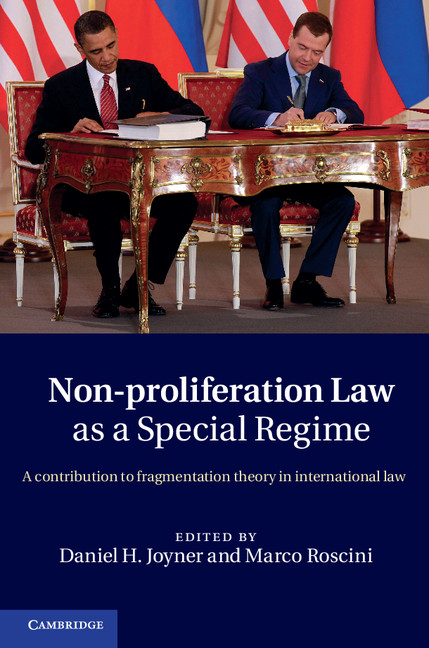
Marco and I are extremely pleased to announce that our new edited volume was published yesterday. The book is entitled Nonproliferation Law as a Special Regime: A Contribution to Fragmentation Theory in International Law, and is published by Cambridge University Press. Here’s the link to the book on CUP’s website. At the site you’ll find some nice pdf excerpts from the book.
I remember sitting with Marco in a patisserie in London in December 2009. Marco brought up an idea. He said he had been thinking about the body of nonproliferation treaties and related organizations, and whether, and to what extent, this issue specific area of international law might be usefully examined by reference to fragmentation theory, as a special regime of international law with specialized secondary rules. At the time, I had recently finished co-editing a book, which had been my second edited book. I can tell you from those two prior experiences that I had absolutely no inclination to embark on another edited book project. So, so many reasons for that feeling that I can explain some other time. But when I heard this idea, it just made so much sense to me, and seemed so substantively interesting and full of promise, that my reticence was overcome and I thought we just had to do one on this topic.
We did talk about co-authoring the book, but we wanted this to be a real collective endeavor among a group of first class international lawyers, so that the results of the study would be less susceptible to criticism as just the argument of two nonproliferation law specialists. We were extremely fortunate that exactly such a group of contributors agreed to participate in the project. And we told the chapter authors from the beginning that we wanted each of them to conduct an independent inquiry in their agreed area of secondary rules, relating either to the law of state responsibility or to the law of treaties, into whether and to what extent there existed in the law and legal practice related to non-proliferation treaties, specific and specialized secondary rules that differed from the general rules of international law on that topic, and/or from specialized rules on that topic found in other substantive areas of international law. To the extent that such specialized rules were found to exist, the author’s second task was to consider whether these specialized rules could be considered as evidence supporting the conclusion that non-proliferation law is a special regime, at least as to that particular topic, explainable by fragmentation and special regime theory.
So yes, this is a very theoretical book, and I know it won’t appeal to many outside of academia, but we do hope that the results and the methodology of the study will be seen as significant contributions to fragmentation theory scholarship, and to understanding of nonproliferation treaties and their specialized rules.
Marco and I would like to thank the chapter authors for their excellent work on the book. They include Malgosia Fitzmaurice, Panos Merkouris, Andrew Michie, Matthew Happold, Nigel White, Eric Myjer, Jonathan Herbach, Dieter Fleck, and Sahib Singh.
And I can’t tell you how thrilled we all were to learn that Judge Bruno Simma had agreed to endorse the book on the back cover. For those who don’t know, Judge Simma is something of a demigod in international legal circles; having served as a Judge on the International Court of Justice, and as a member of the International Law Commission, in addition to his peerless scholarly career. Among his many areas of expertise, he is one of the foremost scholars of fragmentation theory. Here’s what he wrote about our book:
Fragmentation of international law has become a favorite topic in the literature, all too often dealt with in the same worn, tired way, referring to the same few cases and usually ending up with authors making more or less solemn over-generalizations in one direction or the other. Against this background, it is a true pleasure to follow a group of experts both on non-proliferation law and the relevant international law around the Non-Proliferation Treaty on their analysis of the ways in which this treaty regime is “special” without, however, essentially detaching itself from the general law in which it remains embedded. The book thus sets an admirable example of how the ever-increasing number of specialized treaty regimes ought to be subjected to a profound dialogue between experts in the respective subject areas and international law generalists to the profit of both.
We can’t thank Judge Simma enough for those kind words, which compliment the book in precisely the ways in which we hoped it would make a significant contribution.
A Few Recent Things . . . .
Posted: September 17, 2012 Filed under: Nuclear 32 CommentsI haven’t been blogging much lately because of a couple of factors – I had some minor surgery on my neck, and then I was writing the post on the IAEA standards of investigation and assessment, which took a lot more time and effort than I intended.
But here are a number of developments relevant to arms control law that I’ve noticed lately and would like to bring to readers’ attention:
1. Here’s a new article on the USIP site co-authored by David Albright of ISIS. Wow. Just 100% incorrect in its legal interpretations of the NPT. Why is it that in the nonproliferation area everyone, including engineers, physicists, chemists and general policy wonks, think they can do legal interpretation? You won’t find me writing articles about the technical aspects of missile capabilities, or the internal physics of a warhead core. I know these things are outside of my training and qualification to do. But apparently everyone thinks they can do legal analysis. With respect, I think David should stick to obsessing over satellite pictures of tarps at random military bases in Iran.
http://iranprimer.usip.org/blog/2012/sep/07/nam-countries-hypocritical-iran
2. Some important new statements from high ranking Russian officials, both on the lack of evidence of military dimensions of Iran’s nuclear program, and on the wrongfulness, ineffectiveness and imprudence of economic sanctions imposed unilaterally by the West. Important new markers of disunity among the P5+1 on approach to the Iran situation, and some welcome levelheadedness of Russian officials.
http://www.reuters.com/article/2012/09/06/us-nuclear-iran-russia-idUSBRE88507K20120906
http://news.yahoo.com/russia-rebuffs-clinton-syria-iran-penalties-152652475.html?_esi=1
3. The NAM Summit final document, adopted by consensus of the 120 states attending. This is the international community, folks, and they are saying some pretty specific things here in paragraphs 6 & 7 about the scope and meaning of the NPT Article IV right, and about the illegality of attacks or threats of attack against peaceful nuclear facilities. This is a statement that has potential relevance for legal interpretation of the NPT, and possibly also for the formation of customary international law on these points.
http://m.nam.gov.ir/Portal/File/ShowFile.aspx?ID=6d1ea997-6620-465d-881c-e4f64970415b
4. Trita Parsi’s latest article on Iran Sanctions. Such important points to understand about sanctions – and, I would add, points backed up by academic literature. In a situation like the Iran crisis, sanctions do not change target government behavior. They only hurt the ordinary people of the target state, and this in turn will only backfire against those maintaining the sanctions. I wrote about this issue in my article in the Harvard Law and Policy Review Online, discussing some of this literature.
I just got back from teaching my PIL class today, and we were talking about sanctions imposed by international organizations. I told my class that economic sanctions unfortunately appear in many ways analogous to heroin to Western governments. They (sanctions) don’t do any good, and in fact almost always make things worse. They produce terrible effects on ordinary people in target countries, destroying economies and causing unnecessary and undeserved suffering. Nevertheless, the UNSC keeps coming back to this tool of policy time after time like an addict, because it makes them feel good to be doing, and to be seen by their domestic political constituencies to be doing, something in such situations. It gives them a feeling of catharsis, but even they know that in the end all the sanctions will really produce is terrible and undeserved and pointless harm. I thought that was a pretty good analogy.
http://www.thedailybeast.com/articles/2012/09/12/sick-of-sanctions.html
5. Yousaf Butt’s latest article in the Christian Science Monitor. He makes such an important point here that is so frequently not understood in the maelstrom of the U.S. political race to see who can be the most hawkish on Iran – i.e. that the very best way to make sure Iran DOES have a nuclear weapons program, and ACTUALLY WITHDRAWS from the NPT and KICKS OUT IAEA INSPECTORS, is for Israel to attack Iran’s nuclear facilities. Now, this may be what some in Israel, and even in the U.S. want – to start a war with Iran. But for those of us who don’t relish that idea, this is an important point to bear in mind.
The IAEA Applies Incorrect Standards, Exceeding its Legal Mandate and Acting Ultra Vires Regarding Iran
Posted: September 13, 2012 Filed under: Nuclear 57 CommentsThe other day I was reading over the most recent IAEA Director General’s (DG’s) report to the IAEA Board of Governors (BOG) on implementation of safeguards in Iran. The report was submitted on 8/30/12 (GOV/2012/37). I had on my mind some comments and queries that Cyrus Safdari had kindly sent to me. The DG’s report includes the following paragraph in its summary section, which is very similar in language to the summary statements that have been included in other DG reports on Iran over the past approximately six years – though the relevant language has evolved significantly over that time and become more consolidated and conclusory:
While the Agency continues to verify the non-diversion of declared nuclear material at the nuclear facilities and LOFs declared by Iran under its Safeguards Agreement, as Iran is not providing the necessary cooperation, including by not implementing its Additional Protocol, the Agency is unable to provide credible assurance about the absence of undeclared nuclear material and activities in Iran, and therefore to conclude that all nuclear material in Iran is in peaceful activities.
So here the DG begins by saying that the IAEA can verify that all declared, safeguarded nuclear material in Iran has not been diverted to non-peaceful use. This mandate for investigation by the IAEA, and the standard of assessment for this investigation, come directly from Iran’s INFCIRC/153 comprehensive safeguards agreement (CSA), in Article II, which reads:
The Agency shall have the right and the obligation to ensure that safeguards will be applied, in accordance with the terms of this Agreement, on all source or special fissionable material in all peaceful nuclear activities within the territory of Iran, under its jurisdiction or carried out under its control anywhere, for the exclusive purpose of verifying that such material is not diverted to nuclear weapons or other nuclear explosive devices.
But the DG’s report doesn’t stop there. It continues on to then apply two separate and additional legal standards and make two additional assessments based upon them. These separate and additional legal standards are:
1) “the absence of undeclared nuclear material and activities in Iran”; and
2) “that all nuclear material in Iran is in peaceful activities.”
So that got me to thinking, where do these other two legal standards come from? It is an important question, because essentially these two standards, together with the first clearly applicable standard, are the legal standards that the IAEA has been using as its scope of mandate for investigation and assessment regarding Iran’s compliance with its safeguards agreements for at least the last six years or so. And it’s been on the basis of the application of these legal standards, that the IAEA has continued to consider Iran to be in noncompliance with is safeguards agreements, which fact it has reported to the U.N. Security Council and to the world. This assessment by the IAEA has in turn shaped the diplomatic and security climate surrounding Iran, and the substance of negotiations between Iran and the P5+1. It has also formed a basis of asserted legitimacy for the economic sanctions applied both multilaterally and unilaterally by the West that have crippled the Iranian economy. So it’s important to know whether these legal standards are correct, in order to know whether the investigations and assessments based on them are legally correct.
I think there are two sources from which the IAEA would say these two additional legal standards, and the IAEA’s mandate to apply them, derive. However, as I will show herein I think that in both instances this argument is incorrect. And as a result of this analysis, I will argue that these two additional legal standards are ultra vires the IAEA’s authority to apply to Iran, and to be the basis for investigations and assessments by the IAEA. I conclude that the only lawful standard for the IAEA to apply is the first of the three standards: “that all declared, safeguarded nuclear material in Iran has not been diverted to non-peaceful use.” And that pursuant to that sole lawful standard, Iran is in full legal compliance with its safeguards agreements with the IAEA, as the DG once again confirmed in his 8/30/12 report.
Welcoming Dr. Milagros Alvarez-Verdugo to Arms Control Law!
Posted: September 3, 2012 Filed under: Nuclear Leave a commentI’d like to welcome a new member of the Arms Control Law blogging team, Dr. Milagros Alvarez-Verdugo of the University of Barcelona. Dr. Alvarez-Verdugo has a highly developed expertise in WMD nonproliferation law, as well as EU security and defense policy, and has extensively published in these areas in both Spanish and English. She will add significantly to the pool of expertise here at Arms Control Law, and it’s a great pleasure to have her on board!
Her first post will follow shortly, and will consist of some very interesting thoughts on the lead up to the 2015 NPT Review Conference, and specifically on various positions of states regarding the potential universalization of the rules of the Nuclear Suppliers Group. I for one plan to comment on it when she posts it, and I think it might produce some good discussion.
Please see a summary of her impressive bio below:
Dr. Milagros Álvarez-Verdugo is Associate Professor of International Law and EU Law at the University of Barcelona. Her work for the past decade has focused primarily on the nonproliferation of WMD and the EU security and defense policy. She is the author of Incidence of the Security Council on the Legal Regime of Nuclear Weapons (Barcelona, J.M.Bosch, 2007 –in Spanish) and The Security and Defense Policy of the European Union (Madrid, Dykinson, 2003 –in Spanish). She has published articles in international journals such as the European Journal of International Law and European Foreign Affairs Review, and in the major Spanish journals in the field. Currently she is a visiting scholar at Cornell University (2012-13). She has visited previously at Cornell (2004-2005), and Harvard University (2005), and has been Visiting Professor at the Law School of the University of Puerto Rico (2004 and 2008).
Proposal by Hossain Mousavian
Posted: August 23, 2012 Filed under: Nuclear 5 CommentsI saw this article by David Ignatius today. In it, he reports on a conversation he had with Hossain Mousavian, about whom I posted earlier. In this conversation, Mousavian reportedly made an intriguing suggestion for a diplomatic resolution to the crisis over Iran’s nuclear program. Here’s how Ignatius reports it:
An interesting bridging proposal comes from Seyed Hossein Mousavian, a former Iranian negotiator who’s now a visiting fellow at Princeton University. He told me this week that in addition to capping enrichment at 5 percent, Iran might agree to a “zero stockpile” of this low-enriched fuel. A joint committee with the P5+1 would assess Iran’s domestic needs, and any enriched uranium would either be converted immediately to the needed fuel rods or panels, or it would be exported.
In exchange, Mousavian argues, the P5+1 would recognize Iran’s right to enrich uranium and would gradually lift sanctions.
This intriguing proposal lacks official Iranian support, but it would address Israel’s biggest concern and would surely interest American officials. Mousavian also notes Iran’s willingness to allow much wider inspections by the International Atomic Energy Agency into what are known as “possible military dimensions” of the Iranian nuclear program. This transparency proposal would allow the IAEA to monitor any possible breakout, but U.S. officials caution that if the Iranians decided to go for a bomb they could simply expel the IAEA inspectors and make the dash.
This proposal includes some elements that I hadn’t heard of before, in particular the “zero stockpile” idea. Obviously, implementation of this idea would be complicated and certainly imperfect. But in principle it does seem to address some of the core concerns voiced by the P5+1, about Iran’s potential ability to “break out” into nuclear weapons manufacture.
It seems to me that this proposal essentially meets all of the reasonable interests and expressed desires of both sides. Under the proposal, Iran would get to keep its nuclear fuel cycle capability, and have its legal right to do so recognized. The P5+1 would get pretty much the maximum reasonable accountability and transparency of Iran’s fissile material stores, with a cap on enrichment at 5%, and the export out of Iran of all uranium enriched higher than 5%, as well as all excess 5% enriched uranium. I think this is exactly the kind of proposal that should be seen as meeting the reasonable interests and requirements of both sides, and that provides a realistic and face-saving way for both sides to claim victory through compromise.
I think that if P5+1 negotiators are smart, they will see this kind of proposal as the best solution they are realistically likely to get to this impasse, and that they will embrace it as providing a way out of the crisis that avoids war.
I’m well aware that Israel, under its current leadership, is unlikely to be satisfied with such a resolution. But that should not stop the P5+1 from being reasonable and pragmatic, and therefore supporting such a resolution, in the interests of international peace and security.
Welcoming Dr. Gro Nystuen to Arms Control Law!
Posted: August 20, 2012 Filed under: Nuclear Leave a commentI’d like to welcome a new member of the Arms Control Law blogging team, Dr. Gro Nystuen. Dr. Nystuen has a wealth of experience in lawmaking and legal interpretation of sources relating particularly to conventional weapons. She will add significantly to the pool of expertise here at Arms Control Law, and it’s a great pleasure to have her on board!
Her first post will follow shortly, and will consist of some thoughts on the recently concluded U.N. ATT conference.
Please see a summary of her impressive bio below:
Dr. Gro Nystuen is Senior Partner at the International Law and Policy Institute (ILPI) in Oslo where she works on public international law issues, including the ILPI Nuclear Weapons Project (http://nwp.ilpi.org/), humanitarian law, law of armed conflict and disarmament. She took part in the diplomatic processes on the Mine Ban Convention in 1996-1997 and the Convention on Cluster Munitions in 2007-2008, negotiations pertaining to the CCW, as well as the Arms Trade Treaty negotiations 2010 – 2012, on behalf of the Norwegian Ministry for Foreign Affairs. Dr. Nystuen works part time as Associate Professor at the University of Oslo and at the Defense Staff University College in Oslo. She worked in the Norwegian Ministry for Foreign Affairs from 1991 to 2005. She published her doctoral dissertation on the Dayton Peace Agreement, and has published a number of articles on international law, in areas such as international humanitarian law, human rights law, international terrorism, corporate social responsibility and jus ad bellum issues. More information on her experience and publications can be found at http://www.ilpi.org/?p=32&sid=8
ACW Post and FP Article by Jeffrey Lewis
Posted: August 17, 2012 Filed under: Nuclear Leave a commentI wanted to recommend to readers Jeffrey Lewis’s most recent post over at Arms Control Wonk, which also links to a very good article he recently wrote at Foreign Policy. Both address U.S. intelligence assessments of Iran’s nuclear program, and in them Jeffrey provides some very interesting analysis. What stood out to me particularly is some analysis Jeffrey provides about the historical record of the consequences of counterproliferation-oriented preemptive military strikes. Here’s a block quote from Jeffrey’s post:
The decision to conduct an airstrike or not is an interesting policy choice. (Keeping in mind I have a very high burden of presumption against the use of force in general.) The benefit of a strike is an induced pause in the program — more or less what we have now though imposed through force. The question is whether an airstrike creates more delay than the current indecision of the Supreme Leader. So far, I think, the best answer has been no — the NIE believes Iran is reluctant to force the issue by attempting to weaponize its capabilities.
This framing of the policy problem assumes that, once attacked, the Supreme Leader would very likely order a crash program to acquire a nuclear deterrent, a fear that stems directly from Saddam’s reaction to Israel’s destruction of the Osirak reactor. One of the dumbest things I have seen written in a long time is this:
“A similar argument was used by critics of the prospective Israeli strike against Iraq’s nuclear reactor back in 1981 (the critics included then Labor Party head Shimon Peres, now Israel’s president, who reportedly is a major critic of the prospective attack on Iran). But that successful strike actually put paid to Saddam Hussein’s nuclear weapons program, which was never resurrected.”
Iraq did reconstitute its nuclear program as we discovered after the 1991 Gulf War. There is no room for disagreement on this factual point. Whether the Iraqis were competent enough to ever figure it out, they successfully hid an enrichment program for a decade, which probably accounts in no small part for Iran’s late 1980s interest in enrichment technology.
Moreover, the Iraqi “nuclear weapons program” — in the sense of a formal commitment by Saddam to seek nuclear weapons — is best understood a response to the strike on Osirak. All of the historical evidence that I have seen –largely in the form of memoirs by Iraqi scientists like Madhi Obeidi, Imad Khadduri and Jafar Dhia Jafar — suggests Saddam had yet to decide to seek nuclear weapons until the humiliation of the strike by Israel. One can suspect he would have gotten around to it eventually, but as it happened the best evidence is that the airstrike was the catalyst for the Iraqi nuclear weapons effort, which then proceeded undetected for nearly a decade.
This observation is in perfect harmony with the conclusions of Malfrid Braut-Hegghammer’s recent International Security article entitled “Revisiting Osirak: Preventive Attacks and Nuclear Proliferation Risks“
I think that both Jeffrey’s and Malfrid’s conclusions about the likely negative proliferation consequences of counterproliferation-oriented preemptive military strikes, based in the example of Osirak, are part of a growing consensus to this effect. And this consensus should weigh heavily in the ‘negative’ column of any state’s decisionmaking calculus of whether to engage in such a strike against another state.
UNSCR 1929 – The Slayer of Commercial Contracts?
Posted: August 15, 2012 Filed under: Nuclear 3 CommentsI’ve seen a couple of news stories lately about a lawsuit brought by Iran against Russia, for alleged breach by Russia of a contract to supply S-300 surface-to-air missiles to Iran (see stories here, here and here). More precisely, this would I assume be a claim for breach initiated by Iran under the contract, which apparently provides for arbitration of disputes at the ICC Court of Arbitration in Geneva.
Apparently, the $800 million contract was signed in 2007, but Russian President Medvedev signed a decree terminating the contract in September 2010. Russia’s stated reason for the termination was that fulfilling the contract would be in violation of U.N. Security Council Resolution 1929, adopted in June of 2010.
So, in April 2011 Iran instituted the claim for breach at the ICC. Announcing the action, Iranian Ambassador in Russia Seyed Mahmoud-Reza Sajjadi reportedly said:
“We consider the S-300 complex as not falling under the UN Security Council resolution, therefore we are suing Russia to give it this legal cause . . . ”
This case interested me because it is a rare instance of one state canceling an already existing commercial contract with another state on the basis of a U.N. Security Council Resolution. And, of course, it interested me because it involved a source of arms control law emanating from the U.N. Security Council.
Thinking about this case brought back to my mind another, similar case, involving the same U.N. Security Council Resolution. In this case, Pakistan and Iran entered into a commercial contract whereunder Pakistan would supply, and Iran would purchase, natural gas. The contract was reportedly signed on May 24, 2009 (see stories here, here, here and here).
Under the contract, both states reportedly agreed to lay pipelines up to their respective borders by 2014 to carry the gas from Pakistan to Iran. The contract reportedly provided that in the event one side was unable to carry out its obligations of building the pipeline on time, it would be required to pay $2 million per day to the other state as penalty.
Its been a bit more difficult for me to work out the timeline on this case – and I welcome any comments that clarify it – but from what I can gather, after the passage of UNSC Resolution 1929, the government of Pakistan decided it would not go through with the pipeline/gas contract with Iran, citing to Resolution 1929 as a legal prohibition of the deal. I haven’t found any indication that this case was ever submitted to a judicial or arbitral forum for dispute settlement. However, it has definitely become a sore spot in Iranian-Pakistani diplomatic relations.
Thinking about these two cases, then – both the Russia-Iran missile contract, and the Pakistan-Iran gas contract – there are some obvious similarities. Both are commercial contracts entered into before the passage of UNSC Resolution 1929. In both cases, the state contracting with Iran subsequently argued that they could not legally fulfill their end of the contract because of prohibitive provisions in UNSCR 1929. In both cases, Iran disputed that legal analysis.
I’ll just go ahead and add one more similarity to that list. In both cases, the legal conclusions advanced by the states contracting with Iran, and cited as the reason for their effective unilateral termination of the commercial contract, were COMPLETE CRAP. And I’m confident that in both cases, the state making that argument knew that it was complete crap.
New Article by Mark Hibbs on 123 Agreements
Posted: August 13, 2012 Filed under: Nuclear Leave a commentI wanted to call readers’ attention to an excellent new article by Mark Hibbs on the Carnegie website, on the topic of U.S. diplomacy in negotiating nuclear sharing (123) agreements, and particularly on the subject of the so called “gold standard” provision prohibiting ENR activities by partner states. I previously blogged about this issue here and here.
I completely agree with Fred McGoldrick’s comment at the end of the article. Mark’s insight, equity, and pragmatism on this issue is truly a breath of fresh air amidst so much ideologically driven, USG-brown-nosing commentary on the issue by most in the U.S. nonproliferation community.
I’m going to write a post soon giving my thoughts on the failings of the U.S. nonproliferation expert community generally (Mark and a few others excluded). Basically what I’ll be saying is that this behavior is par for the course.
 Arms Control Law