What the UN Secretary-General said at the Monterey Institute of International Studies – And what he did not say
Posted: January 21, 2013 Filed under: Biological, Chemical, Conventional, Missile, Nuclear 3 CommentsOn 18 January, UN Secretary-General Ban Ki-moon delivered a speech on the disarmament and non-proliferation agenda at the Monterey Institute of International Studies. While the Secretary-General highlighted five themes with regard to disarmament and non-proliferation (accountability, the rule of law, partnerships, the role of the UN Security Council, and education), it is what he did not say that I would like to draw your attention to.
Accountability. Ban Ki-moon stresses the special responsibility of the nuclear weapon states in contributing to nuclear disarmament and emphasises that ‘[n]uclear deterrence is not a solution to international peace and stability. It is an obstacle’. This might well be true but flies in the face of reality: the continued reliance of nuclear weapon states’ policies on nuclear deterrence. How those states can be persuaded to change their mind is something the Secretary-General does not address. He also recommends that negotiations are initiated in the Conference on Disarmament to secure legal security assurances for non-nuclear weapon states: while this would certainly be a welcome result at the universal level, it is often forgotten that those assurances are already provided in the protocols attached to the five treaties establishing nuclear weapon-free zones. What the Secretary-General could have also recommended is that the nuclear weapon states that have not done so ratify those protocols as soon as possible.
Rule of law. The Secretary-General maintains that the use of chemical weapons by the Syrian government would be ‘an outrageous crime with dire consequences’. While this is an obvious statement, it would have been interesting if the Secretary-General had expanded on the remedies should such a crime be committed: in particular, does he support the responsibility to protect doctrine to the point of allowing the unilateral use of force by states in reaction to international crimes? (see my previous post on this topic here)
Specific regional issues and the role of the Security Council. Ban Ki-moon singles out the usual suspects, i.e. Iran and North Korea, as his proliferation concerns. He admits that he is deeply concerned about Iran’s nuclear programme and stresses that Iran must comply with relevant Security Council resolutions. It is striking that there is no mention of other proliferators, i.e. India, Pakistan and Israel. True, they are not parties to the NPT and therefore have not violated it, but at the beginning of his speech the Secretary-General had emphatically stated that ‘[t]here are no right hands for wrong weapons’. On the upside, it is welcome to read that the Secretary-General believes that a conference on a zone free of weapons of mass destruction in the Middle East can still be convened in 2013 and that he supports the initiative (more information on the WMDFZ in the Middle East here and here). The Secretary-General does not, however, suggest steps to be taken in order to remove the obstacles that derailed the conference in 2012, in particular Israel’s opposition to the initiative.
Disarmament education. Ban Ki-moon rightly emphasises that funding for disarmament education, training and research is low. The Secretary-General also encourages the academia to include disarmament and non-proliferation issues in their curricula and research agendas. While the contributors to this blog cannot be blamed for not doing their part by researching and publishing on non-proliferation issues, undergraduate or postgraduate courses on non-proliferation law are still rare in universities. Consistently with existing financial resources, this is something that we academics with a non-proliferation expertise perhaps could do more on. If anyone is aware of or teaches university courses on non-proliferation law, why not drop us a line so that we can alert potentially interested students here.
Jordan Paust on Israel’s Right of Self-Defense Against Iran
Posted: January 17, 2013 Filed under: Nuclear 15 CommentsRespected University of Houston Law Professor Jordan Paust has recently posted an op-ed at the Jurist website, in which he gives his analysis and opinion on when Israel would be legally justified in acting in self-defense, pursuant to Article 51 of the U.N. Charter, against Iran.
He hinges his analysis on determining the point at which it could be said, in some hypothetical future context, that Iran had commenced an “armed attack” against Israel. Jordan’s conclusion is stated as follows:
In context, given the facts that: (1) Iran is publicly “gunning” for Israel, (2) Iran has already been continuously complicit in ongoing armed attacks against Israel by Hezbollah and Hamas in violation of international law, and (3) Iran is bound by treaty law to not produce weapons-grade nuclear material and nuclear weapons, one can recognize that an attack would begin at least when Iran continues to violate international law, creates a nuclear warhead, and starts to load it onto a missile without backing down and making such clearly known. If it is known that Iran is building a nuclear weapon for use against Israel, in context it would be logical to claim that an armed attack is underway when Iran starts to create such a weapon.
I have to say that I disagree with Jordan on several points in this analysis. First, I do not agree with his characterization of Iran publicly gunning for Israel, or having made threats against Israel’s security. I addressed this often misunderstood point in a previous post here.
I also would take issue with Jordan’s conclusion that Iran is legally responsible, under the law of state responsibility, for attacks on Israel committed by Hamas and Hezbollah. I’m not categorically saying that Iran is not responsible, but I think the elements of state responsibility would have to be much more clearly made out in these cases. I think that both the Nicaragua and Tadic cases stand for the proposition that financing and general support for the actions of a non-state actor, are not enough for those actions to be legally attributable to a state. As stated in the Tadic case, in order for international legal responsibility to attach, a state must have control over the non-state actor’s activities “going beyond the mere financing or equipping of such forces, and involving also participation in the planning and supervision of military operations.”
Regarding Jordan’s ultimate assessment that “an attack would begin at least when Iran continues to violate international law, creates a nuclear warhead, and starts to load it onto a missile without backing down and making such clearly known,” I would say that what Jordan has essentially done here is argue that, because in his view Iran would have at this point breached several rules of international law, these breaches cumulatively would create a lower threshold for determining when Iran had commenced an armed attack, than would be operative for other states. I think this is a new idea that is not very persuasive, and is actually quite dangerous. It’s kind of like arguing that, because an individual has a criminal record already, the legal standard for them to be convicted of committing a subsequent crime will be more easily met by a prosecutor than if they did not have a prior rap sheet. The law doesn’t work that way. Each legal analysis must be made on its own terms and according to established criteria, and can’t be partially pre-determined by reference to previous actions.
This is also quite a dangerous idea. I mean, look at it from the perspective of, well, any other country in the Middle East. They are firmly of the view (supported by the ICJ and multiple U.N. fact finding missions) that Israel has a checkered recent history of violations of international law in its dealings with the Palestinians. Israel has also used military force in violation of international law against neighboring states, at least in the 1981 Osirak and 2007 Syria airstrikes. Israel has also made multiple threats against Iran that it would attack Iran to keep it from developing nuclear weapons. Israel refuses to even sign onto the treaty that Iran and pretty much the whole of the rest of the world has signed onto, prohibiting nuclear weapons. And as for Jordan’s final criterion, Israel already has nuclear weapons on top of missiles. This is a widely known fact. And who are these nuclear missiles primarily supposed to be used against? Regional threats such as Israel perceives Iran to be. So I would ask Jordan: couldn’t his criteria be applied to justify Iran in attacking Israel in self-defense, just as persuasively or more persuasively than they could be applied to justify Israel in attacking Iran?
I would say that, pursuant to Jordan’s criteria, there are quite a few states in the world that have already commenced armed attacks against their neighbors, who can now respond militarily in self-defense (e.g. Pakistan v. India, NK v. Japan, US v. Iran). I don’t think it’s a good idea to legally recognize this active right of self-defense in such a broad set of contexts.
For my views on the question of whether an attack by Israel on Iran’s nuclear facilities would be legally justified, see my prior posts here and here.
New Albright and Friends Report on ME Nonproliferation (UPDATED)
Posted: January 17, 2013 Filed under: Nuclear 9 CommentsThere’s a new report out, co-authored by David Albright, Sandy Spector and Orde Kittrie, among others, making recommendations for how to deal with proliferation problems facing the Middle East. Here it is.
I have to say I’m most surprised here at the usually thoughtful and reasonable Sandy Spector for aligning himself with this bunch.
I think Jim Lobe’s review of this report pretty much sums it up generally.
A slightly edgier appraisal is given over at Moon of Alabama.
And an insightful review is also given by Muhammad Sahimi.
Personally, I’ll just say two things. First, in a report co-authored by a law professor – one who on other occasions has purported to provide complex international legal analysis – which recommends the threatening, and potential prosecution, of foreign military strikes against Iran to destroy Iran’s nuclear program, wouldn’t you think that there would be at least some consideration and discussion of the legality of these threats and potential strikes under international law? I certainly would. And yet there is none. What does that say to you about the law professor involved?
Second, for a report on how to address proliferation problems in the Middle East to omit entirely any critical consideration of the one proliferation problem that the nations who are actually in the Middle East overwhelmingly consider to be the most serious proliferation problem – i.e. Israel’s possession of nuclear weapons and refusal to sign the NPT or submit itself to meaningful IAEA inspections, as the rest of the countries in the ME are all expected to do upon pain of military attack from the West – is ridiculous, though not unexpected, and in my opinion fairly transparently speaks to the biases, double standards, and general motivations of its authors.
“International Lawifying” the Supreme Leader’s Fatwa
Posted: January 17, 2013 Filed under: Nuclear 5 CommentsA few days ago a friend sent me a link to a recent interview with Iran’s Foreign Minister, Ali Akbar Salehi. The interview was published in the World Policy Journal, Volume 29, Number 4. You can see the full document here, though I think you’ll need a subscription.
One of Salehi’s answers in the interview was particularly interesting from a legal perspective. It regards Iran’s willingness to “secularize” the Supreme Leader Ayatollah Ali Khamenei’s fatwa prohibiting the government of Iran from possession or use of nuclear weapons:
We are ready to recognize the concerns of the West and to try to mitigate them using all the possible instruments that are available, such as additional Protocol 3.1, translating the fatwa of the Supreme Leader into a secular, binding document that would bind the government to this fatwa, to which it is already bound, but which some in the West argue is a religious document, not a secular one. But we are ready to transform it into a legally binding, official document in the UN. And so we are ready to use all means and mechanisms and conventions or safeguards to remove the concerns of the other side.
In a separate interview, published by the Belfast Telegraph, Foreign Ministry spokesman Mehmin Mehmanparast also referred to this idea, characterizing it as Iran’s willingness to “register the fatwa as an international document.”
I suppose I do understand Iran’s motivation to convince the world that such a fatwa has indeed been issued by Khamenei, and that in no uncertain terms it is binding in both a religious and secular legal fashion on the government of Iran, including in its international relations. Apparently – and I didn’t know this before – there have been doubts expressed in some quarters regarding the existence and the binding character of this command by Khamenei.
I really don’t know what practical dividends such an action would pay for Iran, in terms of changing the minds of those who currently distrust Iran’s nuclear intentions. Maybe it could have a persuasive effect on open minded people, who don’t have an ideological or other bias.
My main interest in this idea is in the more technical legal question of precisely what mechanism could be used to translate the Supreme Leader’s edict into a binding, international legal obligation on Iran, which is what Salehi and Mehmanparast seem to be proposing.
My first thought would be the principle iterated by the ICJ in the Nuclear Test Cases, that a unilateral pronouncement by a state of its intent to do or not do something, made with the intention of being bound to the terms of the statement, is binding on that state in international law. In that case, it was statements by French officials indicating that there would be no further atmospheric nuclear tests in the South Pacific. In part relying on these statements, the court decided that the legal issue had been settled, and therefore it was unnecessary to proceed to the merits of the case brought by New Zealand against France. A really useful set of excerpts from international judicial opinions on this principle, including from the Nuclear Test Cases, can be found here.
Following this line of legal principle, it may be the case that Ayatollah Khamenei’s statements on the matter already qualify as binding international legal obligations on Iran, given his position as head of state, and the nature of these statements as statements understood to be binding on the government of Iran. Perhaps it’s the fact of the theocratic nature of Iran’s government, and the inevitable mixing of religion and politics in the person and role of the Supreme Leader of Iran, that have allowed such doubts as there are about the legally binding nature of Khamenei’s edict, to subsist in opinion outside Iran. It may also be the case that these statements, which perhaps could be viewed as essentially addressed internally to the Iranian people, and not externally to the international community, may on the basis of this fact not be clearly understood by the outside world to bind the Iranian government in its relations with other states.
So, to remedy these problems of perception, if Khamenei were to issue a formal oral or written statement, saying what he has already said, and clarifying for the outside world that his edict is in fact legally binding on the government of Iran, and is intended to bind the government of Iran in its international relations, then that should satisfy any remaining doubtful legal criteria and fit his statement clearly under the Nuclear Test Cases binding unilateral statement principle. The statement could be officially transmitted to the Secretary General of the U.N. just for the record, though this shouldn’t be formally necessary.
The other way of course to make such an obligation binding in international law would be through treaty, but in this case I don’t even know who the other potential treaty party(ies) would be. The IAEA? The P5+1? All doubtful. I think the unilateral proclamation route would be by far the most practical route, and should be effective.
Bloomberg Article
Posted: January 16, 2013 Filed under: Nuclear 14 CommentsSorry for the radio silence lately. First the new year, then the BCS national championship game (ROLL TIDE!), and then I’ve been in the third level of exam grading hell for the last several days. But I’ve got several posts coming in the next few days. In the meantime, here’s a bloomberg article on Parchin that quotes Bob Kelley and me:
Bob is really great, and I recommend all of his media interviews and writings. His most recent analysis of the Parchin issue is here. I find him to be objective and to consistently offer some of the most insightful, reasonable, and authoritative technical commentary on nuclear weapons inspection matters and the IAEA. His credibility of course comes from his long career both with the US DOE, and as a member of the IAEA Action Team in Iraq. So he was a real-deal IAEA weapons inspector, unlike some others who are sometimes mis-identified under that title.
Dapo Akande Comments on my ESIL Reflections (UPDATED)
Posted: January 9, 2013 Filed under: Nuclear Leave a comment[UPDATE: There have been alot of very interesting comments posted on this piece by Dapo. I would recommend them to readers.]
My friend Dapo Akande, who is University Lecturer in Public International Law at Oxford University, has kindly provided some commentary on my recent ESIL Reflections regarding NPT Article X(1). You can find his comments over at EJIL: Talk! here. He raises an interesting question concerning how the UN Security Council could address a hypothetical withdrawal by Iran (or any other state party) from the NPT and the CSA. As he says:
[Dan’s] second point, relating to the Security Council, might well be correct in its own terms but does not considerwhether the UN SC could impose the same terms on Iran as the NPT and the Safeguards agreement. The council would not need to order Iran to rejoin those treaties, it could just say that Iran has the same obligations as is contained in those treaties. Now, would that be unlawful or ultra vires? When Lebanon was unable to sign the treaty which was to create the Special Tribunal for Lebanon, the SC simply adoped a resolution containing the same text, thus imposing the same treaty terms on Lebanon but this time as an SC resolution, rather than as a treaty obligation. This was upheld by the Special Tribunal for Lebanon. Could the SC not do the same for Iran?
This is a very interesting and useful question to ask. To me, these questions all fit under the general heading of what are the limits of UNSC authority. There’s been a great deal of writing on that topic, by many international law scholars including myself. I typically find myself in the camp of wanting to establish real and fairly tight limitations on what the UNSC can do in terms of imposing new legal obligations on states that are of a lasting character – the kind of obligations that really should be the subject of treatymaking in my view. But the contours of this principle are of course grey, as for example illustrated by the case of Iraq in 1991 and the disarmament obligations imposed on it by the UNSC in Resolution 687. These new obligations were in response to a clear threat to international peace and security (the Iraqi invasion of Kuwait). In my 2009 book I spent two chapters on these questions. One chapter on the general question of the limits of the authority of the UNSC, and in particular applying this analysis to Resolution 1540. And then a second chapter basically arguing that the jurisdiction of the International Court of Justice to incidentally review the legality of UNSC decisions should be better understood and more actively utilized. That would be the best way to bring some clarity to this grey legal question in my view.
ESIL Reflections on NPT Withdrawal (UPDATED)
Posted: December 23, 2012 Filed under: Nuclear 10 CommentsI wanted to pass along that I’ve just recently published a two-part consideration of the legal meaning and application of Article X(1) of the NPT. Article X(1) is the withdrawal provision in the NPT. It states:
Each Party shall in exercising its national sovereignty have the right to withdraw from the Treaty if it decides that extraordinary events, related to the subject matter of this Treaty, have jeopardized the supreme interests of its country. It shall give notice of such withdrawal to all other Parties to the Treaty and to the United Nations Security Council three months in advance. Such notice shall include a statement of the extraordinary events it regards as having jeopardized its supreme interests.
The pieces were published as European Society of International Law Reflections. You can find them here and here. ESIL Reflections are peer-reviewed, online publications, which are meant to be longer than a standard blog post, but shorter than a standard law journal article. They are a helpful additional online medium for publishing quality international legal scholarship.
My Two Cents on Gun Control Law in America
Posted: December 21, 2012 Filed under: Nuclear 3 CommentsFinally today, I wanted to thank Barry for bringing up the issue of gun control law in America on ACL. He’s right that it’s a very serious and timely issue, unfortunately due to the terrible recent events in Connecticut. And it does of course fit well within the scope of consideration of this blog. I thought I would add a few of my thoughts to those Barry has already expressed in his posts.
The horrific shootings at an elementary school in Connecticut have caused me to do a good deal of thinking and soul searching about this issue, as they have for so many people in America.
I am a gun owner myself, and have been around guns all my life. My family is from the American South, and some of my fondest memories from my childhood and adolescence are going out target shooting with my dad, or going hunting with my dad and granddad and uncles at Thanksgiving. I go target shooting fairly regularly, and enjoy it as a hobby. I’ve just started to teach my twelve year old daughter how to shoot as well. I see it as a life skill that she should have. So I’m someone who has seen what responsible gun ownership and use look like, and how guns and shooting sports can be a part of family traditions. And I know that by far the majority of people who own guns in the American South are like me in these regards.
Years ago, when I was in law school, I was a member of the NRA and was a pretty serious proponent of the rights of gun ownership under the second amendment to the U.S. constitution. I still think that the U.S. Supreme Court’s 2008 Heller decision – the decision in which the Supreme Court interpreted the second amendment to protect an individual right to possess firearms – was decided correctly as a matter of law and history. However, my own views about what reasonable legal limits can and should be placed on gun ownership in America have evolved significantly over the last ten years or so.
Again, I know that guns can be possessed and used safely and responsibly. And if everyone who wanted to possess and use guns would do so in a safe and responsible manner, as I’ve seen countless people do, then we wouldn’t need to be talking about laws restricting possession and use. But clearly that is not the case in this country, and guns clearly do enable those who commit crimes to kill far more people than they would if they didn’t have guns, or at least certain types of guns. And so I do therefore think that we need to make significant changes to our laws in this country, restricting the types of guns that are lawful to possess.
I won’t go through all the law and policy considerations, because I want to get this done. So I’ll jump right to the chase. In my opinion, bolt action rifles and pump shotguns holding the standard 5 shells should be lawful, as they are now. These guns have clear uses for hunting, home defense, and sport shooting. These are the legitimate purposes for which reasonable gun owners want to possess guns, and I think that a reasonable cost/benefit analysis of these types of guns favors their legality.
But after long thought, I have come to the personal conclusion that all handguns, and all semi-automatic rifles, fail the reasonable cost/benefit calculus, and that reasonable gun owners should support these guns being made illegal.
Now I know that this is revolutionary stuff to hear from a gun owner like me. And I know well that there is a mountain of opposition in this country, and particularly in the area of the country in which I live, to ANY restrictions on firearms types, let alone the kind of quite significant restrictions I’m proposing here. And my prescription here would mean that I personally would have to give up several of my guns – some of my favorites. But on the whole, I have become convinced that the reality of the harm that the easy availability of handguns and semi-automatic rifles causes in this country, requires these reasonable restrictions on the types of guns lawful to possess.
We gun owners need to set ideologies and absolute principles aside, and be practical and reasonable, and above all compassionate to the present and future victims of gun violence. We should agree on reasonable restrictions that, while not a panacea to violent crime, will save countless lives, while still allowing those of us who possess and use guns responsibly to continue to do so for generations to come.
More Talk of Japanese Nuclear Weapons
Posted: December 21, 2012 Filed under: Nuclear 1 CommentThis is just a brief post, following up on a longer post I wrote about Japan’s nuclear program a few months ago. I wanted to observe that as a result of the recent elections in Japan, there is a new ruling coalition in the Japanese parliament. Noting the decided shift toward the right that this new parliament represents, this article from the Daily Telegraph makes the following observation:
The LDP’s ally, the Buddhist-backed New Komeito Party, will contribute another 31 seats to the total, giving Mr Abe a “supermajority” and the power to overrule parliament’s upper house.
Even more indicative of the rise of the right was the 54 seats that the Japan Restoration Party claimed.
Only founded in November, the party is led by unrepentant nationalist Shintaro Ishihara, the former governor of Tokyo, who has said he intends to restore the nation’s dented pride.
He has already suggested there is a need for Japan to arm itself with nuclear weapons, expand the military and revise the pacifist constitution.
You can read more about Mr. Ishihara’s views on a range of issues, including nuclear weapons, here. This guy is the head of a party that controls 54 seats in Japan’s 480 seat lower house, and that is a part of the ruling coalition? Yikes.
This development reminded me of the comments made by Shingeru Ishiba, former Japanese Minister of Defense and now member of parliament and Secretary General of Shinzo Abe’s ruling Liberal Democratic Party, about Japan’s interest in keeping its civilian nuclear program healthy so that Japan could use the capabilities afforded by its civilian program, to develop a nuclear weapon if it ever needed to do so. As I noted in my previous post, these comments were reported in a Wall Street Journal article in October of 2011:
Many of Japan’s political and intellectual leaders remain committed to nuclear power even as Japanese public opinion has turned sharply against it. One argument in favor rarely gets a public airing: Japan needs to maintain its technical ability to make nuclear bombs. “I don’t think Japan needs to possess nuclear weapons, but it’s important to maintain our commercial reactors because it would allow us to produce a nuclear warhead in a short amount of time,” Shigeru Ishiba, a former defense minister, said in an interview in a recent edition of Sapio, a right-leaning twice-monthly magazine. ”It’s a tacit nuclear deterrent,” added Mr. Ishiba, an influential parliament member who made similar remarks on a prime time television news show in August while serving as policy chief of Japan’s main opposition party.
So here are two quite influential members of Japan’s ruling governing coalition that have openly supported Japan’s nuclear program as being at least a potential source for development of nuclear weapons. And in Ishihara’s case, he appears to take the poitn further to argue that Japan should weaponize now.
IS EVERYBODY OK WITH THIS? Hey, IAEA, where are you on this one? If you really do think that you have the mandate to investigate and assess possible military dimensions of NNWS safeguarded nuclear programs, then shouldnt you be all over this case – a country with a stockpile of separated plutonium, all necessary technology to build a nuclear weapon, and influential government officials openly supporting nuclear weaponization?
New Paperback!
Posted: December 21, 2012 Filed under: Nuclear Leave a comment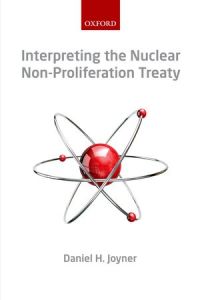
I’m very pleased to announce that my 2011 book Interpreting the Nuclear Nonproliferation Treaty has just been released in paperback in the UK. It looks like it will be out in the US in February or March, but it’s already available for pre-order at Amazon. This is great because the price is now considerably lower than the hardback – down from $88.85 to a mere $32.25! I know what you’re thinking – that’s your Christmas shopping done!
 Arms Control Law