
League of Arab States Council Statement on Postponement of the ME WMD FZ Conference
Posted: March 5, 2013 Filed under: Nuclear 3 CommentsA friend sent me this unofficial translation of the LAS Council’s January 13th statement regarding the cacellation/postponement of the 2012 Helsinki conference, which was to be a major step in the effort to conclude a Middle East WMD Free Zone. Readers will recall that I have posted on this development and its significance previously here, here and here. This statement is extremely important and shows, among other things, how the Arab League states quite reasonably link this issue to the very core of their commitment to the NPT regime.
———————————————————————————————————
(Unofficial translation)
Positions of the Arab States on the postponement of the 2012 Conference on the establishment of a Middle East zone free of nuclear weapons and all other weapons of mass destruction
The Council of the League of Arab States met in an extraordinary session at the ministerial level at headquarters on 13 January 2013.
– Having considered,
- A note by the Secretariat; and
- The recommendations of the “Fifteenth meeting of the Committee of Senior Officials of the Foreign Ministries on the preparations of the Secretariat for the participation of all Arab States in the 2012 Conference, as called for in the final document of the 2010 Review Conference of the Parties to the Treaty on the Non-Proliferation of Nuclear Weapons”, which was held on 12 January 2013;
Decision
- The Council considers the postponement of the 2012 Helsinki Conference a breach of the obligations of the conveners of the Conference vis-a-vis the international community regarding the implementation of the 1995 resolution on the Middle East and the implementation of the final document of the 2010 Review Conference of the Parties to the Treaty on the Non-Proliferation of Nuclear Weapons.
- The Council rejected the justification provided by some of the conveners and holds them responsible for the delay and its consequences for the international community.
- The Council instructed the Committee of Senior Officials to continue to communicate with the conveners and the facilitator to set a new date for the Conference, as early as possible and before the start of the second session of the Preparatory Committee for the 2015 NPT Review Conference.
- The Council also instructed the Committee to continue its engagement with geographical and political groups to rally support for the Conference and to take other steps deemed appropriate in this connection.
- The Council has also instructed the Committee to request the facilitator to continue of bilateral consultations with the parties concerned on the basis of the current formula. The Committee should consider the proposal to participate in extended consultations with regional parties, in accordance with the terms of reference agreed upon in the Action Plan for the Middle East in the Final Document of the 2010 NPT Review Conference, including the 1995 Resolution on the Middle East, which is the basis of the 2012 Conference, and based on the following criteria, which would guarantee the interests of the Arab States:
- The establishment of a set date for the Conference;
- The consultations must be held under the auspices of the United Nations and with a set agenda; and
- Those countries that formally announce their participation in the Conference can attend in the consultations.
- In the event that a date is not set for the convening of the Conference on the establishment of a Middle East zone free of nuclear weapons and all other weapons of mass destruction at the earliest opportunity, the Arab states will determine what steps could be taken, in all disarmament forums, including at the second and third sessions of the Preparatory Committee as well as at the 2015 NPT Review Conference and request the Committee of Senior Officials to develop a comprehensive action plan for the coming period, including additional steps to be taken, and to report to the Council at its next regular ministerial session.
- The Arab League Council at the ministerial level also requested the Secretary General of the Arab League to communicate with the Secretary-General of the United Nations to inform him the position of the Arab States, and to urge him to carry out the international organization’s responsibilities and to play an active role.
- The Council decided that this issue will be on the agenda of its next regular ministerial session.
Aluminum Tubes Again . . . Really?
Posted: March 4, 2013 Filed under: Nuclear 18 CommentsAs if the other similarities between the Western ramp up to its unjustified and disasterous war with Iraq on the one hand, and the West’s current program of action vis a vis Iran (this time facilitated and not checked by the IAEA) on the other, weren’t earily similar enough, we now have yet another similarity. Reuters reports with alarm the transfer of aluminum – one of the most ubiquitously used materials in the world – from a swiss company to an Iranian company. This transfer, Reuters breathlessly reports, could of course have no other end use than in Iran’s centrifuge-based uranium enrichment program. Not that there is any evidence that it ended up there. It just may have (did David Albright co-author this piece? I may have missed it in the byline).
You do remember the furore over Iraq’s reported aquisition of aluminum tubes in the runup to the 2003 war, right? Well if you don’t, see Dave Chappelle’s explanation here at about 1:21 (viewer discretion advised – I think Chappelle is hilarious, but his comedy isnt for everyone).
This story is particularly groan-inducing because it comes almost ten years TO THE DAY after IAEA DG Mohamed ElBaradei gave a speech to the UN reporting, among other findings, the IAEA’s determination that the aluminum tubes acquired by Iraq had not in fact been used in a nuclear program.
An old phrase about those who do not learn from history comes to mind . . .
The forthcoming UN Arms Trade Treaty Final Conference: positive but unpredictable!
Posted: March 4, 2013 Filed under: Conventional Leave a commentThe summer 2012 Arms Trade Treaty (ATT) negotiations ended without adopting a Treaty. Majority of states, the UN and dozens of arms control proponent civil societies were highly disappointed. Of course, some arms control opponents were happy of the outcome. Yet, on January 4, 2013, the General Assembly adopted Resolution 67/234 titled the Arms Trade Treaty. The Assembly referring to the UN Charter, its relevant resolutions on arms transfer, and the failed July 2012 ATT Conference, expressed its disappointment on the failure to conclude a Treaty in that Conference. Noting the Draft Treaty of 2012 (see my previous blogs for details) and the request made by some states to take more time to consider that document, the Assembly has decided to convene a ‘Final Conference’ on the ATT in March 2013. Interestingly, it also decided that ‘the draft text of the Arms Trade Treaty submitted by the President of the United Nations Conference on the Arms Trade Treaty on 26 July 2012 …shall be the basis for future work on the Arms Trade Treaty, without prejudice to the right of delegations to put forward additional proposals on that text’. The Conference will be held from 18 to 28 March 2013 in New York and the Assembly has called ‘upon the President of the Final United Nations Conference on the Arms Trade Treaty to report on the outcome of the Conference to the General Assembly at a meeting to be held as soon as possible after 28 March 2013’. What is clear from Resolution 67/234 is that the Draft Treaty will serve as a basis for deliberations but it is still open for negotiations, consultations and even other opposing proposals from participant states. What is not clear is that while the Conference is final on this matter the anticipated outcome is not entirely known, a Treaty, a GA Resolution or nothing?
The Knives are Out – Olli Heinonen’s Criticisms of Former IAEA Colleagues in the WSJ
Posted: March 2, 2013 Filed under: Nuclear 10 CommentsI just saw this article in the WSJ, including excerpts from a lengthy interview with Olli Henonen. I find it shocking how he goes after his former IAEA colleagues, criticizing them for their “missteps” on both Iran and Syria. He even says that they developed the equivalent of “Stockholm Syndrome” with regard to these nations, and that this somehow explains why they were so kid-gloved in their treatment of Iran and Syria. Wow. That’s a pretty bold and offensive allegation to make about both DG ElBaradei and DG Blix.
What comes across to me in this article is a picture of Heinonen as the one with biases of mysterious origin. He comes across as hawkish, with the kind of inexplicable, discriminatory focus of attention on Arab/Persian countries in the ME (to be fair, he’s also worried about Pakistan), and a set of unfounded but deeply held suspicions, and similarly unfounded speculations of an exclusively negative quality, that one usually hears from US government officials and the DC nonproliferation community. Not the ideological company I would have expected the veteran Finnish diplomat to keep. But one’s true colors are one’s true colors. And I think that Heinonen is clearly showing them here, and that he wants to tell the world loud and clear what he thinks about his former bosses at the IAEA – like Nobel Peace Prize winner DG Elbaradei – whose fault it is that Iran has reached a point of industrial and scientific capacity that Japan, Germany, South Africa, Brazil, India, Israel, and South Korea also have, to name a few. But of course, we don’t need to worry about any of them.
Kazakhstan Meeting between the P5+1 and Iran
Posted: March 1, 2013 Filed under: Nuclear 13 CommentsLike many, I have been quite pleasantly surprised and heartened by the relatively positive reports coming out of the meeting between Iran and the P5+1 in Almaty, Kazakhstan this week. It does appear that there has been some sense and prudence displayed among the P5+1 in actually making some meaningful concessions in the kinds of sanctions relief they are now putting on the table. This could well be the first step toward a diplomatic resolution of the current crisis, if – and this is a big if – both sides can continue displaying good sense, pragmatism and positivity. We know from sad experience in this and other diplomatic contexts that auspicious beginnings often produce disappointing results. On this subject, see this insightful analysis by Paul Pillar.
EU Sanctions on Iranian Businesses Adjudged Illegal
Posted: February 27, 2013 Filed under: Nuclear 2 CommentsI’ve also been meaning to write something for some time on the recent cases in which the EU General Court has ruled that sanctions imposed on Iranian businesses unilaterally by the EU – i.e. unauthorized by the U.N. Security Council – are unlawful. These are very significant cases, and as I understand it the illegality of these sanctions has become so well settled that the affected parties are now moving on to actions against the EU seeking compensation for the harm caused by these illegal acts of the EU. As noted in this report of the most recent case, the Court has ruled that “The Council (of EU governments) is in breach of the obligation to state reasons and the obligation to disclose to the applicant … the evidence adduced against it.” The Bank Saderat case can be viewed at this link.
EU law is one of the many areas outside of my expertise, so I would welcome comments from ACL colleagues and others who could explain to readers the bases for these decisions of the General Court better than I can.
Penn State Symposium Video is Up
Posted: February 27, 2013 Filed under: Nuclear 2 CommentsYou can find it here. You may have to load an updated media player (called “Mediasite”) on your computer. It does make the presentation look good, though. The video is also divided into segments, which makes it easier to find particular panels or presentations. I and Ambassador Butler are on Panel 1. I dont think I’m at my most eloquent here, but I think I do manage to get my points across. I really recommend that you listen to Ambassador Butler’s presentation. I also HIGHLY recommend that you watch both FLynt’s and Hillary’s presentations – Flynt gives the opening address, and Hillary gives the concluding address. I was very imporessed by them, and persuaded of their views.
Arab League Boycott of Nonproliferation Meetings
Posted: February 21, 2013 Filed under: Nuclear 16 CommentsWow this is a big deal – the Arab League, led by Egypt, are threatening to boycott nonproliferation meetings, including the upcoming NPT PrepCom meeting in April. They are upset about the lack of progress in actually progressing the agenda of a WMD free zone in the Middle East, and in particular over the non-occurrence of a conference on this issue that NPT states parties agreed by consensus in the final document of the 2010 NPT Review Conference would be held in 2012.
Readers will remember that I wrote a couple of pieces about this months ago when we learned the 2012 conference wouldn’t be happening. See here and here.
I think some people have underestimated how strongly Arab states feel about this subject and how, as I explained in those previous pieces, they link the concept of a ME WMD Free Zone very directly back to the decision to indefinitely extend the NPT in 1995. To them it was part and parcel of the bargain reached in 1995 that made the positive vote on indefinite extension happen.
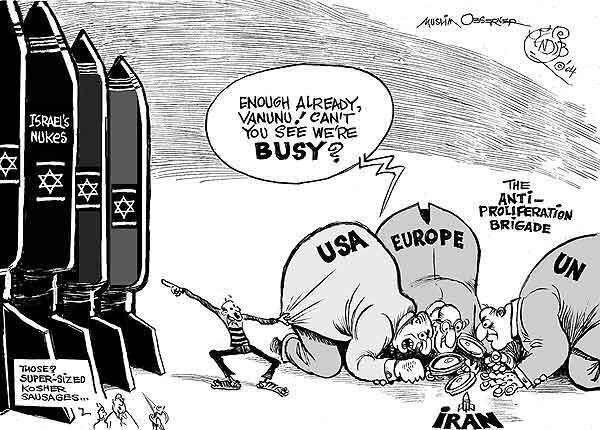
I’m personally glad that they are taking a stand on this issue, and I hope that they keep the pressure up and actually follow through with their boycott if necessary. The hypocrisy and inequity of the West’s willfully blind eye toward Israel’s possession and implied threats of use of nuclear weapons are unacceptable to the rest of the states in the ME, as well they should be. I think the Arab states have finally had enough of the failed promises of the West to address this problem, and that they are saying clearly that the future of the NPT regime itself depends on meaningful progress on this issue.
Yousaf Butt on Washington Post/ISIS Magnets Story
Posted: February 21, 2013 Filed under: Nuclear 17 CommentsI just had to draw readers’ attention to yet another great new piece by Yousaf Butt, this time in the Bulletin of the Atomic Scientists. In a really first class piece of explanatory journalism, Yousaf takes apart and persuasively discredits a Washington Post story based on information and analysis provided by ISIS and David Albright. Yousaf is once again shining the light of actual scientific and objectively analytical rigor, upon the analysis of ISIS and Albright that has become widely seen as superficial, speculative, and agenda driven.
 Arms Control Law