Russia Threatens to Invoke Force Majeure in New START, and Alter its Position on Iran
Posted: March 20, 2014 Filed under: Nuclear 10 CommentsBoris Mamlyuk, a law professor at the University of Memphis, has written a fascinating piece at the Cambridge Journal of International & Comparative Law blogsite, about the threat expressed by a Russian official to invoke the force majeure clause in the New Start treaty of 2010, to restrict US inspection visits in Russia. According to Mamlyuk:
The reasons offered by Moscow for the force majeure or countermeasure or reprisal (depending on one’s viewpoint) was the imposition of targeted sanctions by the U.S. against Russian and Ukrainian nationals, and other “unfriendly acts by the U.S. and NATO” with respect to Russia’s Ukraine policy. As of March 8, 2014, these unfriendly acts presumably include: (1) U.S. Defense Secretary Chuck Hagel’s announcement on March 6, 2014 to suspend all military-to-military engagements and exercises with Russia; (2) a series of steps U.S. Defense Department will take to reinforce allies in Central and Eastern Europe during this crisis; (3) reinforcement of NATO troops in Poland and presence of a U.S. guided-missile destroyer (USS Truxtun) in the Black Sea.
I hadn’t heard about this threat before, but it does go hand in hand with even more recent threats made by Russian officials, in response to the sanctions imposed by the West against Russia related to the ongoing crisis in Ukraine. As of today, these possible retaliatory measures include Russia changing its approach to and positions regarding negotiations between the P5+1 and Iran regarding Iran’s nuclear program. According to a GSN article today:
A multilateral effort to defuse a nuclear dispute with Iran would take a back seat to Russia’s “reunification” with the Crimean Peninsula, Russian Deputy Foreign Minister Sergei Ryabkov said on Wednesday. Moscow moved this week to annex the Ukrainian territory, prompting a sanctions backlash from Western participants in the dialogue over concerns that Tehran could tap its civilian atomic capabilities to build nuclear weapons.
“We wouldn’t like to use these talks [to raise] the stakes,” Ryabkov said in a report by Interfax. “But if they force us into that, we will take retaliatory measures here as well.”
I was talking with a colleague earlier today about what shape these “retaliatory measures” might take in the context of negotiations with Iran. I suppose they might take several forms; from removing Russian support for some of the more aggressive Western negotiating positions (for example relating to PMD and the Arak heavy water reactor), to moving forward with sanctions busting efforts including building two additional reactors at Bushehr, to supplying air-defense weapons including the S-400 system to Iran. Can you think of other measures Russia might take in this context?
If you are one (as I am) that really does want there to be a deal reached between Iran and the West/IAEA concerning Iran’s nuclear program, so that sanctions on Iran can be lifted and relations progressively normalized, this news about Russia potentially changing its approach to the negotiations may be good news or bad news, depending on how far Russia takes it. If Russia continues to engage meaningfully in the negotiations, and simply tempers even further the most aggressive and unrealistic of the West’s/IAEA’s demands, e.g. regarding PMD, then that could be a good thing, and could help to produce a reasonable agreement that has the potential to endure. However, if Russia changes its position so much that it produces unbridgeable divides among the P5+1, thus making a comprehensive deal with Iran impossible, I think that would be in nobody’s best interests. So, if Russia does choose to express its indignation at Western sanctions, in the context of negotiations over Iran’s nuclear program, I hope it will do so in a way that is measured to be effective and ultimately helpful.
My new book on cyber operations is out
Posted: March 18, 2014 Filed under: Cyber, Intelligence, War 2 Comments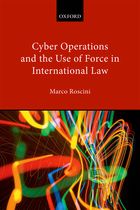
My book on Cyber Operations and the Use of Force in International Law has just been published by Oxford University Press. If you are interested in ordering a copy, please click here, or, if you prefer the US OUP website, here.
Here is the abstract:
The internet has changed the rules of many industries, and war is no exception. But can a computer virus be classed as an act of war? Does a Denial of Service attack count as an armed attack? And does a state have a right to self-defence when attacked in cyberspace? With the range and sophistication of cyber attacks against states showing a dramatic increase in recent times, this book investigates the traditional concepts of ‘use of force’, ‘armed attack’, and ‘armed conflict’ and asks whether existing laws created for analogue technologies can be applied to new digital developments.
The book provides a comprehensive analysis of primary documents and surrounding literature to establish whether and how existing rules on the use of force in international law apply to cyber operations. In particular, it assesses the rules of the jus ad bellum, the jus in bello, and the law of neutrality (whether based on treaty or custom), and analyses why each rule applies or does not apply in the context of cyber operations. Those rules which can be seen to apply are then discussed in relation to each specific type of cyber operation. The book addresses the key questions of whether a cyber operation amounts to a use of force and, if so, whether the victim state may exercise its right of self-defence; whether cyber operations trigger the application of international humanitarian law when they are not accompanied by traditional hostilities; what rules must be followed in the conduct of cyber hostilities; how neutrality is affected by cyber operations; and whether those conducting cyber operations are combatants, civilians, or civilians taking direct part in hostilities. The book is essential reading for everyone wanting a better understanding of how international law regulates cyber combat.
The book also contains a thought-provoking Foreword by Prof. Yoram Dinstein.
Why Putin Will Get Everything He Wants in Crimea
Posted: March 11, 2014 Filed under: Nuclear 11 CommentsNot strictly speaking arms control law related – though obviously everything is interconnected – my dad apprised me of an article that I do think pretty well sums up the international relations situation relative to Russia’s activity in Crimea. See it here.
My favorite quote from the article, which I think is spot on in its assessment, is this:
When it comes down to it, the few diplomatic carrots that the West is willing to offer or withhold from Russia have only as much value as Putin is willing to assign them. His ability to not give a shit exceeds the West’s capacity to do anything he gives a shit about. The fact is that Russia cares a lot more about Crimea than anybody else does — except for Ukraine.
I’ve thought from the beginning that there are very few levers that the US and the West realistically can pull, and even fewer that they prudentially should pull, to influence Russia on these facts. It’s for this reason that I have thought from the beginning that the US and the West should mostly stay out of this situation. There is no genocide or other mass violation of human rights occurring that might morally demand our involvement. This is just a power play by a state that, in that region, is by far the most powerful actor. It is indeed the 2008 Georgia situation all over again. Like then, we have known from the start that we will not choose to match power with power on the ground in order to deter Russia from doing what it wants. And as the article points out, having a working relationship with Russia is too important to too many other things that we might actually, realistically accomplish for good in the world, to risk weakening it on this issue.
As I’ve said before, prudent and effective foreign policy requires knowing what cards you have to play, and playing them in the smartest way possible. Overplaying your hand is a mark of bad foreign policy, and is something that the US does not infrequently.
(* * Just a quick disclaimer to say that my approval of the main thrust of this article does not extend to its description of the details of the Iran situation * *)
Disarmament on top of the world
Posted: March 10, 2014 Filed under: Biological | Tags: Asia, BTWC, Disarmament, Nepal, Ratification, Universalisation, UNODA 3 CommentsGiven that the Chemical Weapons Convention (CWC) has already attracted 190 states parties, the Biological and Toxin Weapons Convention (BTWC) has become something of a laggard. Not just in terms of numbers, but also regarding the time it has taken to secure the 170 ratifications or accessions. It entered into force in 1975, or 22 years before the CWC became effective.
Over the past decade and a half parties to the BTWC have stepped up their efforts to secure more ratifications and accessions. Unlike the CWC, the BTWC does not have an international implementation organisation that can take charge of universalisation initiatives or assist members with the national implementation of their treaty obligations. In 2006, the 6th BTWC Review Conference decided to establish a small Implementation Support Unit (ISU), which is embedded in the Geneva branch of the UN Office for Disarmament Affairs (UNODA), to coordinate and facilitate a variety of activities in support of treaty universalisation and implementation. Since then there has been a notable increase in both the number and effectiveness of events to turn the BTWC into a truly global prohibition on biological and toxin weapons. Several states are now on the verge of becoming a party, and chances are that some will join the convention in the course of 2014.
One such state is Nepal, a small kingdom that embraces the Himalayas. Despite having signed the convention on 10 April 1972, it is besides Myanmar the only continental Asian state not to be a party to the BTWC. The ISU and UNODA’s regional office in Kathmandu, the UN Regional Centre for Peace and Disarmament in Asia and the Pacific (UNRCPD), convened a meeting on 20–21 February to promote early ratification and discuss assistance modalities for the development of national implementation legislation as required under Article IV of the convention. The European Union funded the event through its Action Plan in support of the BTWC.
A dynamic meeting
Twelve ministries and government agencies participated in the workshop. They included foreign affairs, defence, justice, the interior, science and technology, and different law enforcement agencies, among others. Ms Ambika Devi Luitel, Officiating Foreign Secretary of Nepal, Ambassador of the European Union to Nepal Rensje Teerink and UNRCPD Director Sharon Riggle welcomed the participants and outlined the meeting goals. Mrs Jacklin Georges of the ISU laid out the types of decisions she expected to come out of the workshop in order to be able to determine the types of legislative assistance Nepal might require and an assistance calendar before the EU Action Plan expires at the end of 2014. I had the pleasure of giving a general background briefing on the BTWC and its history and an overview of the confidence-building measures parties to the BTWC are supposed to be engaged in. My colleague from VERTIC, Ms Yasemin Balci, detailed the legislative requirements under the BTWC and other legal obligations that may result from being a party to the convention and UN Security Council Resolution 1540. She also described VERTIC’s legislative assistance programme and the ways in which the organisation collaborates with the ISU.
As is usual in such workshops, most participants are exposed for the first time to the details of the BTWC, the reasons why their country should become a state party, and the responsibilities it will assume after ratification (or accession). Fortunately, the meeting itself built on an ISU-organised regional seminar on universalisation held in Kuala Lumpur, Malaysia on 2–4 September 2013. Two representatives from the Nepalese Defence Ministry attended, who at the Kathmandu workshop revealed themselves as true social entrepreneurs. More than any foreigner could have done, they were able to answer the specific questions any Nepalese official had and overcome any lingering (bureaucratic) hesitation. At the same time, Sharon Riggle, given her excellent understanding of Nepalese consultation culture, recommended a couple of times that the foreign experts withdraw from the deliberations. The (to a foreigner such as myself) animated discussions in Nepali invariably led to concrete outcomes, that enabled the ISU to come away with a concrete time line for future activities.
I left the two days of meetings with the impression that Nepal is keen on ratifying the BTWC soon. In the end, the only remaining obstacle is a fully functioning parliament. The Nepalese participants, however, felt confident about the future of their political system, and desired to proceed with the legislative preparations so as to be ready on the day their country finally becomes a full party to the BTWC.
[Cross-posted from The Trench]
Progress in Iran Nuclear Talks Depends on the Israeli Government Coming Clean on its Nuclear Disinformation Campaigns
Posted: March 4, 2014 Filed under: Nuclear 20 CommentsI’m pleased to host another guest post by friend of ACL Dr. Yousaf Butt. Yousaf’s research and writing is always provocative, in the best sense, and I think provides important analysis and critique that you hear from few other voices. I especially appreciate Yousaf’s technical expertise, which few have and which is extremely useful as we lawyers try to understand and work in this highly technical issue area.
———————————————————————————–
Progress in Iran Nuclear Talks Depends on the Israeli Government Coming Clean on its Nuclear Disinformation Campaigns
Dr. Yousaf Butt, a nuclear physicist, is Director of the Emerging Technologies Program at the Cultural Intelligence Institute, a non-profit organization dedicated to promoting fact-based cultural awareness among individuals, institutions, and governments. The views expressed here are his own.
One of the sticking points in the on-going Iran nuclear negotiations is the fate of the so-called “Possible Military Dimensions” (aka “Alleged Studies”) file. This is a compendium of allegations against Iran’s nuclear program – largely gathered by third-party intelligence agencies – that the IAEA would like Iran to respond to. Not only are the allegations largely outside the IAEA legal authority and expertise (because they do not directly deal with nuclear material diversion), but Iran has not been allowed to see much of this secret evidence that is being used against it. Such a process is, of course, not consistent with normal Western legal practice. Iran has responded to what little it has been shown of the PMD file by saying that the evidence thus far shown is fabricated.
Though this Iranian response is often cast as Iran “not cooperating with the IAEA” (or “refusing to discuss the matter”), another possibility must be considered: that Iran is correct. That is, that at least some the evidence has indeed been cooked-up by an adversarial Intelligence service (or by an agent recruited by such an Intelligence service).
A wonderful new book by Gudrun Harrer on the IAEA inspections in Iraq sheds some light on which countries could be involved in fabricating and planting such fake nuclear “evidence”. On p. 185 of the book, it is confirmed that Israel provided the IAEA with false information on Laser Isotope Separation activities in Iraq. The reference for this information is the author’s interview with David Albright of ISIS (see at this insert the relevant scanned pages from the book):
Israel has, of course, long been suspected of being behind some of the forged and suspect evidence against Iran: the neutron initiators, AP graphs, etc., but until now it was hard to definitely pin the blame on that country. Thanks to David Albright at ISIS, we now know that Israel has been guilty of planting disinformation with the IAEA in the past.
The German intelligence agency has also discredited much of the secret evidence against Iran.
Having myself analyzed some of what is (evidently) in this PMD file – with Dr. Ferenc Dalnoki-Veress of the James Martin Center for Nonproliferation Studies – I can say that the evidence is certainly of poor quality and/or an amateurish forgery. It does not look like anything a state-level research scientist would produce. There are large and conspicuous mathematical and physical errors in the material.
Similarly, Robert Kelley has assessed that at least some of the evidence purporting to show weaponization research work continuing past 2004 is less than compelling:
[The] evidence, according to the IAEA, tells us Iran embarked on a four-year program, starting around 2006, to validate the design of a device to produce a burst of neutrons that could initiate a fission chain reaction. Though I cannot say for sure what source the agency is relying on, I can say for certain that this project was earlier at the center of what appeared to be a misinformation campaign…. Mohamed ElBaradei, who was then the agency’s director general, rejected the information because there was no chain of custody for the paper, no clear source, document markings, date of issue or anything else that could establish its authenticity…
David Albright’s confirmation of Israeli nuclear disinformation goes hand-in-glove with statements from former IAEA director, and Nobel Prize winner, Mohammed ElBaradei. In his biography, ElBaradei says that the documents that the IAEA had about the alleged neutron initiators in Iran circa 2008 were given to the Agency by Israel. He further states that Israel gave him permission to show the evidence to Iran.
So the question is, why has the IAEA not cooperated with Iran in evaluating material like they did with Iraq circa 1995, in the incident mentioned by Harrer?
Iran could be genuinely helpful if they were allowed to see the original evidence and comment on it. When the IAEA worked with Iraq to evaluate documents, the Iraqis helpfully pointed out mistakes that the IAEA could independently confirm. Isn’t that the example we would like to see with Iran?
Being charged with secret evidence also goes against every notion of Western justice. The IAEA either needs to drop the PMD file, or amend their procedures.
Unfortunately, it is quite likely that the Israeli government is once again carrying out nuclear disinformation, possibly in collaboration with the MEK, an Iranian terrorist – in some nations, formerly terrorist – organization opposed to the current Iranian regime.
Over the past weekend, it was also confirmed that Israel masterminded the assassinations of Iranian nuclear scientists. These assassinations, too, perhaps were carried out with local MEK collaboration. If the Israeli government is capable of assassinating civilian Iranian scientists, would fabricating nuclear intel on Iran trouble their consciences? Presumably not. Especially as they have done it in the past, according to David Albright at ISIS.
Before further pursuing Iran on the PMD file – which may contain substantial forged evidence – it would make sense to ask Israel to come clean about any fabricated intelligence it may have planted with the IAEA. It is quite possible that some of the PMD file is not fake. Israel’s assistance and cooperation in identifying what is fake and what is not would be most helpful. If David Albright of ISIS has further insight into this – as he did in the Iraqi case – his involvement would also, of course, be very welcome.
It is becoming increasingly difficult to give credibility to hyperbolic Israeli statements about Iran’s underhandedness in pursuing its nuclear program, when Israel itself has been underhanded in pursuing clandestine disinformation campaigns against NPT states, while itself remaining resolutely outside the NPT.
There are several points for the IAEA to consider in light of these recent developments:
1. Should the IAEA reject all evidence from Israel against Iran and other adversarial states now?
2. Should the IAEA, generally, not accept intelligence from non-NPT states?
3. The IAEA should show Iran any evidence it wants an Iranian response on. Anything less is not consistent with Western notions of justice. Furthermore such cooperation could unveil the origin of any possible forgeries in the PMD file.
4. The IAEA and the US should ask Israel to come clean on any fabricated “evidence” it may have inserted into the PMD file.
5. As I have suggested previously, it would be best to simply drop the PMD file as it relates to decade old unauthenticated allegations of possible research. It is not even clear that what is in the PMD file – even if true – would be a violation of the NPT or the safeguards agreement.
6. If the IAEA really wants to pursue the content of the PMD in a legal way they can initiate special inspections or undertake arbitration as provided for in the CSA. The IAEA does not even have the technical expertise in-house to undertake investigations of missiles, warheads etc. which are mentioned in the PMD file.
7. Since Iran is now in compliance with its safeguards agreement, Iran’s nuclear file – currently hung-up in the Security Council – should return to the IAEA. The referral to the Security Council was unorthodox and politicized to begin with, and there is no rationale for Iran’s nuclear file to remain there post-2008. (Footnote 38 of the latest IAEA report on Iran makes clear that the remaining issues are not IAEA safeguards issues but extraneous UNSC ones).
8. This also means that the UNSC nuclear-related sanctions on Iran should now be dropped. In fact, they ought to have been dropped in 2008.
David Albright must be commended for his helpful insight into fabricated Israeli intelligence in Iraq, and hopefully can assist in tracking down similar disinformation in the case of Iran.
Relatedly, we must thank him and ISIS also for showing the international community expensive satellite pictures of Parchin, in which one can see that west of the paving activity, the site is untouched, and so the IAEA could get environmental samples there (if they even needed those). This undercuts ISIS’ own conclusion that the site has been magically “sanitized” by paving. Normally, of course, the IAEA would take such swipe samples from within the buildings where any suspect U naturally collects: in the corners and at the places where the walls meet the floor.
The technical weaknesses in ISIS’ and IAEA’s approach to Parchin were previously commented on.
The IAEA’s technically unsound obsession with environmental sampling at Parchin may also mean they are confusing the site at Marivan (where open-air implosion tests may have taken place) with the site at Parchin (where implosions in a chamber are alleged).
From the May 2008 Board report, referring to the Marivan site:
A.2. High Explosives Testing
[………….]
Document 3: Five page document in English describing experimentation undertaken with a complex multipoint initiation system to detonate a substantial amount of high explosive in hemispherical geometry and to monitor the development of the detonation wave in that high explosive using a considerable number of diagnostic probes.
And the alleged weapons’ studies annex Nov 2011:
43. Information provided to the Agency by the same Member State referred to in the previous paragraph describes the multipoint initiation concept referred to above as being used by Iran in at least one large scale experiment in 2003 to initiate a high explosive charge in the form of a hemispherical shell. [……] Further information provided to the Agency by the same Member State indicates that the large scale high explosive experiments were conducted by Iran in the region of Marivan.
So what is the point of carrying out environmental sampling at Parchin (where chamber experiments are alleged) and not at Marivan where open-air experiments were allegedly done? Is the IAEA – and ISIS – confused between Marivan and Parchin?
The IAEA’s unprofessionalism in vetting the content of the PMD file, and in the obsession over Parchin (which the IAEA visited twice already) vs. Marivan smacks of an agenda to target Iran rather than any sound technical analysis. It is likely to blow up the Iran nuclear deal for no good reason. Iran has cooperated with the IAEA on the PMD file by saying that the material it was shown was fabricated – this may be true. Now Israel should also cooperate and come clean about what forged material – or material from compromised sources like “Curveball” – may be within this file. David Albright, with his past knowledge and evident expertise in fabricated Israeli intelligence should also step up to the plate.
And, certainly, Iran should be shown any evidence it is being asked to answer to by the IAEA. The Agency should also spend about half an hour and check whether the site it is interested in for environmental sampling is Marivan or Parchin. Environmental sampling at Parchin makes little sense. At Parchin, swipes would be taken from within the buildings since chamber-based implosions are alleged. While it is at it, the IAEA should also review the technical basis of their conclusions on Syria.
It is hard to take the Agency seriously when it persists in being blatantly unprofessional.
Dr Jim Walsh, a research associate at MIT, has an excellent suggestion about what to do with Iran’s “PMD” file – as paraphrased by Mark Hibbs: “If the nuclear activities were in the past, I don’t care. It’s dead, and it’s regretful, but let’s do a deal with Iran that moves forward.”
But before we do that, the IAEA should ask Israel to come clean about its potential role in fabricating some of the “evidence” within the PMD file.
Given its historical misuse, the IAEA should also re-visit whether it will continue to accept intelligence from third-parties, especially non-NPT member states.
Debunking the myth of Nazi mosquito-borne biological weapons
Posted: March 4, 2014 Filed under: Biological | Tags: Armament, Biological warfare, Nazi Germany, World War 2 1 CommentStarting at the end of January, several press items reported on an academic article published in the December edition of the quarterly magazine Endeavour. Based on documents from the Dachau concentration camp, Dr Klaus Reinhardt, a biologist at the University of Tübingen uncovered that Nazi scientists wanted to use mosquitos as insect vector for the delivery of malaria plasmodium protozoans. According to the article abstract:
In January 1942, Heinrich Himmler, head of the Schutzstaffel (SS) and police in Nazi Germany, ordered the creation of an entomological institute to study the physiology and control of insects that inflict harm to humans. Founded in the grounds of the concentration camp at Dachau, it has been the focus of previous research, notably into the question of whether it was involved in biological warfare research. This article examines research protocols by the appointed leader Eduard May, presented here for the first time, which confirm the existence of an offensive biological warfare research programme in Nazi Germany.
In 1999, while at SIPRI, I oversaw the publication of a volume in the Chemical & Biological Warfare Studies series edited by Erhard Geissler and John Ellis van Courtland Moon on Biological and Toxin Weapons: Research, Development and Use from the Middle Ages to 1945. Geissler, now a retired professor in molecular biology and genetics, wrote the chapter on Germany’s biological warfare programmes before and during World War 2. He basically debunked the myth that the SS was conducting a secret offensive biological warfare programme against Hitler’s explicit orders not to investigate such weapons.
Reinhardt claims to have recently uncovered fresh documents from Dachau and suggests that the earlier assessments of Germany’s offensive BW activities are wrong. Being familiar with Geissler’s investigations — particularly with the 900-page mastodont, emphatically entitled Biologische Waffen – nicht in Hitlers Arsenalen — and other historical research on the origins of offensive biological warfare programmes on the eve of and during World War 2, I was mildly sceptical of the new claims. While the possibility of finding new archival material always exists, contradicting a central conclusion of extensive historical research is quite a different matter. An article in National Geographic summarised Reinhardt’s findings, but also noted that they are controversial among researchers. His conclusions were therefore not as absolute as some press items were suggesting, I therefore assumed.
Yesterday, however, Erhard Geissler posted a blog commentary, calling the findings ‘disinformation’ :
Despite the thrilling headline Reinhardt in his article does not provide any new material regarding the dual-use activities performed in the Entomological Institute of the Waffen-SS beyond that what was already published. The low-scale experiments performed by Eduard May in September 1944 on the survival of food-deprived mosquitoes, can hardly assessed as confirmation of “the existence of an offensive biological warfare research programme in Nazi Germany”. Besides that, the main body of Reinhardts paper including its concluding paragraph does not pick up the alleged BW preparations but deals with the “enigmatic figure” of its director, Eduard May.
Geissler concludes:
Up to today there is no evidence of offensive biological warfare research in Germany after the unsuccessful attempts of German biosabotage in WWI. It is a pitty that the misleading heading of Reinhardt ‘s article similar to other disinformation campaigns are favored by some media’s apparent craving for a breaking story that often supersedes thorough investigation.
This is pretty categorical debunking of research findings. To be continued?
[Cross-posted from The Trench]
Kerry on Ukraine
Posted: March 3, 2014 Filed under: Nuclear 10 CommentsI think I’ll file this reported quote from John Kerry under the “Did you think this through before you said it?” file:
Secretary of State John Kerry on Sunday sharply denounced Russian President Vladimir Putin’s “stunning, willful” actions in Crimea, characterizing the move as an “invasion” and saying “all options are on the table” as far as a U.S. response.
“You just don’t in the 21st century behave in 19th-century fashion, by invading another country on completely trumped up pretext,” Kerry said, appearing on CBS’s “Face the Nation.”
Hmmm, invading another country on a completely trumped up pretext . . . What other country has done that in the 21st century? Oh, I know: the US in Iraq in 2003. And I actually think that Kerry would himself largely agree with me in that assessment. So again, did you think this through before you said it?
Nuclear Weapons Life Extension Programs and Article VI of the NPT
Posted: February 27, 2014 Filed under: Nuclear 1 CommentGarrett Hamel — Nuclear Life-Extension Programs
A couple of weeks ago I posted a paper written by one of my students in the class I recently taught at the University of Ottawa School of Law. I said there that two of the papers turned in by students in that class were so exceptional in their quality, and in the timeliness of their subject matter, that they deserved a broader audience.
The second of those papers was written by Garrett Hamel, a JD student at the University of Ottawa, on the topic of nuclear weapons life extension programs and international law. This is a very timely subject, as the question of the future expense of nuclear weapons modernization programs in the US is high politics right now. Garrett did a really excellent job in this paper reviewing life extension programs, and then considering the obligations on all states imposed in Article VI of the NPT related to nuclear disarmament. I highly recommend the piece to readers.
Sources Say the IAEA Thought About Writing a Report, But Didn’t . . . Details at 11 . . .
Posted: February 27, 2014 Filed under: Nuclear 3 CommentsThis new article by Fredrik Dahl really is just the worst kind of empty sensationalism, and in my opinion is also just bad journalism.
It reports that “sources” say the IAEA thought about releasing a new report presenting more information about the possible past military dimensions of Iran’s nuclear program, but then decided not to. These sources don’t know what would have been in the report, had it been written, although they are certainly willing to speculate about what may have been in the report, had it been written, and how important what may have been in the report, had it been written, might have been to ongoing negotiations between Iran and the IAEA.
This is the worst kind of speculative navel gazing about something that DID NOT HAPPEN, and so can’t be challenged on the basis of what ACTUALLY DID HAPPEN. Do they edit things over at Reuters?
Pretty clearly the purpose of this piece is to join with David Albright, whose latest little bit of propaganda is cited in the article, in trying to keep the PMD issue in the spotlight, and by so doing attempt to scuttle any potential deal between the P5+1/IAEA and Iran.
Once again, not cool, Fredrik Dahl.
Getting by with a little help from my friends
Posted: February 27, 2014 Filed under: Chemical | Tags: Arab League, chemical weapons, CWC, Disarmament, Iran, Middle East, Non-Aligned Movement, OPCW, Syria 3 CommentsRidding Syria of its chemical weapons (CW) is a costly undertaking. It is projected to cost many tens of millions of Euros. To this end both the United Nations and the Organisation for the Prohibition of Chemical Weapons (OPCW) have set up trust funds in support of the Syrian CW disarmament project. The OPCW has already managed to collect close to €60 million. International financial and in-kind support were required as Syria had notified the organisation upon its accession to the CWC that it was not in a position to pay for the CW destruction operations. Despite the international community’s assumption of responsibility for the disarmament project via the decisions taken by the OPCW Executive Council and the UN Security Council on 27 September, analysis of the list of donors reveals that neither Non-Aligned Movement (NAM) members (barring a single exception) nor Arab League states have come to the assistance of its fellow member state. Yet both bodies do repeatedly declare their full commitment to General and Complete Disarmament or a region free of non-conventional weapons for the Middle East.
Sponsoring CW Disarmament
In line with Security Council Resolution 2118 (2013) the money in the UN trust fund pays for the purchase and transport of non-military logistical equipment, water transportation, power generators, port shipping fees, drivers, food, fuel expenses, and other related services. According to a fact sheet released by the Joint Mission earlier this month, $7.014 million (€5.1 million) has been received from Denmark, Luxembourg, The Netherlands, Russia and the United States. Japan has pledged an additional $9 million (€6.55 million).
The OPCW operates two trust funds, one to cover operations in Syria and one to pay for the destruction of Syria’s CW. The fact sheet reports that they total €8.66 million ($9.049 million) and €42.4 million ($58.5 million) respectively in actual contributions and pledges. Last Tuesday the OPCW announced that Japan has donated €13.25 million ($18,2 million)—almost doubling the €7.1 million ($9.7 million) the country had initially pledged to both OPCW trust funds—to support operations related to the destruction of Syria’s CW programme. The grand total of funds available to the OPCW now stands at around €57.3 million ($78.74 million). As important are the in-kind contributions offered by several states and the European Union to both the UN and the OPCW. These include a variety of services and logistical support or the making available of special equipment.
The combined totals of funds entrusted to the OPCW represent the equivalent of over two-thirds of the organisation’s annual regular budget, a clear indicator of the magnitude of the undertaking. Adding the in-kind donations, the total value of contributions may actually exceed the OPCW’s annual regular budget. In addition, the OPCW is to recoup the verification costs from Syria. To this end the Council of the European Union decided to unfreeze funds from the assets blocked under EU sanctions against the Assad regime.
Those figures undeniably testify to the sizeable international support for eliminating Syria’s chemical warfare capacity. Closer examination, however, shows that the burden is carried mainly by the Europe, North America, Australia and New Zealand, and Turkey. Russia, Byelorussia, China and three other Asian states—India, Japan and South Korea—make up the remainder. In other words, not a single country from Africa and Central and South America, and a majority of CWC parties from the Asia–Pacific region do not contribute in any way to the project. Even tiny Andorra has managed to transfer €15,000.
The friend of my friend is my . . . frenemy?
Of the 120 members of the Non-Aligned Movement (NAM), which always calls for general and complete disarmament, the elimination of weapons of mass destruction, and international cooperation and development, only India has pledged €736,000 in support of the destruction of CW from fellow NAM member Syria. Iran, a close ally of the Syrian government, currently chairs the group.
Even more striking is the total lack of any form of contribution from the Middle East. (Turkey belongs to the Western Europe and Other States Group of parties to the CWC.) Iran, for instance, actively promotes chemical disarmament. Each year during the Conference of the States Parties it organises an event commemorating the chemical warfare victims of the 1980–88 war with Iraq. Since November 2012 a memorial sponsored by Iran adorns the garden of the OPCW headquarter building. The statue represents a victim gradually losing his/her life from the effects of chemical weapons whose body is simultaneously converted into peace doves. Without concrete action today to safeguard the Syrian people from the consequences of the chemical attacks (irrespective of who might be the perpetrator), Ypres, Sardasht and Halabja are reduced to mere incidents in the history of warfare and denied meaningful commemoration. Being close, Iran may want to press the Syrian government to speed up the removal of the precursor chemicals and intervene to offer its expert medical assistance in the field. Chairing the NAM, it may wish to press members to actively contribute to the international CW removal effort in Syria. For a government trying to reconnect with all constituencies of the global community, active and demonstrable participation might send many positive signals about its political commitment to disarmament in all its national and international dimensions.
None of Syria’s Arab League partners (all of whom except Egypt are parties to the CWC) have even made a token contribution. Some members may have deep-rooted issues with President Bashar al-Assad, but the money does not actually go to him. It contributes to eliminating the possibility that civilians do not have to face another Ghouta amid all the ongoing carnage. Yet, the regional organisation will undoubtedly profess its absolute commitment to a Middle East free from non-conventional weapons at the Preparatory Committee of the NPT Review Conference starting in New York next April. Particularly, it will express its profound frustration with the fact that no meeting to rid the region from biological, chemical and nuclear weapons, and missiles has yet been convened as requested by the final document of the 2010 Review Conference. And for sure it will blame precisely those countries that contribute the most to the elimination of Syria’s CW.
Will somebody point out that by supporting the elimination of Syria’s chemical weapons, Middle Eastern states may actually change the security calculations in their region (including those by Israel), and that therefore they, rather than outsiders, could contribute greatly to their desired goal of regional disarmament?
[Cross-posted from The Trench blog]
 Arms Control Law