
Arrests of Foreigners in Iran Not Helping
Posted: November 6, 2015 Filed under: Nuclear 8 CommentsThe subject of dual nationality Iranian citizens, such as Jason Rezaian, being arrested in Iran on what look like trumped-up political charges, has long been a concern. But I have to say the most recent spate of arrests in Iran of foreigners, in the wake of the agreement on the JCPOA, has been particularly off-putting to me. Take the arrest, reported here and here, of Nizar Zakka. As I understand it, Zakka is Lebanese and also holds permanent residence status in the US. So he is not an Iranian citizen. He has apparently recently been arrested on espionage charges because, according to Iranian state media, he “has deep ties to the U.S. intelligence and military establishment.”
I’m not sure what it means to have “deep ties to the U.S. intelligence and military establishment,” but if that on its own is enough for a foreigner to be arrested in Iran, then this sends a very discomfiting message to people like me who have for some time wanted to visit Iran, but who have both visceral and intellectual concerns about making it back out of the country. I mean, like most people who write about nuclear nonproliferation issues, I know people in U.S. intelligence and military agencies. Does that mean I have “deep ties” to those agencies? I don’t think I do, but I’m not willing to gamble on what the IRGC is going to make of those connections.
I think this recent series of arrests is a real shame, because it is going to make people like me think more than twice about visiting Iran. And particularly because, in the case of Nizar Zakka, he was actually in Iran by invitation of the government to attend a conference. That’s basically why I would visit Iran if I were to go. I’ve talked to several Iranian friends about this possibility in the past, and I was basically just waiting for the right opportunity to accept such an invitation. But honestly I’m not going to do so at this point.
I think I understand at least partially the politics involved. After the JCPOA was agreed, the conservative elements of the Iranian government have wanted to reassert themselves, and apparently they think that arresting foreigners with ties to foreign governments they don’t like will send a message of strength and continued antipathy towards those governments. Well, it may be doing that, but I don’t see that as in any way a constructive move for the country and its interests. I don’t see how Iran’s interests are served by dissuading academics and businessmen who are generally in favor of increased engagement between Iran and the world, from visiting the country. But maybe that’s also on the agenda of the authors of this new policy – to generally discourage engagement between Iran and the rest of the world.
If it is, then congratulations. I think it will work.
How is Israel a Non-Nuclear Weapon State?
Posted: October 8, 2015 Filed under: Nuclear 4 CommentsI just ran across this recent report by David Albright and ISIS. Before proceeding, I just have to take this opportunity to share a chuckle of incredulity with others who have similarly noted Albright’s decision to change ISIS’ Twitter handle to . . . wait for it . . . @TheGoodISIS. Talk about self delusion. I’ve enjoyed some schadenfreude-filled moments lately seeing even the arms control wonk establishment bashing Albright on Twitter.
But back to the report. On the whole it’s innocuous enough – an accounting of civil HEU stocks around the world. But what caught my eye is that on Page 5, Israel is listed in the portion of a table titled “Non-Nuclear Weapon States (NNWS) that received US-origin HEU.” It made me wonder what possible criteria ISIS was using to categorize Israel as a Non-Nuclear Weapon State? Israel is of course not a party to the NPT, which is the legal source for the term Non-Nuclear Weapon State. So Israel clearly can’t be called an NNWS based on its membership in that category of states parties the NPT.
I don’t know if Albright is trying to play some game of semantics here by reference to NPT Article IX(3), which defines a nuclear weapon state as “one which has manufactured and exploded a nuclear weapon or other nuclear explosive device prior to 1 January 1967,” and therefore by exclusion determining that Israel can’t be categorized as one of those, and so must be a non-nuclear weapon state. But if that’s the game, Albright should note that this sentence in Article IX(3), read in full, makes it clear that this definition is only applicable “For the purposes of this Treaty . . .” So this definition, and any negative extrapolation, does not apply to Israel.
So what about just a colloquial use of the term non-nuclear weapon state? If that’s what Albright means here, then he’s being pretty disingenuous in referring to Israel by this term. It’s well documented that Israel possesses nuclear weapons, and willfully turning a blind eye to this evidence – if that is what he’s doing – just makes Albright look like he’s whitewashing over it.
Not very “scientific,” ISIS.
Elephant Not in the Room: Whither the Mythological Parchin Explosion Chamber?
Posted: October 2, 2015 Filed under: Nuclear 11 CommentsAnother great guest post by friend of ACL, Dr. Yousaf Butt, on the technical implications of the findings of the IAEA when Agency inspectors finally visited the site at Parchin that they’ve been angling to visit for years.
—————————————————————
Elephant Not in the Room: Whither the Mythological Parchin Explosion Chamber?
By: Yousaf Butt
Dr. Yousaf Butt, a nuclear physicist, is senior scientific advisor to the British American Security Information Council (BASIC) in London. The views expressed here are his own.
Many reporters and non-proliferation experts have been busy lately arguing over the protocols used for taking samples at the Parchin military site in Iran. They may have missed the elephant in the room. This might be excusable since there is no elephant in the room: the enormous explosion chamber that was supposed to be there was not seen by the IAEA in their latest visit to their latest building of interest at Parchin.
As all hardcore Parchin fans know, the IAEA had visited the site twice before and also found nothing suspicious in – or even around – the other buildings they had previously been interested in. Three strikes and you’re out? Well, not quite: one ought to wait for the results of the sampling before passing final judgment on whether nuclear materials were used at Parchin and whether possible safeguards violations may have occurred.
However, it seems fairly clear by now that the intel supplied to the IAEA regarding the chamber was flawed. Regardless of whether the sampling results end up being positive or not, there is no chamber at Parchin at any of the multiple locations deduced from the intel fed to the Agency by some unknown third-party.
Could the huge chamber have been cut-up and sneaked out as some people at a DC-based NGO have insisted? As Robert Kelley – a former head of the DoE Remote Sensing Laboratory at Nellis Air Force Base and a former IAEA inspections director – explains in a recent SIPRI release, the answer is a firm “No” — because of continuous satellite monitoring:
“A removal operation would be obvious to an observer using panchromatic satellite imaging, supplemented by Synthetic Aperture Radar (SAR) and many forms of multi-spectral imaging.”
To those of us who have been examining the scientific quality of some of the allegations against Iran the non-existence of the mythological chamber has not come as a big surprise: it may well be that the same country that fed the bogus and amateurishly-flawed Associated Press graphs to the IAEA, also fed the now-debunked Parchin chamber story.
As Robert Kelley recaps, there were multiple failures of competence in the 2011 IAEA Annex report that made the Parchin allegations in the first place. Most glaringly, there is no need for an explosion chamber if the aim of the chamber was nuclear-weapons related in the first place: “Claims about the purpose of the alleged experiments at Parchin are not consistent with the logic of nuclear weapons design and testing.”
Apart from the latest Parchin report, non-proliferation experts and reporters would be well-advised to do their due-diligence and read the compendium of expert SIPRI reports written by Robert Kelley and his colleague Tariq Rauf – the former Head of Verification and Security Policy Coordination at the IAEA.
A puzzling question persists, however: If the chamber never existed and there’s no big nefarious deal at Parchin why then were the Iranians so insistent to lead the latest swipe-sampling inspections themselves? It’s uncertain of course, but it may be related to the reports that the IAEA mishandled the Syria investigation and so Iran perhaps wanted to ensure that that is not repeated at Parchin.
The upshot of all this is that the IAEA should stick to doing nuclear materials accountancy and not delve into nuclear weaponization investigations, until its mandate and expertise is broadened to include such activities.
Panel on the Iran nuclear deal
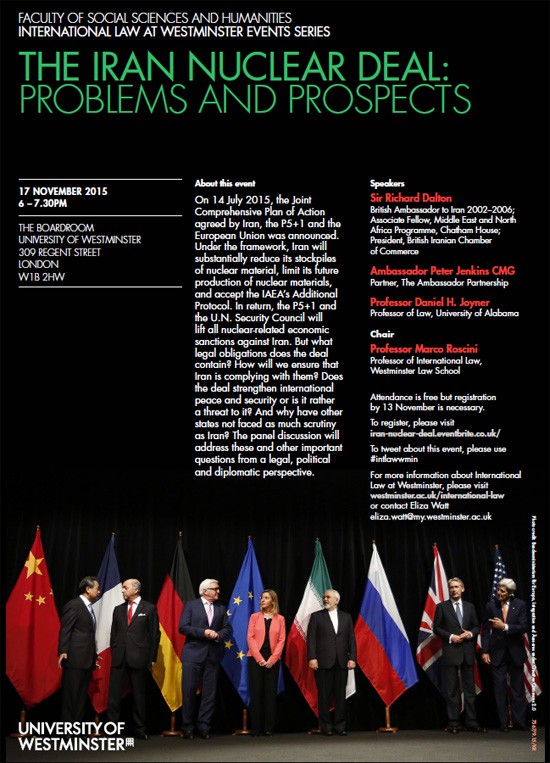
Posted: October 1, 2015 Filed under: Nuclear | Tags: IAEA, Iran, NPT, nuclear security, nuclear weapon states, nuclear weapons Leave a commentOur followers in London and the UK will be interested in this panel on the Iran nuclear deal that will take place at the University of Westminster in London on 17 November. As you know, on 14 July 2015 the Joint Comprehensive Plan of Action agreed by Iran, the P5+1 and the European Union was announced. Under the framework, Iran will substantially reduce its stockpiles of nuclear material, limit its future production of nuclear materials, and accept the IAEA’s Additional Protocol. In return, the P5+1 and the UN Security Council will lift all nuclear-related economic sanctions against Iran. But what legal obligations does the deal contain? How will we ensure that Iran is complying with them? Does the deal strengthen international peace and security or is it rather a threat to it? And why have other nations not faced as much scrutiny as Iran? The panel discussion will address these and other important questions from a legal, political and diplomatic perspective.
Speakers include, in addition to our own Dan Joyner, Sir Richard Dalton (British Ambassador to Iran 2002-2006; Associate Fellow, Middle East and North Africa Programme, Chatham House; President, British Iranian Chamber of Commerce) and Ambassador Peter Jenkins, CMG (Partner, the Ambassador Partnership).
To register, please click here.
Amano Visits Parchin
Posted: September 21, 2015 Filed under: Nuclear 29 CommentsJust a quick post to note that IAEA DG Amano announced on Sunday that he has personally visited the Parchin facility, including the building that has been the subject of so much speculation regarding it’s alleged use as a testing space for nuclear explosive initiators. In a statement about his visit, he said that he and his team were allowed into the building, and that environmental tests were performed in collaboration with Iranian technicians. This was the first time that the IAEA had visited this particular building, though it had visited the Parchin facility twice previously.
The political significance of the DG’s visit to this part of the Parchin facility is huge. It is almost certainly supposed to represent the capstone being placed upon the IAEA’s investigation of the site and it’s role in the agency’s PMD inquiry. And as the Parchin facility has been the most visible and specific part of the agency’s PMD allegations against Iran since the DG’s November 2011 report, this visit appears highly politically symbolic in also marking the beginning of the end of the IAEA’s PMD inquiry as a whole. The JCPOA, of course, provides that the DG must submit a report on the PMD issue to the IAEA BOG by December 15, 2015, upon receipt of which the BOG is supposed to act “with a view to closing the issue.” So the DG’s visit to Parchin would seem to be a communication that everything is moving forward toward this outcome, as planned.
I and others have written a lot about the PMD issue, and the Parchin facility specifically, on this blog over the past few years. I’ve argued all along that the PMD issue was both inappropriate as a subject for the IAEA to be investigating, and overblown in the significance attached to it by many observers (e.g. David Albright, Mark Hibbs). It has been very gratifying to me over the past year or so to see that my view of the PMD issue – i.e. that it should be pragmatically dealt with and the IAEA investigation expeditiously ended – has been the view adopted by the P5+1 negotiators, and eventually by the IAEA itself. This outcome will certainly not satisfy those who pushed so hard for Iran to be required to completely capitulate and confess every detail of its nuclear research programs. But it is the right outcome of an issue that should never have been made into an issue by the IAEA in the first place, and which has demonstrated serious problems regarding the IAEA’s own understanding of its legal mandate, and its utilization of third-party intelligence information.
I will be very pleased to see the PMD issue put to rest, so that the more meaningful and productive issues of forward-looking safeguards on Iran’s nuclear program can be focused on.
Reviewing Parchin
Posted: August 16, 2015 Filed under: Nuclear 37 Comments
Reviewing Parchin
By: Dr. Yousaf Butt
Yousaf Butt, a nuclear physicist, is senior scientific advisor to the British American Security Information Council (BASIC) in London. The views expressed here are his own.
Given some of the exchanges taking place last week, the UN might be concerned about the possibility of the Parchin military complex in Iran triggering an all-out rhetorical war in the non-proliferation community.
Parchin is, of course, the military site in Iran where conventional explosives testing possibly relevant to nuclear weapons research is alleged to have taken place, more than a decade ago.
According to information reportedly leaked by some elements within the US intelligence community, Iran may be attempting to “clean up the site ahead of planned inspections by the IAEA.”
But can Iran really do that by carrying out paving or construction at the site as some commentators have alleged for years? If future IAEA inspections reveal nothing of concern at the site – as past IAEA inspections there did – does this mean Iran succeeded in its alleged sanitization? Or could it be that the IAEA is targeting the wrong building again – like it appears to have done two times in 2005? Or would it simply mean there is no evidence to support the allegations?
Recently, a lot has been made about the location of parked vehicles at Parchin. Should one care where on the site Iran parks cars and bulldozers?
To help answer such questions, here are some simple technical guidelines and some background information:
1. In a case like Parchin – where the IAEA says there is a known building of interest – sampling is best done indoors within that building using swipe samples. External (outdoors) sampling can complement this but is of less intrinsic interest.
2. Tehran cannot sanitize the inside of buildings using paving or bulldozers outside the building. Public satellite imagery released to-date does not tell us whether Tehran has attempted sanitization within the building(s) of interest.
3. In any case, complete sanitization within buildings where work with nuclear materials has taken place is almost impossible to accomplish. The Agency itself states:
Any nuclear process … will also produce particulate materials with particle dimensions in the 0.1 [to] 10 micrometer range. Such small particles are believed to be quite mobile and will travel several meters from their point of origin due to air currents or human activity. This mobility also makes it extremely difficult to clean up an area to such an extent that no particles remain available for swipe sampling. [emphasis added]
4. The location where vehicles are parked, absent other information, is not indicative of very much.
5. The IAEA has visited Parchin twice before and found nothing of concern, possibly because they were targeting the wrong building(s) before, or because there is no actual evidence of nuclear-materials related research at Parchin. The IAEA then stated:
The Agency was given free access to those buildings and their surroundings and was allowed to take environmental samples, the results of which did not indicate the presence of nuclear material, nor did the Agency see any relevant dual use equipment or materials in the locations visited.
If the IAEA happened to be targeting the wrong buildings before, it could also be targeting the wrong building(s) now. The intel the Agency was/is relying on for its allegations appears to be not very solid. Hopefully, the protocol worked out between Iran and the IAEA at the conclusion of the JCPOA provides a framework to reach a quick final conclusion.
6. The IAEA had the possibility to access the current building of interest in 2005 but did not go there then, by choice. Olli Heinonen was head of IAEA safeguards at the time and led the inspections – he described the methodology of choosing which buildings to inspect:
At the time, it[Parchin] was divided into four geographical sectors by the Iranians. Using satellite and other data, inspectors were allowed by the Iranians to choose any sector, and then to visit any building inside that sector. Those 2005 inspections included more than five buildings each, and soil and environmental sampling. They yielded nothing suspicious, but did not include the building now of interest to the IAEA. The selection [of target buildings] did not take place in advance, it took place just when we arrived, so all of Parchin was available….When we drove there and arrived, we told them which building. [emphasis added]
7. Dr. El Baradei who was head of the IAEA when the Parchin and the “Alleged Studies” (now known as PMD) file first surfaced had reservations about the quality of the intel involved, stating: “The IAEA is not making any judgment at all whether Iran even had weaponisation studies before [2003] because there is a major question of authenticity of the documents.” [emphasis added]
To sum up: the most important place to take swipe samples would be on the inside of the building(s) of interest. Construction and paving work outside or the locations of parked vehicles is not of great intrinsic importance, absent other information.
One hopes that the IAEA is indeed targeting the correct building(s) now so that a positive or negative swipe result from inside the building(s) will settle the case quickly and definitively. Incidentally, a negative result would not mean that Iran managed to sanitize the site because the most important sampling would be done indoors where it is almost impossible to get rid of evidence of nuclear materials use.
ABA Journal Seeking Nominations for this Year’s Blawg 100
Posted: August 14, 2015 Filed under: Nuclear 2 CommentsI’m getting around to this a little bit late this year. My apologies for that. The ABA Journal’s request for nominations can be found here.
If a few of you readers wouldn’t mind to nominate ACL, I’d be grateful. I know it’s not a big deal in the broad scheme of things, but it’s been a really nice validation of our work on the blog the past two years to be included on the list.
NOMINATIONS ARE DUE BY AUGUST 16! SO PLEASE NOMINATE TODAY.
Thanks in advance to everyone who takes the time.
Security Council Resolution 2231 and the Joint Comprehensive Plan of Action on Iran’s Nuclear Program
Posted: July 27, 2015 Filed under: Nuclear 14 CommentsNote: Cross posted from EJIL:Talk!
Last week I did a couple of posts elsewhere on the Joint Comprehensive Plan of Action (JCPOA), agreed on July 14 between the P5+1 and Iran regarding Iran’s nuclear program. See here and here. These posts may be of interest in explaining the essential agreement contained in the JCPOA, and in examining some of its key legal implications.
The JCPOA is the culmination of twenty months of negotiations between the P5+1 and Iran, since the initial Joint Plan of Action (JPOA) was agreed by the parties in November 2013. I wrote a post discussing the JPOA here at EJIL:Talk! at the time it was agreed.
I’d like to focus this post on the unanimous passage by the U.N. Security Council on July 20 of Resolution 2231, which can be found here. Resolution 2231 comprises 104 pages of text, inclusive of two annexes, one of which is the entire JCPOA text. I mention this because my primary impression in reading over Resolution 2231 and is annexes for the first time, was frankly astonishment that the parties had been able to agree on such an amazingly complex, thorough and comprehensive diplomatic accord. I was also impressed by the precision of the text of Resolution 2231 itself (apart from a couple of typos) in implementing, in what appears to be a very sophisticated and, as far as I can tell, correct way, the agreement reached by the parties on July 14.
The JCPOA itself and Resolution 2231 appear to represent a major success of international diplomacy, as well as a significant achievement of international law in facilitating the implementation of the diplomatic accord. Again, it is difficult to overstate the complexity of the issues that had to be resolved among the parties to arrive at both the JCPOA and Resolution 2231. And the specificity with which these issues were addressed in both documents – down to weights and measures and dates of implementation – is frankly astonishing, and far exceeds my expectations. And so I compliment all of the diplomats and lawyers involved.
The purpose of Security Council Resolution 2231 is primarily to endorse the JCPOA, which is itself a legally non-binding agreement, and to implement the actions of the Security Council which were agreed to in the JCPOA. Specifically, the Security Council decides in Resolution 2231 that on Implementation Day, as defined in the JCPOA, the previous resolutions of the Security Council regarding Iran’s nuclear program will be terminated. Implementation Day is scheduled to occur when a number of essential actions are taken by Iran, and by the U.S. and the E.U., as spelled out in Annex V of the JCPOA. Practically speaking, Implementation Day is likely to occur within the next 6-8 months.
So again, within the next 8 months, according to Resolution 2231, all of the Security Council’s previous resolutions on Iran regarding its nuclear program, inclusive of sanctions applied pursuant to those resolutions, will be terminated. This is subject, however, to a “snapback” procedure, described in operative paragraphs 11-13 of Resolution 2231. According to this “snapback procedure,” any party to the JCPOA, including Iran, can lodge a complaint with the Security Council at any time alleging substantial noncompliance with the JCPOA’s terms by any other party. If no resolution can be achieved on the matter, the Security Council will vote on whether to continue in effect the termination of its previous resolutions. If this vote by the Security Council fails – e.g. if one of the permanent members votes against it – all of the Security Council’s previous resolutions, including the sanctions implemented thereby, will come back into effect. This process was particularly sought for inclusion by the United States, so that U.S. officials could truthfully say to a skeptical Congress that the U.S., acting alone (i.e. as complainer, and as a permanent member of the Security Council), could if it wished cause the re-application of Security Council sanctions in the event that Iran substantially failed to comply with the terms of the JCPOA.
Assuming the “snapback” procedure is not implemented, however, after the termination of previous Security Council resolutions occurs on Implementation Day, Resolution 2231 puts in their place a more limited, continuing set of restrictions on trade with Iran, which are to continue until UNSCR Termination Day. UNSCR Termination Day is scheduled in the JCPOA to occur in 10 years from Adoption Day. This interim set of restrictions is outlined in Annex B to Resolution 2231, and includes restrictions on trade with Iran, primarily in items and technologies related to Iran’s nuclear program. It does, however, allow for some exceptions for permissible trade in technologies necessary to support the 6,000 uranium enrichment centrifuges which Iran is allowed to maintain in operation throughout the term of the JCPOA.
The restrictions also, notably, include the continuation for five-years of the conventional arms embargo which was a part of previous Security Council resolutions on Iran. The continuation of this arms embargo was one of the more contentious points of the JCPOA negotiations between the parties, and this five-year extension is the resultant agreed compromise.
Importantly, from the perspective of Iran, if all sides abide by their commitments under the JCPOA, Resolution 2231 provides that:
[O]n the date ten years after the JCPOA Adoption Day, as defined in the JCPOA, all the provisions of this resolution shall be terminated, and none of the previous resolutions described in paragraph 7 (a) shall be applied, the Security Council will have concluded its consideration of the Iranian nuclear issue, and the item “Non-proliferation” will be removed from the list of matters of which the Council is seized;
For Iran, this promise represents its ultimate aspiration on this issue – the full removal of international sanctions related to its nuclear program, and its treatment as a lawful possessor of peaceful nuclear energy capabilities.
There would appear to be no “poison pills,” or impossible, or even unreasonable commitments for any party in the text of the JCPOA or in Resolution 2231. Optimism is therefore warranted that this aspiration will be achieved.
Typos in the New Security Council Resolution?
Posted: July 22, 2015 Filed under: Nuclear 2 CommentsI’ve just been reading over the official text of Resolution 2231 on the U.N. website, which is the Security Council resolution endorsing the JCPOA. It appears to me that there are at least two typos in the text. I’m kind of amazed they got through the review process. I picked up on them in the first read.
Here’s the first:
- Decides, acting under Article 41 of the Charter of the United Nations, that, upon receipt by the Security Council of the report from the IAEA described in paragraph :5
I’m pretty sure the colon was supposed to come after the number 5. Not a big deal in and of itself, but it’s really just a proofreading matter.
The second is a bit worse:
- Decides, acting under Article 41 of the Charter of the United Nations, that the terminations described in Annex B and paragraph this of 8 resolution shall not occur if the provisions of previous resolutions have been applied pursuant to paragraph 12;
Paragraph this of 8 resolution? Again, obviously just a switch of words. But this is the text that is up on the U.N. website, and it’s kind of an important legal document. Check it for yourself.
UPDATE: The typos have apparently now been fixed. I know that appropriate staff at the U.N. Security Council Secretariat Branch were notified and asked to do so.
Much, Much More on the JCPOA
Posted: July 15, 2015 Filed under: Nuclear 18 CommentsThis is a long one, folks. So settle in if you really want to get into some legal wonkery.
I published the below introductory piece on the JCPOA over at Opinio Juris. Here I’d like to go into a lot more detail about some of the the legal issues that I see associated with the JCPOA.
To start out with, overall I think this is a very good deal for Iran. They apparently got basically everything they wanted, and certainly the most important things. They get to keep a full front-end nuclear fuel cycle complete with 6,000 operating centrifuges. They get to carry on with centrifuge R&D. Over time they get to upgrade and increase their capabilities all around. The deal stipulates that the end game is for Iran to be considered a nuclear normal state, on par with other NNWS, implicitly recognizing Iran’s right to have enrichment capability and all the other elements of a front-end nuclear fuel cycle. There’s a pathway in the deal for all multilateral and unilateral sanctions to be lifted. These things are all Iran really ever wanted out of the deal.
I think it’s also a good deal for the West and the IAEA. It ratchets down unnecessary tensions between the West and Iran, which is – like it or not – a major regional player now and going forward. It keeps Iran in the NPT and in the IAEA, and lets the IAEA get out of the PMD hole they’ve dug themselves into.
Basically it gives everyone the most important things they’ve said they wanted, creates compromises everyone can live with, and allows everyone to declare victory and save face, which are the hallmarks of a good diplomatic deal.
The JCPOA text creates a serious normative framework that the negotiators have come up with, with a Joint Commission for implementation, a dispute resolution mechanisms, and an agreed implementation program that is very specific on timing and on when everyone has to do things. As I said in my previous post, I think it’s an impressively well crafted and well organized set of documents, so kudos to the lawyers from all sides.
I’d like to comment on a few of the legal issues that the JCPOA raises. Some of this will be overlap from my previous post, but a lot of it will be new.
 Arms Control Law