More Talk of Japanese Nuclear Weapons
Posted: December 21, 2012 Filed under: Nuclear 1 CommentThis is just a brief post, following up on a longer post I wrote about Japan’s nuclear program a few months ago. I wanted to observe that as a result of the recent elections in Japan, there is a new ruling coalition in the Japanese parliament. Noting the decided shift toward the right that this new parliament represents, this article from the Daily Telegraph makes the following observation:
The LDP’s ally, the Buddhist-backed New Komeito Party, will contribute another 31 seats to the total, giving Mr Abe a “supermajority” and the power to overrule parliament’s upper house.
Even more indicative of the rise of the right was the 54 seats that the Japan Restoration Party claimed.
Only founded in November, the party is led by unrepentant nationalist Shintaro Ishihara, the former governor of Tokyo, who has said he intends to restore the nation’s dented pride.
He has already suggested there is a need for Japan to arm itself with nuclear weapons, expand the military and revise the pacifist constitution.
You can read more about Mr. Ishihara’s views on a range of issues, including nuclear weapons, here. This guy is the head of a party that controls 54 seats in Japan’s 480 seat lower house, and that is a part of the ruling coalition? Yikes.
This development reminded me of the comments made by Shingeru Ishiba, former Japanese Minister of Defense and now member of parliament and Secretary General of Shinzo Abe’s ruling Liberal Democratic Party, about Japan’s interest in keeping its civilian nuclear program healthy so that Japan could use the capabilities afforded by its civilian program, to develop a nuclear weapon if it ever needed to do so. As I noted in my previous post, these comments were reported in a Wall Street Journal article in October of 2011:
Many of Japan’s political and intellectual leaders remain committed to nuclear power even as Japanese public opinion has turned sharply against it. One argument in favor rarely gets a public airing: Japan needs to maintain its technical ability to make nuclear bombs. “I don’t think Japan needs to possess nuclear weapons, but it’s important to maintain our commercial reactors because it would allow us to produce a nuclear warhead in a short amount of time,” Shigeru Ishiba, a former defense minister, said in an interview in a recent edition of Sapio, a right-leaning twice-monthly magazine. ”It’s a tacit nuclear deterrent,” added Mr. Ishiba, an influential parliament member who made similar remarks on a prime time television news show in August while serving as policy chief of Japan’s main opposition party.
So here are two quite influential members of Japan’s ruling governing coalition that have openly supported Japan’s nuclear program as being at least a potential source for development of nuclear weapons. And in Ishihara’s case, he appears to take the poitn further to argue that Japan should weaponize now.
IS EVERYBODY OK WITH THIS? Hey, IAEA, where are you on this one? If you really do think that you have the mandate to investigate and assess possible military dimensions of NNWS safeguarded nuclear programs, then shouldnt you be all over this case – a country with a stockpile of separated plutonium, all necessary technology to build a nuclear weapon, and influential government officials openly supporting nuclear weaponization?
New Paperback!
Posted: December 21, 2012 Filed under: Nuclear Leave a comment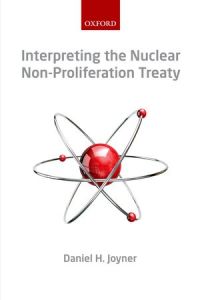
I’m very pleased to announce that my 2011 book Interpreting the Nuclear Nonproliferation Treaty has just been released in paperback in the UK. It looks like it will be out in the US in February or March, but it’s already available for pre-order at Amazon. This is great because the price is now considerably lower than the hardback – down from $88.85 to a mere $32.25! I know what you’re thinking – that’s your Christmas shopping done!
I’m Back
Posted: December 21, 2012 Filed under: Nuclear Leave a comment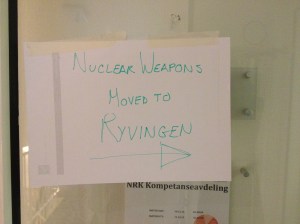
I’ve been pretty quiet on the blog for the past couple of weeks. I’ve been travelling – first to Oslo, and then to Paris. I was in Oslo for a conference organized by ACL’s own Gro Nystuen and the International Law and Policy Institute. It was a great first session of a two-session conference on Nuclear Weapons and International Law – the papers from which will also comprise an edited volume to be published by Cambridge University Press. It was a great meeting with high quality presenters covering jus in bello, jus ad bellum, and nonproliferation law aspects of nuclear weapons possession and use. ACL’s own Marco Roscini was also in attendance, and gave a great paper on the ME WMD FZ. My presentation was on NPT Article VI and the obligation of nuclear disarmament. The conference was extremely well organized. I just had to take a picture one morning of the sign on the doorway leading to the room in which the conference was to be held that day – a different room than had originally been planned. In the context of the conference, all the participants knew exactly what it meant. But I wondered what a casual passerby might have thought of the sign. I thought of naming this post “Evidence of Norwegian Nuclear Weapons Stockpile Uncovered,” but I decided to demur. Who knows, maybe Albright will pick up the scent on this one too. I can see it now – a new ISIS report, and a corresponding post over at Arms Control Wonk with 200 comments, fearfully speculating about what it all must mean, and where Norway’s red line is – after which there will be nothing stopping it from nuking Stockholm. Sigh.
My next stop was Paris, where I gave two presentations. The first was on Thursday at the University of Paris Ouest (Nanterre), where I gave a conférence d’actualité at the invitation of Professor Mathias Forteau, sponsored by the Centre de Droit International De Nanterre (CEDIN). My presentation was on Iran’s nuclear program and international law. Monday I gave a similar presentation at the Centre Thucydide, University of Paris II (Pantheon-Assas), at the invitation of Professor Serge Sur. Both of my hosts in Paris were extremely gracious, and there were great discussion periods with the students and others in attendance at the lectures.
I do have some thoughts and developments to report in subsequent posts.
Are We in the Same Roundtable, Chris?
Posted: December 10, 2012 Filed under: Nuclear 26 CommentsI literally just finished reading Chris Ford’s final contribution to the BAS Roundtable, which was published today. Now, I am a bit delirious having travelled on little sleep over the past day and a half to get to Oslo, but I think Chris has made a gargantuan mistake in this contribution. You can all check me on this, and of course Chris can respond if he wants. But is it me or has Chris forgotten the original question for the Roundtable? All of a sudden he’s arguing that the CSA doesn’t have the investigate tools and authority the IAEA needs to fulfill its responsibilities, and therefore thank goodness there’s an AP that helps to remedy that problem. But that’s where I’m puzzled – we are still talking about Iran’s safeguards compliance, right? And surely Chris knows that the AP isn’t in force on Iran, right? So hasn’t Chris made a huge mistake in forgetting that we’re talking about the standards that apply to investigation and assessment of Iran, and that Iran doesn’t have an AP? All his extolling of the mandate the IAEA is given in the AP is completely irrelevant to Iran’s case, isn’t it? And actually, in admitting that the CSA doesn’t give the IAEA the investigative tools to do what he’s been saying is their mandate under the CSA – namely investigate and assess both correctness and completeness – isn’t he conceding that my analysis of the CSA has been correct? I’m really puzzled about this piece.
The UNGA Recognizes the State of Palestine
Posted: December 3, 2012 Filed under: Nuclear 12 CommentsI’ve written a couple of posts lately on the Israel-Palestine conflict, the most recent of which is here, where I argued that the U.N. Security Council should step in to the situation and act under Chapter VII to legally determine the boundaries of a Palestinian state.
As all will now be aware, the UN General Assembly voted last Thursday to upgrade Palestine’s UN status to “non-member observer state.” I do think that this was a significant manifestation by a supermajority of states (138) of recognition of Palestine as a state, with borders defined by the 1949 Armistice (Green) line.
Of course, this was not the first such manifestation of recognition. To date, 131 of the world’s 193 states have formally recognized the statehood of Palestine. I’m very much a proponent of the constitutive theory of recognition in the law of statehood, so this fact is very influential in my opinion. It’s only the identity of the holdouts (the US and Europe) that keeps the situation at all questionable – though there should be no question in my opinion. In terms of the Montevideo Convention criteria (permanent population, defined territory, government, capacity to enter into legal relations), in addition to the steady stream of formal recognitions since 1988, the state of Palestine has almost certainly existed for decades, simply in a continuing situation of foreign military occupation.
I think that the numbers here are really striking – both in terms of the recent UNGA vote and in terms of formal recognitions. The US so often likes to get on its high horse about how other countries are out of step with, or flouting the “will of the international community” on some issue. Well on this issue, the shoe is most definitely on the other foot, and it’s the US and Europe that are out of step with the will and judgment of the international community – and decidedly so.
Over at opinio juris, Kevin Jon Heller has some excellent analysis of the International Criminal Court jurisdiction implications of the UNGA vote.
It appears that, in direct response to the UNGA vote, Israel has decided to take the perversely provocative and illegal step of moving forward with additional settlement building in East Jerusalem and the West Bank, in direct contravention of the ICJ’s 2006 determination that such settlements in occupied territory are in violation of international law. These actions threaten to make a two-state solution logistically impossible.
I think that all of these developments only support my argument that it’s time for the Security Council to step in and legally determine the boundaries of the state of Palestine. If it did so, and at the same time ordered Israel to withdraw from its military occupation of Palestinian state territory, it would clear the way for the Palestinians to set up, with international assistance, a working government for their state. Such a full and final disposition of the competing territorial claims of Israel and the Palestinians is the only way to move forward meaningfully toward a lasting, peaceful coexistence between the two nations.
My Final BAS Roundtable Contribution is Posted
Posted: December 3, 2012 Filed under: Nuclear 6 CommentsIts here. I’ll go ahead and pasted the text here, since its short. Ford and Persbo will now have a final chance each to respond.
Christopher Ford and I agree on one thing: The IAEA’s Comprehensive Safeguards Agreement (CSA) needs to be read clearly. We differ, however, in that I am reading the CSA both clearly and fully as the text is actually written, and not as Ford and Andreas Persbo — or perhaps the IAEA itself — might wish that the agreement had been written.
Ford and Persbo have cherry-picked phrases from Articles I and II of the agreement to support their arguments that the CSA provides the agency with the authority to investigate and assess whether there are undeclared fissile materials in Iran. However, they essentially disregard the entire rest of the treaty, which details the agreed processes for the agency’s application of safeguards.
It’s as if Ford and Persbo want to convince readers that the CSA and the Additional Protocol are one and the same. Under the protocol, the IAEA’s mandate and the agreed processes for carrying out investigations and assessments, do allow the IAEA, within limits, to investigate and assess the completeness, in addition to the correctness, of a state’s declaration. However, the CSA and the protocol are not one and the same, and the protocol is not in force in Iran’s case. Thus, the IAEA’s mandate for investigation and assessment in Iran’s case must be taken solely from the text of the CSA.
Article I of the CSA is Iran’s basic undertaking, while Article II is the agency’s mandate. Article II states that the agency has the “right and obligation to ensure that safeguards will be applied, in accordance with the terms of this Agreement, on all source or special fissionable material in all peaceful nuclear activities within the territory of Iran, under its jurisdiction or carried out under its control anywhere, for the exclusive purpose of verifying that such material is not diverted to nuclear weapons or other nuclear explosive devices.”
Chiding me for rendering an interpretation inconsistent with the text of Article II, Ford, when quoting the article, rather conveniently omitted the above-italicized clause entirely. But these words are not just superfluous, as his ellipsis implies — they are essential for a holistic understanding of what Article II means within the context of the CSA. This clause explicitly makes the IAEA’s mandate in Article II subject to, and circumscribed by, the procedures agreed to in the CSA.
If Ford’s interpretation were correct — and the IAEA’s mandate were not limited by the agreed procedures in the rest of the CSA — it would mean that the agency would have unlimited authority to ensure that safeguards are applied on all fissionable material anywhere within the territory of Iran, by any means the agency considers necessary, no matter how intrusive or compromising of Iran’s national security or sovereignty. The IAEA could require Iran to meet any evidentiary standard it unilaterally determined, in order to subjectively satisfy itself of the absence of undeclared materials in Iran (i.e., require Iran to prove the negative).
That is a completely untenable reading of the CSA. No state would ever agree to such a broad and unrestricted mandate for the IAEA. That’s why Article II specifies that the agency’s mandate is subject to, and limited by, the terms of the agreement. Those terms stipulate in detail the process to be followed for applying safeguards. That process essentially involves a declaration by Iran, and the IAEA’s verification of the correctness of that declaration.
The agency, therefore, is simply incorrect when it claims that its mandate under the CSA extends to investigations and assessments beyond the agreement’s terms — i.e., beyond verifying the correctness of Iran’s declaration.
A Whole ISIS Report Devoted to Little Ol’ Me
Posted: November 27, 2012 Filed under: Nuclear 17 CommentsSee the piece here.
It’s such a thrill to see so many of my detractors gathered together in one place. As an academic, there is in many ways no higher honor than to have your work perceived as so significant, relevant and influential, that it merits the energies of so many to respond to it. So I thank the authors and endorsers of this report for the high compliment they have given me in producing it. It’s kind of like having had a symposium devoted to my work – to which I wasn’t invited. Well, let me now offer my contribution to the symposium.
I could of course begin with a discussion of who each of the authors and endorsers of the report are, their varying academic qualifications (two of the three authors are not lawyers, and the third is not an international law expert in my opinion), and the biases they likely bring to the subject because of their past, present and likely future ties to governments and to the IAEA itself. But I won’t do that.
I could also, of course, mention again how many positive reviews and endorsements my work has received, including in peer-reviewed journals and in the international legal scholarly community generally. All this of course can be gleaned from my C.V.
All that such a discussion really does, however, is reinforce the point that on these issues there are many people who agree with me, and some who don’t. That’s going to be true of any interesting, important, high profile issue of academic debate, and so it should come as no surprise that it’s true here.
I’m happy to let the analysis and arguments that I’ve made in my books and law review articles, in my op-eds – including the ones presently proceeding specifically on this topic over at the Bulletin of the Atomic Scientists as part of an invited Roundtable – and here on ACL, stand for themselves in the eyes and judgments of readers. I’m confident, as I always have been, that serious experts in international law, and people who understand the role of international organizations in the international legal system, will agree with my assessments of the relevant sources of law.
To be honest, I don’t see a lot in this new piece in terms of actual legal arguments that haven’t been made before in response to my work, particularly over in the BAS Roundtable by Ford and Persbo. And I’ve already responded to them there, with references to my original post here on ACL. So I don’t think there’s much new to respond to here in terms of substance. It does of course have Albright’s nastiness of tone, which one can spot a mile away.
But I would offer a few thoughts on this new iteration of those arguments.
First, I would note the weakness of the assertions made in this piece attempting to legally justify the IAEA’s inquiries into possible military dimensions of Iran’s nuclear program. I of course wrote on this issue some time ago here. I see no persuasive legal arguments offered in this piece that would challenge my conclusion that the IAEA lacks the authority to investigate and to assess weaponization related activities in Iran.
Second, so much of the text of this new piece is devoted to chronicling IAEA practice and statements which imply that the IAEA thinks it has a legal mandate under the CSA to investigate and assess both the correctness and completeness of Iran’s declaration – i.e. to investigate and assess whether there are undeclared fissile materials in Iran. I’ve never argued that the IAEA doesn’t think they have this authority. In fact, their statements and actions implying that they think they have this authority, are precisely what led me to write on this issue in the first place.
But just because an international organization asserts a legal authority, doesn’t mean that it actually has that legal authority. This is analogous to domestic governments who assert that they have certain legal authorities to act, only to have those assertions authoritatively contradicted by courts who strike down those actions as unconstitutional. Similarly here, the IAEA is bound by the limits of its authority in its Statute and in its safeguards agreements, and its simple assertions that it has certain authorities in excess of these textual limitations, do not serve to effectively overcome those limitations. Actions by the IAEA in excess of its authority pursuant to its international legal constitutive sources, are just as ultra vires and therefore invalid, as are the unconstitutional actions of a domestic government. An objective assessment of the IAEA’s foundational legal sources, using proper international legal interpretation, is necessary in order to determine whether the IAEA is acting within its authority. This is what a court would do if it were to be properly seized of the matter.
Third and finally, the IAEA in CSA Article II has the mandate to ensure safeguards are applied in the state party, subject to the terms of the CSA, which only give the Agency certain limited investigative authorities. The IAEA has over time come to consider that the terms of the CSA, and the investigative tools given to the Agency in the CSA, aren’t sufficient for it to make the determinations required of it in CSA Article II. The IAEA now considers that, in order for it to be able to make these determinations, the CSA state party must provide the IAEA with cooperation in its investigations, above and beyond the level of cooperation required of the state party according to the terms of the CSA, including through the signing of a separate and additional treaty, the Additional Protocol. If the CSA state party doesn’t provide this cooperation above and beyond the terms of the CSA, the IAEA thinks that it can still apply what it considers to be its mandate for assessment under the CSA, and by reference to this mandate determine that the state party is in noncompliance with its safeguards obligations – even though as far as the state is concerned, it is doing everything it obligated itself to do according to the terms of the CSA, and is providing all the procedural and substantive cooperation it agreed in the CSA to provide.
Basically, the IAEA has taken the view that it can unilaterally change the obligations of cooperation that states are under pursuant to a CSA, to obligate the CSA state party to give the IAEA increased but unspecified investigative and assessment tools, in order to enable the IAEA to make the determination that there are no undeclared fissile materials in the state party.
And therein lies the problem. The IAEA cannot unilaterally change the obligations of cooperation that states are under pursuant to the terms of the CSA. Instead of realizing this fact, and working within the limits of its existing legal authority and the existing legal obligations of Iran, the IAEA has instead insisted on applying pressure on Iran to cooperate above and beyond the terms of its CSA, and has maintained that until Iran provides this extra cooperation, the Agency will continue to find that Iran is in violation of its safeguards obligations – even though Iran has been providing the procedural and substantive cooperation it agreed to provide according to the terms of the CSA, the only safeguards agreement currently in force upon Iran.
It’s basically a case of one party to an agreement unilaterally trying to change the rules of the agreement, and alleging that the other party is in breach of the agreement if they don’t abide by the new rules.
So this has essentially produced the standoff that we see reflected in IAEA DG reports on Iran. The IAEA insisting that it be given more investigative cooperation by Iran than that which Iran is required to provide in its CSA, Iran refusing to provide that additional cooperation, and the IAEA maintaining that if Iran doesn’t give that additional cooperation, the IAEA will continue to determine that Iran is in noncompliance with its safeguards obligations.
The IAEA is simply wrong in doing this, and is aggravating the crisis regarding Iran’s nuclear program through its attempts to act ultra vires its legal authority.
ME WMD Free Zone Conference Will Not Be Held In 2012, No Revised Date Set
Posted: November 27, 2012 Filed under: Nuclear 7 CommentsI just wanted to bring this important development forward to the top of the list. As a number of commenters have pointed out in the comments to my related post a couple of weeks ago, it’s now official that the ME WMD Free Zone conference that was agreed in the 2010 NPT RevCon Final Document to be held in 2012, will not be held in 2012, and there appears to be no revised date set. I recommend to readers the statements from various governments on the matter, which have been shared in the comments section of the earlier piece. I’m hoping to get one or more commentary pieces on the blog on this development and its implications, by ME officials or area specialists in the coming days. This is a very significant and unfortunate development that bodes ill for the future of the NPT Review Conference process.
New Contributions to BAS Roundtable [UPDATED]
Posted: November 20, 2012 Filed under: Nuclear 14 CommentsI just thought I’d note that there have been two additional contributions so far to the Bulletin of the Atomic Scientists Roundtable involving Chris Ford, Andreas Persbo, and myself.
Both Chris and I have published contributions subsequent to the initial ones by each author, and this next Monday Andreas’s next piece should be up. [UPDATE 11/26: Its now up. Andreas seems to have given up on legal analysis entirely at this point, and now tries to support his arguments with the assertion that “Law is decided by policy, and policy is often determined by experience.” Wow. I don’t even know what that’s supposed to mean, but Andreas seems to have left the building of proper legal interpretation and argumentation. Further, somehow Andreas doesn’t understand that my statement that the IAEA DG has “consistently confirmed that all safeguarded material in Iran is currently in peaceful use” is correct. I said “all safeguarded material,” meaning all material that Iran has declared and that is therefore under IAEA safeguard.]
Have a look at Chris Ford’s piece published just yesterday. Don’t worry – I’m preparing a crushing reply. It will be published not this coming Monday but the next (December 3).
Albright Wrong on Legal Analysis Again
Posted: November 15, 2012 Filed under: Nuclear 8 CommentsSee this ISIS report by David Albright, just posted today. It’s a rundown of “facts” about two companies that may have worked with an Iranian defense organization called the Physics Research Center (PHRC) in the 1990’s, and whose work with the PHRC may have aided in the PHRC’s obtaining items from abroad that may or may not have violated other countries’ export control laws. Yawn. And from these facts there can, of course, be no other conclusion than the one reached by Albright that “the PHRC was part of a chain of secret organizations, the long-term aim of which was to lay the basis for nuclear weapons development.”
Sitting here in 2012, it’s hard to see how a study like this of possible export control violations by Iran 15-20 years ago is of any real relevance and usefulness to the current set of legal and diplomatic issues regarding Iran.
But as a legal matter, I take issue substantively with David’s conclusion, which is:
More generally, the IAEA needs to continue investigating the PHRC. It should insist that Iran answer questions derived from PHRC procurement information as part of the IAEA verifying the completeness of Iran’s declarations under its comprehensive safeguards agreement. The IAEA has the legal mandate to do so and the international community should support this effort.
Apparently David just couldn’t resist making another legal assessment, even after our pointed conversation about his doing so a while ago. Well, his assessment is just as wrong on this outing. Currently, the IAEA does not have a legal mandate to assess the completeness of Iran’s CSA declaration. Only its correctness, as I’ve been explaining in my contributions to the current Roundtable at the Bulletin of the Atomic Scientists site, and as I discussed in greater detail in a previous post here .
So whatever the PHRC may or may not have done back in the 1990’s, it’s ancient history now and irrelevant to, and merely a distraction from, the real current issues regarding Iran. And the IAEA does not in fact have the authority to investigate it. Wrong again, David.
 Arms Control Law