Chemical weapons in the Middle East remain sensitive
Posted: December 14, 2014 Filed under: Chemical | Tags: Chemical warfare, chemical weapons, Middle East, Syria Leave a comment[Cross-posted from The Trench]
On 4 December I addressed a workshop on Nuclear Safety, Security and WMD Non-proliferation. The event was organised by Atomic Reporters and the Vienna Center for Disarmament and Non-Proliferation (VCDNP), together with the Stanley Foundation and the James Martin Center for Nonproliferation Studies (CNS). The target audience consisted of more than 20 journalists from or working in the Middle East.
My presentation ‘Responding to chemical weapon use in Syria’ addressed the allegations of chemical weapon (CW) use in Syria since early 2013 and the international CW disarmament operation over the past 15 months.
The audience’s reactions at times illustrated how sensitive the question of CW remains in the Middle East. When people are forced outside their comfort zone offered by established reference frameworks, regional security discussions quickly become tense. If ever serious progress is to be made on the idea of a zone free of non-conventional weapons in the Middle East, preparing a common reference framework for the participants in the debates—particularly civil society constituencies who must prepare the ground to make proposed solutions politically and socially acceptable—will be an unescapable task.
Lale Kemal, a Turkish journalist, captured the exchanges very well in a piece for the Daily Zaman on 8 December. If she leaves you with the impression that the discussions were not just intense, but also most stimulating, then I can confirm they were.
Middle East’s ‘unique’ status on chemical weapons
A colleague from a Middle Eastern country reacted sharply when a speaker in a recent workshop in Vienna used the term “Muslims” in some of his references to the countries in the region during his presentation on the issue of chemical weapons. The colleague urged him to use the names of the countries instead of generalizing them with their affiliation to Islam. The topic of chemical weapons is a sensitive one. Jean Pascal Zanders, director of The Trench — a website specializing in reporting on chemical weapons — told the workshop audience in Vienna that with the exception of the First Indochina War, all cases of major chemical warfare after World War II have taken place in the Middle East.
Yet this journalist’s reaction to the speaker in his usage of the term “Muslims” does not change the reality that — in the words of Mehmet Dönmez, head of Turkey’s Religious Affairs Directorate — around 900 Muslims per day are killed by fellow Muslims around the world, including in the Middle East. Nevertheless, the topic of the workshop for journalists from the Middle East, held in Vienna between Dec. 3-5, was on nuclear safety, security and WMD non-proliferation. WMD is short for “weapons of mass destruction,” which are chemical, biological and nuclear weapons — the deadliest weapons that have so far been developed by humankind.
The workshop was sponsored by the United Arab Emirates (UAE), along with nongovernmental organizations the James Martin Center for Nonproliferation Studies (CNS), the US-based Stanley Foundation and Vienna-based Atomic Reporters. The event was hosted by the Vienna Center for Disarmament and Non-Proliferation (VCDNP). It was a follow-up to the first workshop, which was held in I.stanbul in June of this year in cooperation with I.stanbul’s Okan University.
Going back to the topic of chemical weapons in the Middle East, Zanders from The Trench cited the known incidents of the usage of chemical weapons in the region, including Egypt during its war with Yemen in the 1950s and Iraq against Iran in 1984 during the long-lasting war between the two countries in the 1980s, as well as Iraq’s use of mustard gas against its own Kurds. Syria lately staged a sarin gas attack against its own citizens in Ghouta, near Damascus. Syria’s chemical weapons were destroyed under a deal it struck with some world powers, yet it is unclear whether the country is still hiding some of its chemical weapons stockpile.
Meanwhile, Israel is the only country in the Middle East widely known to possess nuclear weapons, even if it neither denies nor confirms their existence. Iran is accused by the international community of seeking to develop nuclear weapons under the guise of developing nuclear energy power plants.
Dr. Chen Kane from the CNS strengthened Zanders’ assertion, saying during the workshop that, concerning cases of the usage of chemical weapons as well as their possession, the region is unique. According to her, in the Middle East, all three categories of weapons of mass destruction — chemical, biological and nuclear — have been pursued by different states and chemical weapons have even been used in the region on several occasions. She mentioned fundamental ongoing territorial, religious, ethnic and other disputes that underline that the reality of WMDs and that the acquisition of WMDs in the region is interrelated and politically and security-motivated. Out of the seven violations of the Treaty on the Non-Proliferation of Nuclear Weapons (NPT), Dr. Chen said five are from the Middle East — Iran, Iraq, Libya, Syria and Egypt. This situation illustrates the risk associated with nuclear programs in unstable countries and war zones. It is unclear if any Middle Eastern country possesses biological weapons. The unstable nature of the Middle East also carries the risk of terrorist groups obtaining WMDs.
In February 2015, the Ja?far al-Tayya-r brigade and the al-Nusra Front gained control of the al-Kibar site (also called Dair Aizour) in Syria, where a nuclear reactor believed to have been under construction was destroyed by Israel during an air raid in 2007. According to Zanders, the Islamic State in Iraq and Syria (ISIS) — a terrorist group against which US-led Western and Arab coalition forces are currently carrying out an air campaign in both Iraq and Syria — has not obtained WMDs.
Turkey, a NATO member and a neighbor to the Middle East, came under criticism a long time ago for using white phosphorus — a kind of a chemical weapon — against militants from the outlawed Kurdistan Workers’ Party (PKK). However, Zanders stated that such allegations from the PKK have never been confirmed by international organizations addressing WMDs.
The absence of a security framework or organization in the Middle East — where there is no regional conventional arms control culture — to mitigate the danger of WMDs poses a great threat to the region in particular and the world in general.
Wow! Did the OPCW really say that?
Posted: December 13, 2014 Filed under: Chemical | Tags: Allegation, CWC, Disarmament, international law, Israel, OPCW Leave a comment[Cross-posted from The Trench]
It is true that pressure for Israel to join the Chemical Weapons Convention (CWC) is steadily mounting. Presently 190 states are party to the treaty. Besides Israel, only Angola, Egypt, Myanmar, North Korea and South Sudan have not ratified or acceded to it. As participants in the 2014 Jonathan Tucker Conference on Chemical and Biological Arms Control heard yesterday from Dr Peter Sawzcak, Head of Government Relations and Political Affairs Branch of the Organisation for the Prohibition of Chemical Weapons (OPCW), Myanmar is expected to ratify the CWC in its forthcoming parliamentary session in January. The Council of Ministers of Angola, which will take up a non-permanent seat in the UN Security Council next year, is to decide on joining the Arms Trade Treaty, Biological and Toxin Weapons Convention, and CWC really soon. South Sudan may also become a party to the CWC in the near future as part of a broader package deal under development. As was pointed out by some other speakers at the Jonathan Tucker Conference, being in the company of North Korea is not good for a democracy such as Israel.
However, in an article published on 11 December the Times of Israel quoted an anonymous OPCW official affirming that Israel has a chemical weapon (CW) stockpile. He also stated that he knew the size of the chemical arsenal, but refused to go into details. According to a second article in Arutz Sheva Israel Radio quoted the official as saying that the UN needed to begin an investigation of Israel on its chemical weapons stores, as it did with Syria.
According to the Times of Israel, he also said that Egypt has thousands of tonnes of CW.
Israel is a CWC signatory state. Under Article 18 of the Vienna Convention on the Law of Treaties a signatory state is obliged to refrain from acts which would defeat the object and purpose of a treaty. In other words, if Israel were indeed to have a CW stockpile, it would be in a clear breach of its international obligations. This is not a light accusation to make. Particularly if it is made in the name of the multilateral organisation that is responsible for ridding the world of these heinous weapons.
Striking too is the lack of nuance in the claims. Egypt and Israel have had past CW programmes. But in the absence of reports of troop training and testing of munitions, how useful is it to retain aging stockpiles? Would the agents be subject to degradation? Are stocks being replenished (which implies active CW production facilities)? Egypt’s ‘thousands of tonnes’ puts the country in the same league as Iraq under Saddam Hussein and North Korea (according to South Korean assessments) and well ahead of what has been removed from Syria over the past eighteen months. Mohamed Heikal, an Egyptian journalist and commentator on Arab affairs, described in his excellent book Illusions of Triumph: Arab View of the Gulf War (London: Fontana, 1993, pp. 91–93) how then Egyptian President Anwar Sadat closed down Egypt’s CW production plant after the 1973 Arab-Israeli war and in 1981 refused to reopen it to supply Saddam Hussein with CW. To the best of my knowledge, this passage has not yet been seriously challenged.
Considering the culture of confidentiality at the OPCW and the organisation’s systematic refusal to comment on individual states—just take the many anodyne press statements on the CW disarmament project in Syria—the incident is remarkable to say the least. One would hope that those specific assertions were intended to be wholly off the record, but even so…
Update
OPCW Statement Regarding Israeli Media Reports on a Recent OPCW Briefing
Thursday, 11 December 2014
OPCW officials met with a group of journalists from Israel on Monday of this week and briefed them on the OPCW’s work, achievements and future challenges. On the issue of achieving universality of the Chemical Weapons Convention (CWC), it was mentioned to the journalists that there are six non-States Parties to the Chemical Weapons Convention, including Israel.
In regard to the capacities of those six countries, it was clearly stated that the CWC verification regime functions on the basis of declarations, and that the OPCW would be able to ascertain possession of chemical weapons by any non-State Party only after it joined the Convention and made a formal declaration to the Organisation.
Engaging Israel on CWC Ratification – Part 1: Outsider Perspectives
Posted: November 24, 2014 Filed under: Chemical | Tags: CWC, Disarmament, Israel, Middle East, Ratification, Universalisation 1 Comment[Cross-posted from The Trench]
The Israeli Disarmament Movement together with the Chemical Weapons Convention Coalition (CWCC) and Green Cross convened two days of roundtable discussions on Chemical Weapons, Israel and the Middle East in Tel Aviv. The third day, 12 November, a briefing was held in the Knesset. In a region where (existential) security and the nuclear weapons stand central to any debate on arms control strategies, the exclusive focus on chemical weapons (CW) was a rare occurrence.
The meeting goals were twofold: promote ratification of the Chemical Weapons Convention (CWC) by Israel and to have Israel take a more positive stance in the diplomatic engagements to establish a zone free of non-conventional weaponry in the Middle East. The conveners viewed CWC ratification as a potential significant step towards achieving the latter goal.
Each day had different ambitions. Day 1 sought to broaden knowledge of CW issues and the functioning of the CWC among a diverse group of Israeli civil society constituencies and reporters. Day 2 followed Track II approach, engaging representatives from Israeli academic institutions and think tanks, and other policy shapers. On the final day the invited speakers briefed parliamentarians in the Knesset.
This report summarises external arguments why Israel should ratify the CWC. The next posting will focus on Israeli views.
Üzümcü: “After Syria I do not see any country able to use chemical weapons anymore”
Posted: November 17, 2014 Filed under: Chemical | Tags: Chemical warfare, CWC, Disarmament, International Humanitarian Law, OPCW, Syria 3 Comments[Cross-posted from The Trench.]
The last day of October, a sunny Friday in The Hague, I met with Ambassador Ahmet Üzümcü to reflect on the previous year and a half, during which the civil war in Syria suddenly thrust the Organisation for the Prohibition of Chemical Weapons (OPCW) into the spotlight.
In March 2013 United Nations Secretary-General Ban Ki-moon requested technical assistance from the OPCW to investigate alleged chemical weapon (CW) use in the war-torn country. Six months later, after a serious incident in which sarin nerve agent killed and poisoned many hundreds of people in the Ghouta district of Damascus, Syria unexpectedly joined the Chemical Weapons Convention. And so began an urgent and perilous disarmament project. The announcement that the OPCW was to receive the 2013 Nobel Peace Prize just knocked international expectations from the organisation several notches higher.
The Syrian disarmament project has had a clear impact on the OPCW. Not just on its daily operations during the past 18 months, but it will also affect its future. However, the key question is whether the OPCW’s success in trying circumstances can inspire the international community to revive disarmament as a security tool.
Syria’s CW precursors have been evacuated and are almost all destroyed. Destruction of former CW production facilities has now begun. What were you thinking last year when you accepted the tight deadlines in the US–Russian Geneva Framework Agreement?
The Framework Agreement reached in Geneva on 14 September of last year was a significant achievement. The Russians and Americans wrapped up their negotiations in four days, which surprised us as much as the whole international community. We knew that the OPCW could be called on to address the chemical part of the Syrian conflict. In which form and under which conditions, we did not know then. Even so we were prepared to get involved and if necessary, to take the lead, all the while knowing such a project would be very challenging.
We first saw this document on 14 September. On 27 September, the Executive Council decided on OPCW involvement and a few hours later the United Nations Security Council (UNSC) endorsed that decision. Between both dates, we had 13 days to prepare our team for deployment to Damascus, work out the modalities, and so on. Having said that, I should add that the Technical Secretariat had been preparing itself for several contingencies. They included possible investigation of alleged CW use. We were thus ready when in March 2013 the UN Secretary-General called upon our expertise. In September, we had a team of 60 volunteer inspectors ready to go to Syria. They had trained to carry out different tasks.
Still, I was following the Geneva talks from Beijing. The negotiators raised questions whether we would be ready to do this or that. Our responses were all positive. We looked at our gaps. We identified a few areas where we would need some additional support, so we decided to rehire some of our former experts and hire some external experts. Important to us was to act swiftly and diligently. We also had to demonstrate to the international community that after 16 years the OPCW had the necessary capacity and expertise. I think we succeeded.
As I said, on Friday, 27 September, the decision was taken here. The same day the UNSC endorsed it in a resolution. On Monday, our inspectors were on their way. On Tuesday, they arrived in Damascus. The UN clearly had some difficulties to match this pace. The UN mechanism is huge compared to ours. So I called Secretary-General Ban Ki-moon on Thursday, the day before the UNSC decision. I told him that we were ready to deploy and asked him for logistical and security support, which we received. Despite the magnitude of the challenge and the security situation in Syria, I think the Technical Secretariat was fully prepared to lead. When I say ‘lead’, I of course refer to the technical part of the operation. We relied on the UN for logistical support and security.
The other obvious challenge was the financial dimension. In that respect, having seen the support from the whole international community for this Russian–US initiative, I actually did not have any concerns. It was proven later on that we would have the necessary funds in both the UN and the OPCW Trust Funds. Financial aspects would not be problematic and they never were.
A year ago, I should say, we were both mentally and physically prepared to go to Syria. I personally was involved in setting up a task force, which I chaired every morning on the 7th floor of the OPCW headquarters. This also gave me the opportunity to know better some of our staff members. They were really capable and pleased to be able to help coordinate such a major operational mission.
Chlorine: A weapon of last resort for ISIL?
Posted: October 26, 2014 Filed under: Chemical | Tags: Chemical warfare, Chlorine, Iraq, ISIL, Terrorism, War 6 CommentsOver the past few weeks several press reports have suggested that the Islamic State of Iraq and the Levant (ISIL) have resorted to chlorine use in attacks in Iraq and Syria.
The grouping is no stranger to chlorine. In some earlier incarnation it was known as al Qaeda in Iraq (AQI) and later it rebranded itself as the Islamic State of Iraq when it explicitly began trying to control territory. Harsh imposition of its strict interpretation of Sharia law and extreme violence towards anybody refusing total subjugation to its rule soon had Sunni tribal leaders uniting in resistance early in 2007. They also began cooperation with forces of the US-led coalition occupying Iraq since 2003 and the Shia-dominated Iraqi government. AQI started mounting large-scale operations involving several hundreds of fighters to capture local seats of power. During the first half of 2007 suicide attacks with lorries rigged with a large quantity of explosives evolved from isolated incidents to terrorise and destabilise societies to a tool integrated in assaults against government centres and fortified positions. After an isolated attempt in October 2006, AQI launched almost 20 chlorine attacks in the first half of 2007.
This posting is a first effort to understand the dynamic behind ISIL resorting to chlorine and perhaps some other toxic chemical substances in military operations in Iraq and Syria. If current chlorine attacks can be confirmed, then some interesting parallels with the brief episode in Iraq may be discerned (but the hypotheses do require further study to be confirmed):
New naval anti-piracy tactics – pepper spray and “domestic” riot control
Posted: October 14, 2014 Filed under: Chemical | Tags: BTWC, CWC, Piracy, Riot control agent, UK 13 Comments[Cross-posted from The Trench]
Yesterday the Smithsonian “Smartnews” site featured the article Robot Ships And Pepper Spray—the Latest in Pirate-Fighting Tech. According to the piece, UK researchers are actively looking into mobilising capsaicin – the active ingredient in pepper spray – to fend off pirate attacks at sea:
[…]
The age of naval battles between huge ships on the high seas seems to have passed into distant memory. Instead, some of the most devastating attacks on giant vessels in recent years have been executed by boats small enough to get through the larger ships’ defenses.
But now, governments around the world are working on technology designed to stop these attacks. In the U.K, researchers are working on a remote monitoring system—called the MATRiX system—that resituates the traditional responsibilities of a lookout to land-bound control rooms. The system has a connected network of anti-pirate deterrents attached to the outside of the ship. If a threat is detected, the deterrant [sic] system releases two relatively simple tools—nets that will catch in the propellers of attacking boats and a fog of capsaicin, the active ingredient in pepper spray (and bear repellent).
[…]
My question is: how does that fit with international law?
It stretches the understanding of non-prohibited purposes as defined in Article II, §9(d) of the Chemical Weapons Convention (CWC), which allows the use of riot control agents for law enforcement purposes, including domestic riot control. The concept of “law enforcement” is vague in the CWC and efforts are underway to clarify the notion in the context of various research and development activities concerning incapacitants.
In this particular case, however, it seems that not even law enforcement officials would the responsible for the decision to release the capsaicin against pirates (unless they are the ones sitting in “land-bound control rooms”). The afore-mentioned article suggests that the device would be deployed by the merchant ship under attack. Even if law enforcement officials would be at some land-based centre, would they be able to override the captain’s authority or would they just give the captain the green light to activate the system when needed? If the captain must call in authorisation from land, what country’s jurisdiction would come into play? The country under whose flag the ship is sailing? The country on whose territory the control rooms are located? The country whose nationality the law enforcement officials possess?
In light of the ongoing privatisation of security (who actually uses force to defend the ships against attacks? who sits in the land-based control rooms?), the blurring of boundaries between armed conflict and counter-terrorism / -crime operations, and the banalisation of riot control agents, it would appear that legal clarity about this new contraption should be established by the relevant national authorities and the international community (represented by the Organisation for the Prohibition of Chemical Weapons—OPCW).
Having said that, capsaicin is a toxin—a poison produced by a living organism. As such the legitimacy of its application is also covered by the Biological and Toxin Weapons Convention (BTWC). That treaty does not distinguish between whether the compound was derived from the chili pepper or produced synthetically. More importantly, however, the BTWC does not make an exception for law enforcement purposes. This leaves the question as to whether “law enforcement” can be considered to be one of the “other peaceful purposes” in Article I.
As it stands now, nobody has really been able to give me a sound explanation why the provisions of the CWC should supersede those of the BTWC.
I am open to good legal arguments.
Threat posed by Islamic State’s capture of Iraq’s Muthanna CW site
Posted: September 29, 2014 Filed under: Chemical | Tags: chemical weapons, CWC, Iraq, Islamic State, Middle East, Terrorism, Verification 3 CommentsIn a letter dated 7 July 2014 Iraqi Ambassador to the United Nations Mohamed Ali Alhakim notified UN Secretary-General Ban Ki-moon that ‘armed terrorist groups’ had entered the Muthanna complex on 11 June. The next morning a project manager observed them looting of some equipment via the camera surveillance system before the ‘terrorists’ disabled it. The document, as cited by the Associated Press, explicitly referred to the capture of bunkers 13 and 41, two locations still holding chemical weapons (CW) so severely damaged during the 1991 war to liberate Kuwait that until today they could not be disposed of in a safe way.
The capture of two CW storage bunkers at Muthanna by Islamic State of Iraq and the Levant (ISIL, now shortened to Islamic State) has raised fears of chemical warfare in Iraq as well as Syria. The insurgent grouping’s habitual resort to extreme violence in combat, its strict upholding of Sharia law, and uncompromising attitude towards ‘non-believers’ leave many a commentator convinced that it will stop at nothing in its pursuit of the Islamic state.
Analysis of documents relating to the dismantlement of the Muthanna complex in the 1990s and the subsequent monitoring of the site however demonstrates that it would be all but impossible for ISIL to acquire and use Iraq’s former CW, or for that matter, the toxic residues of warfare agents.
Should the ISIL fighters still find sarin, then the probability of the agent’s degradation below any useful degree of purity is extremely high. An additional 20 years have passed since the UNSCOM Chemical Demolition Group sealed the storage bunkers. Mustard agent is far more stable, but both UNSCOM and UNMOVIC reported significant degradation. 155mm artillery rounds were found to contain hydrogen gas and other breakdown products leading to considerable internal pressure. Moreover, the thick-skinned shells proved particularly difficult to penetrate and drilling risked ignition of the built-up gases.
UNSCOM selected two bunkers at Al Muthanna for their solid structure. After completion of destruction operations, it sealed the structures. They blocked off all entrances with two brick walls and a 5cm layer of tar in between them. A third brick wall was erected at a distance of 1 metre from the second wall and the space in between was filled with reinforced concrete. Together, the overall thickness of the entrance seals amounts to 1.5 metres. The hole at the top of bunker 13 containing the sarin rockets and precursor chemicals from a US bomb in 1991 was closed by filling the whole inner room with soil through that hole and then plugging it with reinforced concrete.
Any penetration of the bunker by ISIL fighters would require major dismantling and rubble removal, all the while not knowing the exact location of the toxic chemicals, propellants and explosives and facing potential exposure to contaminated soil or air. Even the Organisation for the Prohibition of Chemical Weapons (OPCW) is still considering how it might proceed to determine the bunker’s exact contents.
More technical details on the state of Iraq’s former CW and tables on the contents of the bunkers are in an article I wrote for the August edition of CBRNe World. Registration may be required, but it is for free.
[Cross-posted from The Trench.]
The banalisation of tear gas
Posted: August 17, 2014 Filed under: Chemical | Tags: chemical weapons, CWC, International Humanitarian Law, Riot control agent, Tear gas 6 CommentsI am not the only person who is concerned by the banalisation of tear gas as a riot control agent. Over the past few years, the intensity with which such agents have been used has increased markedly, to the point that whole sections of cities now routinely become saturated with the toxic chemicals. In particular Michael Crowley of Bradford University’s Non-Lethal Weapons Project has published studies on the fast technological development and growing global markets of riot control agents and their delivery systems: one in collaboration with the Omega Research Foundation, and one, co-authored with Dana Perkins, then expert of the 1540 Committee, for the Biochemical Security 2030 Project, University of Bath. Likewise, the Physicians for Human Rights issued a report in 2012 on the Bahrain government’s indiscriminate use of tear gas, and in 2013 another one on tear gas excesses in Turkey.
The recent massive use of tear gas by a highly militarised local police force to quell riots in Ferguson, Missouri, has drawn renewed attention to a weapon that the Chemical Weapons Convention bans as a tool of warfare.
Anna Feigenbaum has just published a historical overview of tear gas in The Atlantic, starting with the fist use of a chemical weapon by the French in World War 1 exactly 100 years ago this month.
Perhaps most striking is her compilation and mapping of global tear gas use during 2013 (my screenshot):

A PDF printout of the incidents she has listed runs for 19 pages.
Alas, if a riot control agent is used as a tool for law enforcement or domestic riot control purposes, then the Chemical Weapons Convention does not consider it as a chemical weapon and therefore falls outside its scope of application.
[Cross-posted from The Trench]
Gradually making sense of Syria’s CW declarations
Posted: August 11, 2014 Filed under: Chemical | Tags: chemical weapons, CWC, Disarmament, Mustard agent, OPCW, Ricin, Sarin, Syria, Verification 1 CommentSince my last update on the elimination of Syria’s chemical weapon (CW) capacities in May, all precursor chemicals have finally left the country. Some have been shipped to facilities in Finland and the USA, where they are in the process of being destroyed. The United Kingdom meanwhile completed the destruction of 190 tonnes of chemicals at an incinerator in Ellesmere Port.
As of 7 August, 74.2% of Syria’s entire stockpile of chemical warfare agent precursors have been destroyed. Other chemicals are meanwhile being neutralised on board of the US vessel Cape Ray in the Mediterranean, and the resulting reaction mass will eventually be commercially incinerated too.
The Organisation for the Prohibition of Chemical Weapons (OPCW) is gradually slipping off the radar screen of international media. The huge pressure of safely evacuating the precursor chemicals from the war-torn country now removed, the organisation can slowly return to its more familiar role in the background of international politics: monitoring compliance with the Chemical Weapons Convention (CWC) and resolving any outstanding issues. Syria will increasingly become more integrated as a ‘normal’ member of the OPCW. This, however, does not mean that the OPCW will relax its efforts to achieve full accounting of its chemical warfare programmes, clarification of allegations of CW use, or complete destruction of all relevant declared facilities. Syria’s recurring amendments to its initial declaration of 23 October 2013 demonstrate the grinding, but nonetheless steady progress the OPCW is making.
Two new elements (at least to outsiders) have surfaced over the past couple of weeks: Syria’s presentation of a destruction plan for abandoned chemical weapons (ACW) and the declaration of a CW production facility dedicated to ricin manufacture.
Re-hexamination of Syria’s sarin
The UN Secretary-General’s latest monthly progress report on the elimination of Syria’s chemical warfare capabilities refers to Syria’s submission on 14 July of a destruction plan for two sarin-filled munitions. Syria denies ownership of these CW and has therefore declared them as ACW.
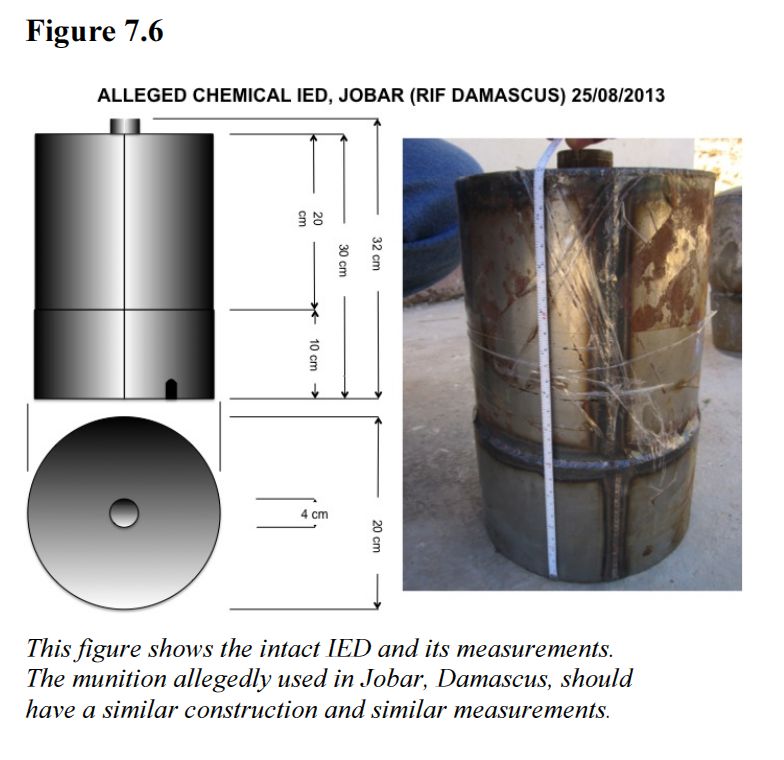
The two munitions were recovered after the CW attack at Jobar, an eastern suburb of Damascus, on 24 August 2013 (i.e., three days after the Ghouta chemical attacks). Four days later, Syria notified the UN Secretary General of the use of an improvised explosive device (IED) releasing a foul and strange odour. The UN team investigating alleged CW use visited the site on 29 September. It was unable to examine the place of impact or recover munition fragments, because mine clearing operations had completely corrupted the surroundings. Syrian officials handed over IED fragments and contaminated soil samples, which they claimed came from the incident site. For obvious reasons, the UN team could not certify their chain of custody.
According to the Final Report by the UN Mission (p. 65), the investigative team ‘was also presented with two metal canisters discovered by Government soldiers during the offensive operations in Jobar on 25 August 2013 in the immediate aftermath of the incident and in close vicinity of the site of the alleged incident’. These were said to be identical to ones used in the chemical incident the day before. Made of steel sheeting of 1mm thickness, the plates were bent and welded together manually at a sub-industrial standard. The canisters nevertheless revealed a high degree of expertise with the electric welding process. The UN investigators were also able to establish that ‘a detonator and a coiling of the detonating cord, acting as a booster, composed the fire train, electrically initiated’. They had an internal fill capacity of up to approximately 4 litres (see figure below). The two metal canisters are the ACW Syria declared to the OPCW. (This description corrects the suggestion in my posting of 26 May that the two ACW were Volcano rockets. The claim that Syria did not declare any Volcano rockets as CW still stands, however.)
Analysis of their contents by the OPCW confirmed sarin as their payload. Moreover, the filling displayed all the characteristics of sarin as produced by the Syrian government, the principal telltale sign being the presence of hexamine (hexamethylenetetramine). Since its presence in samples was first reported by the UN investigative team last September in relation to the Ghouta attack and the OPCW later released that Syria had declared 80 metric tonnes of the chemical in connection with sarin production, there has been furious speculation as to its exact role. In a recent analysis focussing explicitly on the role of hexamine, UK-based CW expert Daniel Kaszeta argued that the Syrians used the compound as an acid scavenger in the final reaction of their rather unique sarin production process. Reacting DF (methylphosphonyl difluoride) with isopropanol yields sarin and hydrofluoric acid, the latter being a toxic and extremely corrosive gas that would have quickly damaged the production and agent filling installations. Hexamine binds this acid, and does so more efficiently than other amino compounds.
However, recent discussions with officials from some Western states indicate two other roles of hexamine, namely as catalyst and stabiliser. The catalyst function is probably closely tied to the acid scrubber role. In an e-mail exchange today, Ralf Trapp, a chemist and consultant to the OPCW, confirmed that hexamine increases the yield of the chemical reaction by pulling the equilibrium between the precursors and reaction product (sarin) in favour of the latter. As a result, the sarin concentration receives a significant boost, possibly up to 60%. This degree of purity is considerably higher than the yields achieved by Iraq in the 1980s.
As a stabiliser, hexamine probably allowed the Syrians to store freshly produced sarin for days, if not several weeks. This understanding is more compatible with views before the civil war that Syria’s CW served strategic deterrence. Munitions declared to the OPCW last autumn also seem to validate those views. Initiating the final reaction shortly before use, as was the case in Iraq, would have undermined this doctrinal role. The insight also raises fresh questions about the curious White House claim last August that the United States had observed Syrian preparations for three days prior to the Ghouta attacks.
Strictly speaking, the chemical analysis of the sarin in the two ACW confirms beyond any doubt that the nerve agent was produced by means of the same process as the one used by the Syrian government. The distinctive signature, however, cannot exclude the possibility that insurgents might have captured some CW. Western officials tend not to give much credence to this hypothesis.
Castor beans: cancer research, castor oil, or ricin?
The latest monthly progress report also reveals that on 14 July Syria submitted yet another amendment to its initial declaration. The document lists a dedicated ricin production plant. As a weapon the toxin is banned under both the Biological and Toxin Weapons Convention (BTWC) and the CWC. The CWC requires the verified destruction of CW production facilities, but the amendment claims that it is located in an area not under government control. It also states that the entire quantity of ricin produced was eliminated prior to the entry into force of the CWC for Syria. If correct, then Syria need not declare its past toxin weapon holding. CW disarmament in Syria, however, is hardly a normal operation. As with its claimed destruction of 200 tonnes of mustard agent early in 2013, the OPCW must investigate those statements to ascertain that the country is not hiding any residual CW.
This progress report was the first to publicly mention ricin production. Last April concerns about the toxin had already filtered out of the United Nations, but they have thus far remained a relatively low-level matter at the OPCW. This was in part a consequence of the high-priority preoccupation with getting the precursor chemicals out of Syria, and in part because nothing seems to indicate that the country presently has ricin weapons. Questions remain nonetheless.
Syria apparently cultivated castor oil plants (Ricinus communis) on several tracts the size of football fields. In itself, this is no so unusual as the oil makes for an excellent lubricant for heavy engines, such as those in military lorries. However, Syria’s initial explanation referred to cancer research and treatment, which was wholly implausible in view of the minute quantities of ricin required for research. Castor oil also lacks any medicinal value to cure cancer. It was used to deliver some chemotherapy drugs to tumours, but occasional side effects, such as allergic reactions, have led to the adoption of alternatives. Starting in the 1980s, Texas Tech University and Texas Tech University Health Sciences Center conducted long-term research on the oncological application of genetically modified ricin to kill diseased cells. According to a press release of October 1998, ‘just two acres of land, given the right castor seed, could produce enough ricin to meet the world’s pharmaceutical supply need for cancer treatment’. Ricin is also being investigated in relation to neurological degenerative disorders and in the treatment of intractable painful neuropathies. It is rather hard to think of Syria as a global supplier of medicinal ricin many times over.
This leaves the question of ricin as a weapon. Ricin is an instrument of choice for assassinations, as befell Bulgarian dissident writer Georgi Markov in London in 1978. More recently clumsy attempts to send ricin-filled letters to hated persons, including President Barack Obama, have also put the spotlight on the agent. Since the First World War many states considered ricin as a possible tool of warfare, but they have never incorporated it as a standard agent into their chemical and biological warfare arsenals. Despite the military attractiveness of its toxicity, the toxin poses several serious problems in relation to large-scale production, longer-term storage (unless turned into a solid), and dissemination techniques. While none of these problems are insurmountable, the net effect is that the agent is more cumbersome to weaponise or less effective on the battlefield than alternatives.
Right now the reason behind Syria’s declaration of a CW production facility exclusively dedicated to ricin manufacture remains murky. On the one hand, in view of the many publicly available accounts describing the many difficulties of producing and especially storing the toxin in free state for longer periods of time, it almost seems implausible that Syria would have embarked on a major ricin weapon programme. Interestingly, several Western officials I recently spoke to tend to discount public Israeli reports on Syria’s ricin programme. The annual US State Department report on arms control treaty compliance for 2014 dropped the reference to ricin-based biological weapons in the BTWC section and does not mention the toxin in the separate CWC compliance report. The 2013 treaty compliance document still stated: ‘In 2004, Israel’s Intelligence and Terrorism Information Center said in a report on Syria that the Scientific Studies and Research Center had been developing ricin-based biological weapons’.
On the other hand, if the Syrian factory was indeed dedicated to the production of oil or lubricants, the possibility exists that it used a cold hydraulic pressing technique, in which case 1–5% by weight of ricin might remain in the resulting mash. A fact sheet on ricin by the OPCW Science Advisory Board (SAB) released in February 2014 notes that castor oil production plants are not subject to Schedule 1 inspections under Article VI of the CWC. The SAB therefore recommended that the Director-General encourage National Authorities in producing countries to promote hot pressing and other techniques that ensure inactivation of residual ricin in the waste mash. In other words, the Syrian amendment might reflect a compromise with the OPCW to remove any ambiguity about the purpose of the ricin resulting from a particular production process in view of the need for absolute certainty that all aspects of the country’s CW programme have been eliminated. A future oil-extraction plant using a process that inactivates residual ricin could then be constructed without the need for long-term verification modalities for that installation.
A possible explanation for the ricin factory declaration for sure, but more details are required to confirm the scenario. To be continued.
And the destruction of mustard agent?
As I reported in May, OPCW inspectors were looking into Syria’s claim earlier this year that it had destroyed some 200 tonnes of mustard agent in the spring of 2013. They are still trying to obtain further documentation substantiating these destruction operations. Onsite inspections of the disposal sites are still pending before this particular file can be closed.
[Cross-posted from The Trench.]
 Arms Control Law